Skip to content

Posts tagged ‘stock pick’

Hortonworks Fourth Quarter Update – The hadoop adoption cycle continues

Hortonworks is the second of the three companies I own that reported on Thursday night.  The first, Ichor Holdings, I wrote about yesterday.   The third, Radisys, I’ll get to shortly.

I originally wrote about Hortonworks along with another company Attunity in November after doing some research on Hadoop and concluding that its adoption presented a good growth opportunity for the companies involved.  At the time the stock was trading at $6, had recently been issued a sell recommendation from Goldman Sachs, and was pretty hated all around.

Nevertheless the company was growing like a weed (40% annually).  It was also bleeding cash flow like a sieve.  But at an enterprise value of less than 2x revenue I found it difficult to pass up the growth.  Knowing Wall Street loves those growth stories, I figured a couple solid quarters would put the stock quickly back on its feet.

Fast forward a few months and that is exactly what you got.  The company is still growing like a weed (revenue was up 39% in the fourth quarter, guidance was for 28% year-over-year growth in 2017), they are not bleeding cash flow quite so materially (cash flow in the fourth quarter was actually close to flat), and the stock isn’t hated quite so much.

At $11 and with a $1.40 of cash the stock is still trading at 2.4x revenue.  So the valuation is actually not that different than when I bought it.  One key difference is that back then the cash level was higher (roughly $130 million), the shares outstanding were lower (the company issues stock like toilet paper) and the price per share was lower, so cash was a much bigger piece of the overall valuation and that was partly what I found interesting.

The most interesting thing about the fourth quarter was that growth in their Hortonworks Data Flow platform has really taken off.  I wrote about HDF in my original write-up.  I’ll repeat how the company described HDF at the Pacific Crest conference last year:

Now [customers] want to have the ability to manage their data through the entire life cycle.  From the point of origination, while its in motion, until it comes to rest and they want to be able to drive that entire life cycle.  It fundamentally changes how they architect their data strategy going forward and the kind of applications and engagements they can have with their customers.   As they’ve realized this in the last year its changed everything about their thinking about how they are driving their data architecture going forward starting with bringing the data under management for data in motion, landing it for data at rest and consolidating all the other transactional data.  So it’s a very big mind shift that’s happening.

I still think HDF could be a big growth driver for the company and we are starting to see that.  They said on the fourth quarter conference call that HDF grew 6x year over year in the fourth quarter.

So there is lots of reason to think growth will continue.  Nevertheless, I am reluctant to add.  It’s the cash flow that still gives me pause.   While the fourth quarter number was good, they’ve approached break even cash flow in the past only to diverge again into big losses the following quarter.   They said on the call that they expect mid-teens negative operating cash flow in the first quarter.

More optimistically, they also said that they expect break-even cash flow in the third or fourth quarter.  So that would be a turning point.  But then in response to a question about whether we should expect free cash flow after that, if felt like they were trying to scale back expectations:

Yes, I don’t want to talk beyond that yet, Q3, Q4 seems a long way out, but from a – if you think about free cash flow we have been running may be $2 million to $3 million a quarter on CapEx. Q4 was a little light, I think it was under $2 million, but I think once we get to the sort of breakeven number sometime between Q3 and Q4 we will reassess to how much above that we want to punch.

So I’m not sure what to think.

Hortonworks also issues a lot of stock, which while it doesn’t factor into the cash flow number, does dilute shareholder value.  The shares outstanding have gone up by almost 3 million in the last couple of quarters.

On the other hand is my experience with Apigee.  Another high growth company, with cash flow, that was issuing lots of shares, and the company never really sorted any of that out yet the stock tripled from the $6 price I bought it at to the almost $18 where it was bought out by Google.  Hortonworks could easily follow that path.

There are certainly reasons to add.  Strong growth, ramping of HDF.  They announced another new product launch, enterprise data warehouse in February, and are gaining traction on their Azure and AWS offerings.  They also stand to gain visually from accounting changes enacting in 2018 that will allow them to defer less revenue and spread out commission expense, in turn improving the income statement.

Nevertheless my gut, informed by the aforementioned concerns about cash generation and stock issuance, is telling me not right now.

I think if the stock pulled back on a market pullback I would be more likely to add.  But it’s hard for me to double up at this price, as I have been prone to do with other ideas that start to work.

So I’ll probably sit with my 2-3% position and watch what the stock does.  I prefer to take the safe route when my gut is giving me pause.
Taking a position in a recent IPO moonshot: Ichor Holdings

Over the last couple of weeks I spent my spare time listening to presentations from the Needham conference.

Most of what I heard was pretty boring.  A few were from companies that I own (Radcom, Radisys, DSP Group, Oclaro, Nimble and BSquare) and I adjusted a few of my positions upon review (I reduced Radcom a little, added to Oclaro).  But most were new companies that I haven’t heard of before.

I was on the lookout for a good idea and I think I found one.  The company is called Ichor Holdings.  They provide fluid delivery systems for semi-conductor equipment manufacturers.  In particular they produce two products, one a gas delivery sub-system and a chemical delivery sub-system.

The stock was an IPO in December (here is the prospectus).  The IPO went for $9, which was a steal.  It’s over $15 now, which means its traded up significantly.

I bought some at $14.  I haven’t mentioned the stock until now because I kept waiting for a correction so I could buy more (well it came briefly one morning when it dipped into $12’s for a couple minutes but I was at work and not available – argh).  So now it broke out and I’ve given up.  I probably am rushing this write-up out a little, but given the move in the stock I feel like if not now then maybe never.

So you are looking at a stock here that is up almost 50% in the last couple of months.  Caveats apply.  Nevertheless, here’s what I think, why I bought it at $14 and you can choose if you want to wait for a correction or not.

There is a narrative for not waiting.

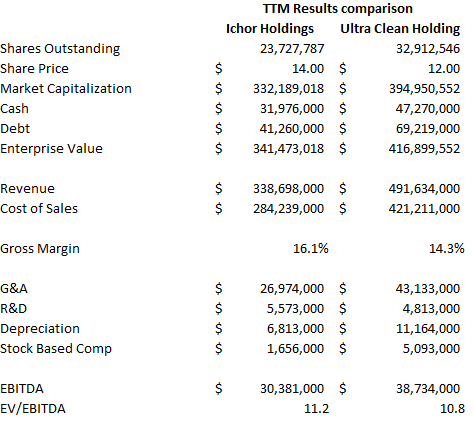
There are two big players in the outsourced semi-conductor equipment market that manufacture fluid delivery sub-systems: Ichor and Ultra Clean Holdings.  These are fairly similar companies.  I think that Ultra Clean also does some more general component manufacturing and Ichor has a chemical delivery business, but overall the two companies are comparable.

Ichor and Ultra Clean compare favorably based on TTM results.

ichor1

Everything seems reasonable so far.  But here is where it gets interesting.  Both companies pre-announced very strong fourth quarter revenues in the last few weeks.  Here is Ichor’s announcement and here is Ultra Cleans.

Ichor’s revenue growth in the fourth quarter was a rather incredible 104% year over year.  There was a small acquisition (Ajax, which contributed $13.4 million in revenue since it was acquired in April 2016) that brought the company into the chemical delivery business but apart from that it was all organic growth.  Ultra Clean had an impressive 67% year over year growth.  Again, organic.

Ichor said that revenue in the first quarter would exceed the fourth quarter.  So we have at least three more months of this tremendous growth.

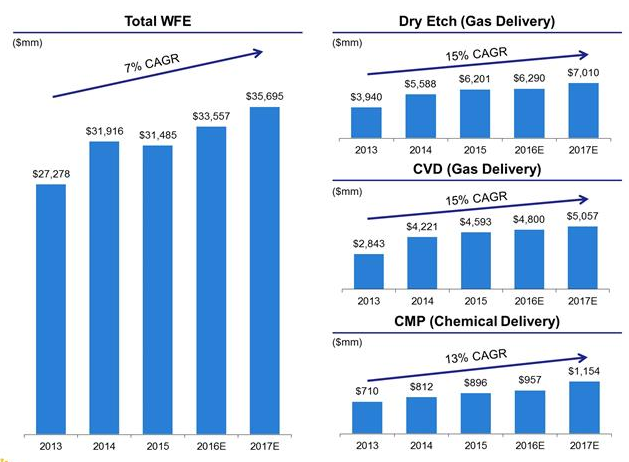
There are a couple of takeaways from Ichor’s and Ultra Clean’s Needham presentations (here and here) that help explain the growth.  First, both are benefiting from decent wafer fab equipment demand growth, around 6%.

Second, as chip complexity increases and moves to “multiple patterning, tri-gate, or FinFET, transistors and three-dimensional, or 3D, semiconductors” (eg. 3D NAND), deposition and etch sub-systems growth becomes even stronger (Ichor says 15%).  Each layer that is added to the chip requires another etch, deposition and CMD step.  Ichor says this dynamic in the market only began in the second half of last year and is “still in the early innings”.  The following is a slide from Ichor’s presentation:

ichor2

Finally, their customers, the OEM process tool providers (LAM, Applied Materials, etc), are outsourcing more of the equipment manufacturing, so Ichor and Ultra Clean are gaining share that was previously held by their customers.

Ichor has the added bonus that they are growing their chemical delivery business at an even faster rate.  I think that the acquisition of Ajax earlier this year brought them into the business, but they may have had a small footprint prior.

The chemical delivery business (via Ajax) was a single digit million revenue business a few years ago but has grown 10 fold the last few years.  They currently have 10% market share so there is room for further growth.

Ichor doesn’t provide a detailed breakout of revenue between their gas delivery and chemical delivery businesses but did say at Needham that Chemical was about one-ninth of revenue and they could see it getting to one-third.

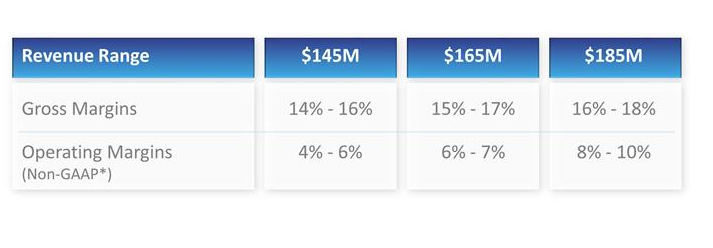
The other consideration that applies for both companies is the business model has good leverage to revenue increases.  While Ichor was a little vague on this, only saying that they have a “variable cost structure that drives highly leveraged earnings model”, and that their operating costs remain relatively flat as revenue increases, Ultra Clean was more specific, providing the following table in their slide deck at Needhams:

ichor3So I took a reasonably sized position at $14.  I’m willing to watch how this plays out over the next few months.  But I look at this as more of a trade.  If the stock gets up to $20 in the next couple months, I’ll be a seller.

The thing is, I don’t know how long this cycle is going to continue.  It will turn.  I haven’t done a lot of work on the semi-equipment cycle and I don’t even know where to start to determine when that inflection occurs.  And surely the kind of revenue increase we saw in the fourth quarter isn’t going to continue forever.

Nevertheless, with the fourth quarter numbers that Ichor has guided to, they are trading at well under 10x EBITDA (I didn’t run any scenarios yet so I can’t say exactly where I think that ends up).  They are an IPO, which means they are under-followed and probably being estimated conservatively by analysts.  And they have already forecast at least one more quarter of significant growth.   So the runway is clear for another few months.  I’ll look forward to any pullback.

Aercap – full value of ILFC acquisition is not in the stock

I got the idea for Aercap (AER) after listening to a Bloomberg Taking Stock podcast with Martin Sass.  Sass recommended Aercap along with American Airlines (another company I am in the process of looking at) as he’s gone from hate to love on the airline industry.  He called Aercap’s deal to acquire ILFC “transformative”, pointing out that it “will make Aercap Holdings the #1 aircraft leasing company in the world”, and yet that “it’s trading at only 8x earnings.”

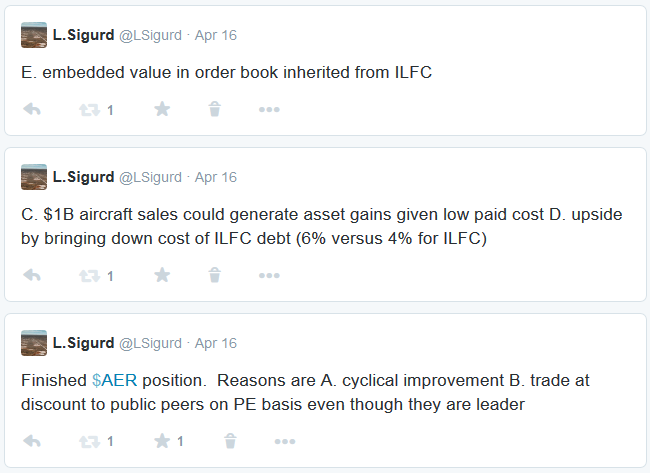
On Thursday I tweeted a few reasons justifying my position in Aercap.  You want to read these from the bottom up.

reasons

In this post I am going to follow up on that tweet with a more detailed description of my investment thesis. Read more

I think the Market has it wrong with Jones Energy (JONE)

The most frustrating thing that has happened in the last few weeks has been to watch Jones Energy get clobbered from $18 to $14.  Frustrating because I think the market has it wrong.

The drop has been precipitated by Jones cautious comments about the test of a new frac design.  To recap, Jones initiated a 20 well program that increased the cluster density per frac and the amount of proppant used (which resulted in a bigger frac per stage).  The program was done to evaluate whether this would increase production and EUR’s enough to justify the increased cost (about $900,000 per well).  The company provided progress when they released their February 14th company update.  They basically said that the evidence so far is not strong enough to justify moving to the new completion technique and that more data is required:

Of the 14 wells with 30 or more days of production, 12 have produced at or above historical type curve. Over the next two quarters, the Company will monitor production data on the test wells and undertake additional optimization techniques, prior to making a decision on whether the level of production is significant enough to justify the incremental capital investment per well, and which design to utilize going forward. In the interim, Jones Energy will be employing its traditional open-hole completion technique in the Cleveland, which is the basis for its guidance for the balance of 2014. Going forward, the Company expects its average Cleveland AFE to remain at a best-in-class $3.1 million, which we expect will allow us to continue to generate compelling rates of return in our core play. Read more