Skip to content

Posts tagged ‘stock picks’

Precision Therapeutics – Buying into the Sales Ramp

Precision Therapeutics (AIPT) is roughly a $12 million dollar market cap company.  They have 11 million shares outstanding and no debt.  After a January share and warrant capital raise (which I am including in my share count) they should have about $4 million of cash on hand.  They also have a $1 million note receivable from joint venture partner Cytobioscience.

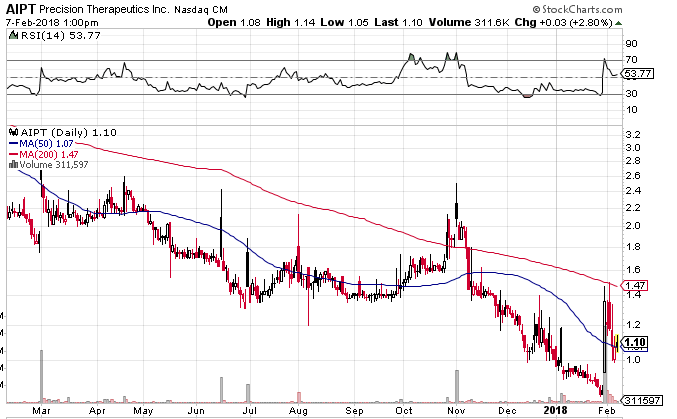
The recent share and warrant raise diluted shareholders significantly.  The placement was for 2.9 million units, consisting of shares at $0.95 and 0.3 warrants prices at $1 per share.  This was a $1.50 stock as recently as November.

Precision raised the cash because they are burning cash.  I estimate cash burn per quarter is about $1 million per quarter.  This will probably continue.

Those are the facts, most of them not pretty.  So why did I take a position?

The STREAMWAY System

Precision markets a medical fluid waste disposal system called the Streamway System.  The system is a wall mounted device located in the operating room.  During procedures surgical waste fluid is continuously removed via suction, passed through proprietary filters, measured and recorded, and then passed directly into the building’s sanitary sewer.

This is very different than traditional waste handling during procedures.  Competitive solutions use mobile carts and disposable cannisters that have to be replaced, often multiple times during the procedure, and in many cases treated with gels to minimize the chance of contamination.  Even so, accidents occur and they are expensive.  Hospitals spend $4,500 on average for a mishap.

Here is a look at Streamway (Skyline is the former name of Precision) and its competition:
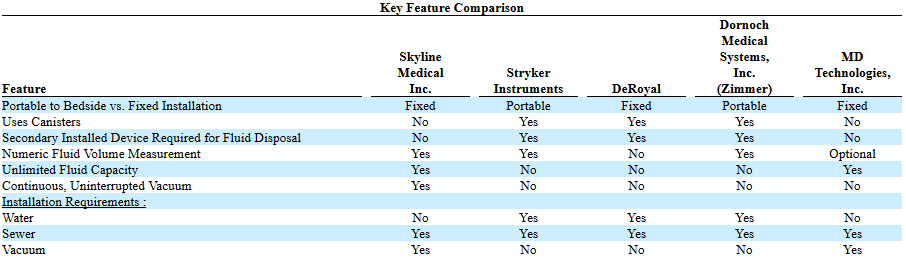
The Streamway system has a number of advantages over incumbent waste disposal options:

  1. Price: Cost of the unit is similar to slightly less than competition (Stryker system plus docking station costs $34,000 though I suspect they have been discounting to try to squeeze Streamway), but the disposable cost is 1/2 to 1/8 of the cost of replacing cannisters
  2. Safety: no chance to spill fluid or to have an accidental catheter removal during a cannister change
  3. Labour: cannisters have to be changed during a procedure anywhere between 2-10 times.  This is entirely eliminated with Streamway
  4. Accuracy: can more accurately estimate volume extraction than the manual estimation using cannisters
  5. Ease of use: removal of clumsy cannisters, latching, and replaces with simple instrument panel with instructions
  6. Time: Procedures do not have to be stopped to replace cannisters which can result into 20-50% faster surgery

The primary negative with Streamway is installation.  It has to be hooked up to the sewage line and therefore the operating room needs to be shut down and the wall cut open to complete the install.  This has been a sticking point, particularly as hospitals are not unhappy with the mobile carts they’ve been using.  Precision has taken to emphasizing the improved safety of using Streamway.

The cost advantage of Streamway is significant.  This is from the last 10-K:

A study by the Lewin Group, prepared for the Health Industry Group Purchasing Association in April 2007, reports that infectious fluid waste accounts for more than 75% of U.S. hospitals biohazard disposal costs. The study also includes findings from a bulletin published by the University of Minnesota’s Technical Assistance Program. “A vacuum system that uses reusable canisters or empties directly into the sanitary sewer can help a facility cut its infectious waste volume, and save money on labor, disposal and canister purchase costs.” The Minnesota’s Technical Assistance Program bulletin also estimated that, in a typical hospital, “. . . $75,000 would be saved annually in suction canister purchase, management and disposal cost if a canister-free vacuum system was installed.”

A second study, by the Tucson Medical Center, found similarly significant savings.  They estimated they would save $22,000 per year in a single operating room.  Bottle costs for the mobile unit they had installed previously were $107 per procedure.  The Streamway disposable cost brings that down to $24 per procedure.

In general, the $24 price tag is a favorable disposable expense compared to the costs of replacing cannisters, waste disposal, gel costs and labor for the competing Stryker and Zimmer systems.  Those systems need to have cannisters replace anywhere between 2-10 times depending on the procedure.  The material and waste disposal costs can be between $25 – $100 (or more) and on top of that there are labor costs and the time cost of having to pause the procedure to empty the cannister.  You add to that the risk of a contamination event (which is going to be a $4,500 hit) and its easy to see how Streamway saves money.

Struggling Sales

So you can make the argument that Streamway is a superior system.  Nevertheless the company has had a horrible time ramping sales.  On the third quarter conference call the CEO Carl Schwartz, came clean about what had been happening:

When I took over as CEO in 2016 like many of you I thought the Streamway System was a slam dunk…Nothing could have been further from the truth.  We had two very entrenched competitors, Stryker and Zimmer, who have their units at most hospital facilities in the country.  In addition they were able to bundle their units in with other operating equipment, offering substantial discounts.  Furthermore, it became increasingly evident that many institutional hospital customers would not allow us to connect to the hospital sewer system because they did not want us to open the operating room wall.  Given these challenges and the fact that their unit and ours effectively removed fluids, what was our competitive advantage?  After several months of effort we discovered that our most competitive advantage was our ability to avoid the spread of infection in the hospital by eliminating any contact between the infectious materials and the patients and staff and we have been hammering that home where ever we present the Streamway system and in newspaper articles all over the country.  As you know it has been a slow going but we are making substantial progress.

In addition to pressure from the competition in the United States, the company has been slow getting regulatory approval in non-US districts.  Up until this year their sales staff and list of distributors was sparse.  It was a situation where you had a solid, superior product, but it was competing against well-funded incumbents, and marketing and sales dollars were not enough to mount an offensive.

In fact it seems like management had begun to give up themselves.  There was a failed merger with Cytobioscience in the summer.  There was a subsequent joint venture with Helomics and a proposed one with Cytobioscience.  Indeed even the strategy for 2018 includes the following statement:

To expand Skyline’s business to take advantage of emerging areas of the dynamic healthcare market. To this end, management is implementing a Merger & Acquisition strategy focused on finding and acquiring high-growth companies that have established operations and the ability to drive both revenue and capital appreciation for the Company, or entering into strategic relationships with these companies.

Even if management was just being strategic with its new diversification approach, investors were frustrated.  Listening to conference calls in 2017 is a painful exercise.  Lots of frustrated investors, many of them long time investors, having been expecting a steep sales ramp, saw unit sales trickle in a 1 or 2 a quarter and the share price lag.

With cash levels dwindling, management had to raise capital with the dilutive raise I mentioned previously.  That, along with the failed Cytobioscience merger, was likely the last straw for many investors.

As a consequence, the share price hasn’t done well.  The one year chart illustrates the disappointment:
Things are turning

I’ve had Precision Therapeutics on my watchlist for the last 6 months.  I can’t remember why I added it, I’m pretty sure it was mentioned by someone on twitter though I don’t remember who.  When I looked at it a number of months ago I thought they had an interesting product but there was no indication that they were gaining any sales traction.  So I passed.

However that appears to be changing.  In early January the company announced that they had sold 5 Streamway systems in the fourth quarter. They sold another 6 systems in January alone.  I wish I had been paying a bit closer attention to the company when this news release came out, as I would have probably started buying it back then.

I did pay attention to the second news release that came out last week.  Precision projected 100 systems sold in 2018 from the United States alone.  I caught the stock soon after it jumped on the news.

Precision sold 10 systems in 2017.  This includes at least 1 system sold in Canada.  So the projection for 2018 is for at least 10x 2017 sales.

While up until now sales have drifted aimlessly, the company has been doing a lot of work behind the scenes that has set themselves up for this type of increase.  They have:

  1. Hired 4 regional sales managers and a VP sales in early 2017. Up until the end of 2017 they had a single regional sales manager and no VP Sales.
  2. Signed a contract with Vizient, which is a healthcare improvement company with a $100 billion in purchasing volume, in the summer
  3. Partnered with Intalere, a health care supply chain manager
  4. Signed a 3 year agreement with Alliant Health, a Service-Disabled Veteran-Owned Small Business that sells medical device products to the federal government, to sell STREAMWAY to into Federal Hospitals

And while early sales have been sporadic, they do mark first steps toward greater penetration, opening up the opportunity for more significant deployment once the systems benefits are experienced.  Take for example, the two units sold in the third quarter.  Both sales were to single operating rooms across much larger hospital networks, in one case a 6 facility network and in the other a 11 facility network.  On the third quarter call Schwartz said they were in discussions to standardize waste management across each network.

Foreshadowing the increase in sales, Precision did 92 demos in the first three quarters and equaled that amount in the fourth quarter alone.  They did 145 quotes in the first 3 quarters, and more than 75 in the fourth quarter.

International sales have been even slower to come then domestic, but in the last 6 months Precision has made some strides there as well.  In June they got the CE mark for the system, which allows them to start selling the devices into Europe.  Later in the year they partnered with Device Technologies, which will be selling Streamway in Australia, New Zealand, Fiji and the Pacific Islands (they seemed quite excited about the Australia opportunity on their third quarter conference call).  They added a distributor in Canada as well as have been selling systems directly.  They added another distributor selling into Switzerland in November and opened a European office a few days ago.  Its worth pointing out that the 100 unit sales projection is not including any sales outside of North America.

One time and Recurring Revenue

Streamway systems retail for about $24,000 per unit.   100 units should equate to around $2.4 million in revenue.

That will be a big uptick from 2017 revenue.  The company has been printing quarterly sales in the $100,000-$150,000 range for the last few years, so the 5 Streamway units sold in the fourth quarter and the 6 and January should provide a nice revenue ramp.

However maybe the more important consideration is that as more Streamways are installed into operating rooms, recurring revenue will scale as well.

Precision generates recurring revenue from the sales of disposable filters and cleaning fluid. According to the 10-K, the filter and fluid retail for $24.  The company recommends changing the filter and cleaning the unit (with the fluid) after every procedure.

I think hospitals are doing this more like every 2-3 days. Nevertheless, Precision has been generating about $100,000 of revenue per quarter from the sales of the disposables.  Given that there is about 100 units currently in operation, it works out to $1,000 of revenue /unit/quarter.  While the company doesn’t provide margins from disposables, its pretty easy to estimate them.  In the second quarter no Streamway units were sold, and the company generated $106,000 at 80% gross margins.

It looks like the average operating room performs 2-3 surgeries per day.  If hospitals actually used the disposables after every surgery, I estimate revenue would be more like $4,300 to $6,500 per quarter per unit sold, or over 4-6x what I estimate it is now.  That’s a lot of reason to promote proper usage.

Even at the current disposable usage rate, 100 extra units means $400,000 more high margin recurring revenue annually.  Add that to existing consumable revenue, and add on the $2.4 million from unit sales, and I get annual revenue of about  $3.2 million for 2018.

CRO Joint Ventures

Probably because Streamway sales have been slow, management has looked to alternative lines of business to boost interest in the stock.  The initiatives kicked off in the summer with an announced merger with Cytobioscience, a contract research organization (CRO) that specializes in testing the cardiac safety of drug compounds.  The merger was subsequently postponed in favor of a joint venture in November, and at the same time a second joint venture was announced with Helomics, another CRO company.

As it stands now, Precision has a 25% ownership stake in Helomics and a $1 million loan to Cytobioscience.  The joint venture with Cytobioscience was supposed to close by year end but I haven’t seen anything to that effect.  Listening to the last conference, it seems like even the merger with Cytobioscience may take place once audits and accounting work are completed (it was suggested that the merger didn’t transpire because of auditing required on Cytobioscience before it could be merged with a public company).  On the other hand this article, which I can’t read in its entirety, says that Cytobioscience walked away from the merger, so who really knows.

I don’t know what to make of these two joint ventures and the move into CRO.  It seems like the CRO business is growing.  Whether these companies are at the forefront is anyone’s guess.  Cytobioscience said on the second quarter call that they expected $700,000 of revenue a month by the first quarter of 2018.  Helomics, which specializes in customizing cancer treatment based on finding patterns with their patient database, is in a growing field.

I’m also not entirely sure why these companies want to merge with Precision.  The Streamway doesn’t really have a strong connection to the CRO businesses that they operate from what I can tell.   Precision does have net operating losses of $11 million that could be utilized against future profits.  So maybe that’s it?

Just last week the Economist dedicated an article (and a cover) to the emerging field of using data to provide better diagnosis and treatment.  The article talks about using AI to better customize treatment to patients.  That is essentially what Precision will be trying to do in their partnership with Helomics.

Summary

Cash on hand should be enough to get Precision through 2018, and maybe further depending on how these sales develop and how much they end up spending on partnerships.  If I ignore cash, the price to sales (P/S) multiple that the company trades at is 3.5x.  Including cash its more like 2.5x.

Given the growth (10x the revenue in 2017), the margins (gross margins of 80%), and momentum in engagements across the United States and internationally, this doesn’t seem out of line to me.

The stock is hated by investors because it has disappointed for so long.  There is a long list of bashers I’ve seen on twitter and a few on SeekingAlpha.  None of these bashers have brought up a point that has concerned me though.  They are mostly just rehashing past price declines.

I think the stock moves higher.  At the very least it should get back to its November levels, which were above $1.50.  If there is evidence that the strengthening of sales of Streamway is sustainable over multiple years though, that should just be the beginning.  The recurring nature of the disposable sales adds a lot of value as more systems are installed.  Finally, if the Cytobioscience merger becomes a “go” again, that would be another catalyst to the stock.

So you have a beaten down stock, pretty clear indications of sales momentum, and the outside chance that something bigger is announced.  All around it seems like a decent bet.

Note: I have been told there is a SeekingAlpha article by Jonathon Verenger on Precision that is quite good.  I haven’t read it yet because I wanted to write up my own ideas first without influence.
CUI Global Second Quarter results – lots of irons in the fire

While I have been reluctant to add to any stock right now and have been weighing any purchases carefully, I did add a bit to CUI Global after the release of their second quarter results.

As a reminder, the company operates in two segments. Their Power and Electromechanical segment sells power supplies, power monitoring and interconnect products, and has recently collaborated with a small start-up called VPS Partners to create a technology for datacenter power management called ICE.  In the Energy segment CUI Global offers their GasPT gas analyzer system, a newly developed odorizer, VE probes for sampling gas and performs integration and engineering project work.

Segment Results

The company had an improved second quarter, mostly due to the Power and Electromechanical segment.  That segment saw a big jump in revenue, from $13.6 million in the first quarter to $18.2 million in the second quarter. The company attributed the jump to an inventory refresh from distributors, a ramp in sales from new distributors, particularly Arrow Electronics, and design wins from 2015 and 2016 that are now ramping into production.

Regarding Arrow, on the second quarter conference call the company said they saw “much more upside” in the relationship with Arrow and that Arrow, which became a distributor early this year, is expanding the CUI Global product line and re-ordering products already.

Revenue continued to lag on the energy segment, coming in at $4.3 million versus $4.1 million in the first quarter.  The company remains held up by tariff issues with Snam Rete, which was the first major customer for the GasPT units.

More on Snam Rete

As the company reiterated on the second quarter call, the Snam Rete contract calls for 7,000 GasPT units and is worth €120 million to CUI Global.  It’s an extremely significant contract.  Snam Rete is installing the GasPT units at the offtakes of major industrial customers, where they will be used to more accurately and quickly measure gas usage by these customers.

CUI Global delivered the first 400 of these analyzers last year before receiving word from Snam Rete that they would not be able to install any more of the units until they received regulatory approval to switch out devices on third party sites.  Bill Clough (the CEO) described the issue back on the fourth quarter conference call as follows:

The plan that [Snam Rete] rolled out to install these device is to buy the installation point from these high-end industry customers. Right now where the customer connects to the gas system is currently owned by the customer and due to EU regulations that come into effect next year, the customer has to upgrade that connection, which is going to be quite costly. Snam is offering to buy that connection point from them and to install our device along with some other upgrades that they are going to do including flow computers and other things. And in order to do that they also need to buy an access or an easement to get in and obviously maintain what they are installing.

There is no problem whatsoever if the customer voluntarily agrees to that, which they believe almost all customers will, as obviously they sell an asset that’s going to cost them a lot of money during next year, and so it’s something that becomes a revenue generator as close to cost. However, the energy authority over there says the problem arises with customers who do not want to just pay. Those customers would be paying the same tariff as the customers who do participate, which they felt was a potential anti-trust violation, or what they what they are having to do is, design and implement a two-tariff system, which they have done in the past.

There has been progress on the Snam Rete bottle neck.  A few days before the quarter announcement I got an email from a friend pointing to a press release from Snam Rete (here).  The release described Snam Rete’s commitment to the “upgrading of measuring systems located at redelivery points of the transportation network through the acquisition of metering systems from final customers”.  The press release outlined a €310 million loan from the European Investment Bank that would be used, in part, to acquire these offtakes.  CUI Global referred to this press release on their conference call.

Also on the call Bill Clough said that Snam Rete had met with the regulatory authority in June, that the meeting was “productive” and that they expected to here back after the August recess.

The issue with Snam Rete still appears to be a delay, and not a permanent impasse.  I would argue that the current share price is reflecting more the latter than the former.  Snam Rete’s schedule on deployment is expected to require 100 analyzers a month.  At €17,000 per analyzer, resumption of this contract alone would more than double Energy segment revenues.  That positive outcome is just not priced in at a $3.50 stock price.

Odorization Orders

The Snam Rete press release linked to above also describes a commitment to the “installation of odorization systems for industrial final customers”.  This is referring to the purchase of CUI Global odorizer product, which is a product that simply mixing in an odorizing chemical with otherwise odorless natural gas.  CUI Global licensed the technology from Engie at the same time that they entered into the relationship with them.


On the call management said that Snam Rete is looking at purchasing 1,300 of the odorizers.  They said Engie is also looking at deploying the odorizers throughout their system.  CUI Global said on their first quarter call that odorizers would sell for €7,000 to €10,000. The odorizers are still in the beta phase of development but they are proceeding to field trials (with Snam Rete) in September.

Other GasPT orders

CUI Global is making progress with Engie as well as in North America with a pipeline company in Alberta (TransCanada?).

Regarding Engie, CUI Global submitted a bid on 1,000 GasPT units and 1,000 remote terminal units (RTUs) to be installed by Engie’s subsidiary Endel.  They said on the call that they are the only bidder, and they that have already been spec’d in on the design.  The per unit revenue for the analyzers is in the €17,000 to €20,000 range, and there is similar pricing on the RTUs.  So again, another big opportunity.

In Canada, the company has had their previous Italian testing approved by Measurements Canada, which leaves a final step of a 3 month installation test on a Canadian pipeline.  This is expected to begin in September.

Future Billing Contract

This is a contract with DNV GL to explore the potential of using GasPT units to monitor the delivery of biogases into the delivery system.  The project is in the early stages and won’t result in revenue until 2019 at the earliest.  However it could have big implications if it concludes favorably.  Clough said that if the project is approved and deployed across the network (the UK) it would require in the range of 45,000 GasPT units.  If adopted in other European countries (France, Germany, the Norwegian nations), a similar magnitude of units would be required for each country.  Keep in mind the Snam Rete contract, which is extremely significant in its own right, calls for 7,000 GasPT units.

ICE Technology

The last data point that I will touch on is the ICE technology.  As I mentioned above, this is a partnership with VPS to provide a power optimization solution for datacenters.  CUI Global provides the hardware while VPS has developed the software.

On the second quarter call for the first time management gave a bit more color around the opportunity.

There “is no competing technology in terms of doing peak shaving” to ICE.  The return on investment by implementing an ICE system is significant, as it can unlock 10% to 20% of power capacity.

So far beta and sampling testing have reported good or better than expected results.  They expect small, immaterial revenues in beginning in the fourth quarter.  This will be followed by a pick-up in 2018 and adoption (assuming it occurs) in 2019.

They delineated the revenue opportunity based on data center size.  The smallest scale centers are $750,000 opportunities, the average datacenter is a $2 million opportunity, and the largest scale datacenter is $30 million opportunity.

The overall total addressable market (TAM) is estimated at $700 million to $1.5 billion for North America and 5x that for the rest of the world.  I suspect that these numbers are for the entire ICE product.  As CUI Global delivers only the hardware, and I get the sense that the innovation is really the VPS software, their fraction of the TAM is likely quite a bit less than the total.  Nevertheless, it’s a big market for a little company.  They said that in the mid-term they could see revenue ramping to a few million per quarter and in later years with scaled adoption it could be as much as $15-$20 million.

Overall

At $3.50 CUI Global has a market capitalization of $75 million.  Net debt is about $4 million.  They plan to raise about $4 million cash from the sale of their Washington facility. That cash influx, combined with the better outlook from both the energy and electromechanical segments has led them to cancel the at the market (ATM) share program.  I think a lot of investors looked unfavorably at the ATM program, particularly the uncertainty as to whether the company was helping to beat down its own stock over the last few months (they weren’t).

At the current market capitalization the company trades at 1x revenue.  Given the opportunities outlined above, I think its still a reasonable bet, which is why I added a little last week.

Wading into another Biotech: Eiger Biopharmaceuticals

As I have talked about on occasion, I am a newbie to biotechs.  To help with my learning curve I rely on a number of biotech investing gurus .  One of them is, Daniel Ward, and over the last few months I have gotten a couple of ideas from him.  One of these is Eiger Biopharmaceuticals (EIGR).

What I like about Eiger is that they have five trials in mid-stage development and plenty of data readouts in the short term.  So (in theory at least) they shouldn’t have been killed by any particular read out.

But that thesis hasn’t played out as I had hoped yet.  The stock tanked a few weeks ago from $11 down to below $9.  The collapse coincided with data presented at European Association for the Study of Liver (EASL) conference in April.   The results were for phase 2 studies that were investigating how their drugs Lonafarnib and (to a lesser degree) PEG IFN Lambda were successful in targeting the Hepatitis Delta virus (HDV).

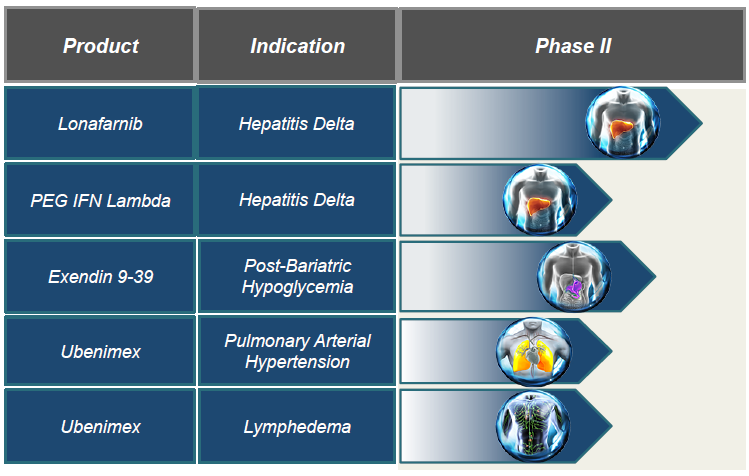
These aren’t the only programs that Eiger has in progress.  In total there are 5 programs, targeting 5 indications with 4 different drugs.  In addition to the two drugs targeting HDV, Eiger has a Post-Bariatric Hypoglycemia program, a pulmonary arterial hypertension program and a Lymphedema program.  All of the programs are in Phase 2.

I’m not going to go into all the programs in this post (its long enough already).   I’m going to focus on the Phase 2 results for Lonafarnib that were presented at EASL.   For more detail on the other programs, there is a good presentations archived on their website from the BIO CEO conference that describes all the programs and gives some background into the HDV indication that I won’t get into here.

Eiger and HDV

So to recap, Eiger has two drugs targeting HDV: Lonafarnib, which they obtained from Merck, and PEG-IFN Lambda (Lambda), which came from Bristol Myers.  Both of these drugs are in Phase 2 of development.

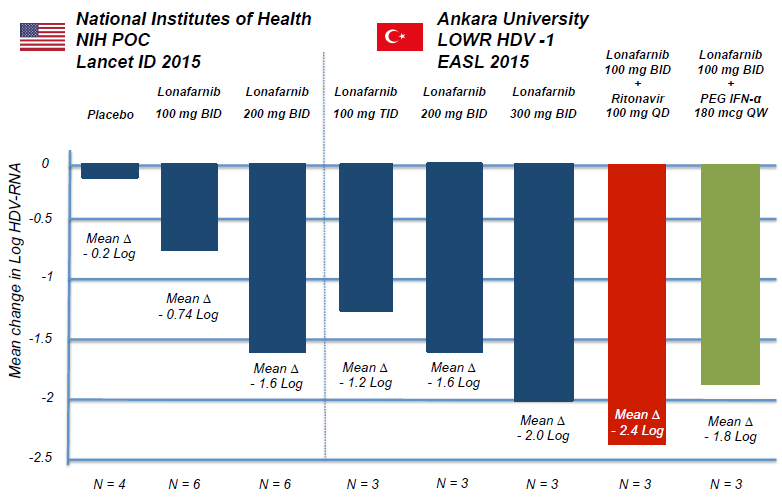
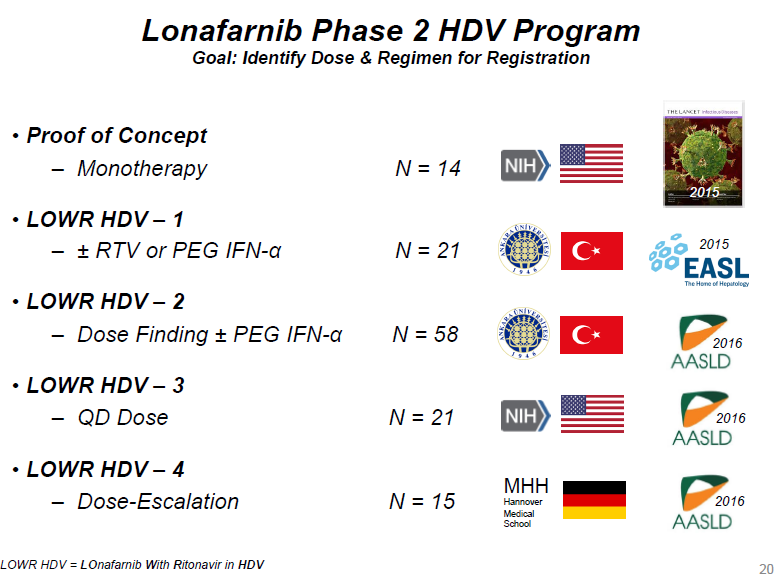
Three phase 2 studies were presented at EASL.  LOWR HDV-2, 3, and 4 as listed below.  The LOWR HDV-1 program had been completed and presented in 2015.  LOWR-2 had already had early results presented in 2016.  LOWR-3 and LOWR-4 were brand new data:

The LOWR-3 and LOWR-4 programs looked at different dosing options of Lonafarnib boosted by another drug called Ritonavir (Ritonavir is a drug used for HIV and you add it to the mix to improve efficacy).  LOWR-2, which also looked at dosing, had an additional wing of the study where a number of patients trialed a 3 drug cohort that included PEG-IFN-Lambda in addition to Lonafarnib and Ritonavir.  This was the only part of any of the studies tha looked at Lambda, which will have its own results presented later this year.

So what happened to make the stock tank on the results?  First, they weren’t perceived to be as good as earlier data.  The most apples to apples comparison that can be made is between the 100mg leg of the LOWR-3 program and the LOWR-1 program.   Here are the results from the earlier LOWR-1 program after four weeks:

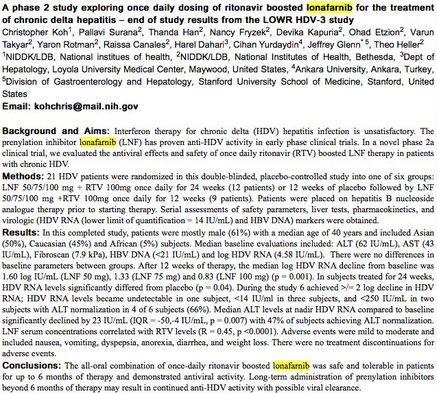
The LOWR-3 program gave 100mg of Lonafarnib and 100mg Ritonavir once daily for 12 weeks to 3 patients. So that should be comparable to the red bar above. The abstract from LOWR-3 is below. The relevant sentences are about 3-4 lines down in the results section (ignore the highlights, they are just artifacts of a word search I was doing).

The mean log decline for LOWR-3 at the 100mg dosage was 0.83 log IU/ml.   This is quite a bit less than the red bar from the earlier program.

The LOWR-3 study was more comprehensive than just the 3 patients taking 100mg Lonafarnib for 12 weeks.  There were also 3 patients at a 75mg dose and 3 others at 50mg that took the drug for 12 weeks (I’ll talk more about these in a second). In addition to this there were 12 more patients given the drug for 24 weeks (at the same dose increments of 50mg, 75mg, and 100mg).  In the abstract it said that six of these 24 week patients saw greater than 2 log IU/ml decline in HDV RNA, so that’s good.  But there was no mention of an average HDV RNA decline for all 12 patients, which seems an odd omission.  It would be nice to see the entire paper to get all the data.

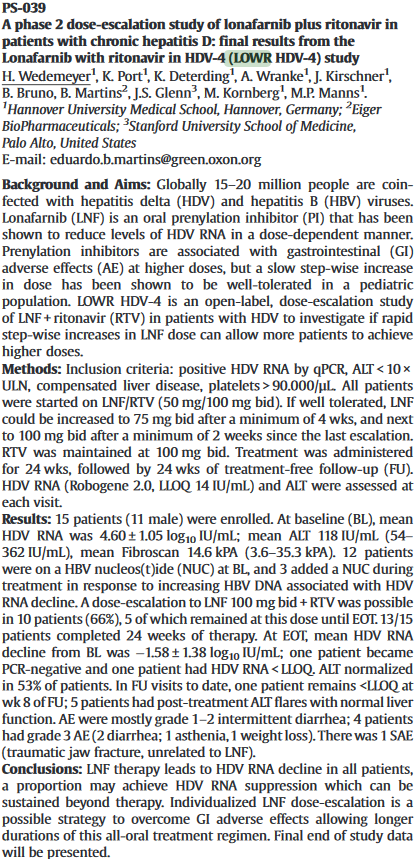
A second study, LOWR-4, looked at an increasing dosage.  In this study 15 patients were given gradually increasing dosages of Lonafarnib.  They started 50mg Lonafarnib, escalated to 75mg if tolerated and then to 100mg.  They were also give 100mg of Ritonavir throughout, just like the other study.  Below is the abstract.

The mean decline in HDV RNA for this study was 1.58 log IU/ml which, while below the 2.4 log IU/ml from the LOWR-1 study (remember again the red bars from above), is not too bad considering the dose was lower for some of the study.

Maybe the more interesting take-away from the LOWR-4 study was that the standard deviation of patients was +/- 1.38.  I Maybe misunderstanding what that means but it seems like a lot of dispersion to me.  I suspect it suggests that the drug performance has a large degree of variability in different patients.

So far what I’ve described is how Lonafarnib didn’t work as well as previous studies, but that it still worked pretty well.  There was a definitive decline in HDV RNA levels, and it was well tolerated in all 3 studies, so there is no reason a patient couldn’t stay on the drug longer to presumably greater affect.

I think the final piece of the puzzle of why the stock went into a tail spin is evident when we look back at the 12 week dose comparison from the LOWR-3 study (the one I said I’d come back to).  I briefly mentioned how in addition to the 100mg Lonafarnib arm there were other patients taking 75mg Lonafarnib and 50mg Lonafarnib along with Ritonavir.  A comparison of the results of these different wings is surprising:

After 12 weeks of therapy, the median log HDV RNA decline from baseline was 1.60 log IU/mL (LNF 50 mg), 1.33 (LNF 75 mg) and 0.83 (LNF 100 mg) (p = 0.001)

According to the above, the lower dosed patients had a better response(?!?).  This is odd to say the least.  I don’t think the market liked that.

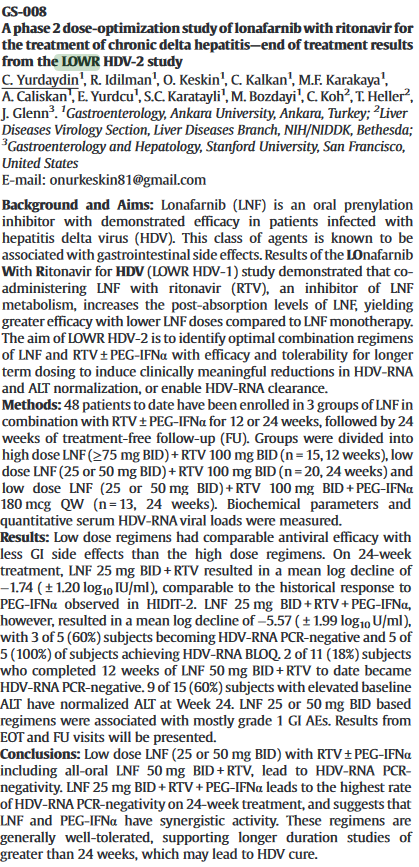
The LOWR-2 results also showed increasing the dosage had a murky impact on efficacy.  I’ve pasted that abstract below.  As I mentioned earlier, this is the second presentation of LOWR-2, as it was completed earlier than LOWR-3 and LOWR-4.  There is a video of the earlier results that were presented here.

As the abstract describes, one arm of the study had 25mg Lonafarnib twice daily along with 100mg Ritonavir.  Those patients saw a mean log decline of 1.74 log IU/ml (albeit for 24 weeks), quite a bit better than the higher dosed 12 week patients from the LOWR-3.  I realize this comparison is not quite apples to apples, but again, it adds to the cloudy picture around efficacy and increased dosing.  Indeed the study concluded that “low dose regimens had comparable antiviral efficacy with less GI side effects than the high dose regimens.”

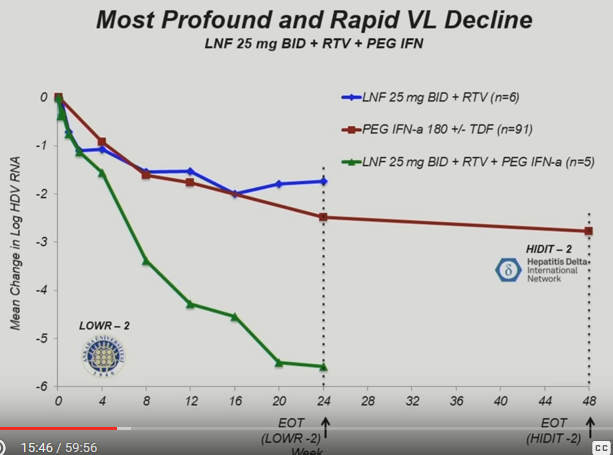
By far the best piece of news from the LOWR-2 study (and I think what the market is really overlooking) was the outsized effect of the arm that used Lonafarnib, Ritonavir and Lambda together.  Repeating the relevant excerpt from the abstract (my underline):

[Lonafarnib] 25 mg BID + RTV + PEG-IFN alpha, however, resulted in a mean log decline of -5.57 ( ± 1.99 log10 U/ml), with 3 of 5 (60%) subjects becoming HDV-RNA PCR-negative and 5 of 5 (100%) of subjects achieving HDV-RNA BLOQ

In the conclusion the authors speculated at a cure:

NF 25 mg BID + RTV + PEG-IFN alpha leads to the highest rate of HDV-RNA PCR-negativity on 24-week treatment, and suggests that LNF and PEG-IFN lambda have synergistic activity. These regimens are generally well-tolerated, supporting longer duration studies of greater than 24 weeks, which may lead to HDV cure.

Note: In my original write-up I mistakenly equated PEG-IFN alpha with PEG-IFN Lambda.  I didn’t pay enough attention to the Greek symbol being used.  These are different drugs.  Alpha was used in the 3-drug tests with Lonafarnib that I talk about here.  But in future tests Lambda will be used.  Lambda is the drug that Eiger owns.  Eiger says that Lambda has similar downstream signaling pathways as Alpha and that because it targets a different receptor it is expected to have less side effects.  But obviously this means there is a little more uncertainty than if Lambda had been used in the 3-drug trial.  So my conclusions below are a little less pronounced.

To get a better sense of just how well the 3-drug cohort worked, I snipped this screenshot from the earlier presentation of the results.  The 5 patient group taking Lambda in addition to Lonafarnib and Ritonavir is in green.

This seems quite promising.

What do I think of all of it?

Well for one I think it’s a great learning experience for me.  I’m digging into data and trying to make sense of it, and at the end of this investment I’ll be able to look back and see what I got right and what I got wrong and hopefully learn a lot for the next time.

With respect to the HDV phase 2 results, I suspect that the stock has overreacted.  I understand that the results are messy, but there is clearly efficacy here.  Maybe the most important point to consider is that Lonafarnib is producing a large standard deviation and these are a small sample of results.  So the noise is producing some inconsistent data.

Moreover, it seems very significant to me that the 3 drug combination that includes Lambda had such impressive results.   With two drugs in development for HDV there are a number of ways Eiger can win here.

The other consideration that I haven’t focused on in this post is that this is only one of Eiger’s programs.  As I mentioned earlier they also have a Lambda program, a Post-Bariatric Hypoglycemia program, a pulmonary arterial hypertension program and a Lymphedema program.  Each of these are in Phase 2 and will have read-outs this year.

There are a lot of shots on goal here.  And this is a $70 million market capitalization stock with $60 million of cash, so its not pricing in a lot of success.  Again, I would recommend going back to their presentations to learn more about the other programs.  I’ll probably talk more about each of them as new data comes out.

Revisiting Zargon after the debenture amendment

I wrote about my position in Zargon in my September update.  I bought the stock because, after a large asset sale of their Saskatchewan properties at a favorable price, the company seemed poised to recover with an uptick in the price of oil.

As an aside, what a long post that update was!  I really was cramming a lot of information into the monthly updates I used to focus on.  Hopefully having the updates dispersed into smaller chunks will make for easier reading.

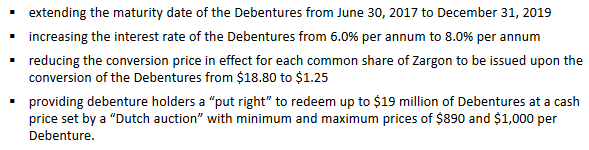
On Friday Zargon announced that their 6.00% convertible unsecured subordinated debentures due June 30, 2017 would be amended, pending approval of holders. The amendments are as follows:

debenture_terms

When I looked at Zargon in the fall I did so with the assumption that they would have to dilute to raise capital to pay back the debentures.  I was optimistically thinking that would happen at around a 80c share price.

With this deal Zargon is using the cash it has available to pay what of the debenture it can, and then, rather than issuing equity at the current level, its saying give us 3 years and we will issue equity at a 50% premium.

So its much less dilutive than I had been anticipating.

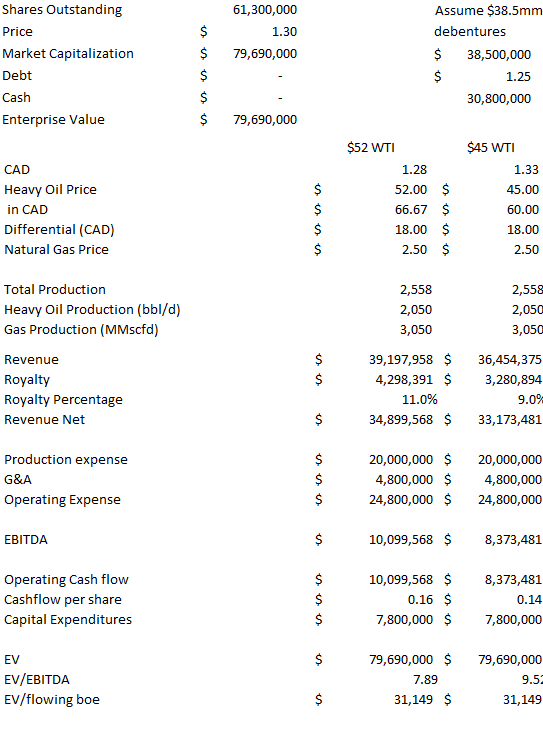
I took a look at what Zargon would look like if the debentures are converted.  This happens at a stock price of $1.25, so I took a look at the company at $1.30.  That implies over 50% appreciation from the current level.  What I’m doing here is asking the question “is this is a reasonable valuation for this company?” – if it is, then there is a lot of upside in the stock.

If I assume that Zargon uses the $19 million to purchase the  debentures at par (as opposed to 89% of par), which would be the worst case outcome of the put option, they end up diluting 31 million shares with the rest of the debentures (at $1.30 the debentures would be in the money).  The capitalization and metrics look something like this:

incomestatement(Note that my $52 scenario assumes a 1.28 CAD/USD exchange whereas my $45 scenario assumes 1.33 exchange.  I am trying to be conservative by using an $18 differential between WTI and what Zargon realized.  This differential was $10/bbl in the third quarter)

Total market capitalization is still only $80 million.  There is no debt.  And you have a company with a best in class decline rate of ~10%, producing 2,500boepd that is 75% oil.

On traditional metrics it looks reasonable.  Even after the large price appreciation the company would still be trading at $31,000 per flowing boe and at a little under 8x EV/EBITDA, which is in-line with peers once you account for the fact that the resulting company has no debt.  At $52 oil ($66 Canadian), they can keep production steady with capital expenditures of $6.3 million (in the recent corporate presentation they breakdown the $7.8 million of capital expenditures they expect to incur in 2017 and $1.5 million of it is for land retention).  This leaves around $4 million of discretionary cash flow for growth.

I think Zargon could turn out to be a good idea in a rising oil price environment.  It wasn’t, and isn’t a great company at $40 oil.  Its barely treading water.  At $50 it gets its head above.  In the high $50’s there is real value there.  I thought we were moving into a rising price environment in September and I am more convinced of that now.  So I think there is more chance Zargon moves higher than lower.