Skip to content

Posts from the ‘Portfolio’ Category

Week 394: New Years Resolutions

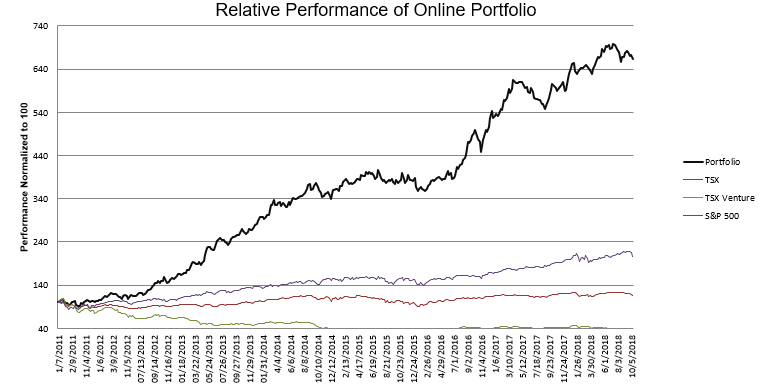
Portfolio Performance
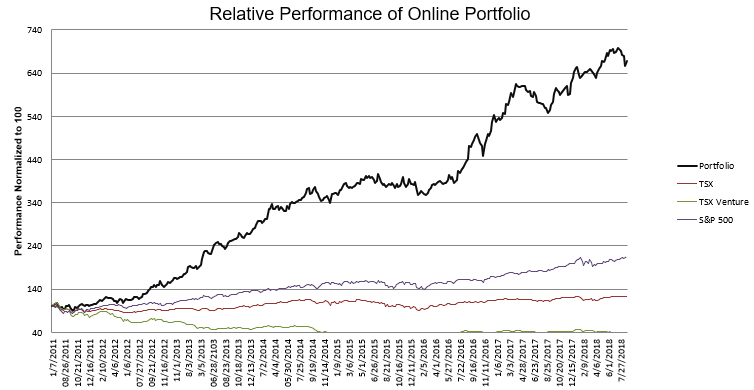
Thoughts and Review

Here are a few investment resolutions for the new year:

  1. After a stock has a good run, I will sell a decent amount of it, no matter how much I like it.
  2. I’ll stay away from illiquid stocks that will be hard to get out of in a bad market
  3. I will stay away from stocks with high levels of debt
  4. I will be very thoughtful before purchasing any stock not generating free cash flow
  5. Be selective
  6. Post more!

These resolutions could also be described as Lane Sigurd’s investment strategy for a bear market.

Some of them are at odds to how I have invested over the long bull market we’ve been in.  Over that time I held my winners and watched them turn into two, three or five baggers.  I didn’t worry about debt.  In fact I coveted levered stocks that would really run if the tide turned.  I didn’t give a second thought to liquidity because I was always able to get out.

I think we are still in a bear market.  Maybe we’ll top out soon, maybe we’ll run back up near the highs, I don’t know.  But I am positioning myself based on the expectation that in the next few months there will be another leg down.

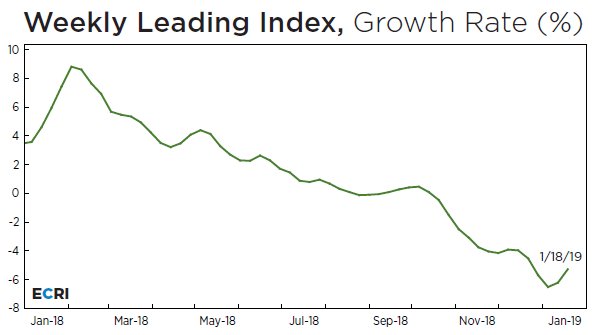
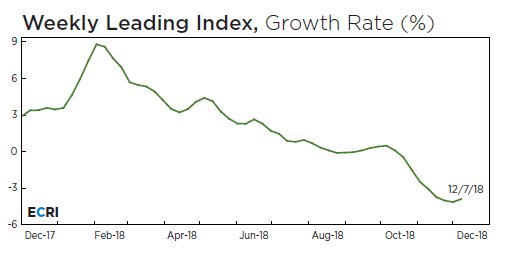
Having said that, there is a bit of good news.  The Weekly Leading Index looks like it might be putting in a bottom.

Is it possible this is just another 2016-like blip?  Possibly but I’m still going with the bear market view.  Maybe I’ll have to change my mind on it.  But not yet.

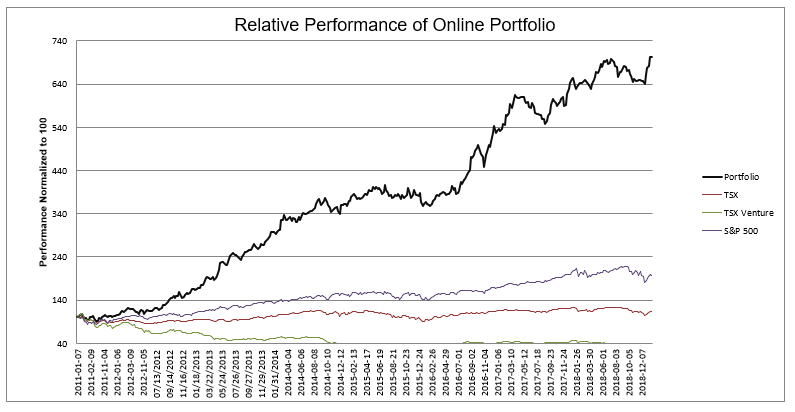
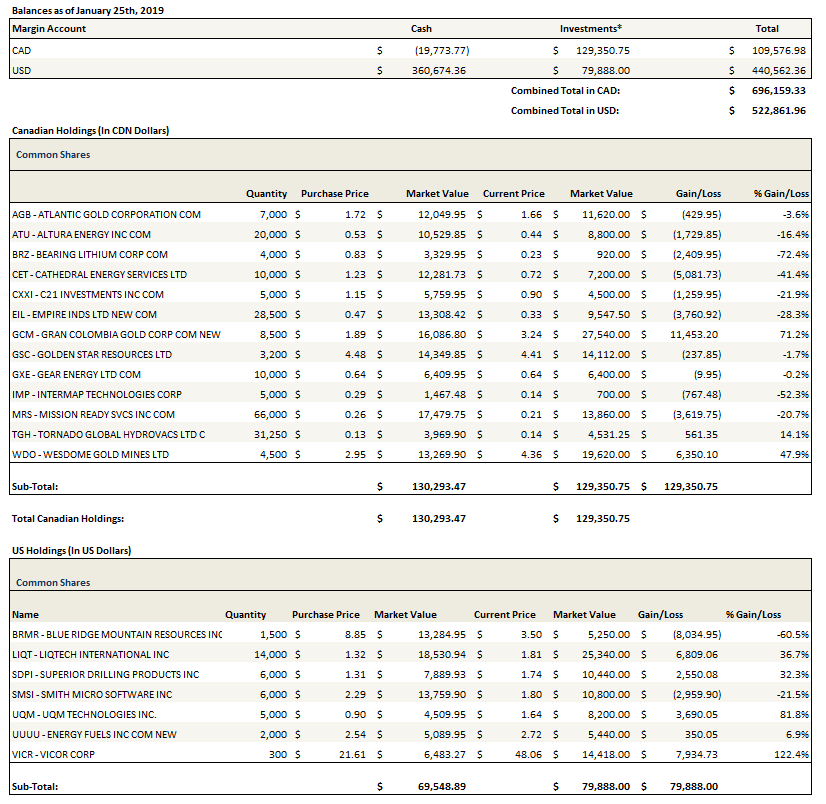
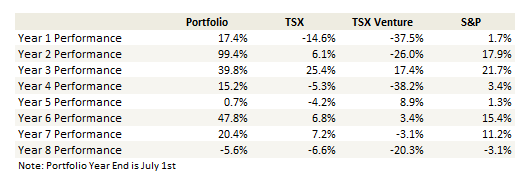
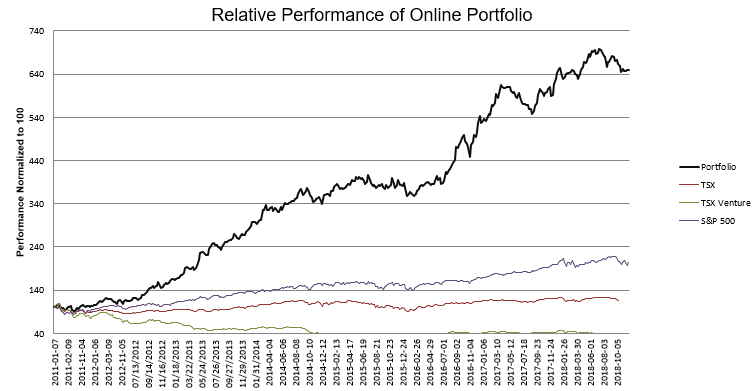
Looking back, December was a tough month, but I had a lot of cash and that helped cushion the blow.  And while I was not lucky enough to go all in at the bottom I did pick at a few positions in December, and the positions I held onto had big runs in January.  So I sit here now at (somewhat shockingly) new portfolio highs.

I’m a bit surprised by that.  My portfolio still has some 70% cash after all.  The market still isn’t great.  It’s really just a bit of luck and timing really.  A number of my remaining positions had big runs.  Liqtech took off.  Gran Colombia took off. Vicor, Golden Star and Wesdome all had nice moves.  UQM Technologies got taken over.  I bottom fed on a few small positions (Identiv, UQM and a few oil names) that all had really nice bounces off the bottom.  Meanwhile I went a few weeks where none of my positions went down.

Having had good performance while not owning very many stocks makes me think that in this market I would be better off being selective than to go with my more usual shot-gun like approach.   In the past I’ve taken small positions in a bunch of stocks, even if I wasn’t completely sold on them all, and watched whether they would develop.  A few would become big winners and I’d add to those as they went up.

I’m not going to do that in this market.  Instead I’ll hold cash and wait for stocks that I have a lot of conviction with.  We’ll see how it works.

So it was a pretty good month.  But I am not overstaying my welcome.

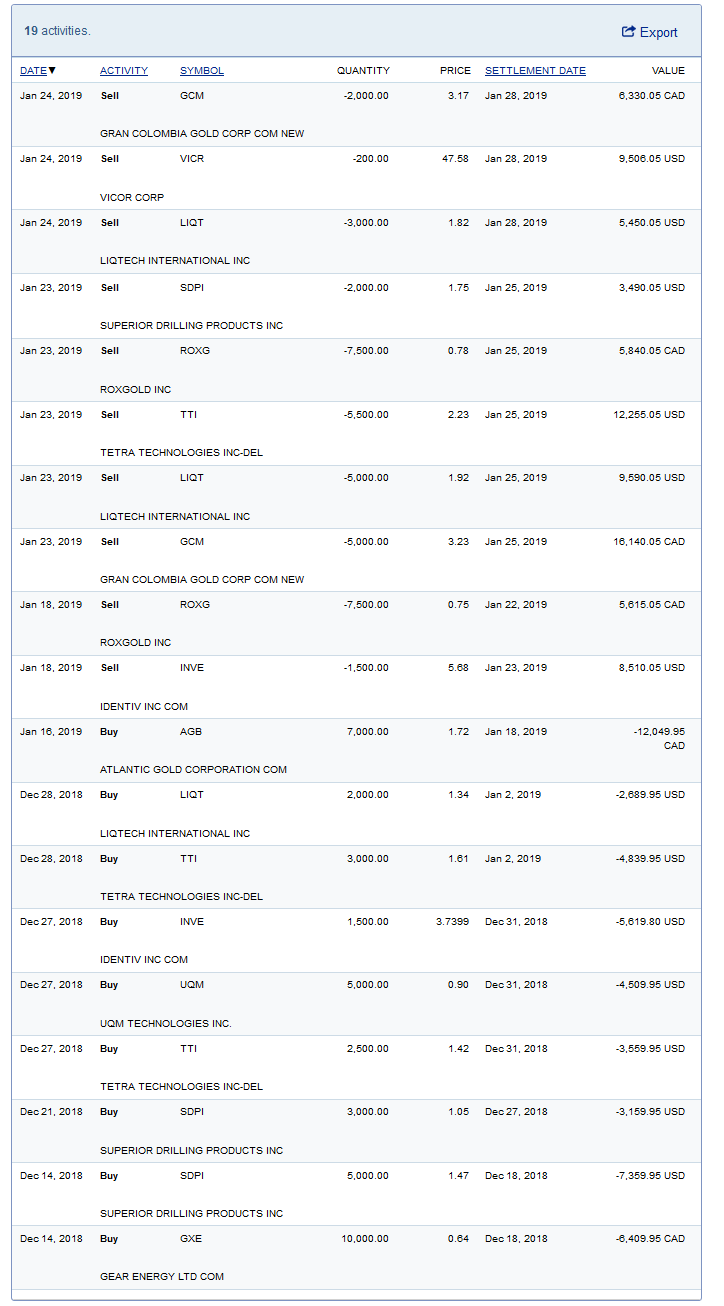
True to my first resolution, I have been selling my winners.  I sold out of three of my trades entirely already (Identiv, Tetra Technologies and Lone Star).  I reduced my Liqtech position by half.  I reduced Gran Colombia and Vicor as well.

I sold some losers too.  I got rid of Roxgold, Gear Energy and reduced my position in Empire Industries.

One stock I’m not selling is Wesdome.  As much as I love my other gold names, the more I dig into what Wesdome is onto at Kiena, the more I love it the best.  It’s not cheap I know, but its got so much going for it.  It’s in Canada and not in an area with questionable politics.  There are two mines with great potential for expansion.  But what I really love about the story is just how cheap the growth from Kiena will come for.  Something I had overlooked in the past were comments by Wesdome management that the mill at Kiena is worth $100 million.  That is basically a $100 million asset that was useless that is now an integral piece of their development plans.  That they can bring Kiena on-stream (and I’m seeing estimates from anywhere between 90,000 oz to 130,000 oz from brokerage for the project) for $50 million is about the most efficient gold development project I’ve seen.

As for my last resolution, I have been lax about posting.  It’s harder to post in a bear market.  Even when I get up the courage to buy a stock, I have weak conviction because of the market.  I find that it takes a lot of conviction to write about something because mentally it kind of ties you to the idea.  That makes me reluctant to lay out a thesis when I might get scared and sell a week or two later.  Or worse, I might hold it because I wrote about when I really should be selling.

UQM Technologies is a good example.  I bought it in November, sold it, then bought it again in December.  I didn’t write about it either time, even though it was a great story.  I was just worried the market might keep falling and I would be doing another round of selling if it did. UQM would be a stock I would cut.  Fortunately the market turned around and I didn’t.

I’ll try to put aside those fears in the new year and write about my positions more.  Even if I look at all of them right now as having the time frame of a pin-pulled hand grenade.

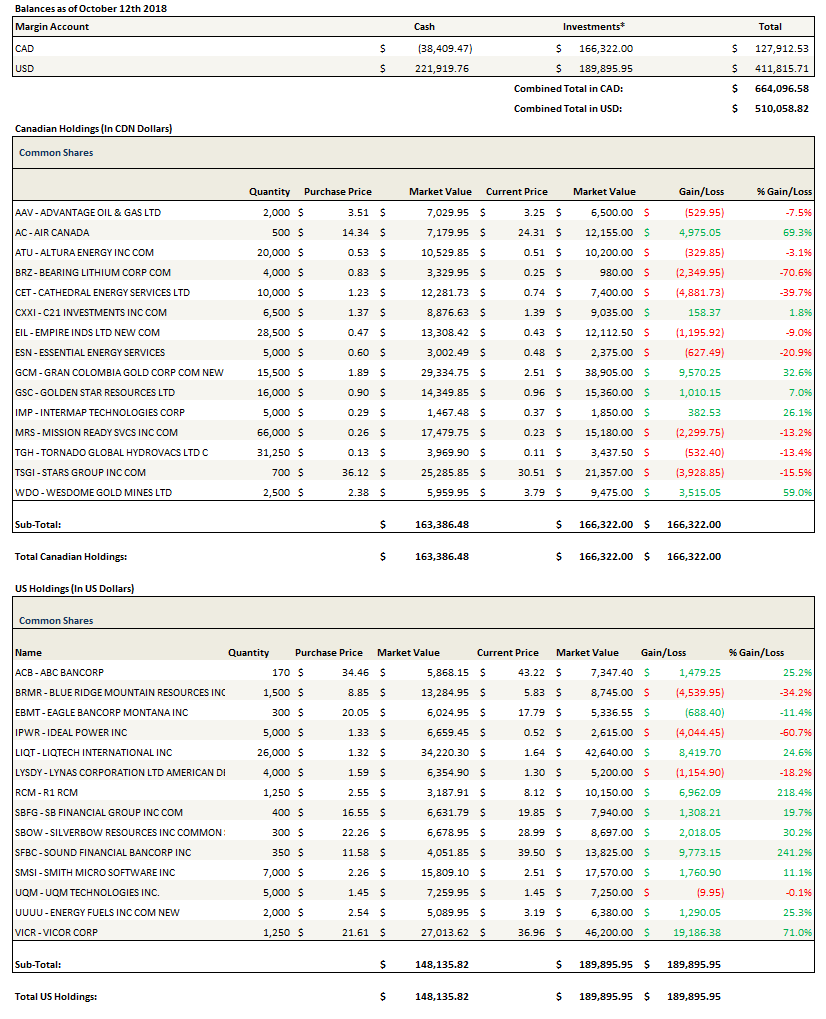
Portfolio Composition

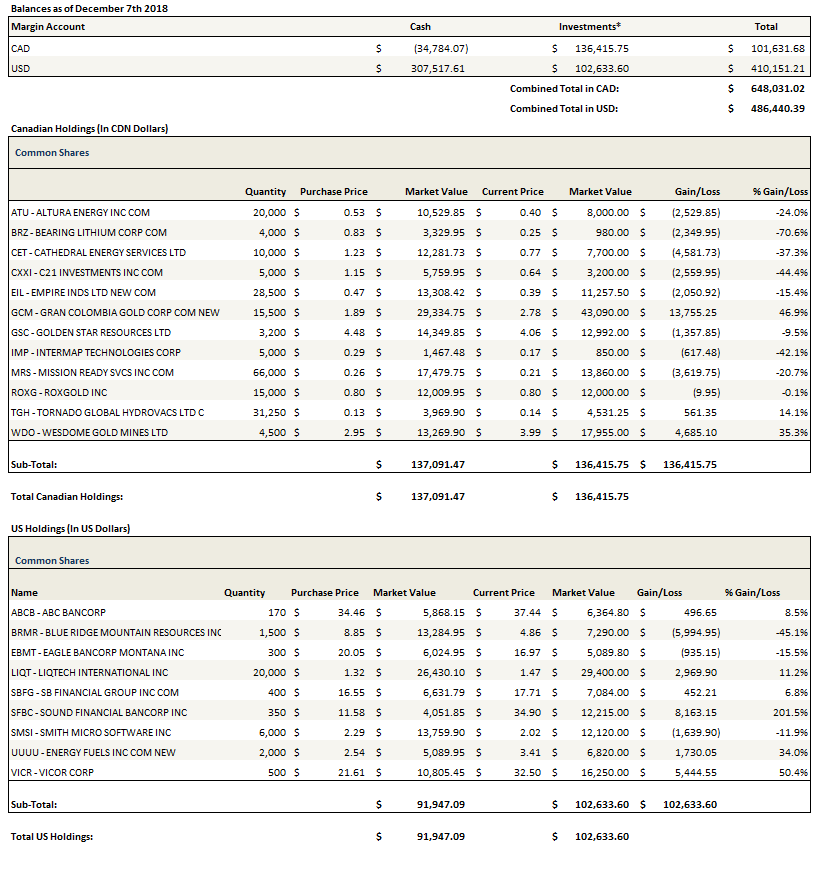
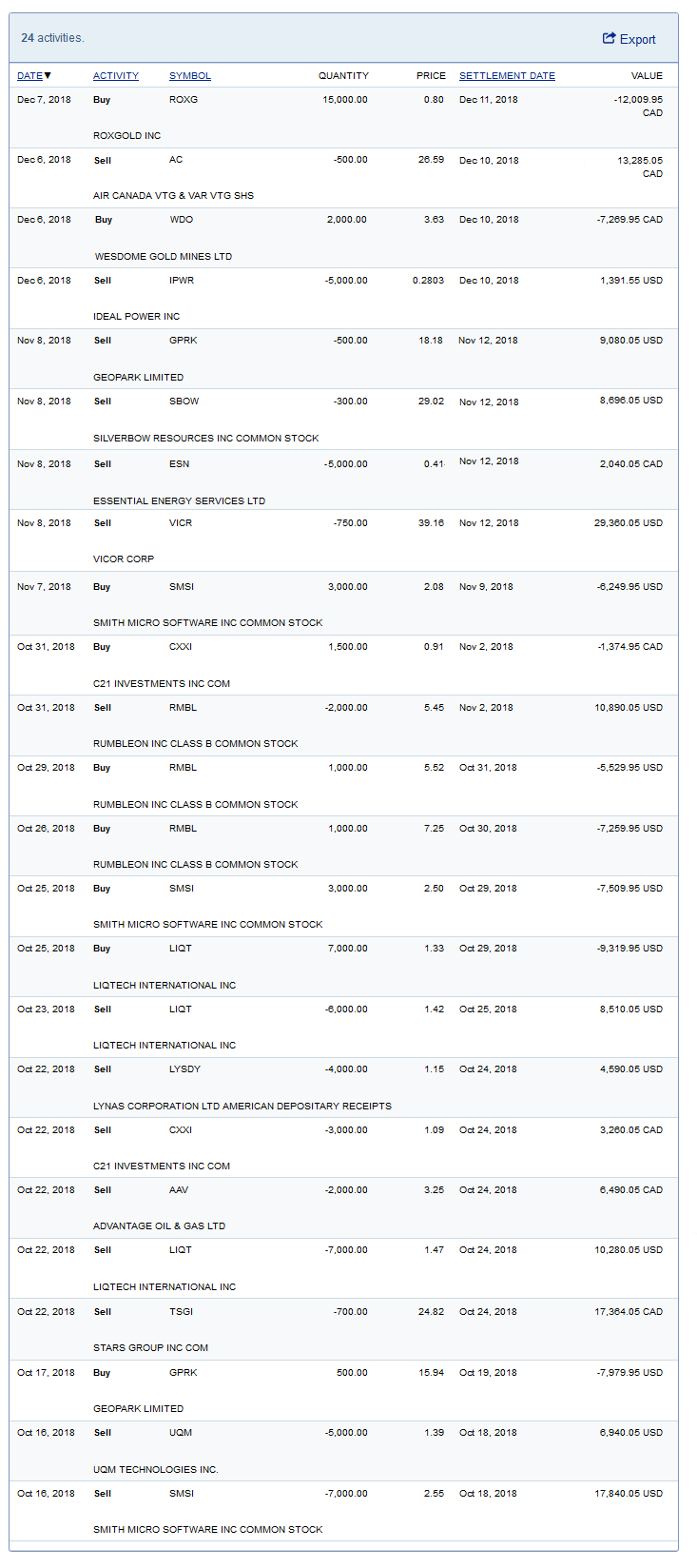
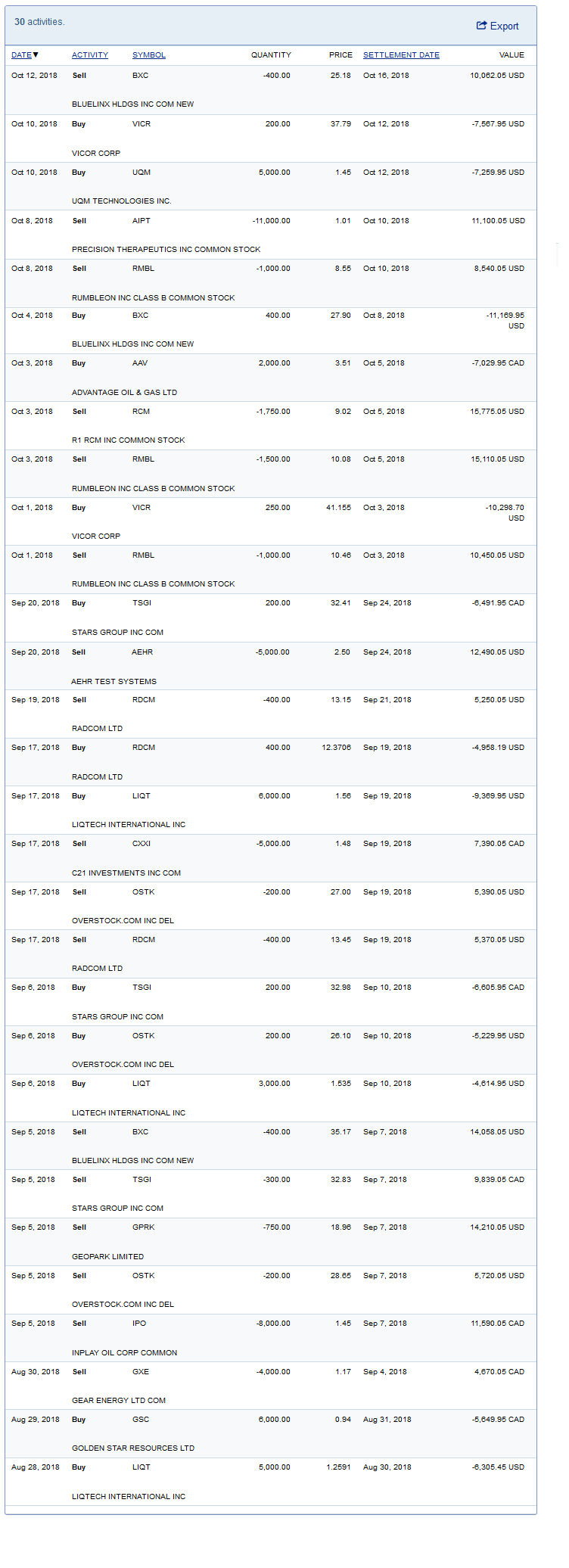
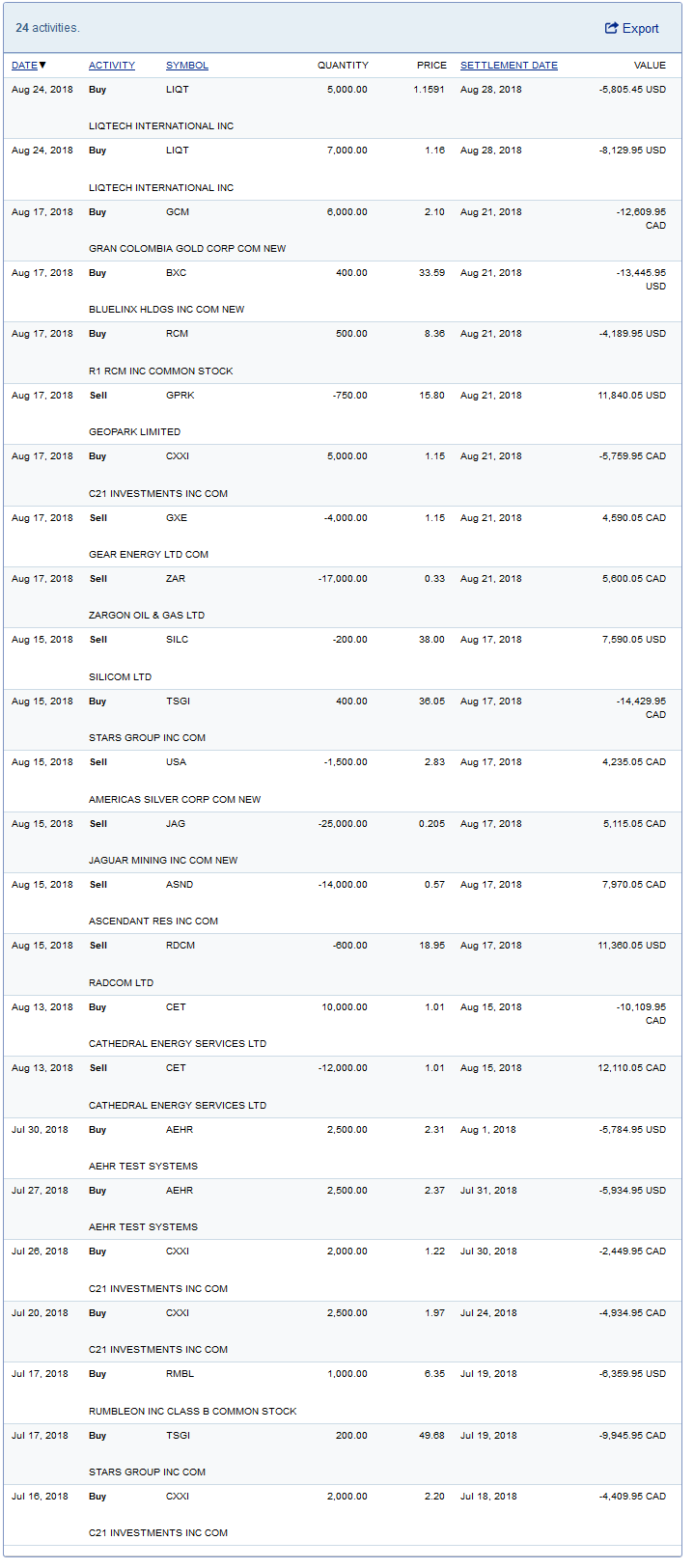
Click here for the last seven weeks of trades.


Week 387: My Recessionary Portfolio

Portfolio Performance


Thoughts and Review

I haven’t written in a while.  I don’t have much to say, the markets are brutal and I am in no hurry to start picking new stocks.  So its not a lot of fun writing.

I have continued to sell stocks in the last two months.  My already high cash position is even higher.  I’ve hunkered down.

I see no choice but to continue to sell.  The problem is that with the small and speculative stocks in a bear market the only safe place is cash.  So even as I went into the fall with a very high cash level, over the last 8 weeks I made it even higher.  As of this weekend the online portfolio I track with this blog is at 75% cash.  That trails my actual portfolio, which is now up to 85% and my RRSP is basically now a GIC.

I even sold my long-held bank stocks this week (not reflected in the portfolio below, which I updated for December 7th).  It’s a bit of a personal watershed for the portfolio and the blog.

I rarely have talked about these stocks since they are boring, but they have been great performers for the last 6 years.  I’ve held them through pretty much the entirety that I have been writing this blog.  Which is to say some tough times!  Yet with the yield curve inverting and leading indicators rolling over I decided to finally exit the trade.  I sold Sound Financial, SB Financial, Eagle Bancorp, and ABC Bancorp (they were the firm that took over Atlantic Coast Financial).  It was the end of a era!

That I am selling these stocks, which I held through some crummy times in 2015 and 2016, should tell you something.  I’m pretty bearish on where the economy is at.

The weekly leading indicators put out by the ECRI were at 144 week lows before a slight uptick this week.

The pH report recently said (also in a Real Vision interview which I’m not sure I can reproduce here so I won’t) that they thought we were on the cusp, if not in, a global recession.

Chemicals are the best leading indicator for the global economy. Data for both Chinese and global chemical production are warning that we may now be headed into recession.

On top of that we have the Fed raising interest rates and quantitative tightening, which are reducing the availability of credit.

And then there’s the trade war.

If this isn’t the tide going out, I don’t know what it.

Look, I’m not the smartest guy in the room.  All of the funds and firms and experts undoubtedly know more than I do.  So I might be wrong and maybe this is another pause, another correction, before takeoff.

What I do know is to respect my limitations.  And trying to guess the bottom in a market that is in a downtrend on top of a bunch of negative economic data just seems like a foolish exercise to me.

No one is paying me to take risk.  So when the environment isn’t conducive, why should I?

The last time I did something like this was January 2016.  That period turned out to be a false alarm.  This one might too.

This is what I wrote in my February 2016 blog post.

The point of existence of a hedge fund is to risk money in order to make more of it. You can argue the particulars of that statement, that risk reduction can occur through various hedges, diversification, concentration, whatever your flavor is, but the bottom line is that the money should be at risk somewhere or why is the fund even there?

But that’s not my job. While part of what I am trying to do is of course maximize my profit line, my first mandate is also very clearly and in capital letters, TO NOT BLOW MYSELF UP.

What I guard against with absolute vigilance, is insuring that my capital doesn’t permanently disappear.

You can look back on these comments and say they were poorly timed.  February marked the bottom, the market started to recover, in the fall when Trump was elected it really took off.

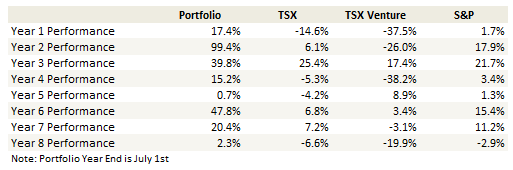
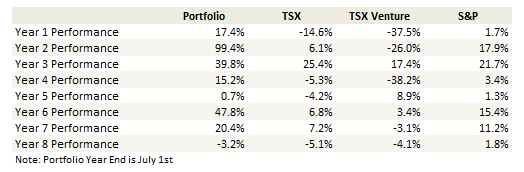
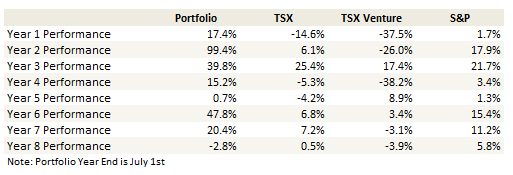
But the reality is that I greatly benefited from that rally.  My Year 6 performance (the table at the beginning of this post) from June 2016 to June 2017 was one of my best 12 month periods.  The market turned and so did I.  If that happens again I’ll turn on a dime just like I did then.

But I’m not going to sit around and wait for that turn while the market grinds lower.

You can look through my portfolio and look at what I sold.  I’m not going to go through the whole lot.  What I’ve held, I’ve done so for two reasons.

First, most of these stocks aren’t terribly economically sensitive.  Liqtech isn’t go to sell less scrubber filters because the economy is slowing (in fact a lower oil price probably means they sell more).

Second, the TSX Venture has already gotten creamed.  The few Canadian stocks I hold there have not done great, but they’ve done okay.  This seems like a bad time to throw in the towel there, especially since the positions are small.

And then of course there is Mission Ready which apparently isn’t going to trade again until the next decade.  Not that I’m complaining.  If I had the option to put all my stocks on a trading halt for the next 12 months I think I’d have to consider that.

(As an aside there was a piece of bullish news out of Mission Ready just released on Friday.  One of the company insiders exercised their 15c warrants that expire in a week.  One would think that an insider would not exercise warrants if they thought the Unifire deal was going to fall through).

So I don’t know.  Maybe I will find another compelling recession proof stock that will compel me.  That might be a hard proposition.  If not, and if this is more than your run of the mill correction, then this blog might be a bit boring for a while.

I’ll tell you though that when I see the turn, I’ll be in the middle of it.

So I did take a small Canadian oil position this week.  I don’t know how long I will hold it so take this for what its worth.

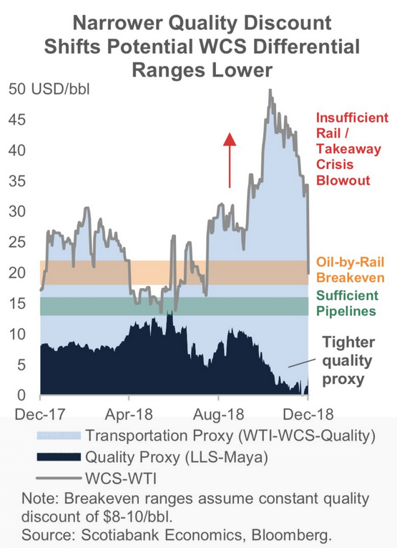
Gear Energy.  I owned it before and sold it after Western Canada Select spreads blew out.  The stock fell apart like I thought it would.  But in the last week and a bit the mandatory production cuts implemented by the Alberta government have worked wonders on Western Canadian Select differentials.

Part of the mandatory cut is that companies producing under 10,000 bbl/d are exempt.  In fact companies under 10,000 bbl/d can actually produce up to that level before being affected by the cut.  I was surprised to find this to be the case.

Before being forced to shut-in production in November Gear was guiding to 7,500 boe/d.  They have an acquisition that will bring that up to nearly 10,000 boe/d but those assets are in Saskatchewan and so they shouldn’t count toward the ceiling.

Small companies like Gear (and Altura Energy, which I continue to own) are in the unique position of benefiting from the spreads and having the ability to grow.  I don’t know if the market will see it that way.  I have heard the argument that capital just won’t come back to small-caps period. Maybe so.

I haven’t run the numbers for Gear but I did a detailed type curve model of corporate production for Altura and found that at C$40/bbl realized prices they can drill 5 wells next year, stay within cash flow and grow production slightly.  Right now WCS prices have risen to over $50 (the latest PSAC quote has them at $54).  At those prices Altura can grow production significantly (10-20% I think) while staying within cash flow.  I’ll maybe do a post of my model there shortly.

These companies aren’t in a terrible position any more.

No guarantees I keep any of my positions.  All comments in this market have the life expectancy of a hand grenade.

Portfolio Composition

Click here for the last eight weeks of trades.  Note that this update is of December 8th, so it is a week old and doesn’t have my small purchase of Gear, my bank sales or my sale of Smith-Micro.

Week 279: Cautious on trade(s)

Portfolio Performance

Thoughts and Review

I haven’t written a post since my last portfolio update.  Up until this last week I did not add a new stock to my portfolio.  I have sold some stocks though.  Quite a few stocks really.

I have been cautious all year and this has been painful to my portfolio.  While the market has risen my portfolio has lagged.  I have lagged even more in my actual portfolio, where I have had index shorts on to hedge my position and those have done miserably until the last couple of weeks.  In fact these last couple of weeks  are the first in some time where I actually did better than the market.

My concerns this year have been about two headwinds.  Quantitative tightening and trade.

Maybe its being a Canadian that has made me particularly nervous about the consequences of Trump’s protectionism.  With NAFTA resolved I don’t have to worry as much about the local consequences.  But I still worry about how the broad protectionist agenda will evolve.

I continue to think that the trade war between the United States and China will not resolve itself without more pain.  The US leadership does not strike me as one open to compromise.  Consider the following observations:

Peter Navarro has written 3 books about China.  One is called “Death by China”, another is called “Crouching Tiger: What China’s Militarism Means for the World” and the third is called “The Coming China Wars”.

In the Amazon description of Death by China it says: “China’s emboldened military is racing towards head-on confrontation with the U.S”.  In the later book, Crouching Tiger, the description says  “the book stresses the importance of maintaining US military strength and preparedness and strengthening alliances, while warning against a complacent optimism that relies on economic engagement, negotiations, and nuclear deterrence to ensure peace.”.  The Coming China Wars, his earliest book (written in 2008), notes “China’s dramatic military expansion and the rising threat of a “hot war”.

Here’s another example.  Mike Pence spoke about China relations last week at the Hudson Institute.  Listening to the speech, it appeared to me to be much more about military advances and the military threat that China poses than about trade.  The trade issues are discussed in the context of how they have led to China’s rise, with particular emphasis on their military expansion.

John Bolton’s comments on China are always among the most hawkish.  Most recently he spoke about China on a radio talk show.  Trade was part of what he said, but he focused as much if not more on the Chinese behavior in the South China Sea and how the time is now to stand up to them along those borders.

Honestly when I listen to the rhetoric I have to wonder: Are we sure this is actually about trade?

Is it any coincidence that what the US is asking for is somewhat vague?  Reduce the trade deficit. Open up Chinese markets. Less forced technology transfer (ie. theft). Now currency devaluation is part of the discussion.

I hope that this is just a ramp up in rhetoric like what we saw with Canada and Mexico.  That the US is trying to assert a negotiating position before going to the table and reaching some sort of benign arrangement.  But I’m not convinced that’s all that is going on.

If this has more to do with pushing China to the brink, then that’s not going to be good for stocks.

I can’t see China backing down.

From what I’ve read China can’t possibly reduce the trade deficit by $200 billion as the US wants without creating a major disruption in their economy.   Never mind the credibility they would lose in the face of their own population.

Meanwhile quantitative tightening continues, which is a whole other subject that gives me even more pause for concern, especially among the tiny little liquidity driven micro-caps that I like to invest in.

I hope this all ends well.  But I just don’t like how this feels to me.  I don’t want to own too many stocks right now.  And I’m not just saying that because of last week.  I have been positioned conservatively for months.  It’s hurt my performance.  But I don’t feel comfortable changing tact here.

Here’s what I sold, a few comments on what I’ve held, and a mention of the two stocks I bought.

What I sold

I don’t know if I would have sold RumbleOn if I hadn’t been so concerned about the market.  I still think that in the medium term the stock does well.  But it was $10+, having already shown the propensity to dip dramatically and suddenly (it had fallen from $10 to $8 in September once already), and having noted that Carvana had already rolled over in early September, I decided to bail at least for the time being.  Finally there was site inventory turnover, which if you watch daily appeared to have slowed since mid-September.  Add all those things up and it just didn’t feel like something I wanted to hold through earnings.

I was late selling Precision Therapeutics because I was on vacation and didn’t actually read the 10-Q until mid-September.  That cost me about 20% on the stock.  I wrote a little about this in the comment section but here is what has happened in my opinion.  On August 14th the company filed its 10-Q.  In the 10-Q on page 14 it appears to me to say that note conversion of the Helomics debt will result in 23.7 million shares of Precision stock being issued.  This is pretty different than the June 28th press release, where it said that the $7.6 million in Helomics promissory notes would be exchanged with $1 shares.  Coincidentally (or not) the stock began to sell off since pretty much that day.

Now I don’t know if I’m just not reading the 10-Q right.  Maybe I don’t understand the language.  But this spooked me.  It didn’t help that I emailed both IR and Carl Schwartz directly and never heard back.  So I decided that A. I don’t know what is going here, B. the terms seemed to have changed and C. it’s not for the better. So I’m out.

I decided to sell R1 RCM after digging back into the financial model.  I came to the conclusion that this is just not a stock I want to hold through a market downturn.   You have to remember there is a lot of convertible stock because of the deal they made with Ascension.  After you account for the conversion of the convertible debt and all the warrants outstanding there are about 250 million shares outstanding.   At $9.30, where I sold it, that means the EV is about $2.33 billion.  When I ran the numbers on their 2020 forecast, assuming $1.25 billion of revenue, 25% gross margins, $100 million SG&A, which is all pretty optimistic, I see EBITDA of $270 million.  Their own forecast was $225 – $250 million of EBITDA.  That means the stock trades at about 9x EV/EBITDA.  That’s not super expensive, but its also not the cheapie it was when I liked the stock at $3 or $4.  I have always had some reservations about whether they can actually realize the numbers they are projecting – after all this is a business where they first have to win the business from the hospitals (which they have been very successful at over the last year or so) but then they have to actually turn around the expenses and revenue management at the hospital well enough to be able to make money on it.  They weren’t completely-successful at doing that in their prior incarnation.  Anyways, I didn’t like the risk, especially in this market so I sold.  Note that this is an example of me forgetting to sell a stock in my online tracking portfolio so it still shows that I am holding it in the position list below. I dumped it this week (unfortunately at a lower price!).

I already talked a bit about my struggle and then sale of Aehr Test Systems in the comment section.   I didn’t want to be long the stock going into the fourth quarter report.  Aehr is pretty transparent.  They press release all their big deals.  That they hadn’t announced much from July to September and that made it reasonably likely that the quarter would be bad.  It was and the stock felll.  Now it’s come back.  It was actually kind of tempting under $2 but buying semi-equipment in this market makes me a bit nervous so I didn’t bite.  Take a look at Ichor and how awful this stock has been.  Aehr is a bit different because they are new technology that really isn’t entrenched enough to be in the cycle yet.  Nevertheless if they don’t see some orders its not the kind of market that will give them the benefit of the doubt.

BlueLinx. I don’t have a lot to say here. I’m not really sure what I was thinking when I bought this stock in the first place.  Owning a building product distributor when it looks like the housing market is rolling over was not one of my finer moments.  I sold in late August, then decided to buy it in late September for “an oversold bounce”.  Famous last words and I lost a few dollars more.  I’m out again, this time for good.

When I bought Overstock back in July I knew I was going to A. keep the position very small and B. have it on a very short leash.  I stuck with it when it broke $30 but when it got down to $28 I wasn’t going to hang around.  Look, the thing here is that who really knows?  Maybe its on the verge of something great? Maybe its a big hoax?  Who knows?  More than anything else what I liked when I bought it was that it was on the lower end of what was being priced in and the investment from GSR showed some confidence. But with nothing really tangible since then it’s hard to argue with crappy price action in a market that I thought was going to get crappier.  So I took my loss and sold.

Thus ends my long and tumultuous relationship with Radcom.  I had sold some Radcom in mid-August before my last update primarily because I didn’t like that the stock could never seem to move up and also because I was worried about the second quarter comments and what would happen to the AT&T contract in 2019.  I kept the rest but I wish I would have sold it all.  In retrospect the stocks behavior was the biggest warning sign.  The fact that it couldn’t rise while all cloud/SAAS/networking stocks were having a great time of it was the canary in the coal mine.  As soon as the company announced that they were seeing order deferral I sold the rest.  I was really quite lucky that for some reason the stock actually went back up above $13 after the news (having fallen some $4-$5 the day before mind you), which let me get out with a somewhat smaller loss.  The lesson here is that network equipment providers to telcos are crummy stocks to own.

Finally, I sold Smith Micro.  This is a second example where I actually didn’t sell this in the online portfolio until Monday because I didn’t realize I had forgotten to sell it until I put together the portfolio update.  But it’s gone now.  I wrote a little about this one in the comment section as well.  The thing that has nagged me is that the second quarter results weren’t really driven by the Safe & Found app.  It was the other products that drove things.  That worries me.  Again if it wasn’t such a crappy market I’d be more inclined to hold this into earnings and see what they have to say.  They could blow everyone away.  The stock has actually held up pretty well, which might be saying that.  Anyways I’ll wait till the quarter and if it looks super rosy I’ll consider getting back in even if it is at a higher price.

What I held

So I wrote this update Monday and Vicor was supposed to report Thursday.  Vicor surprised me (and the market I think) by reporting last night.  I’m not going to re-write this, so consider these comments in light of the earnings release.

One stock I want to talk about here is Vicor, which I actually added to in the last few weeks.  Vicor has just been terrible since late August.  The stock is down 40%.  I had a lot of gains wiped out.  Nevertheless this is one I’m holding onto.

I listened to the second quarter conference call a couple of more times.  It was really quite bullish.  In this note from Stifel they mention that Intel Xeon processor shipments were up significantly in the first 4 weeks of the third quarter compared to the second quarter.  They also mention automotive, AI, cloud data centers and edge computing as secular trends that are babies being thrown out with the bath.  These are the areas where Vicor is growing right now (Vicor described their core areas on the last call as being: “AI applications including cloud computing, autonomous driving, 5G mobility, and robots”).

Vicor just started shipping their MCM solutions for power on package applications with high ampere GPUs in the second quarter.  They had record volume for some of their 48V to point of load products that go to 48V data center build outs and a broader acceptance by data center players to embrace a 48V data center.  There’s an emerging area of AC-DC conversion from an AC source to a 48V bus.  John Dillon, who is a bit of a guru on Vicor, wrote a SeekingAlpha piece on them today.

I know the stock isn’t particularly cheap on backward looking measures.  But its not that expensive if the recent growth can be extrapolated.  I’m on the mind it can.   Vicor reports on Thursday.  So I’ll know soon enough.

The second stock I added to was Liqtech.  I’ve done a lot of work on the IMO 2020 regulation change and I think Liqtech is extremely well positioned for it.  When the company announced that they had secured a framework agreement with another large scrubber manufacturers and the stock subsequently sold off to the $1.50s, I added to my position.

I’m confident that the new agreement they signed was with Wartsila.  Apart from Wartsila being the largest scrubber manufacturer, what makes this agreement particularly bullish is that Wartsila makes its own centrifuges.  Centrifuges are the competition to Liqtech’s silicon carbide filter.  If Wartsila is willing to hitch their wagon to Liqtech, it tells me that CEO Sune Matheson is not just tooting his horn when he says that Liqtech has the superior product.  I’ve already gone through the numbers of what the potential is for Liqtech in this post.  The deal with Wartsila only makes it more likely that they hit or even exceed these expectations.

Last Thought

I took tiny positions in three stocks.  One is a small electric motor and compressor manufacturer called UQM Technologies.  The second is a shipping company called Grindrod (there is a SeekingAlpha article on them here).  The third is Advantage Oil and Gas.  All of these positions are extremely small (<1%). If I decide to stick with any of them I will write more details later.

Portfolio Composition

Click here for the last seven weeks of trades.

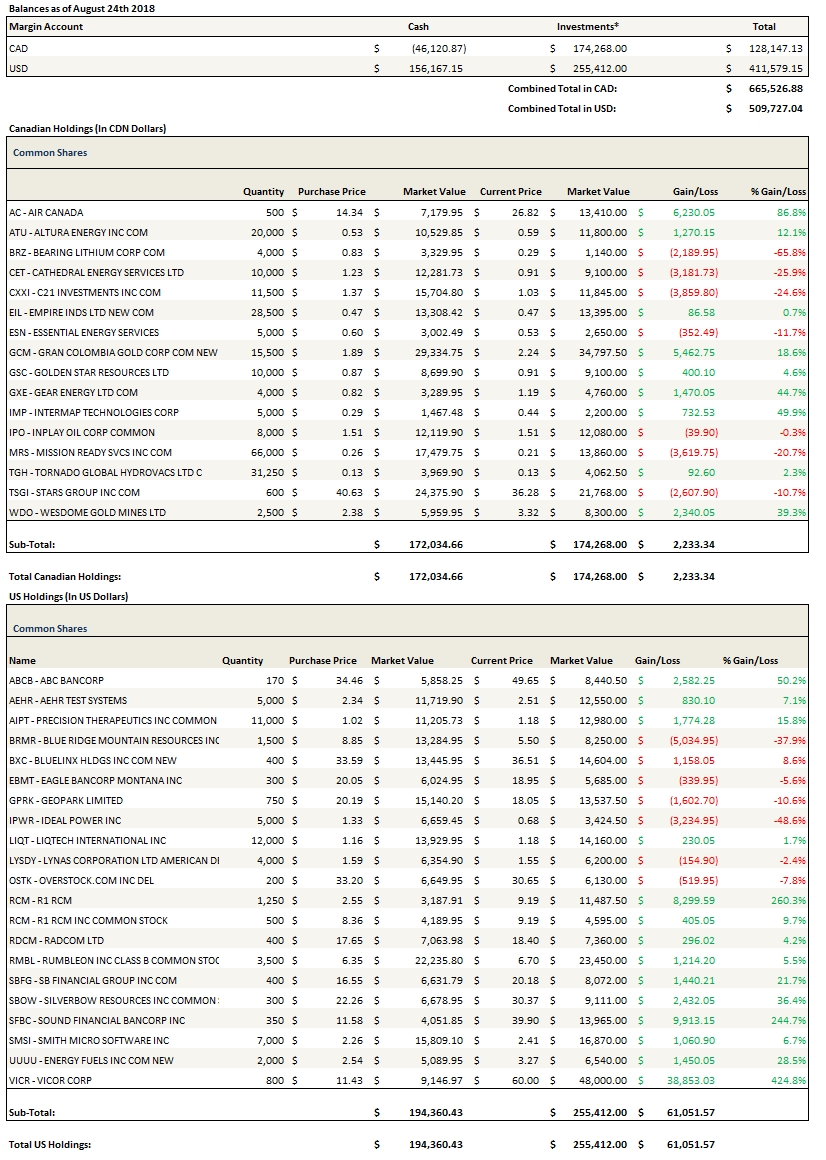
Week 372: Stealth Correction (also updates on Mission Ready, Blue Ridge and Empire Industries)

Portfolio Performance

Thoughts and Review

First off, the portfolio updates in this post are as of August 24th. I’m a little slow getting this out.  So the numbers don’t include what has happened in this last week.

I really got it handed to me in August.  The portfolio was cruising to new highs in July but those were short lived.  Top to bottom I saw a 6% pullback in a little over a month before finally bouncing a couple weeks ago.  Fortunately that bounce has continued this last week so things aren’t as dire any more.

What was funny about the move is that it didn’t feel like things were going that badly.  Usually when I lose 5-6% in a month (this seems to be an annual occurrence for me) I’m tearing my hair out, contemplating throwing the towel in, and generally in a state of disrepair.

Not so this time.  I have been surprisingly unconcerned by the move.

Why have I taken it in stride this time?  Here are a few reasons I can think of.

1. I lost on stocks that I still have conviction in.  Take for example Gran Colombia Gold (which is one of my larger positions).  I’m just not that worried about the move, as painful as it has been.  I’m still up on my position, and it remains cheap with no operating concerns.  I don’t feel like it warrants my worry.  RumbleOn was another (another large position), touching back into the $5’s at various points over that time.  We know what transpired there this last week.

2. I was getting beat up almost entirely by my Canadian stock positions.  Its probably irrational but I don’t worry as much when its my Canadian stocks that are going down.

3. Earnings for most of my positions were pretty good, even if those results weren’t reflected in the stock price.  Vicor was great.  Gran Colombia was stellar.  RumbleOn was fine.  R1 RCM was another stand-out, as was Air Canada.  No complaints.

Anyways it is what it is.  Things have gone better this week.  In the rest of the post I want to talk about 3 stocks in particular and these have turned into rather long excursions.  So I’ll leave any further portfolio comments for another time.

Mission Ready Solutions

Mission Ready has been halted since July 18th.  Nine times out of ten if a stock is on a 6 week halt it wouldn’t be a good thing.  Yet I’m pretty sanguine about the company’s prospects.  The news so far has been pretty good.

The big news happened on July 31st, when Mission Ready signed an LOI to acquire Unifire Inc.  They followed this up with an update on the foreign military agreement on August 2nd.  Then there was another news release August 7th that gave more detail on the foreign military agreement and more detail about the acquisition.  Finally they followed all of this up with a conference call to investors on August 15th.

Having spent some time reviewing Unifire and the deal, I am of the mind that it is a good one.   I am also cautiously optimistic that it will close.  On the conference call the CEO of Unifire was in attendance and spoke at it.  While that doesn’t mean it’s a done deal, his attendance and all the detail provided by Mission Ready points to it being well along.

Here’s the deal.  Mission Ready acquires Unifire for $9 million USD.  The purchase price is comprised of $4 million in cash and 26 million shares (priced at 25c CAD.  They are also taking on at least $6 million of debt (I say at least because Mission Ready didn’t specifically say what Unifire’s total debt was, only that they would be paying back $6 million USD of debt upon close).  With 129 million shares outstanding at $0.25c, $15 million works out to about 50% of the Mission Ready enterprise value.

Unifire is bringing a lot to the table.

As per the first press release Unifire’s “trailing revenue for the 6-month period ending June 30, 2018 was approximately USD$18.3 million”.  Their net income was $750,000 USD.  That’s a lot more than what Mission Ready has (as per the second quarter financials, Mission Ready is running at about $1 million of revenue a quarter).

More importantly, in the second press release (the one where they expanded on the details) Mission Ready pointed out that Unifire was the following:

  • A Department of Defense Prime Vendor.
  • A contract holder for the Defense Logistics Agency (“DLA”) Special Operational Equipment (“SOE”) Tailored Logistic Support (“TLS”) and Fire & Emergency Services Equipment (“FESE”) programs.
  • held “multiple General Services Administration (“GSA”) schedules, blanket purchase agreements and contracts with organizations such as the Department of Homeland Security, the U.S. Army Corps of Engineers, West Point United States Military Academy, Idaho National Laboratories, Hanford Nuclear Facilities, United States Air Force, United States Marines, United States National Guard, United States Navy, and many others”

I dug into this a little bit further.  Turns out that Unifire is actually 1 of only 6 participating vendors from the DLA Troop Support program (from this original Customer Guidelines document issued by the TLS).  Here’s a short list of the types of equipment offered by this program:
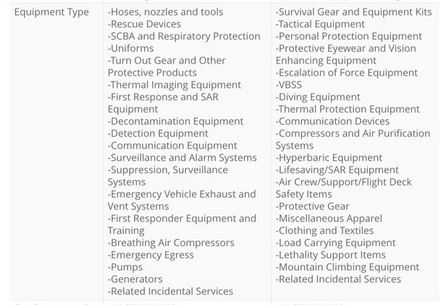
What does being a vendor of this program mean?  It means that if, as a government organization, you want to order one of the 9,000 items covered by the Troop Support Program, you can (I don’t believe the program has mandatory participation but I’m not sure about that) do it through one of these 6 vendors via this program and get subsidized product.

So who would order through the program?  According to ADS, “authorized Department of Defense, Federal Government and other approved Federally-funded agency customers”.

The overall amounts of product involved are significant.  According to this article:

With both being small-business set-asides, and continuations of prior contracts, the first contract will be used to procure special operations equipment (SOE) worth $1 billion per year, and the second will allow for the purchase of a total $985 million in fire & emergency services equipment (F&ESE).

These are big numbers.  So when Mission Ready stated the following in the August 7th news release with respect to Unifire’s justification for entering into the merger, they weren’t kidding:

Unifire has been limited in its ability to secure the initial capital required to facilitate many of the larger solicitations. Mission Ready has identified sources of capital that will enable Unifire to pursue TLS solicitation opportunities on a much larger scale than they have been able to at any point in their 30-year history, thereby creating immediate and significant growth potential.

Unifire has been getting maybe $30-$40 million a year in total revenue.  But its sitting in the enviable position of being 1 of 6 companies participating in a $2 billion program.  The lost opportunity is significant.

That said, Unifire is a significant vendor for the Department of Defense.  Here is Unifire’s revenue from contracts over the past few years (from Govtribe.com).  It seems to mesh up fairly well with Mission Ready’s stated revenue numbers for Unifire:
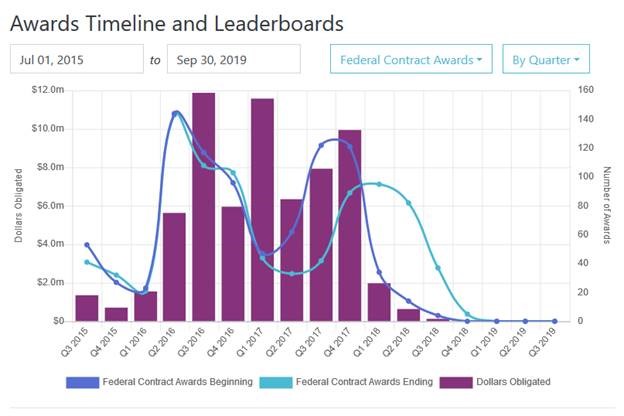
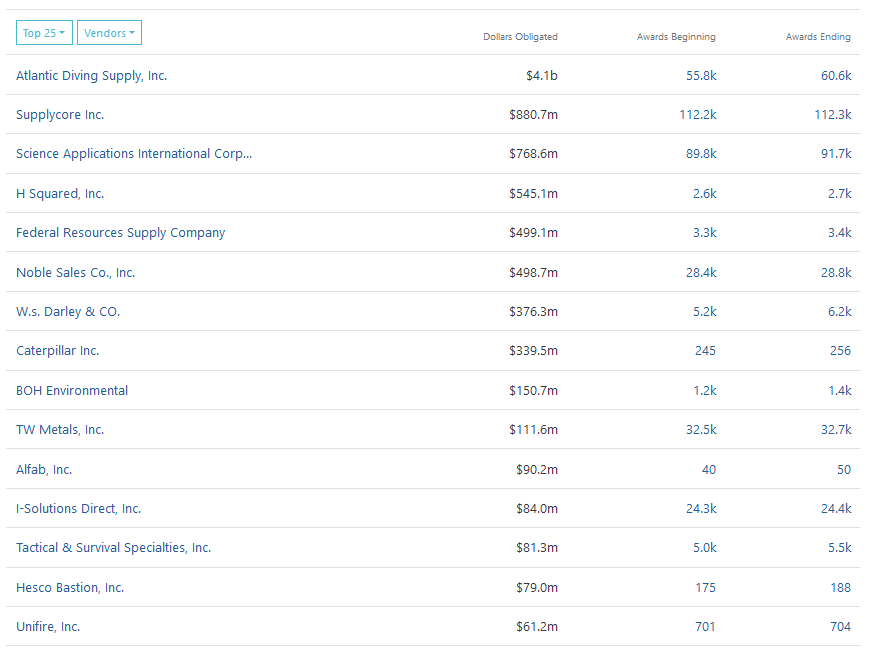
In fact Unifire appears to be the 15th biggest Construction and Equipment vendor with the DOD.
What Mission Ready is apparently bringing to the table is availability of capital.  They are going to raise $15 million USD at 25c [note: it was just pointed out to me that the 25c number wasn’t communicated and there was no pricing specified for the PP.  I could swear I read or heard that number somewhere but maybe I’m getting this mixed up with the Unifire shares.  I’ll have to dig into this].  They are also going to enter into a credit facility of a minimum $20 million USD amount.  The idea is that with the capital, Unifire will have a higher “solicitation readiness” and be able to bid on much more than the $2 million per month that they can right now.

Of course the other thing Mission Ready has is a suite of products that will fit nicely with what Unifire offers, and to which Unifire’s manufacturing capacity can be utilized.  And they also have this massive $400 million LOI with a foreign military that we continue to wait on.

On that matter of the foreign military distribution agreement, it appears the wait will continue.  In the August 2nd press release they explained what we already knew.   They had expected to receive orders by now but that this hasn’t happened and while they expect to still receive orders this year, they really don’t know what to expect any more.

They had more comments on the August 7th news release, which was more upbeat, if not cryptic.  With respect to the foreign military purchase order they said the following:

The Company is working diligently to finalize the Licensing Agreement in advance of the initial purchase order(s) (“Purchase Order” or “Purchase Orders”) and expect to complete the agreement for consideration by all parties no later than August 24, 2018.

You could read into it that they expect of some sort of purchase order soon that they need to get this new agreement in place for?  Maybe?  Bueller?  But who really knows.

Here’s what I do know.  I know that if the LOI for Unifire falls through and no PO comes from the foreign military then this thing is going to be a zero (or at least a “5 center, which is effectively the same thing).

But I also know that if the Unifire deal closes, if Mission Ready closes a $15 million financing and a credit facility of $20 million, if Unifire secures the $100 million of business in the next 18 months that is mentioned as a minimum requirement in the terms of the facility, and if the foreign military PO comes through, this stock is going to have a significantly higher capitalization then the current $25 million (CAD).

Honestly, when I review all the details above, I think the odds are on the latter scenario.

Blue Ridge Mountain

Oh Blue Ridge.  This stock has turned out to be a bit of a disaster.  I bought it at $9 and then at $7 thinking that it could be worth maybe $15 in a relatively short time as they sold the company at a premium.  With the news this week that they are merging with Eclipse Resources that value is likely to be realized over a much longer time period.

I still like the stock and plan to hold my new shares of Eclipse.  But I also recognize that this is a broken thesis.

I think what happened here is two-fold.  First, part of the value in Blue Ridge was in their stake in Eureka midstream, which seemed like it could be valued at $200 million or more itself.  In fact when the company announced the deal to divest their stake in Eureka (back last August), they said that the transaction was valued at between $238 million and $308 million (I’m not going to post the slide that breaks down that value because it has confidential written all over it for some reason).

Well presumably, given that the stock was trading at at $225 million enterprise value before the merger, the market didn’t agree.  The problem was that much of the “value” in the Eureka sale was in the form of fee reductions and the removal of minimum volume commitments (which I don’t believe are going to bring any cash in, though I’m still not sure on this).  So it was different than receiving tangible cash.

The second thing is something I missed originally.  As I wrote about in my original article on Blue Ridge last year, they have a lot of acreage prospective for the Marcellus and Utica.  What I didn’t understand well enough at the time was that much of the acreage in Southern Washington county and northern Pleasant county was outside of what is considered to be the “core” of these plays.  While the step-outs Blue Ridge has had so far have actually been pretty good, there is a lot more work to be done before the acreage gets the sort of value that acres in Monroe, Wetzel or Marshall county get.

I kinda figured this out earlier this year, but by then the stock was in the $6’s, which seemed to more than reflect my new understanding, and honestly even if I wanted to sell it at that level I couldn’t have given the illiquidity.

Well now with the Eclipse merger there is liquidity.  I think what you saw in the subsequent days was a lot of the bond funds that had picked up the stock in bankruptcy and who were now stuck with equity (which could very well be outside of their mandate) selling Eclipse in order to neutralize their Blue Ridge position and effectively get out of the stock.

That this seems to have waned on Friday, in particular given a pretty rough Stifel report on Eclipse, is likely a good sign.

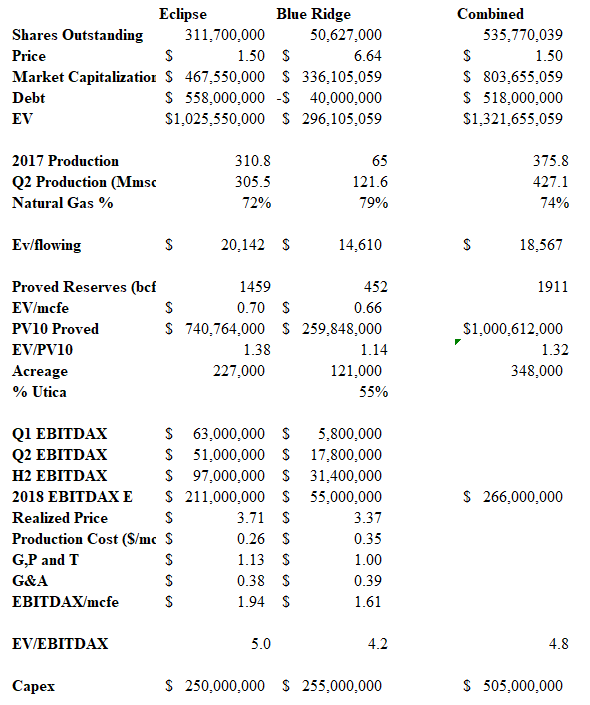
My take is that the combined entity is not expensive.  Here is a little table I put together of what the individual parts and the new Eclipse looks like (my $6.64 for Blue Ridge is based on the conversion of Eclipse at $1.50 per share):

If you look at the comps, the combined Eclipse doesn’t stack up too badly.  5x EBITDA for a company anticipated to grow 20% in 2019 is probably a little cheap compared to peers.

Peer comparisons are hard though because there aren’t a lot of smaller, all natural gas, players in the Marcellus/Utica.  From what I can see its dominated by big companies like Range, Southwestern and EQT.  These companies are 10x the size or more.  They generally trade at higher multiples but that isn’t necessarily instructive.  The smaller “peers” are more oil weighted and in other basins.

So what do I conclude?  I’m going to stick with Blue Ridge/Eclipse because A. it’s not expensive, B. the Blue Ridge management team is leading the combined entity has done a good job operationally with Blue Ridge, C. There is a lot of undeveloped acres between the two companies and if they can prove up even a fraction of them the stock price should reflect that, and D. this is a nice way to play the upside option on natural gas.

But it didn’t turn out the way I expected.

Empire Industries

Empire announced second quarter results on August 27th.  It was another “meh” quarter.  But patiently I wait.

The reality is that Empire has been a perpetual “just wait till next quarter” story since last September when they announced the co-venture partnerships.  They have an incredible backlog of business.  Contract backlog as of June 30, 2018 was $280 million.  The co-ventures have a tonne of promise.  But neither the backlog or the co-ventures have translated into results yet.

They continue to struggle to turn the backlog into profits.  In the second quarter gross margins reversed (again) to 16.7% from 19.6% in the first quarter.  Remember that the magic number the company has said they should be able to achieve is 25%.

The problem has been the continued work through of three first generation rides that are being built at very little margin.  In fact the company said on the conference call that these contracts contributed no margin in the second quarter.  I had hoped that by the second quarter we would see the impact of these essentially unprofitable contracts abate.  But that wasn’t the case.

I talked with investor relations about this and it appears that in the third quarter we should see less of an impact.  But whether this means 22% margins or 18% margins is anyone’s guess.

Management also seem to recognize that their cost structure just isn’t low enough right now.  Part of the problem appears to be that they operate much of their manufacturing out of Vancouver.  They hinted that there are going to be changes in this regard in the next few months.

One of the key opportunities was how rapidly the growth — the market was growing, but with this growth came an increasingly apparent need to improve our cost competitiveness to capitalize on this growth. As a result, Empire has undertaken an aggressive action plan to reduce its cost structure, as described in detail on previous calls by Hao Wang, President and Chief Operating Officer of Dynamic Attractions, a wholly owned subsidiary and the primary business unit for Empire…The organization-wide cost-reduction initiative is well underway, reducing our headcount and fixed costs. Furthermore, we’ve identified and implemented design, procurement and production efficiencies that can improve our execution capabilities and our financial results.

They went on to say that “margin expansion is a top priority”.  This is a good thing because it’s crazy to be letting this backlog pass without making any money from it.

The other piece is expansion.  Again they touched on this (“we’re actively looking at innovative ways to increase our production capacity”) in the second quarter call.  It’s clear that right now they are capacity constrained. For instance, the backlog has essentially doubled over the last year and a half and yet the quarterly revenue is pretty much the same.  Its nice to have a backlog that extends out 3 years but it would be nicer if they could grow revenue a bit.

And then there is the co-ventures.  Nothing to announce but still on-track to be announced this year.

Just to recap the co-ventures, last August Empire announced the creation of two co-venture attractions companies.  The intent of these companies were to partner with “tourist-based locations” to co-own and operate Flying Theatre rides.  One of the companies, called Dynamic Entertainment Group (DEGL), would partner with US locations, while the other, called Dynamic Technology Shanghai (DTHK), would partner in Asia (China most likely).

It was a complicated structure with a rights offering (at 50c) and a private placement to their Shanghai partner Excellence Raise Overseas (EROL) also at 50c.

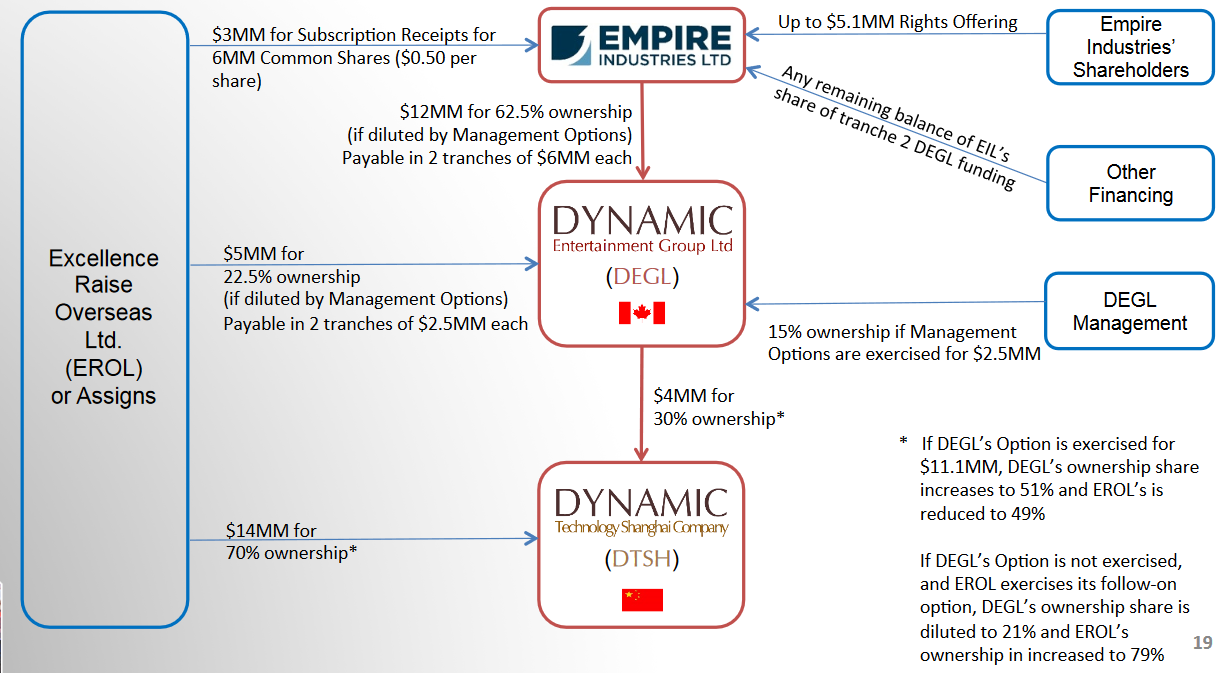
In total Empire invested $12 million in the ventures.  They own 62.5% of DEGL and (I think) 22% of DTHK.  The ownership in DTHK is via DEGL, which is makes things complicated.  The other 28% of DEGL and 78% of DTHK is owned by their partner EROL.  EROL and Empire invested at the same valuation.  Got that?

This somewhat ridiculously complicated ownership structure can be summed up with the following graphic (from the September 2017 presentation):
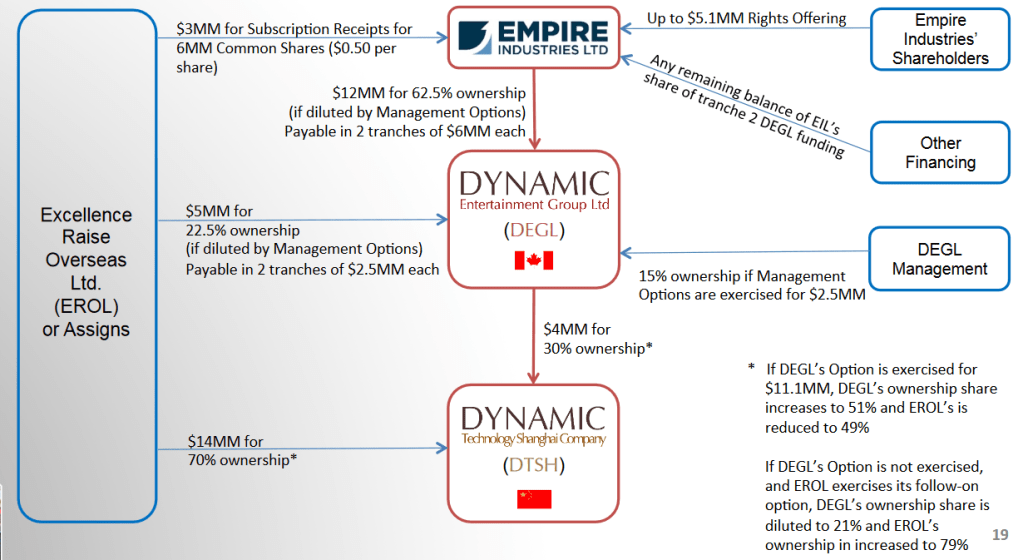
At the end of the day Empire gets to own 63% of a venture that will build and operate attractions in the United States and about 20% of a venture that will do the same in China.  Empire also gets to build the attractions that these ventures market.  Originally this was going to be at a low margin of 15% but given the recent results that margin is looking to be pretty much right in line <rolls eyes>.

Way back when the venture opportunity was finalized I was able to dig up more information on the economics of the attractions business.  First, I found information on the economics of what appears to be a fairly similar existing ride called FlyOver Canada.  The attraction is part of Canada place in Vancouver.  Flyover Canada is a virtual flight ride experience.  Its also owned by a public company named Viad, so unlike every other attraction I read about, there is actually publicly available information about its performance. Here is a quick summary from the 2016 Viad 10-K:

Flyover Canada showcases some of Canada’s most awe-inspiring scenery from coast to coast. The state-of-the-art, multi-sensory experience combines motion seating, spectacular media, and special effects including wind, scents, and mist, to provide a true flying experience for guests. FlyOver Canada is ideally located in downtown Vancouver, Canada. FlyOver Canada is rated by Trip Advisor as the #1 “Fun & Games in Vancouver” and has been awarded with the Trip Advisor Certificate of Excellence.

Flyover Canada is essentially a flying theater, which is the exact same attraction that Empire is looking to co-venture.  Empire has built numerous flying theaters in the past and references a number of them on their website’s Flying Theatre description.  It doesn’t appear that Empire built Flyover Canada (it was a competitor Brogent) but they did build Flyover Italy, Soaring over California, and Soaring, a Florida attraction.

Viad purchased Flyover Canada from Fort Capital at the end of 2016.   According to the Fort Capital press release at the time of the sale, the purchase prices was $69 million Canadian (remember if all goes well Empire and its ~$50 million market capitalization is going to own 63% of one of these in the US and 20% of another in China).  Flyover Canada had 600,000 guests and generated $11 million in 2016, so it’s a $20 a pop ride.  In their 2016 10-K Viad gave the following 2017 forecast for FlyOver Canada:

FlyOver Canada is expected to contribute incremental revenue of $9 million to $10 million with Adjusted Segment EBITDA of $5 million to $5.5 million.

The numbers are in US dollars.  Flyover Canada ended up doing $10 million of revenue in 2017, and though there was no EBITDA breakdown I have to assume it was close to expectations.  So it’s margins of 50%+

At the time I talked to IR about the opportunity.  The information I got was that depending on the size of the ride, revenue would be around $8-$14 million USD per year depending on the size.  Margins on the ride would be around 50%. A smaller ride would cost $10 million to $12 million to build, while a larger attraction would cost $18 million.  So these numbers are all pretty much inline with Flyover Canada.

The idea was (and is) that net to Empire’s 60% ownership, and assuming a split with a landowner, they should get somewhere between $3 million to $4 million of recurring EBITDA (CAD) out of the US deal.  I didn’t get any information on the Chinese opportunity.

Empire (via Dynamic Entertainment Group) would partner on the attraction with a landowner in a tourist destination.  The deal would be structured so that Empire got a preferential return until the cost of the ride is paid off.  Empire would make 10-15% margins on the design and construction of the attraction as per their contract with DEGL.  There is also a $3 million subsidy for developing creative content in Canada which would reduce the overall manufacturing cost to $7-$9 million.

The expectation was that the EBITDA should get a multiple of 10x.  Viad bought FlyOver Canada for about that multiple.  Again, if Empire got a 10x multiple on $3 million of EBITDA, that would eat up much of the current capitalization right there.

Overall, it’s always seemed like a decent venture for Empire once it gets off the ground.  The company invested $12.1 million via $8 million in equity and $4 million in debt.  In return they would eventually get the $2-$4 million of recurring EBITDA from the US venture, add two near-term attractions to their construction backlog (one for the US and one for China), and get some additional EBITDA (I don’t know how much) from the Chinese venture.

Of course like everything else with Empire this is a waiting game.  On the call they said “Before the end of the year, we expect to announce our first co-venture location. We expect to have an opening sometime in 2019”.  Hopefully we get an announcement soon.

Portfolio Composition

Click here for the last six weeks of trades.  Note that this is August 24th, so I’m a week behind here.