Skip to content

Posts from the ‘Portfolio’ Category

Week 53: Betting on a Housing Bottom

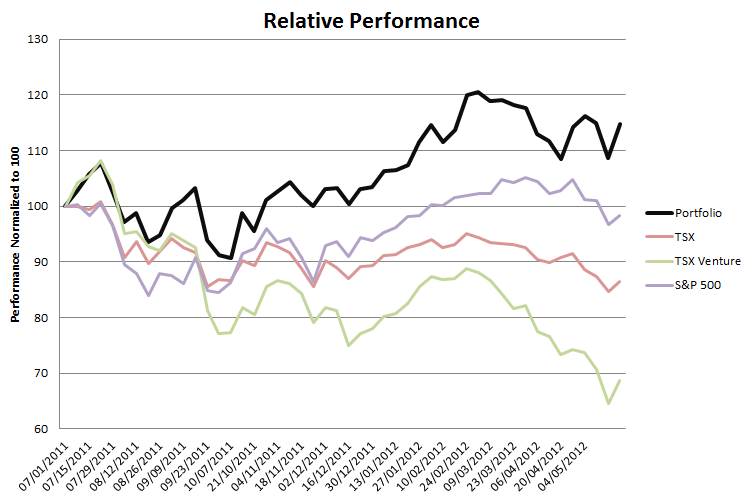
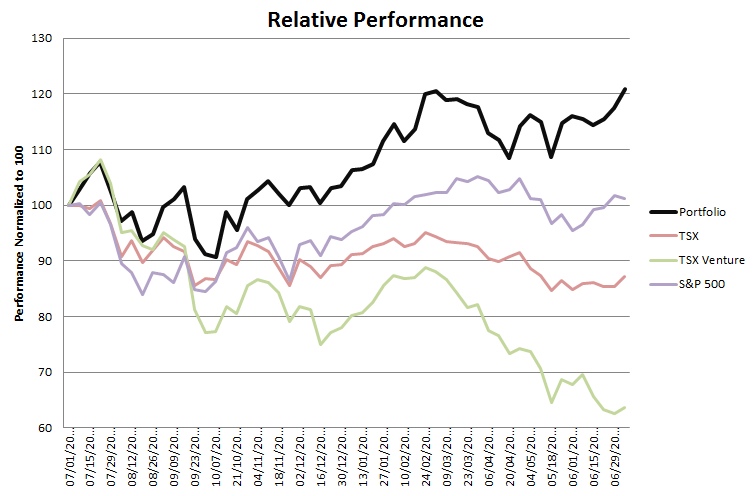
Portfolio Performance
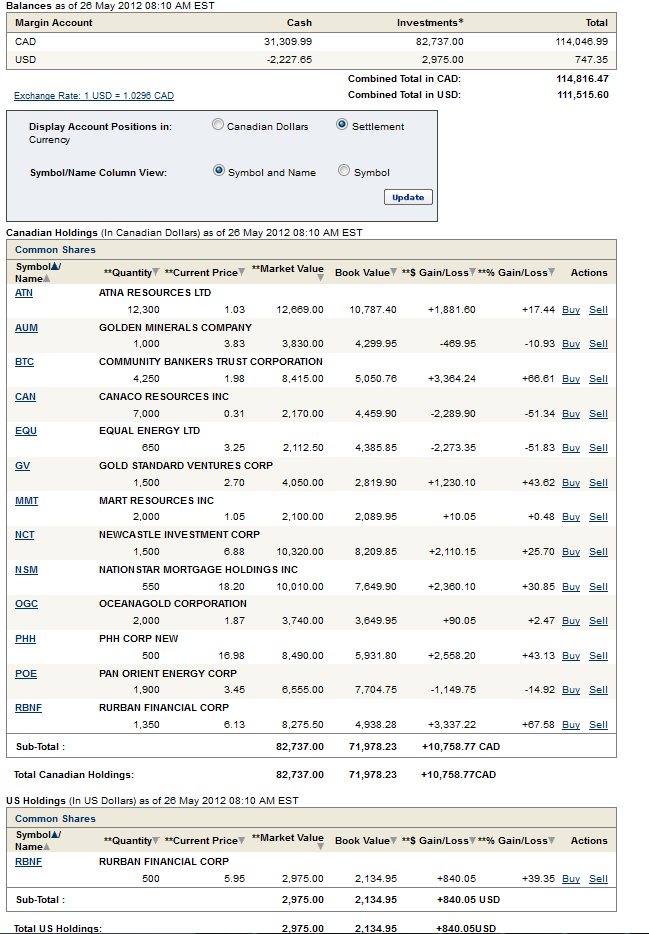
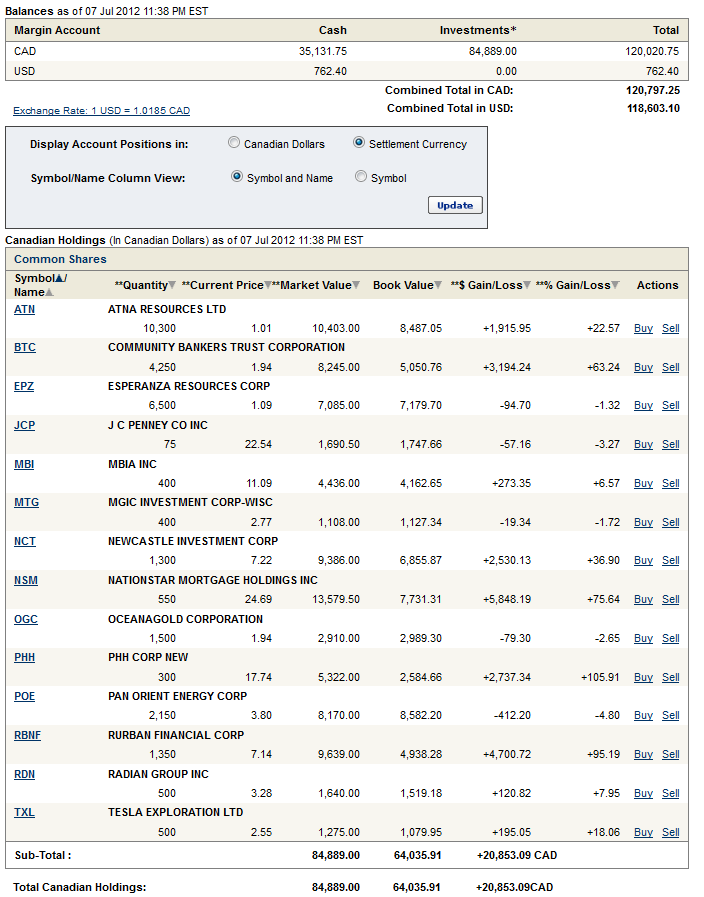
Portfolio Composition
 

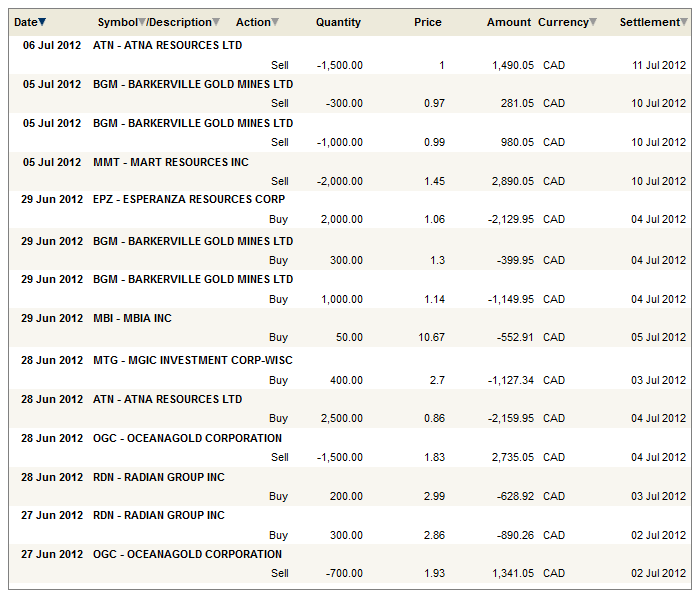
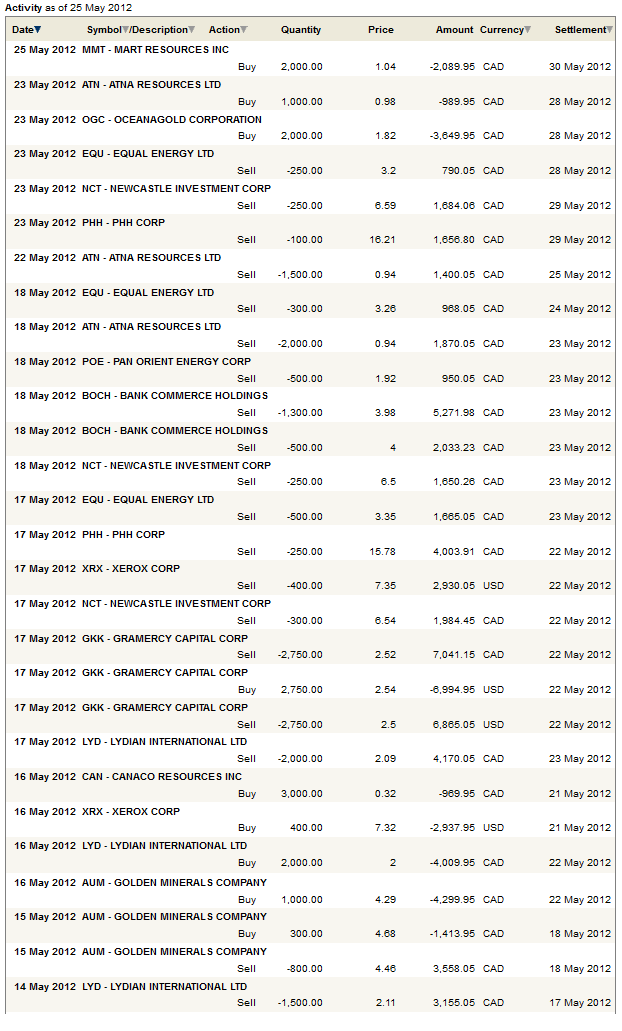
The trades that took place in the last two weeks can be viewed here.

Summary of Portfolio

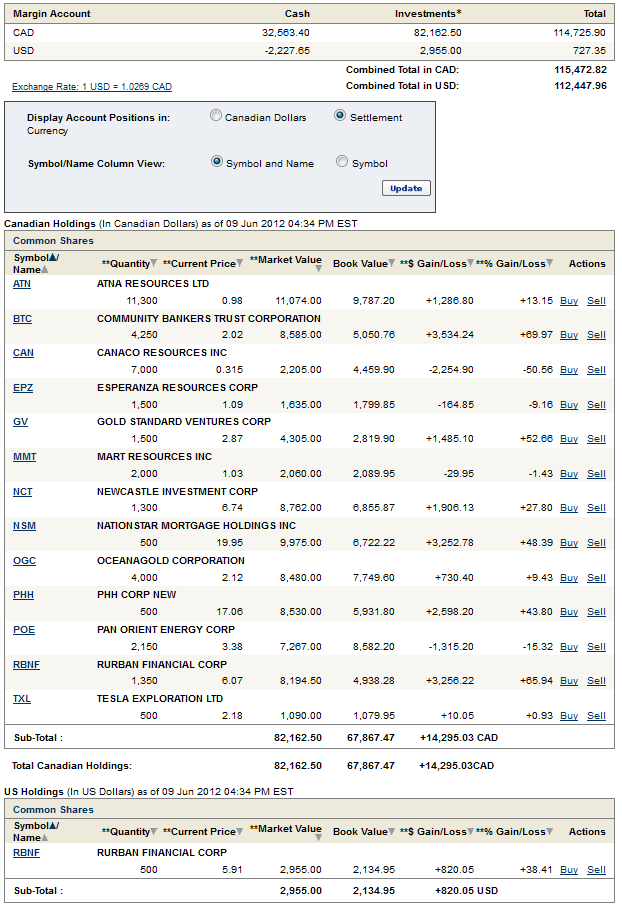
There were a couple of positions that had big moves over the last few weeks.  The first is Nationstar Mortgage Holdings (NSM).  Nationstar is now more than a double from my original purchase and up over 75% for the entire position.  Both Nationstar and Newcastle Investments (NCT) have been strong of late, and I think that’s likely due to the expectation that they will win the ResCap bidding war.  According to an 8-K filing that Nationstar made on Thursday, their bid for ResCap was raised $125M. At this point the risk is that they don’t win the bid and that the stock falls back.  However, I bought the stock well before the Rescap sale and I still believe that there is some upside even ignoring Rescap.  Even without the Rescap deal, Nationstar has grown substantially through the purchase of the Aurora portfolio and Bank of America’s servicing assets. I’m reluctant to sell any shares yet.

Another stock that has had quite a run is Rurban Financial (RBNF).  The last time that I talked about Rurban was mid-May, and I haven’t mentioned them since because, well, nothing has happened.  The stock is boring and goes up. I like that.  However if you had asked me back when the stock was $5 when I would consider selling I probably would have said around $8.  We are getting close to that number now.

As I wrote about earlier this week, I added positions in two monolines, Radian Group (RDN) and MGIC (MTG).  Of the two, I am most inclined to add to Radian on any pull back.  I’ve been reading whatever I can get my hands on about the mortgage insurance industry over the last week and I think I have wrapped my head around most of it.  The regulatory landscape is really quite mind-boggling, the changes that have taken place since 2008 quite tectonic and there are about a million acronyms used with many of their definitions not easily found.

Nevertheless, out of chaos come opportunity.

I really like what I see in the insurers; the leverage to a housing bottom (just a bottom, not a barn-burning recovery), the cheap price (close to being priced for bankruptcy),  insuring what are probably some of the best quality mortgages they have ever insured, margins increasing as their government owned competition, the Federal Housing Authority (FHA) raises their prices in an attempt to limit the government market share, and the insurers stand to benefit from the general stance that seems to have evolved that government should limit their role in the housing industry and that private insurance should take more of a role.

What holds me back from making these insurers larger positions is the economy itself.  A recession would not be good for housing.  Nevertheless, I am somewhat emboldened by the fact that the stocks I own that are dependent on the US economy (in addition to those discussed already I would put Community Bankers Trust (BTC) , MBIA (MBI) and PHH Corp (PHH) into this bucket as well) have held up quite well in this latest downdraft.

What I sold

I sold Mart Resources (CA:MMT) this week (note that while I sold the stock in the portfolio I track here, I do still own a position in other portfolios).  When I originally bought Mart four weeks ago I wrote the following

The company has two news events that I suspect are going to occur shortly.  The first is the potential for an announcement of a dividend.  I believe that such an announcement could result in a significant pop in the stock, as it gives credibility to what is otherwise looked on warily as a Nigerian story.  The second is a pipeline deal with Shell, which would allow Mart to increase their production, perhaps substantially, and allow the brokerages that follow the story to up their targets based on larger 2013 volumes.  Again, I am looking for an event to occur in somewhat short order, but I am not holding this stock for the long run.

Mart released news earlier this week that they were going to provide a quarterly dividend of 5 cents a share and a special dividend of 10 cents.  They announced the pipeline deal  a week before that.  The stock is still cheap; it trades at maybe 4x cash flow (which does not consider the production expansion that will come in the next year) and at a rather silly 14% yield.  I’ll probably buy back in at some point, maybe even soon.  I just don’t love the way the market is behaving, in particular the way that Spanish bonds have jumped back to nearly 7% and so I am reluctant to .  I also don’t rally buy this oil rally; it seems prefaced on Middle East tensions and that is fickle mate.  Mart, having moved so much higher so fast, seems like it would be likely candidate for portfolio trimming if oil drops again below $80.  I’ll wait this out and see what happens over the next couple of weeks.

I sold some OceanaGold (CA:OGC) in the last two weeks.  Part of what I sold was because I thought that Atna Resources (CA:ATN) had gotten too cheap again at $0.85 and so I moved money from OceanaGold to Atna.  I have also been researching Esperanza Resources (CA:EPZ) and I thought that they, having been hit from selling after a share offering but now having plenty of cash and owning my preferred heap leach deposit that will be low capital expenditures and low cash costs, were in a better position in this uncertain environment.  The other reason behind the selling was that these gold stocks just aren’t working.  The jobs report on Friday should have sent gold flying, but it didn’t.  The thesis I have expected isn’t playing out.  Whether that is because the Rupee is so low that Indian demand is sluggish, because investors aren’t willing to think of gold as a safehaven just yet, or because there is a nefarious plot to undermine gold being played out in smoky dim lit rooms on the outskirts of Washington, the bottomline is that it hasn’t been working.   And I always try to do more of what works and less of what doesn’t.

Finally, my adventures with Barkerville ended on Thursday when I sold out.  The deciding factors were that the stock wasn’t behaving like a stock should if it truly had a 10 million ounce deposit (though the alternative explanation that the weakness is being caused by warrant holders cashing out could be contributing), and that the data that is available from the company just doesn’t look like 10 million ounce material (if you look at the 7 sections that Barkerville has on their website, it looks like Cow Mountain has a number of narrow (albeit potentially high grade) veins. It also looks like the veins are somewhat sparsely populated across the length of the intercepts.

I honestly have no idea what Barkerville does or doesn’t have and so I have decided to make discretion the better part of valor until such time that I do.
Week 49 Update: Hedged Bets

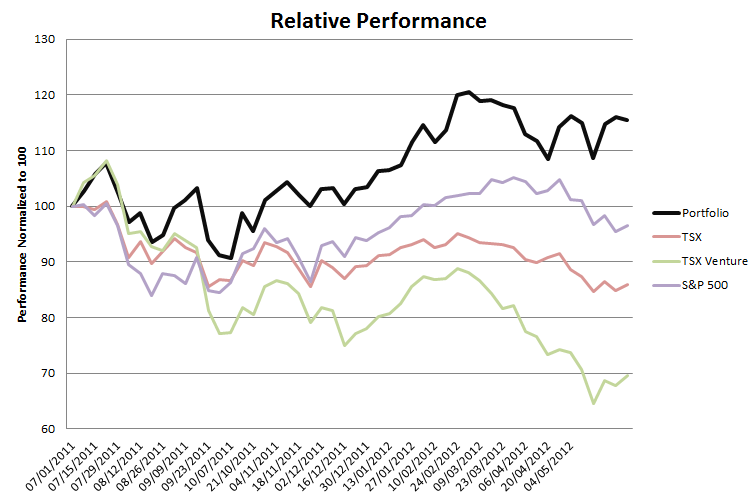
Portfolio Performance

Portfolio Composition

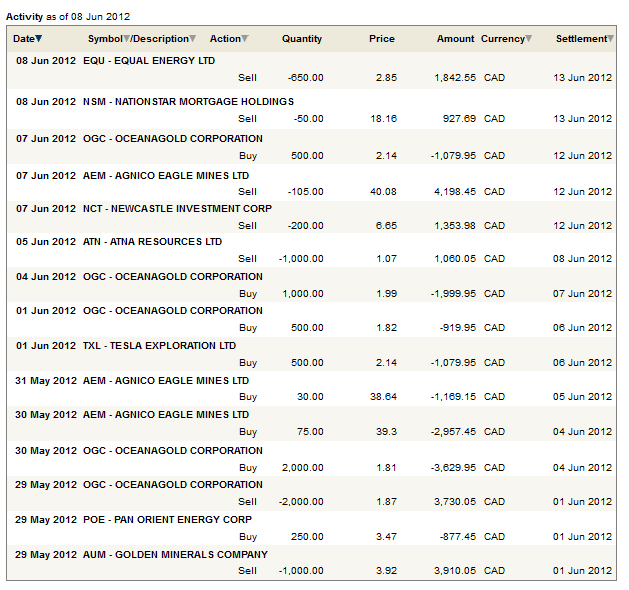
For the last two weeks of trades, click here.

With the news this weekend that Spain will receive E100B to help recapitalize its banks, one has to think that the markets will open higher on Monday.  However whether these gains can hold is an open question.  One hundred billion euros hardly fixes Spain.  It won’t bring down unemployment, or plug the budget deficit.   It will do nothing to help persuade the Greeks to stay in the EU.  All the problems that existed on Friday still exist.  But now the Spanish banks have more capital.

My strategy for almost a year now has been that with regards to the Eurozone, it is best to sell first and ask questions later.  What I realized from living through 2008 is that no one, or at least very few, can predict the consequences of a major shock to the financial system.  I come back to the point that I have made before that in 2008 it took  for two days after Lehman for the markets to begin to react to what the bankruptcy had unleashed.  It was not anticipated.  The consequences of systemic shocks are not at all clear beforehand.

Some would say  that I am fighting the last war with my fears.  They might be right.  But I have yet to hear a pervasive argument as to why what is happening in Europe will definitely not create a systemic shock at some point.  There are plenty of arguments as to why it should not.  Greece is too small.  Money managers and banks have known about it for a year.  The banks have been capitalized through the LTRO (and now the Spanish bailout).  The problem with these arguments is that they deal with the knowns, and the problem with a financial shock is with the unknowns.    Moreover, there are very intelligent people, like the Michael Novogratz interview I posted, that believe the consequence of a Greek departure is an open question.

Staying Small

My response to the uncertainty has been to  get smaller.  I was smaller throughout the second half of 2011.  When the LTRO led to a rally in stocks, I briefly got bigger again.  This was, perhaps, a mistake.  As I wrote in early January I didn’t believe that the effects of the LTRO would be much beyond the short term liquidity it provided.  Yet I got caught up in the mini-bull that occured from January to March and took on more risk.  The lastmonth and a half has been about taking that risk back off.

As an individual investor the primary advantage that I have is that there are no expectations of performance.  I do not have to outperform the benchmarks and no one will be taking away the money I manage or my job if I don’t.  The consequence is that the only thing keeping me from derisking in an uncertain environment is my own psychology.  If I can warm up to the perspective that it is ok for others to make money while I am not for a time then there is nothing to prevent me from getting out and waiting it out until a time when the game appears to be more clear.

Its that last point that can be tough to follow.  When markets are rallying and I am sitting in 30% cash, it can be difficult to swallow.  Monday will undoubtedly be frustrating. Stocks I have pared back on will rally, and stocks I have not bought yet will be bid up further.

There are a number of companies I have been looking seriously at in the last couple of weeks, but that I am waiting to pull the trigger on until at least the Greek election has past.  Xerox, AIG, MBIA are all companies I think will do well in the coming months.  I just want to buy them at a lower price.

Waiting for a lower price is perhaps the most difficult thing to do with investing.  But I don’t see the resolution in Spain as a lasting solution to the greater problems of either that country or of Europe as a whole.  It certainly does nothing to remove the risk of a Greece exit.  Until that risk begins to diminish, either from an exit or an integration, I am reluctant to take on too much risk myself.

And so it is that I plan to sit on my 30% cash position.  Staying small.

Week 47 Update: When in doubt – Get Small

Portfolio Performance

Portfolio Composition


For the last two weeks of moves, click here.

Letting Go…

The occupation of investing is really one of evaluating risk.  If you run a large institutional fund or a hedge fund or some other large sum of money, you perform this evaluation on a formal basis, giving its conclusions a formal sounding name like risk adjusted return or something of the like.  If you are an individual investor your process is much more informal, your conclusions are often not written down (though a blog helps in this respect), but nevertheless you are continually going through the same basic process of evaluating the potential risk against its potential return.

I try to eliminate risk through exhaustive research of the companies I invest in.  That elimination process involves getting up at five in the morning on weekends and spending hours readings through 10-Q reports and MD&A’s. It involves staying up late on week nights listening to conference calls and reading industry publications.  All this effort is done in the attempt to understand what makes each particular business tick, and to understand if the fundamentals of that business are improving in such a way that value is about to be realized.

I find this to be time well spent.  On the one hand I enjoy the investigative process.  On the other, it is profitable.  I am often able to narrow my focus to sectors that should experience positive fundamentals, and then to further narrow my focus to companies within those sectors that have competent management teams and solid assets that can deliver on a consistent basis.  Whether the sector is mining or mortgages, paper or potash, banking or bitumen, it makes little difference to me.  Given the time I can understand the business and develop a thesis to invest or not, and more often than not I am right.

In the 1990s and in the early part of this decade that was all you needed to do to consistently beat the market.  You could do the work, pick good companies, understand the industry trends and wait for it to play out.  It was a simple time.

Nowadays however, following that recipe in a vaccuum can you leave you without a leg to stand.  The market today is analogous to playing a hand of cards where within the deck lies a single trump card that if played automatically will lose the hand for you.  You can manage the cards you are dealt the best you can, do your darnest to evaluate the probabilities and make the best risk adjusted decision, but if that trump card is played you will lose it all.

That trump card was the US banking system in 2008 and it is the European sovereign system now.  In either case the details differ, but the trump-like nature is essentially the same.  The risk is systemic, the probability of that risk occuring is unknown, the outcomes of that risk impossible to quantify.  Whenever you play a hand in the market these days you put yourself in danger of the consequences that the risk happens to be realized while your money is still on the table.

Because this is a risk that is so difficult, perhaps impossible, to understand, there is no way to hedge against it.  I have yet to hear anyone, expert or otherwise, offer up a coherent and definitive conclusion on what to expect if Greece exists the Euro.  Do markets open down 10% and continue to fall? Is it a non-event and an opportunity to buy?  Is Greece this years Bear Stearns, to be followed by a few months of a false reprieve before the big one hits, perhaps it being Spain that takes on the role of Lehman this time around.

There was an excellent conference call held by Donald Coxe this week.  During the call Coxe laid out the situation in Europe as well as anyone has.  It appears to be coming to a head.  More and more what we are seeing is that people, organizations and banks are making adjustments on the assumption that the Eurozone will not hold.  Banks in the Eurozone are frantically trying to tie their loans to countries that may be forced to leave by getting financing from within those countries rather than abroad.  Assuming there is an exit, the potential for a true global financial crisis is great if it is not an orderly one.  Along with that would very likely come a global recession.

While it is not clear whether Greece will leave this week, next week or next month, it has become more clear that they will indeed leave eventually.

What is unclear is how such an event will ripple through the system.  To provide a few examples, consider the following:

  1. Right now the Eurozone countries run deficits with one another.  Primarily Germany runs massive surpluses against southern periphery deficits.  These imbalances are currently tallied in something called the TARGET2 mechanism.  Target2 is essentially a way of transferring funds to countries (like Greece and Spain) that are running current account deficits so that those countries don’t run out of money.  As long as all the countries are in the Eurozone these liabilities are just a paper trail between the individual Euro nation central banks and the ECB.  However if a country with a large Target2 liability leaves the Eurozone, suddenly that liability needs to be paid back (the ultimate owner of the liability is the ECB).  But will it be paid back?  If it isn’t the ECB will take a big hit to its capital, potentially one that is big enough to cause the Central Bank to run out of capital completely.  What happens when a Central Bank runs out of capital?  I don’t think anyone really knows.  Without a doubt it will be damning to confidence at the least.
  2. What exactly is going to happen to Greece (or a little later, to Spain) if they leave the Euro and stop receiving funding from the rest of the Eurozone?  The reason Greece is able to make basic payments such as salaries, pensions, drug and medical benefits, is because of the inflow of money from outside the country.  If that inflow stops, what happens to the country?  Does it devolve from borderline chaos to complete chaos?  You have to wonder.
  3. There are pension funds and insurance companies and other large entities that perform basic public services that likely have large balances of periphery debt.  I was listening to the Goldman Sachs Insurance conference before bed last night.  William Berkley, who is the CEO of the William Berkley Corporation, gave a fascinating talk about the industry.  Most interesting perhaps is that Berkley believes that the biggest source of upside in the insurance industry over the next 24 months is likely to come from the failure of one or more of the large insurance giants in Europe.  He gave it a 50/50 chance of happening.  The reason he expects it to happen is because he is fairly certain that these companies are holding the bag on a large amount of peripheral sovereign and corporate debt.  If this doesn’t scare you, it should.  While 2008 began with the crisis of Lehman, it was amplified and extended by the crisis of the insurer AIG.  Had AIG not been dealt with, that crisis could have been far worse.
  4. What will bond holders of Spanish, Portugese, and Irish debt do in response?  You always have to remember that, as Donald Coxe has described, the situation is existential.  What that means is that the perception of weakness is weakness, and it will breed weakness.  Will a Greek exit destroy the perception of Spain to such a degree that it becomes inevitable they will leave to?  Do Spanish bond rates skyrocket in response?

Look, I am not an expert on the Eurozone or the consequences of a break-up.   I’m just throwing out these ideas to highlight the complexity of situation and to illustrate how it is basically impossible for any of us to make a legitimate assessment of it.  What it means to our investments is anybody’s guess.

Lighten Up

All I think I can do in a situation like this is to get smaller.  Take on less risk, don’t take too many chances, wait for it to play out one way or another before wading in too far.  Remember that even after Lehman went bankrupt, it took a few days for the market to recognize the consequences that were about to be felt.  I don’t think this was because the market was ignoring those consequences so much as that no one really knew what they were until they started to happen.  Same considerations this time around.   It could be Y2K all over again.  It could be Lehman all over again.  We will just have to wait and see.

As an individual investor you are at many disadvantages.  You don’t have access to the research, you don’t have access to the capital, you don’t have the range of strategic alternatives (hedging, taxes, etc) that a larger investor would be privy too. But the one advantage that you have as an individual investor is your ability to act quickly and to the extreme.  A mutual fund, pension fund or hedge fund would have a lot of difficulty going to all cash, both from a logistical and a performance perspective.  As an individual you answer to no one but yourself.  You generally can cash out with little to no movement of the underlying stock price.  If things get hairy, you have a legitimate choice as to whether or not to wait it out until they aren’t anymore.

Such is even more the case for my particular circumstance.  The reality of chasing above market returns is that I am constantly venturing into areas that are volatile.  Such is the case with gold stocks, oil stocks, even to an extent with the mortgage servicing stocks and smaller banks.  These companies trade up and down to a greater extent than the market.  Whether the fundamentals dictate it or not they will move down hard if the general market moves down.  There is no amount of analysis  that I can do to mitigate or prevent this.  I can only accept this consequence as the likely reality, and plan accordingly.

I completely sold out of Gramercy Capital, Bank of Commerce Holdings, and Shore Bancshares in the last two weeks.  I lightened up on the rest of my holdings by 10-20%.  I ended this week with a little less than 30% cash.  I plan to raise that cash level to 50% in the next week or two.

I would have an even higher cash level already, except that I have also entered into two short term positions as well.  OceanaGold and Mart Resources.  My thesis for OceanaGold is that the situation for the gold stocks appears to be turning.  There have been a number of days where the stocks have outperformed the bullion, and there was even one day were gold was down substantially while many of the large cap mining stocks were up.  This appears to me to be the start of something.  OceanaGold remains one of the cheapest gold producers out there.  It is by no means the most efficient producer, and thus it has also been beaten down substantially during this bear market in gold shares.  I bought some shares at $1.80 simply on the notion that if this is a turn in gold stocks, OceanaGold should see some outsized gains as it recovers the ground it lost.  If gold weakens further or if the gold stocks resume their downward trend, I will bail quickly.

Mart Resources is purely an event driven purchase.  I own Mart in another broker managed account already and so I follow the story closely, but have never owned it in the account I track here so I don’t talk about it much.  The company has two news events that I suspect are going to occur shortly.  The first is the potential for an announcement of a dividend.  I believe that such an announcement could result in a significant pop in the stock, as it gives credibility to what is otherwise looked on warily as a Nigerian story.  The second is a pipeline deal with Shell, which would allow Mart to increase their production, perhaps substantially, and allow the brokerages that follow the story to up their targets based on larger 2013 volumes.  Again, I am looking for an event to occur in somewhat short order, but I am not holding this stock for the long run.  If the events in Greece take a turn for the worse, I plan to cut and run.

I come back to the quote I gave last week from Peter Bernstein.  I think this is something worth repeating at a time like this:

The trick is not to be the hottest stock-picker, the winning forecaster, or the developer of the neatest model; such victories are transient. The trick is to survive.

We live in impossible to understand times.  You have to accept your own limits of knowledge and simply walk away from the table.  Will I miss opportunities by having such a high level of cash?  Quite possibly.  But you can’t chase shadows.  You have be a prudent manager of risk.

Its a Shitty Time to be a Stock Picker

I find picking stocks to be a lot of fun.  I run through numbers and sleuth out scenarios and wrap my head around business models, all in an attempt to predict the future and find that golden opportunity. I enjoy making spreadsheets and flow diagrams and all the other tools that I use to figure out how a business works.

There are few things as exhilarating as when you find an oportunity.  When you run through a 10-K or an MD&A and the light goes on and you are like, holy crap, hasn’t anyone else figured this out?  So you run the numbers again and read through all the releases again and you sit back in your chair and stare at the screen and say to yourself, “this is a gift.”

That’s good stuff and that is what makes the work worthwhile.

What is frustrating is when you do all the work, have confidence in what stocks should work well in the future, and none of it matters.

And that is where we are today.

On Friday I spent a few hours pouring over the Nationstar Mortgage Holding 10-Q filing.  The company is a no-brainer.  They are going to earn $3+ this year, maybe much more than that.  Being a recent IPO offering, the market has only started to realize they exist, and so they trade at $17, when if you ask me they are worth $25+.

Earlier in the week I looked at Xerox.   A beaten down situation, trading near the 52-week low, at a multiple of less than 8x forward earnings.  Perfect stock to sock away and wait for it to get back into double digits.

This morning I listened to the Atna Resources conference call.  They are on target with Pinson.  The operational efficiencies they introduced at Briggs have started to pay dividends in the way of lower costs, and I think we will see further cost reductions going forward.  The stock is trading at less than 2x what they will cash flow next year once Pinson is up and running.

Three great opportunities.  Each would be solid bet.

But because of Europe, I feel foolish to bet too much on anything.  I have to get smaller and smaller because no one really knows what is coming next.

I listened and read everything I could find on Europe last week.  No one really knows how it will play out.  Not Dalio, not Mauldin, not Novogratz, not Coxe, not Saut, and on and on.  If you really listen carefully to each of the experts, they all hedge their bets in one way or another.

What do you do?

I raised cash on Wednesday, Thursday and Friday.  My current cash level is about 25%.   I raised cash by selling out of Gramercy Capital Corp and Bank of Commerce Holdings, reducing my position in Pan Orient Resources and Equal Energy (finally succumbing to the philosophy of doing less of what isn’t working), and taking 10-15% haircuts from most of the other stocks in my portfolio, including PHH Corp, Newcastle Investments, Atna Resources, and Golden Standard.

I hated to do it.  The market right now is very oversold.  The Dow has been down 12 out of 13 days.  One would expect a market rally here at some point.  Greece is still over a month off and its hard to imagine we only go down from here to there.  Still, many of the stocks I own had held up well, had not yet broken down, and so I felt the necessity to act while I could.  As I wrote on Thursday, the Novogratz interview spooked me into action.  As it turns out, I was barely able to lighten up before the bottom began to fall out of stocks like PHH Corp and Newcastle.

The only stock I have not sold any of is Nationstar Mortgage Holding.  I am watching it carefully.  It has a lot of strength, and I think it may be under accumulation by larger funds.  Being a recent IPO, its underweighted by everyone.

But even with Nationstar, I make no promises that I will continue to hold my position at its current size.  In this environment I have to protect capital.  You have to live to fight another days.

Its helpful to review this quote from Peter Berstein, during times like this:

After 28 years at this post, and 22 years before this in money management, I can sum up whatever wisdom I have accumulated this way: The trick is not to be the hottest stock-picker, the winning forecaster, or the developer of the neatest model; such victories are transient. The trick is to survive. Performing that trick requires a strong stomach for being wrong, because we are all going to be wrong more often than we expect. The future is not ours to know. But it helps to know that being wrong is inevitable and normal, not some terrible tragedy, not some awful failing in reasoning, not even bad luck in most instances. Being wrong comes with the franchise of an activity whose outcome depends on an unknown future (maybe the real trick is persuading clients of that inexorable truth). Look around at the long-term survivors at this business and think of the much larger number of colorful characters who were once in the headlines, but who have since disappeared from the scene.

There will be stocks to pick on another day.