Skip to content

Posts from the ‘Uncategorized’ Category

Some Things are Working, so I’m getting Nervous

The shipping trade is working. It’s working!

So I am selling. Not completely, but I pared down a bit (because, after all, this is shipping).

But…. even though the move last week was really good (especially for Euroseas) I am reluctant to take all my money and run after one big week.

My reason? The set-up just seems so darn bullish. Everything I read points to a tighter market in the months ahead. There are 300 containerships trying to dock around the world that are just sitting there waiting. There is an orderbook of containerships and bulkers that won’t deliver material new ships for 2 years minimum. The drybulk order book seems particularly thin. There are environmental regulations on the horizon that are making shipowners think twice about ordering multi-million dollar fossil fueled propulsioned ships that could be deemed obsolete in a few years. There are sky-high rates going into seasonal strength. And now there is COVID at a big Chinese port that has backed things up in China to even worse conditions than the already bad ones they were in. I mean, yeesh.

I subscribed to J. Mintzmyers SeekingAlpha platform a couple months ago, when I thought there might be something to this whole shipping trade. I’m not going to share all of what he says or the research he provides because the subscription is a lot and I don’t want to get into trouble.

But I think I can safely give my conclusions. I have listened to all the post-Q1 interviews that Mintzmyer has done with shipping companies and they are unequivocally bullish. There is just so much running in favor of containerships and dry bulk right now. And I said this in my last post: that even though it is the containership market that is strongest right now, I have a feeling that it will be the dry bulk market that actually does the best in the longer run.

So I am going to stick this one for a while yet. These markets seem destined to get tighter, which could make the stocks go up even more.

Flip-flop on Biotechs

A little over a month ago I sold pretty much all of my biotechs. It was like a mini biotech-centric version of one the portfolio purges that I do from time to time. I stayed out of all my biotech names for about a week or so. And then I bought them back and then some – at pretty much the same prices I sold them at. You can see this in the portfolio page – Lyra’s average cost, for example, went from $10 to $7. That wasn’t magic, it was just me selling, and then thinking better of it.

Why I sold is clear – it was not working. But why did I buy back? During that week I held no biotechs, the stocks did nothing. But they also did nothing. Which is to say, they stopped going down.

I watched Lyra for 5 days, without any skin in the game. Those days are circled in green.
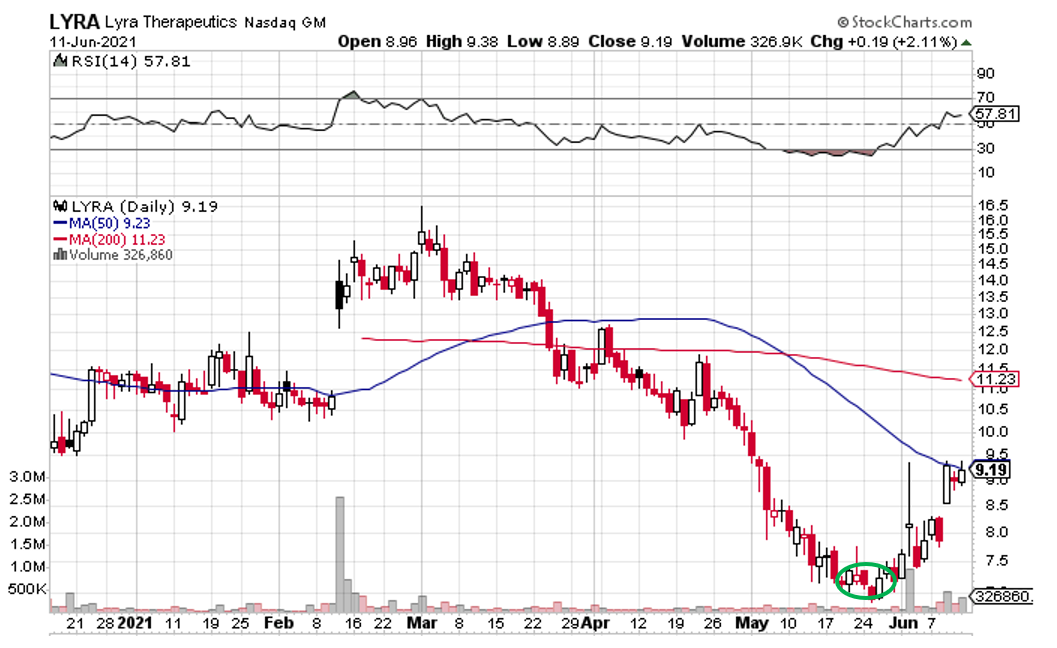
During that time the stock felt like it just did not want to go down any more. I had been watching the stock since December and the intraday action was different than it was during the March to May period when the stock fell and fell and fell.

But it was not just Lyra. A number of the Biotech stocks that I track were following the same pattern. It made me go hmmm. And that led me to buy back Lyra, and add two other names.

I added Zosana Pharma and Clearpoint Neuro. I am not going to talk about Clearpoint because everyone talks about Clearpoint and I am just renting here, not owning.

As for Zosana, I owned Zosana briefly in February when biotech stocks were doing those crazy pre-market gap-ups. For whatever reason, Zosana is one of those 2nd or 3rd tier momentum stocks – not with the consistent momo of a GameStop or AMC, but a stock that every so often catches fire and runs up. If you can catch that, you can do okay on it.

But Zosana is not just a do-nothing shitco. Well, I guess it kind of is, but not completely. They do have something that may be worth something someday. Maybe.

Zosana has been going through clinical trial for a transdermal microneedle form of a drug called zomitriptan.

Zolmitriptan is used in acute migraines. Zolmitriptan is one of most potent triptans. The triptan market is big – $4.8b market overall. The standard delivery for zolmitrptan is oral, injectable, or nasal. Non-orals represent $650mm of the market. Zosana is offering a different delivery, through a patch. Indications from the trials are that it works better than the existing alternatives.

So Zosana has potentially a better vehicle. It is called Qtrypta. You put this little patch on and the drug is administered through your arm.

I got interested in Zosana a few months ago because the stock is very reasonable (the stock has a $100 million market cap and $17 million of cash), and the brokerage reports that I read seemed quite positive on the outlook.

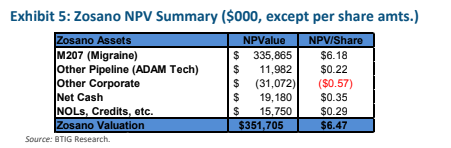
While I never know whether I can trust the research of HC Wainwright or BTIG, they at least paint a compelling upside if all goes according to plan. For example, BTIG gave the stock a $6.47 NAV in their initiation report:
Zosana’s problem is that the FDA did not approve the drug after Zosana completed their Phase 3 study. They gave them a complete response letter, or CRL, which is usually a letter saying no dice.

But in this case the letter just outlined a few issues that Zosana had to rectify before the FDA would approve the drug. They wanted clarification on safety data, and they wanted Zosana to repeat the bioequivalence study. It seems there are concerns that the drug levels administered to all the patients were not consistent.

While none of this is ideal, it is also not a death knell. In April, Zosana announced that they had met with the FDA and come up with an acceptable study to satisfy the concerns. They said “we believe that this study can be executed quickly and will address the last remaining clinical request from FDA regarding the resubmission of our NDA for Qtrypta”.

Ok, so great. They do the study, maybe they get approved, maybe they are successful at marketing their alternative delivery system, maybe the stock gets to the BTIG NAV. Maybe not.

I am not smart enough to be able to tell you how this all plays out in the next 1-3 years. But I can say that: A. the bad news is baked in, B. the news flow seems to have gone positive, C. the stock is one of these “jumpy” meme-esque kind on names in a market that is going meme-me again, and D. the stock chart is a lot like Lyra.
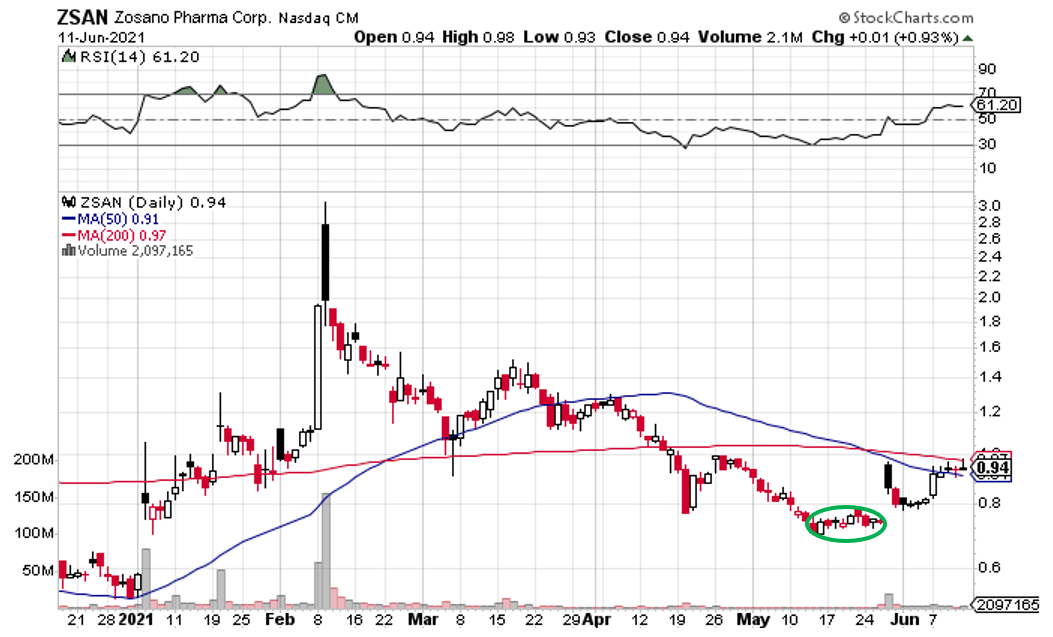
So…. worth a punt.

Eastside

Eastside Distilling has been a frustrating laggard up until just recently. I wrote about Eastside a couple of times last year. I took what is for me a pretty large position and watched the stock drastically underperform other microcaps through the end of last year and the beginning of this year.

It was painful. Apart from one short-lived run up at the beginning of February, Eastside languished at about the price that I bought it.

What was confounding was that Eastside seemed like such a perfect play for reopening. The stock was well below its pre-pandemic level (it was in the $1.50 range vs $3 per share a year before). Eastside had clearly suffered from restaurant and bar closures and that would be changing shortly. And… at a corporate level the company was in far better condition that it was a year earlier. The new management team had a plan, they were clearly focused on driving cash and not just running up revenue and losses.

Yet the stock did pretty much nothing.

That has changed in the last few weeks.
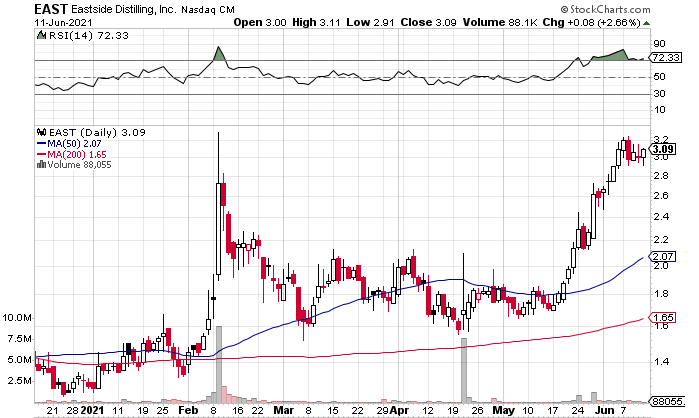
The stock began to rise shortly after the company announced Q1 results. While those results were nothing particularly amazing, they were another step in the right direction. So who knows, maybe management talked to some fund, maybe there is a brokerage report that I don’t know about? Someone is buying the stock.

What I do know is that the new management at Eastside has done an admirable job of reducing costs, selling off unprofitable product lines, monetizing inventory, reducing cash burn and just generally turning the business around.

The two numbers that highlight the turnaround are that. year-over-year, gross profit was up 25% and opEx was down 17%. Management has really focused on selling spirits that have better gross margins while dialing back their marketing and G&A expense. No surprise that leads to a more profitable business.

Having said all these positives, I am starting to take some of my position off here. It has been a good run and while I can envision how this could be a $5 or $10 stock some day, it is going to take time I think and god only knows what the bumps in the road will be.

But beware! This has been my Achilles heel. Over the last 9 or so months I have been burnt by taking profits. I have taken profits on soooo many stocks that have gone much higher. Kopin, Silvergate, Inspired Entertainment, Identiv, Beam Global, Prothena, Bionano, Foresight and on and on – it’s ridiculous when you think of all the stocks that have been doubles or even multi-baggers after I sold out.

I have treated all these tiny little microcap speculations the same way I always do – when they go up enough, start selling (while you can). In the past, that has been the prudent strategy. Over the last 12 months, it has meant leaving a lot of money on the table.

But what can you do? You gotta stick to your playbook.

Tornado

Speaking of moonshots, and one that I have not sold: I have no idea why Tornado Hydrovacs is going up.

This is one of those stocks that I have owned forever. It was a spinout of Empire Industries, and while I gave up on Empire (now Dynamic Technologies) a while ago, I have stuck with Tornado.

Tornado makes hydrovacs. They operate out of Alberta. Right before Covid they bought a large facility in Red Deer to expand their production. Everything seemed to be on-track. But…

Obviously, since Covid the results have been pretty meh. As of Q1, they had not turned around just yet. In the press release of their Q1 report Tornado said “production at the facility located in Stettler, Alberta was reduced by approximately 60% for the second half of 2020 and 20% for Q1/2021. As at March 31, 2021, approximately 25% of the Company’s employees had been permanently laid off.”

Tornado did make a reasonably positive outlook statement in their Q1 MD&A:
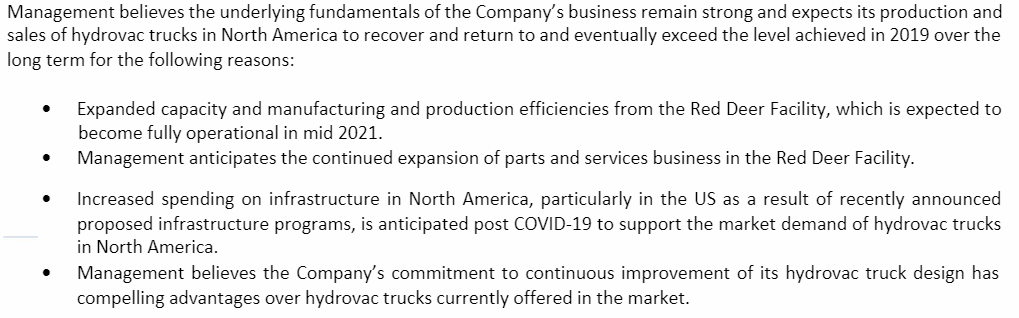
I can kinda get that this stock should do well over the next couple of years. It should benefit from the increased infrastructure spending and such. And that is really why I have held it. But based on the available information, I am not quite sure why its run up like this over the last couple weeks.

Two more thoughts/ideas and then I will be done.

Vertex and Vidler

First, I bought Vertex Energy, a stock I have owned previously, when they announced the acquisition of a refinery from Shell. Hat tip to Glen who compelled me to look at the news after I was so skeptical about it that I ignored it for a day even as the stock went up 100%. I don’t really have much more to say about this one because honestly, I just don’t know. Vertex made a very cheap refinery purchase that they say they can transform them into a biodiesel powerhouse. If they can make good on this, the stock is only getting started. But because I don’t really know, I already sold half. I would probably sell the rest on a move to $12+.

Second, I bought a company called Vidler Water Resources. Vidler owns and develops water assets. I am still pretty early into the name and so I’m still trying to figure out all the details, but the big picture looks good.

Vidler owns water rights and water credits in Nevada, Arizona and Colorado. There is a big water problem brewing in these states. Lake Mead, which is the Hoover Dam lake, is drying up. If you google search Lake Mead you can read about a dozen articles describing how bad its getting and how rationing will be in store this year.

So Vidler is in the right place at the right time. What I haven’t yet worked out is how much they will benefit from the increasingly desperate search for water, it seems pretty clear that they will benefit and the stock does not appear that expensive.

I got the Vidler idea from mrmojorisinX on twitter. He is a smart hedge fund guy that makes very hard to understand tweets that never name names but where if you are enterprising enough to decode what he is saying you can sometimes get very good ideas from. This looks like one of them to me so far.

Gold Stocks

Finally, last thing, gold. So… I’m doing pretty well on my gold names, but that doesn’t really have much to do with gold. It is really to say that I am doing pretty well on Wesdome. Wesdome has been great because the results at Kiena have been tremendous and the stock is going up even as gold is going nowhere.

But that brings me to my larger point. I’m not quite sure what to make of gold stocks right now. They are… strong. That is not a word you associate with gold stocks 95% of the time. But gold stocks are surprisingly strong given that gold is not.

I’ve woken up about a half dozen mornings in the last 3 weeks, looked at the price of gold, looked at the sentiment on gold-twitter, and thought, “yup, this is the day the gold stocks are going to get creamed”.

And then it didn’t happen.

Even today, gold stocks opened down. But they haven’t stayed there.

If this was any other sector I would be saying, THIS IS A SIGN!. But with gold stocks, with whom I have battled with for years with which I am perennially disappointed when I overstay my welcome, I have zero trust in even the strongest signals and therefore I will say nothing except for – it is interesting.

A Sign of Life from the Shipping Trade?

I have been in the shipping trade for about 4 weeks now. Up until today it has not really worked.

The stocks have bounced around. I have made a little on ESEA and GRIN, lost a little on NMM and SBLK and done nothing at all with DAC. Overall, I have been flat.

I was beginning to doubt the idea. It was the usual doubt – sure the stocks seem very cheap, but maybe the market just won’t care?

There are plenty of reason for the market not to care. For one, these stocks are well off their lows of last year. For two, the shipping business is terrible, self-serving and full of management teams that have a history of incinerating cash. For three, rates are at decade highs and why get in at the top?

FWIW there are really two separate ideas here. There is a containership trade and a dry bulk trade. They have pretty different dynamics, so you need to talk about them separately.

The containership trade is the more immediate of the two. The shortages in containerships is happening now.

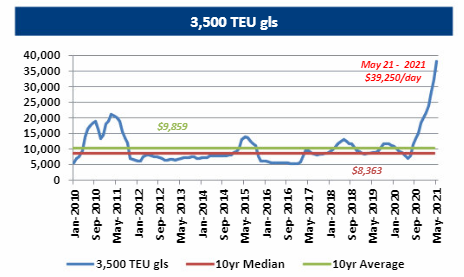
Containership rates are off the chart. They are at (I believe) all-time highs.

The first question that comes up when you see this chart is whether this is just a blip due to the pandemic.

To some extent that seems to be true. We have the restocking of inventory at the same time as post-pandemic demand in the United States is sky-high. There are also shutdowns at at least one very large port in China because of a COVID outbreak.

But if this was just a blip, what you would expect to see are very high spot rates and much lower two, three and four year charters.

But that is not what is happening. Containership owners are booking long-dated charters at huge rates.

Just to give one example. A 3.8k TEU containership (a TEU is one of those big cargo containers that stuff gets shipped in) was booked last week for 5 years at $35,000 per day to CMA CGM.

A 3.8K TEU is a Panamax size (Panamax is between 3-5k TEU). This chart is from the Euroseas Investor Presentation:

3,500 TEU shipping rates have not been above $10K per day for years. And yet now there are customers willing to book them out for 5-years at $35K per day?

This makes me stand up and take notice. It does not look like a blip to me.

Yet the market is trading these stocks at levels that is saying it is just a blip.

I mentioned the Euroseas analyst estimates in my last post. Average estimates (albeit this is from the only two brokerages that cover them) are $6.50 per share EPS for 2022. That means the stock has been trading at a little over 2x earnings. This would make some sense (but not a lot in my opinion) if spot rates were sky high but long-term rates were much lower. But it makes no sense when ships are booking 5 years at $35K.

The only gotcha in the idea is that the order book has ticked up. And we know we can’t trust containership owners to make sensible decisions. These new orders won’t begin to be delivered until 2023 at the earliest, and I have read a few opinions that explain how the market will easily absorb them. But still…

The other thing about the containerships is that there is a real dearth of names, at least on the North American exchanges. There are only a handful of stocks with meaningful containership exposure. And a bunch of those have already chartered most of their ships out for the long-term. While this was a prudent move in the past (after 10+ years of a bear market in containership rates) it is not right now.

ESEA, DAC and ZIM are the only pure plays I see that have meaningful spot/short term exposure. NMM does as well, but it is not a pure play, because it owns dry bulk ships, and its management is basically a shit show (though I do own it anyway).

I have been posting a lot of articles on containerships on the RNO board. I am not going to go through all the details of these articles but suffice to say, the situation for shipping containers appears to be getting tighter, not looser. It reminds me a little of the wacky situation that developed in 2007 with the dry bulk market.

Just sayin….

On to dry bulk.

The dry bulk trade is a bit of a different beast. The dry bulk trade is a longer-term trade. Rates did spike, particularly for capesize vessels, but it seems to me they could go much higher for longer because the supply side is not responding.

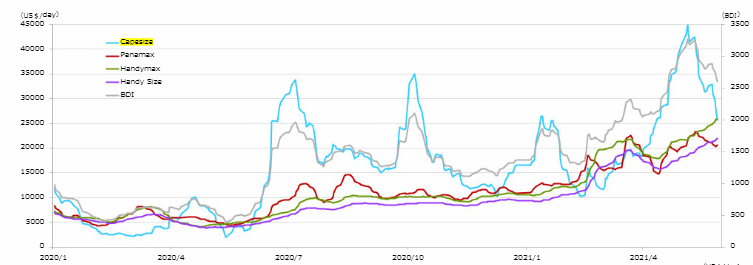
In the short term though, the dry bulk rates are not as strong as containerships. In the case of Capesize ships, rates have pulled back quite a bit.

Q1 spot Capesize rates averaged $17,000, one of the best performances in several years while Q2 was tracking close to $30,000, a very high level only comparable to the 2000s bull market. But in the last couple of weeks capesize rates have pulled back to around $20,000 now.

But while Capesize rates have taken a breather, as you can see in the chart the smaller size ships have remained quite strong.

Capesize rates are very volatile/seasonal and so you can’t get too worked up over the volatility.

The big picture here is two-fold. First, dry bulk rates are going to depend on demand for bulk goods like iron ore, grain, coal, and metals. In this sense, the dry bulk sector actually fits a lot better with the commodity bull market thesis that I have been grappling with.

But dry bulk also has some negatives that come from that same thesis. For one, if China reduces steel production and switches away from dirtier steel production that will hurt iron ore and metallurgical coal imports. For two, over the longer term thermal coal transportation is bound to decline with stiffer carbon limits.

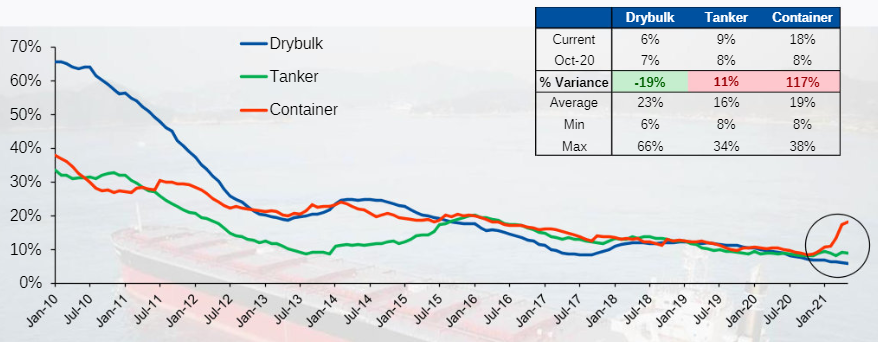
On the other hand, the dry bulk supply situation has not seen any increase in ships (see the above mentioned order book chart). The combination of shipyards that are full and the carbon requirements of new dry bulk vessels make placing new dry bulk orders a bit tricky. Star Bulk described it like this at the Capital Link conference:

The order book has decreased to a record low 5.7 percent of the fleet, with just5.8 million dead weight reported as firm orders between January and April. Upcoming environmental regulations and uncertainty about future propulsion has helped keep new orders under control, while shipyard capacity is quickly filling up with containership and other orders.

This is what Golden Ocean said about dry bulk on their last conference call:

It is clear that fleet growth is slowing down dramatically. In fact, we are looking at the lowest fleet growth in 30 years. At the moment, the order book is likely to stay muted. There’s a very limited amount of slots available before 2024. We see increasing prices for the assets, mainly due to steel, but also due to increased demand. And of course, availability of finance and new emissions are also keeping the order book in check.

We have a potential further catalyst as we will see the new IMO 2023 regulations enter into force. It is assessed by some that upwards 80% of the dry bulk fleet is not in compliance with the new regulations, and the easiest and cheapest way to get in compliance is by slow steaming. Therefore, we expect quite a lot of slow steaming from 2023 at a time where we are already seeing very, very few additions to the fleet.

For the next 2 to 3 years, we expect this situation to tighten even further. Demand is simply going to outpace supply until 2024

Finally, Stifel pointed out the following in a piece they did on dry bulk, titled “How High can you Go? Looking at Upside Potential in Dry Bulk Shipping”. They described how until ship owners know what the carbon rules are for their ships, they will be less likely to book new builds of dry bulk carriers than other types of large ships (like containerships and crude oil ships) because retrofitting a dry bulk ship is far harder:

Outfitting a large containership or VLCC with LNG capacity would only increase the cost of the ship by 5-10%, whereas the incremental cost for a Capesize vessel would be an extra 20% and for a Supramax it would be an extra 35%

The other nice thing about dry bulk is that, unlike containerships, there are a number of little shitco-like companies that operate in the sector and that will run up if rates are higher for longer. Grindrod is the one I bought so far, but there are others.

After today I am again cautiously optimistic that this idea is going to work out. But this is shipping so who really knows.

Stelco, Algoma and Carbon

It is a little hard to write about the commodity investments I am making. Because I am just not sure yet – about the short term.

The long-term trend to me is clear – and it is all about carbon. But whether this is the right time to be buying some of these names – I have less confidence in that.

Right now I own some copper, some tin, some steel and a few shipping stocks. All of these names have had big runs already, and they have all pulled back. But most are way above their historic levels, and so they could pull back a lot more.

So I am more cautious than bullish right now.

But at the same time, these stocks are trading at extremely cheap multiples if you think that the price of the underlying commodity can hold these levels.

I bought Atico Mining a few weeks ago – it is at around 2x cash flow with copper that this level.

Or take the shipping stocks I own. Euroseas 2022 EPS is projected at $6.50 per share – the stock is ~$15. Navios Maritime Partners 2022 EPS is projected at $11.45 next year. The stock is ~$26.

And yes, I know, commodity stocks are to be sold when the multiple is low. And yes, with respect to shipping, management will inevitably destroy any shareholder value they create during the cycle, so even more buyer-beware there. Nevertheless, as I’ve been posting on IV, there are reasons to see the glass half full.

Steel is another sector with crazy low multiples if you believe in anything close to current prices are sustainable (current prices are a little more than 2x their average over the last 3 years).

On their first quarter call Stelco put the following statement on one of their slides:

On the call Stelco management said that if they generated $2 billion of EBITDA, that will convert to $1.4 billion of free cash. Stelco has an EV of about $2.9 billion right now.

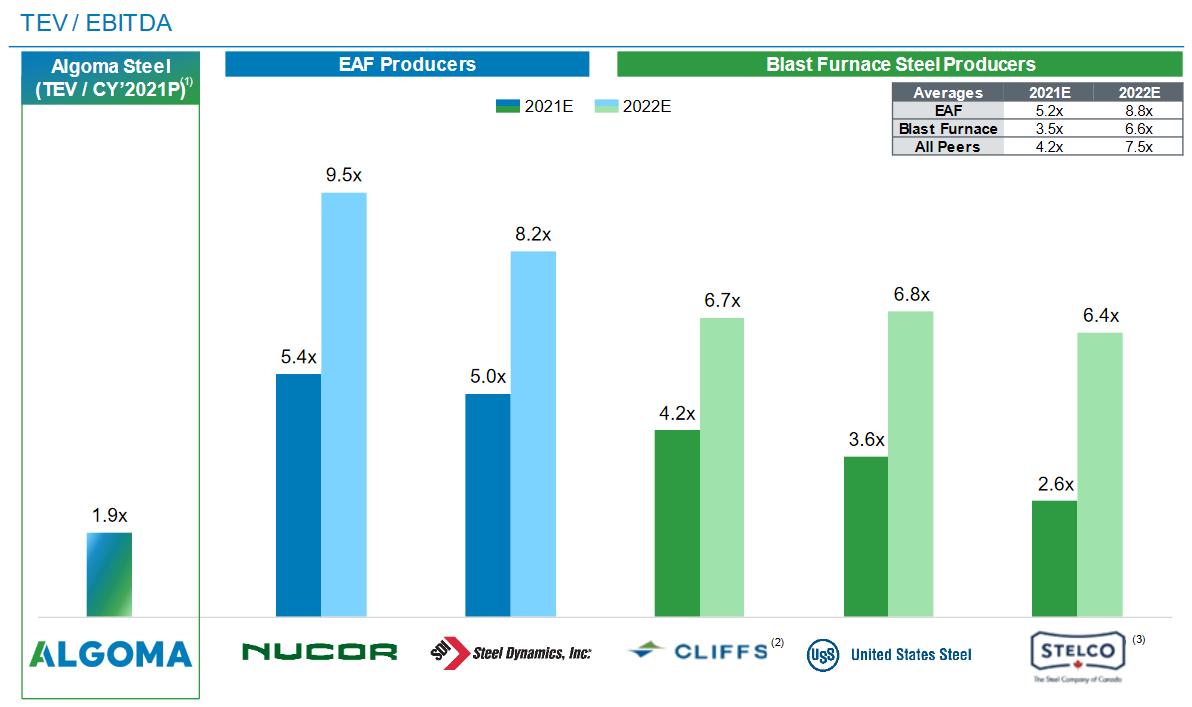
I thought wow, you can’t get much cheaper than that can you? Well, it turns out that you can at least come close. Last week Algoma Steel decided to go public via a SPAC deal with Legato Merger Corp.

The combined company will have at EV of $1.7 billion, which includes cash of about $300 million and net debt of $200 million.

Algoma expect $900 million of EBITDA this year with the assumption of $1,250/t steel. Stelco’s was based on the H2 forward curve, which was at $1,500/t. So I think that Algoma is actually a little cheaper than Stelco if you were using apples to apples pricing.

Algoma is also getting a cash injection that they plan to use to build out an EAF furnace. EAF steel makers use scrap instead of iron pellets and coking coal to make steel. They trade at larger multiples – Nucor, the biggest EAF steel producer in North America, gets a crazy 8x PE multiple!

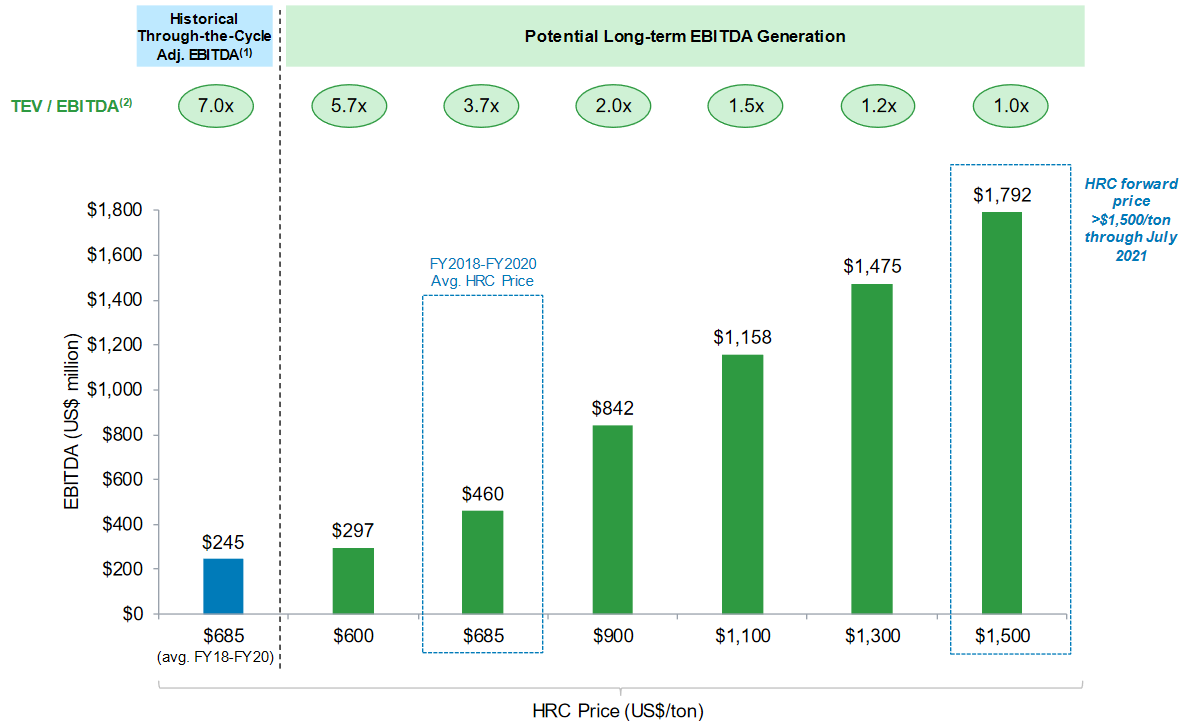
When Algoma finishes their EAF conversion they will be producing 3 million tonnes of steel (versus ~2.4 million tonnes now) and they will be doing it more cheaply. Algoma gave estimates of what their EBITDA multiple post-EAF conversion would look like at various steel prices:

But Algoma told us something else about their EAF conversion that in my opinion is even more important than how profitable they could be was it is done.

They told us how much carbon will be reduced.

I am not sure of very much yet with this commodity cycle but the one thing I am convinced of is that it is going to be driven by carbon. The changes we are going to make over the next 10 years are going to be massive. And they are going to have an equally massive impacts on commodities, both good and bad.

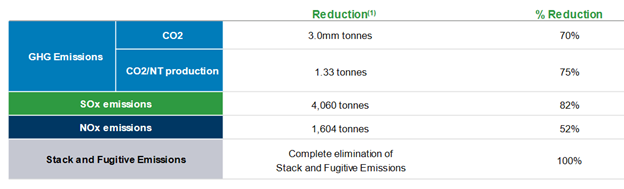
Look at what Algoma is saying. They plan to reduce their carbon emissions by 70%, by 3 million tonnes, by converting to an EAF.

But you might say – so what? Well, in 2030 we are likely in a world of $150 per tonne carbon. $100 per tonne is guaranteed. Those 3 million tonnes are worth $300 million to $450 million a year.

So what happens to those Chinese steel producers, those that are far higher carbon emitters than Algoma? I am convinced that the EU is going to put up carbon tariffs at some point. The US and the rest of the west will eventually follow. They won’t have a market.

The Chinese are not making overtures about shutting down steel mills by the end of this year because they are altruistic. They see the writing on the wall. Those mills are going down one way or another. They go from low-cost producer to uncompetitive in a world where carbon is priced accordingly.

So I’m not sure what the price of steel is going to be next year. Probably lower than it is now. Same with copper, same with container ship pricing. But I am getting more sure that in the long run some of these commodities are going maintain the levels that we are seeing and maybe even go higher. In fact its possible that the market, which has run up these commodities to heights that I don’t think anyone expected, is telling us just that. Because pricing carbon changes everything.

Why I think the CAD may not go down

I am losing money. And I couldn’t be more excited about it.

I say that tongue in cheek. But both statements are, in fact, true.

First, I am losing money. I have had a rough couple of months.

The culprit? That damn Canadian dollar.

The Canadian dollar has risen ~5% in the last month and a half. Depending on the account, I had between 1/3 to 2/3 of my cash in USDs. So I have taken a 3%+ hit on currency. In the tracking portfolio I use for the blog, I am over 80% USD. That puts me down over 4% on CAD!

Losing money sharpens the mind. On Monday I said enough. I sold all my large-cap USD stocks and moved the money back to Canadian dollars. I sold Amazon, Facebook, Eli Lilly, Bristol Myers, and Ford (which I had bought but never got a chance to talk about).

Why? If the CAD keeps going up, it is too big a headwind. If the Canadian dollar goes to 90c then these US listed stocks need a 10% gain just to break even. If it goes to par, they need 20%. That is a bad risk/reward.

But what if this is the top? I mean we have had a relentless move in the USD/CAD from 1.45 to 1.20c, including this blow-off 5c move over last 6 weeks. Maybe that is the end of it?

I am just not convinced this is going to end.

For the last couple of weeks I have been watching the Canadian dollar and thinking that something bigger was going on.

It does not want to go down. You can just feel it from the way it trades. It has had plenty of opportunities to correct. It has chosen not to. We had a bad employment number, we have had announcements of lockdowns, we had so-so economic numbers. The CAD kept saying – “I don’t care”. Even on days when oil is down big, usually these are days where the CAD follows with big down moves, but lately I’ve noticed a more lethargic response.

So I keep asking myself what is going on? And of course there is only one thing it could be. The only reason that the Canadian dollar ever goes on a sustained uptrend.

A commodity boom.

Yes I know what you are saying – well duh – corn is $6, copper is $4.50, steel is $1,500, iron ore is $200.

But those prices do not necessarily mean a boom. They could be transitory. Like the Fed (and Cathie Wood) say – a blip as we replenish inventory after the pandemic.

That is what I thought was happening. I didn’t really give much consideration to rising commodity prices in March and April. I was like “Sure, whatever. This is just another manifestation of the same speculative fever that is driving up Gamestop and ARK.”

But then Gamestop fell. ARK fell. All the high flyers fell. Commodities didn’t. Moreover, neither did the Canadian dollar.

So I started to capitulate to the idea that maybe there was something to this. I just didn’t know what. The charts were telling me that something was happening that was bigger than just speculation. I waded in a few weeks ago and bought the Ag stocks.

Last week I followed it up by buying into a few base metal stocks (copper and tin). Then this week I bought two steel stocks.

Steel stocks? I must be crazy right? Steel is forever a horrible business. These stocks are just off multi-year highs. I mean this is going to be a disaster right?

It could be. I have to admit that even though these stocks have moved significantly, we are only a few months into the move. The “signal is weak” as Hugh Hendry says. It could just be a blip.

But it feels like a signal. One which compelled me to get my foot in the door.

I think it could be telling us that significant changes are happening.

What changes might those be? Well… let’s use steel as an example.

China produces nearly 60% of the world’s steel. Much of it is dirty.

But the world is changing. Emissions are starting to matter. Plug Power didn’t go up 20x last year on smoke and mirrors. Sure, there were smoke and mirrors, but there was also a recognition that dirty is going away and clean is going to rule.

China recognizes this. Maybe it is because they honestly care about improving the environment. Could be. It could also just be that they don’t want to be left behind.

The EU is already talking about how they may restrict imports from “dirty” producers that have weaker carbon mandates. China sees the writing on the wall. Change or the world will change without you.

For the first time it looks like China is not just paying lip service. They shut-down 7 steel mills in Tangshan in April. I read that in Tangshan they are forcing the shutdown of 30-50% of steel production by year end. If they did that across China it would be over 500 million tonnes of steel.

To put that in perspective, Nucor produced a little over 20 million tonnes of steel last year.

I think this is just the beginning. The “greening” of commodities is one of those themes that just feels right to me. We already know that some commodities (like copper) are going to see big increases in demand from the greening of the world. And now we are beginning to see how others (like steel) are going to be greened themselves.

I mention steel but you can go through the list. Aluminum production (again over 50% coming from China) is very dirty. And what about nickel? Indonesian nickel in pig-iron, which has a horrible environmental footprint, has been the elephant in the room of western nickel producers since 2008. And rare earths – OMG I read an article last year about Chinese rare earth production – it is an environmental disaster. Yet its like 80% of worldwide production.

What if the world starts saying no way. What does that mean for commodity prices?

You can see how this could be a very big deal. And this is the sort of situation where price takes a back seat. It just doesn’t matter. If we have to accept $1,000+ steel or $10+ nickel in order to save the planet, do you really think that any country is going to balk?

So look, I may be buying close to a top. This last week has been a week of correction even as the market roared higher. I am trying to start small to get my foot in the door, and I plan to add if they strengthen to higher highs.

I just remember at the end of 2001, when I was a brand new, newbie investor right out of university reading my Dad’s Donald Coxe Basic Points publications. Coxe was showing all these charts of commodity producers like BHP and Rio Tinto and saying this was just the first movement of the symphony (he talked like that, which is great).

And so I bought Aur Resources. This was a copper stock. This was really my first, ever bet on a stock – like the first time I did the work, made a spreadsheet, and didn’t just act on a tip or something.

I bought Aur at over $3. I remember I was very worried. Because Aur had been like a $1-$2 stock not long before. And here I was buying it after a move to $3.

Sure enough, in the first few months Aur corrected back. I was distressed. But Donald Coxe kept saying, ignore the noise and buy more because we are about to have something big.

So I did. By 2003 Aur Resources was my largest position. The stock was $4. Then $5. Then $8. By 2007 it was bought out at $40.

I may be totally off base on this. It is still so early, it is hard to know if this is truly a tectonic move and not just a blip. But if I am right then we are at 2001 or 2002 in a game that didn’t end last time until 2008, and probably would have went straight up until 2012 if the US hadn’t imploded their housing market.

That’s why I am not staying on the wrong side of the Canadian dollar. And why I’m actually pretty excited even though my portfolio is not.

PS: He says this better than I do.