Skip to content

Posts from the ‘Uncategorized’ Category

An Ag Cycle

Food price inflation.

I can’t get over the move we are seeing in ag prices.
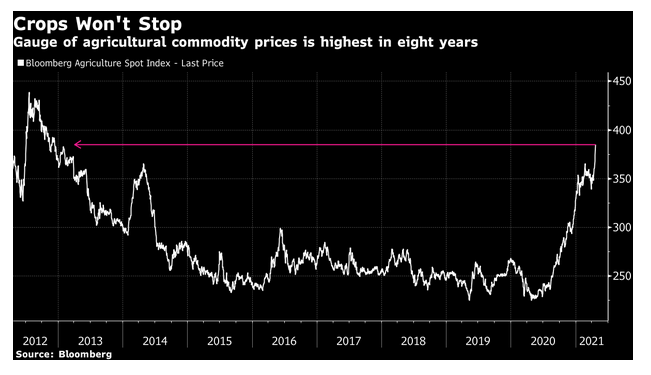
To think that corn is over $7 a bushel right now. Its pretty much a parabolic move.

Image

My first foray into agriculture was in 2006. Donald Coxe, who I followed closely, became a huge agriculture bull. I did extremely well buying fertilizer stocks, seed stocks and machinery stocks. Then 2008 happened and the party ended.

I made a second foray into Ag from 2009 to around 2012. Again, a sustained move that lasted a few years.

I learned from Donald Coxe not underestimate the duration of a bull market in ag. You don’t see this kind of move unless there is something tectonic going on below the surface. Something that will last 2 years, not 2 quarters.

Corn acres in the United States came in well below early expectations while soybean acres beat only modestly. I see estimates from January that there would be 95-97 million acres of corn and 87-89 million acres of soy beans. The latest estimate right now are showing corn coming in at under 93 million acres and soy beans just over 90 million acres.

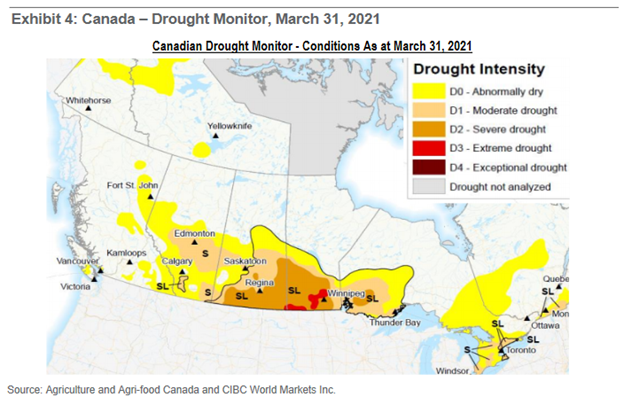
In Brazil there are drought conditions that are not looking good for their corn crop. And in Canada, I can attest to the fact that moisture this year has seemed low.
What could go wrong? Well for one, a lot of buying is coming from China. They are restocking and dealing with rebuilding their swine herds after the last bout of African swine flu and that demand might be transitory. China loves to blindside the market by stepping away if it’s in their best interest.

Never underestimate the ability of the North American farmer to squeeze more yield out of the same acre.

And is this (and every other inflationary force) a one-time global restocking after the pandemic that will end in a couple quarters?

Picking Ag stocks is tricky. There is interplay among Ag commodities – what is good for corn is bad for chickens, bad for soybeans but often good for wheat. Ag stocks often have a finger in many pies so you really have to be careful with what you are buying.

The two things I felt most sure of, at this early stage of my research, are that A. there is going to be more demand for fertilizer and B. farmers are going to do very well.

So I took a couple mid-cap positions.

I bought Mosaic and Nutrien, which are fertilizer plays (though Nutrien is diversified beyond fertilizer). Mosaic has the best leverage to potash (other than Intrepid Potash, which I looked at and based on the earnings reaction today maybe I should have bought instead). And I bought Ag Growth International, which should benefit from increased farm income. I’ll talk about Mosaic and Ag Growth for now.

Mosaic

I have always loved potash stocks. I know the nutrient has its limitations – it is not as necessary as N and K and so farmers (and countries) can balk and walk away if prices rise too quickly.

But from what I’ve read the potash producers have some cards in their favor. India just signed a surprise contract at $280 per tonne, $50 per tonne higher than the previous agreement. Port inventories in China are low. And of course grain prices are high.

Spot potash prices in Brazil are already $330 per tonne.

Mosaic put together the classical “bull case for fertilizer” slide in their March presentation.
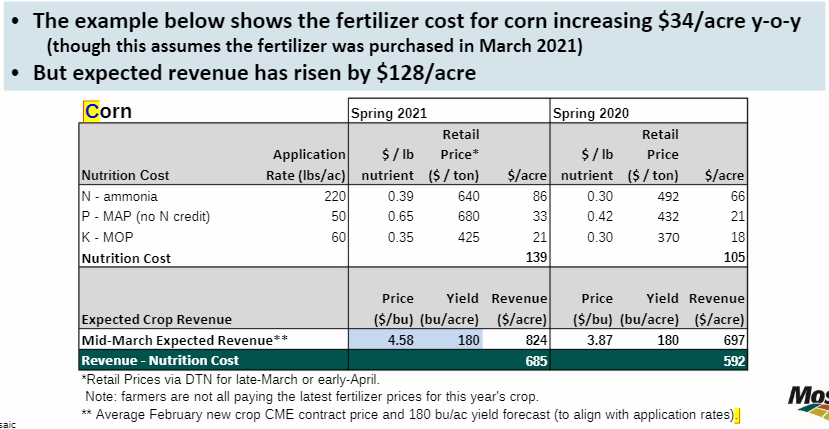
Simply put, the bull case is – yes fertilizer prices are up but grain prices are up even more! And you presumably should get a better yield per acre with better fertilizer application.

Mosaic will benefit. They own two potash mines in Saskatchewan and another small one in Texas. Mine capacity a little under 10 million tonnes. They produced 8.4 million tonnes last year.

I calculated that every $50 per tonne increase is another ~$400 million of revenue. Most of that, ex-taxes, should drop to the bottom line. That is close to a buck a share of EPS.

Mosaic’s other major business is phosphate. Midwest phosphate prices are $600 per ton FOB right now. This is up substantially year-over-year.
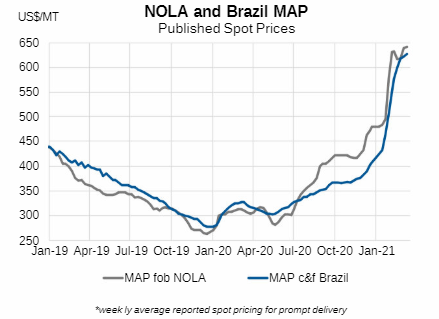
Inventories for phosphate look an awful lot like they did in 2009-10.
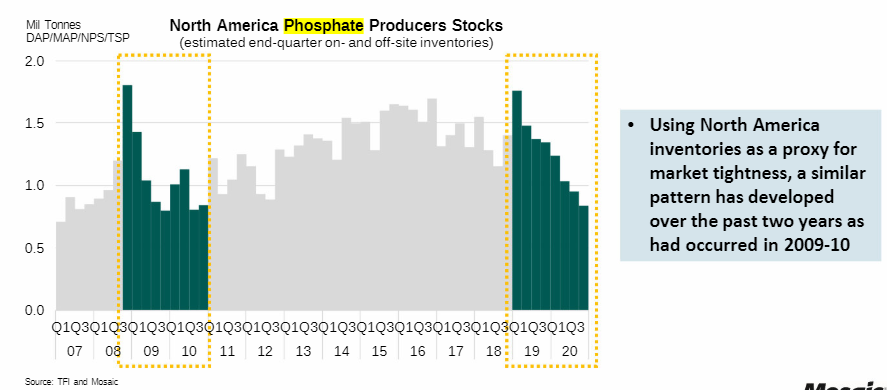
Mosaic’s phosphate operations are in the United States and Brazil. In the US they have capacity for just under 10 million tonnes of processed phosphate while in Brazil they have capacity for another 4 million tonnes (that is equal to 70% of Brazil’s annual production). They produced about 8,500kt of finishes product last year at a selling price of $360 per tonne.

Mosaic’s revenue from phosphate this year is, so far, significantly above last year. February revenue was $297 million vs $172 million in 2020. January revenue was $337 million versus $198 million. This does not include the Brazil operations, where sales were roughly flat yoy.

The Phosphate segment did about $2 billion in sales and $400 million in gross margin in 2020. This year I think they’ll do well over $3 billion of revenue. Probably over $3.5 billion. That extra $1.5 billion of revenue is going to almost all fall to operating income.

If you look at analyst estimates, they are pegged for ~$2.6 billion of EBITDA this year. That is after $1.5 billion of EBITDA last year. When you look at where potash and phosphate prices are, I think Mosaic is going to beat those estimates by a lot.

What’s more, the stock is anything but expensive. On analyst estimates the stock trades at a little over 6x this year’s EBITDA. In the 2009-2011 cycle, Mosaic’s EV/EBITDA got to over 11x. Once they show they are beating estimates, the multiple goes up.

Ag Growth International

AFN provides grain handling equipment to farmers and grain buyers. Augers, belt conveyors, bins, aeration equipment.

The bet here is that a reopening and rising grains prices has got to boost demand. It appears to be so far. On the fourth quarter call the company said backlog entered the year up 20% yoy and was up 40% yoy in March – and that March comp had not been impacted by COVID yet.

There are a couple of negatives that are going to hit their business this year. First, the bins are steel, which is going up in price (though that actually might pull forward demand in the short run).

Second, they sell into the US but costs are in Canadian, so this rising Canadian dollar (the bane of my existence) is going to be a headwind.

And third, they had a bin collapse last year, and that creates some uncertainty. I will get to that later.

But the stock is not super expensive. I bought it at $40. That is under 13x trailing (adjusted) EPS. The company had a dividend of $2.40 per share in 2019, which would be a 6% yield if reinstated.

While just a general improvement in business conditions is the main story, the kicker comes from their AGI SureTrack product. SureTrack is a connected farm type of product. It is directed at both farmers and grain buyers.

SureTrack is made up of a number of tools to monitor the farm. There is a grain bin monitor that tracks your grain level, quality and bin conditions. A field monitor keeps track of conditions in the field. There is tank manager for monitoring fuel and liquids. a dryer manager for monitoring grain drying. There is a marketplace for monitoring prices and connecting buyers and sellers. And there is an economics module that helps you maximize your margin based on growing, hauling, labor and fuel costs.

There is a very good discussion on the fourth quarter call where a lot of detail on SureTrack is provided.

They put together the platform through acquisitions of IntelliFarms, Affinity Compass, CMC as well as our investment in Farmobile.

AFN describes what SureTrack provides as follows:

They sell SureTrack through 3 principal channels: direct to farm, direct to commercial users, including grain buyers and food processors and through their dealer network.

AFN already has a large dealer network – they can sell SureTrack through 1,000 existing dealers in the United States.

There is a comp here with the recent IPO FarmersEdge.

SureTrack and FarmersEdge have one big similarity – they are both SaaS solutions for managing farm operations.

But Suretrack is not really in competition with FarmersEdge. There is a bit of overlap, but not much.

FarmersEdge is really a monitoring and predictive tool for managing the crop in the field. Seed selection; precision planting; precision application; machine automation; soil probes, satellite imaging and telematics data used to determine plant health and problem areas.

SureTrack provides a platform to manage the farm itself. FarmersEdge is upstream, SureTrack downstream.

FarmersEdge did about $46 million of revenue this year, up about 100% yoy. They lost $8 per share and had $44 million of negative free cash flow. SureTrack did $23 million, with less growth – 16% yoy or 33% on a retail equivalent sales basis (more on that shortly). While SureTrack is not yet cash flow positive, they said on the Q3 call they expected to reach that shortly.

The FarmersEdge solution is definitely the sexier of the two products but the fact remain that they both manage operations on the farm. With that in mind, FarmersEdge has a market cap of $740 million. AFN is going for about $1.5 billion, including debt.

Now there is a question of how much SureTrack is really a SaaS business. AFN sells the IoT hardware and the subscription. The hardware currently makes up most of AFN’s revenue. The company breaks down the revenue buckets in their MD&A where they reconcile their “Retail Equivalent” revenue with the actual revenue that they are allowed to book.
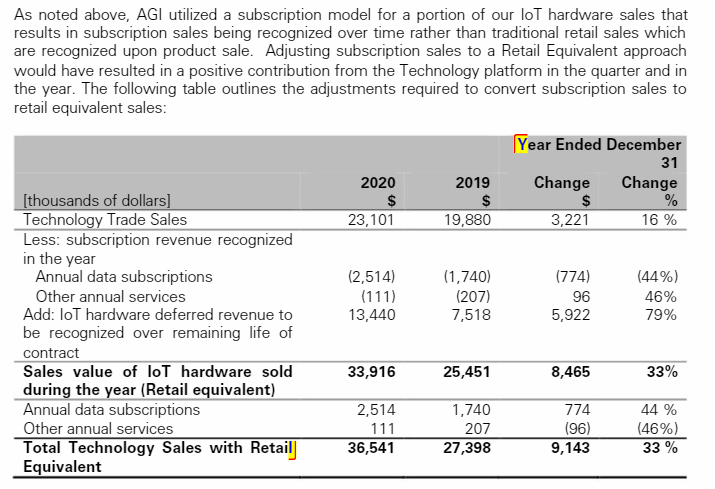
There are positive and negative takeaways here. The negative is that the actual data subscription revenue is small. The positive is that the real apples-to-apples sales number should be the “Retail Equivalent”, which means the business is growing at a 33% clip.

It sounds like AFN is changing the way they sell SureTrack this year. They will be selling more of the IoT hardware upfront rather than packaging it with the subscription. This is actually going to make revenue look better than it should this year.

While the subscription revenue is, so far, small, that also means the market left to tackle is large. On the fourth quarter call they pegged the North American addressable SaaS market for SureTrack at $2 billion. The IoT side is another $10 billion.

CIBC is targeting 50% growth for SureTrack this year. That seems a little aggressive to me, but I do note that the data subscriptions grew at 44% last year, and that was with COVID. When one analyst asked about margins Tim Close, the CEO, seemed to agree with the assessment that 60-70% gross margins and 20% EBITDA margins would be in the ballpark. Close has talked about 50% growth in the past.

Whether this is a true SaaS business or not, I could see analysts getting onboard with comps to FarmersEdge and viewing AFN as a technology play. If SureTrack can pull off some eye-popping growth numbers this year, I think that could generate excitement and boost the stock quite a bit.

The rest of the business is not that exciting, but it is steady. They did $1 billion in revenue last year and generated $149 million in EBITDA. The year before that they did the same $1 billion in revenue and generated $144 million in EBITDA.

The company does have an albatross around its neck because of a pretty large mishap they announced in September. One of their bins collapsed at a commercial installation in Vancouver. This SA article goes over it quite well. There are two sites, with the same customer, that were affected. They have allocated $70 million as their cost of remediation of the two sites (they said they would be replacing the entire structures, including the hopper base). They said in the original press release that the original cost was $19.1 million so I’m not sure why its so high, unless maybe they are expecting legal costs too?

Anyway, what’s done is done and this does appear to be done. I mean its not great, it raises some questions about their ability to execute (assuming they are at fault, which has not been determined yet). But the biggest concern would be if this incident caused them to lose customers.

That doesn’t seem to be the case. As I mentioned at the start, the backlog is strong.

My last comment is there is quite a bit of debt here. There is $409 million of long-term debt and another $307 million of debentures. So the overall enterprise value is about $1.5 billion.

On an EV/EBITDA basis that puts the stock at 10x. On an adjusted EPS basis its cheaper – at 13x trailing earnings where I bought it.

On a free cash flow basis RBC puts 2020 at $2.44 per share – or 17x trailing FCF. RBC forecasts free cash flow at $3.16 per share this year and $4.67 per share in 2022. That seems pretty aggressive to me but if they hit it, the stock should be higher. I saw that CIBC is also forecasting $4+ of free cash flow in 2022.

So those are my two main farm plays. I havee a couple micro-cap bets as well that I will maybe talk about in detail another time. Imaflex and Flexible Solutions. Both provide solutions that reduce crop input costs.

Imaflex does it by producing crop protection films that cut down on pests and weeds in the soil around the plant. I’ve owned this stock for a long time and they finally seem to be putting together the results I’ve long hoped for. They did 12c EPS last year which means this is not an expensive stock.

Flexible Solutions markets a chemical call thermal polyaspartate that prevents fertilizer from crystallizing and therefore reduces the amount of fertilizer that needs to be applied. The company announced a disappointing number for Q1 revenue due to shipping constraints and the stock tanked on that. I decided to buy that dip to $3.

With respect to the rest of my portfolio, the mega-cap drug stock trade did not really work out as well on earnings as I had hoped. I screwed up on COVID. First Lilly, then Bristol Myers both took hits on earnings due to COVID. The problem (or not problem, depending on how you want to look at it) is that with vaccines here (none of which are supplied by BMY or LLY), the treatments these companies were supplying for COVID patients are no longer required.

I originally sold my BMY but decided to buy it back yesterday. I am keeping LLY because the pipeline is better and the Alzheimer drug could still surprise, which I believe would send the stock through the roof.

I forgot to mention retail in my last post. I was listening to a podcast of Mad Money a couple of weeks ago. Cramer had on Matt Boss, Retail Analyst from Morgan Stanley. Boss described retail as being in the second inning. I found it compelling.

So I looked at some of these retail stocks and yes, they have moved a lot, but they are not that expensive. Foot Locker trades at 15x this years earnings and 12x next years. Big Five Sports, I’ve talked about a lot in the past and it remains under 10x earnings if you believe they can do $2 EPS this year (they guided to 50c in the first quarter). The Gap

I bought Foot Locker and Big Five Sports early last week.

Finally, I bought Chemtrade International last Monday. I timed that one well (for once). The stock is up 8% since I added it. It has a great dividend, is cheap and its products should be levered to both recovery and to price pressure. Another one to talk about more another time.

A Bull Market – But Only in the Index

The market keeps going up – literally every day – but you would never know if it you just looked at stocks.

Well, some stocks that is. Large cap stocks are on fire. The mega-cap tech stocks that I got into a few weeks ago have been on a tear. Typically boring stocks like Deere and Caterpillar are in a whole other world. Yet almost every day they go a bit higher.

But if you aren’t in the high-flying mega-caps then woah, man, it is nasty out there.

I think Thursday was the epitome of what is going on. The S&P was on fire, up 46 points, over 1%. But I could list dozens of stocks that were not just down for the day but down big.

And I’m not just talking about perennially out of favor sectors like oil or gold. These are former market leaders and darlings that were pummeled.

Plug Power, the hydrogen fuel cell leader of the next energy age, was down 8%. Exone, the Ark owned (they own nearly 10% of the company!), high flying 3D printing stock, was down over 6%. On Wednesday the leader of the Bitcoin banking revolution (and previous portfolio holding) Silvergate was down 15%.

Apart from Tesla, the EV stocks are getting shellacked. Apart from Tesla, the ARK stocks are getting shellacked. Even the SaaS names, which have had some recovery over the last few weeks, remain 10%, 20%, or 30% below their highs of mid-February.

Always Overthinking

Honestly, I should have stuck with my original thesis – buy mega cap tech (Facebook, Amazon, Google) and touch nothing else. Because everything else (except for the gold stocks, which I did manage to pick the bottom in) has been a drag on my portfolio.

I was right about Facebook and Amazon and I have done well on them. But much of those gains have been negated by the down moves of Intellicheck, Eastside Distilling and Biomerica – remember I (foolishly) bought those back.

I have since ended up selling down some of these small-cap positions. I am sheepish to admit another flip flop but they just haven’t been “acting” right. I still own all 3 names but the size of the positions is smaller. I sold out of Rada completely again.

It is a bizarre twist that in a market that only goes up, if I ignore the mega-cap stocks I own, what is doing the best are the short positions.

In the one portfolio where I can own puts and have shorts, I am doing better because stocks like Plug Power, Exone and Silvergate have free fallen. But where I have to be long only, I’m basically running to stand still as these small-cap losses offset mega-cap gains.

It is confounding. You wonder what to do? Do you double down on small-caps because if the market is this strong how can they continue to be this weak? Do you sell the shorts that are working because how can they keep going down in a roaring bull market? Do you sell the large-cap winners because this market must be broken if so many of the former leaders are going down and so inevitably they will break down too?

Bull Markets in Hubris and Valuation

The one thing that you CAN’T seem to do is put on index shorts. Believe me I try. Individual stocks may go down every day but the indexes only go up.

I read the Einhorn letter a couple days ago. He describes how his firm was killed by their shorts in Q1. They were hurt so bad they took them off and replaced them with shorts on the indexes.

That makes me go hmmm. How many other funds have given up shorting individual stocks and are now shorting the S&P? And how many of those funds are seeing that trade go completely and totally south as the niche stocks they own (because they are smart guys) go down while the index goes up?

That makes it very hard to hold too much short the S&P. As much as I want to be a bear, the market won’t let me.

But this can’t go on forever. I really should write a post on valuations and hubris, both of which are in huge bull markets.

Valuations of some stocks are just mind-blowing to me. That Caterpillar trades at 28x earnings, roughly double the average multiple of the last five years, while its revenue is not expected to get back to 2019 levels until 2023 does not make much sense. Or that EPAM Systems, which is basically an IT outsourcing company, can go parabolic to 60x earnings in a job market that is still far from healthy.

Hubris is best seen in stocks like Sea Limited or Peloton, twitter DARLINGS, which, well, I don’t even know where to start. What astounds me are that those most vocal about these names have nothing useful to say about them. I have yet to see the Twitter longs post a single thoughtful point, they don’t even bother refuting the bear case, they just say they aren’t worried (which, to be fair, they have had no need to be for the last year) and the bull case seems mainly to be “look at how fast these online/stay-at-home businesses grew during the pandemic”, rocket ships, diamond hands and so on. How can these guys be the “winners”?

But I am betraying my inner curmudgeon. Must – keep – an – open – mind.

What is Working

The only thing I know right now is that the big cap stocks are working. So I am trying to do more of that. I moved some of the profits out of Amazon and Google but I put that money and more into the large-cap drug stocks. I mentioned in a previous post that I had bought Bristol Myers and Abbvie. I decided to buy even more Bristol Myers (it is my largest position now, overtaking Facebook), and I added a new position in Eli Lilly. I may add Merck as well.

Bristol Myers

Bristol Myers has full-year 2021 guidance of $7.35-$7.45 per share. They also have a ~3% dividend. That puts the stock, even after having a nice move this week, at under 10x earnings.

There are not many stocks that you can say trade under 10x earnings right now. In fact, outside of the drug stocks, a few banks, and OTC listed names that are hard to own in any size, I don’t think there are any stocks that you can say trade under 10x earnings in this market.

And yes, Bristol Myers has some pipeline issues with drugs running off patent and they will need to replace those drugs. But still – 9x earnings.

And those pipeline issues are not imminent. From 2020 to 2025 Bank of America is estimating 4% top line growth. Even further out, with run-offs of Revlimid, Opdivo, and Eliquis, BMY still will only see a -2% annual decline in revenue – and that assumes the company does not do anything to stem it.

Eli Lilly

Eli Lilly is not as cheap as Bristol Myers (it trades at 23x this year’s earnings) but that is because Eli Lilly has a far better pipeline of drugs and therefore more potential for growth in the future.

Their drug tirzepatide (a diabetes & obesity candidate) exceeded expectations and performed better in head-to-head competition with Ozempic (from Novo Nordisk) in recently released data.

And Eli Lilly has an Alzheimer drug, Donanemab, that could be another blockbuster if approved.

Lilly just announced results for the Ph2 trial on Donanemab. Those results appeared to be very positively. But after Lilly released more details a month or so later, the market soured on it.

The reason is because Donanemab both worked and did not work.

It worked in the sense of doing what it was supposed to do – the drug removes amyloid plaque from the brain. Donanemab reduced amyloid plaque by 78% versus the placebo.

But, what it did not do is improve the disease as much as hoped. The drug showed a 3 point improvement on a cognitive measurement technique called the integrated Alzheimers Disease Rating Scale (iADRS). The hope had been that the improvement would be double that.

What that means is that Donanemab will not see accelerated approval. But Donanemab will still go to a Ph3 trial. So the drug is far from dead.

Meanwhile the stock took a big hit because when Lilly came out with the preliminary results in January, they focused on the plaque reduction. All the analysts upgraded the stock and the price of the stock jumped to $210. Then the complete results were released and the stock was sitting with all these bagholders that lost their conviction.

I just think that at $180, in this market, and with the Alzheimer drug very much alive and kicking, Lilly is another good bet.

Novavax

The final good bet that I added a few weeks ago is Novavax, though it has already moved quite a bit. My thought there was that the problems with the AstraZeneca and J&J vaccines were going to become a bigger issue over time.

While I would happily take the AstraZeneca vaccine if I could, that is because here in Canada getting a vaccine remains elusive. Once the vaccine production begins to catch up with demand, I think the AZ and J&J vaccines are going to lose their market share to competition like Novavax.

Novavax has their Ph3 results coming up in the United States and Mexico. Now it is possible that those results could fall flat, but given that the Ph3 trial in the UK already showed strong efficacy, that seems unlikely.

Meanwhile we have started to get the first rumblings that the vaccine may be dosed every year – like a flu shot. If that is the case, companies like Novavax and Moderna are way too cheap. Novavax trades at 11x this years earnings and 7x next years earnings. Moderna trades at 7x this years earnings. Those numbers make sense if this is one-and-done, but they seem too low if we have to be inoculated for COVID every year.

A Sucker for Pain

And even with all my reticence with index shorts, I did add back some hedge for the IWM and NASDAQ when I added back the small cap names (and of course I have lost money on both ). I also added a small position in the VXX late this week, which has been hammered of late.

I fully expect to be balled over on these, but hopefully if I am it will be because some of these micro-cap stocks have finally perked up.

A Bet on Biotechs

I have an awful lot of cash. While I am trying to not be in a hurry to use it (for all the reasons that I have explained in the past few posts), it is hard to pass when I see a decent looking trade.

As I wrote back in December, I am more inclined to believe that we are seeing a new bull market in the Biotech group than I am for other sectors. A longer-term chart of the XBI, which consolidated for years heading into this break, certainly looks that way.

Well, if that’s what I think then at some point I have to put my money where my mouth is. Therefore, after selling out of many of my biotechs during my portfolio purge last month, I have decided to buy back one of those names back and add a couple of others.

The one I am buying back is Renalytix. I wrote about the stock previously here.

Renalytix is developing a platform that will help physicians diagnose chronic kidney disease (CKD) early on. The platform is called KidneyIntelX.

KidneyIntelX takes in a range of patient data, including validated blood-based biomarkers, inherited genetics and personalized patient data from the EHR system. It uses a repository of patient histories with CKD to compare to the patient data, and then, using an “AI” algorithm, it spits out an assessment of where the patient stands in terms of risk of having or developing CKD.

This is a brand-new platform, so the company does not have any revenue yet. What they have so far are partnerships that look pretty good to me.

Their first partnership was with Mount Sinai health system. Right now, they are in the process of rolling out their first test reports to physicians in the Mount Sinai network. Mount Sinai will use KidneyIntelX to manage their 65,000 patients with DKD (that is diabetic kidney disease). They have another 150,000 patients with CKD.

Next Renalytix announced a partnership with Davita in January. Davita is one of the largest providers of kidney care services (205,300 patients at 2,809 outpatient dialysis centers) in the U.S. They wwill rollout KidneyIntelX to three states to start with, in hopes of identifying CKD patients earlier on.

Finally Renalytix announced this month that they had secured a partnership with the University of Utah to implement KidneyIntelX system-wide at University of Utah Health, which would include 1,700 clinicians across six states.

Renalytix also said in their March Q2 news release that they expected more partnerships announced before their June YE.

There is an upcoming catalyst this week. Renalytix should hear back from the FDA on their final submission for breakthrough device designation. In February 2021, the FDA sent written notification to Renalytix stating that it expected the final review process would return to normal no later than April 15, 2021.

If Renalytix gets final approval, which I would assume they will, KidneyIntelX will be approved for Medicare coverage via a rule called Medicare Coverage of Innovative Technology (MCIT). This rule, which was just finalized by HHS in January, provides for “opt-in national Medicare coverage determination for medical devices and diagnostics approved or cleared out of the FDA Breakthrough Device designation program.”

Pricing for the test has already been finalized at $950 per. The number of people that have CKD in the United States is 37 million and the Medicare spend on CKD is $120 billion. Worldwide the number of people with CKD is 850 million (!!).

There is a big problem with catching CKD early on. 38% of patients with CKD initiate dialysis with little or no prior clinical specialist consultation, and up to 63% of patients with CKD initiate dialysis in an unplanned fashion with a central venous catheter and/or during emergency hospitalization.

When I look at the Stifel initiation report for Renalytix, they estimate revenue of $46 million in 2022 and $85 million in 2023. These numbers were primarily based on the Mount Sinai patient population (Renalytix did not have Davita or Utah Health partnerships at the time of the report) so they should be even higher now.

The stock is not cheap – the market cap is about $800 million at this level. But if Stifel is right about how many tests and how much revenue we’ll see, it could begin to look very reasonable on a P/S basis, particularly if those 2022 and 2023 numbers go up with Davita and Utah Health.

What’s more, I know this market is all about TAM and quite honestly this looks like a very big TAM to me. Unless I’m missing something (which is possible – maybe there is a hiccup with the FDA or the test volume Stifel is estimating is too optimistic) then the stock could go quite a bit higher I think.

The second biotech I have added is a new position. Lyra Therapeutics.

I have had Lyra on my radar since December. It is one of those stocks where my timing has sucked. I had resolved to buy it on February 10th – the day before the stock popped $3 on an analyst initiation report.

I waited and waited and now it is pretty much back to that level. So I bought it.

Lyra has developed a drug delivery system to the nasal cavity, called their XTreo platform. XTreo is a patch that is implanted by the ENT during a “brief, noninvasive procedure”.

The patch carries with it momestasone furoate (MF), which is the standard of care treatment for chronic rhinosinutitis (CRS). The MF dose is time-released to the cavity and will last 6 months.

The upside of XTreo is that it can deliver the drug directly to the site of the inflammation rather than through a nasal spray or injection. The six months of time-release means the patient does not have to be compliant with administering it multiple times a day. And maybe most importantly, the indication that Lyra is going after is very broad – CRS with and without nasal polyps – which means that they will cover a lot of patients if approved.

The last point is the most important one I think. There are a number of drugs out there that treat CRS, but none with quite the combination that Lyra’s drug and delivery, LYR-210, offers.

The closest comparison is IntersectENT’s Sinuva. It was approved in 2017. Like LYR-210 it is a patch and it time releases MF. But it was only approved for post-surgery patients with nasal polyps. That is a small population. In 2020, which admittedly was likely impacted by covid, Sinuva only did about $5 million in revenue.

Optinose’s Xhance did much better – $48 million in revenue in 2020 after $30 million in 2019. Xhance is a nasal spray, it has to be administered twice a day, it is $425 per dispenser and each dispenser only lasts 15-30 days.

Merck’s Nasonex, which is the original MF nasal spray, did $200 million last year. But the drug has been off-patent since 2014. Merck did a little under $1 billion in sales with Nasonex the year before generics came to market.

Bank of America estimated 1.8 million patients a year that would qualify as the pre-surgery addressable population. At $2,000 per procedure that would be $4 billion of TAM.

Lyra had Ph2 results released in December and they were viewed unfavorably by the market (you can see that the stock tanked early-December, when they were released). But the issues with the results seem to have had more to do with COVID then with the performance of LYR-210.

The company could not enroll as many patients as they wanted, and because they had a smaller enrollment pool they needed a bigger effect from the drug versus the placebo to get the P-value (estimate of clinical significance) that they needed.

As it turned out, LYR-201 still reached clinically significant results for 8, 12, 16, and 24 weeks of treatment (it is the 7,500 micro-gram dose you want to look at in the chart below). But they did not for 4 week data, which was the primary endpoint.

Here’s the thing – the Ph3 trial that they expect to start later this year is not going to use the 4 week endpoint. It is going to use a 24 week endpoint. This should be a far lower hurdle for them to leap over.

Lyra has a ~$150 million market capitalization and about $75 million of cash. While it is not a perfect stock – I mean the indication is crowded, Optinose is in a Ph3 of their own for CRS, and Lyra isn’t developing a new drug, just a new way of delivering it – it seems like a reasonable bet on decent results now that the stock has tailed back off.

So those are the two I wanted to talk about.

We’ll see. I might be wrong – maybe the run in biotechs is over and they are back to a bear market. But I just find that hard to believe given the liquidity in the market, the strength of the market, and the chart of biotechs having broken out from such a long base. Anyway, we will find out shortly if this is an extended downturn or just another test.

Half Right and/or Half Wrong

One of my favorite books on investing is the very first book Jim Cramer ever wrote, called Confessions of a Street Addict. He wrote the book quite a while ago, before he had a show on CNBC and had turned into kind of a meme of his own, back in 2002.

Cramer was a hedge fund manager and a pretty good one. The book is about those hedge fund years. It has a lot of insights on how he managed the market with his fund.

There are some nuggets in the book that I have taken to as my own rules. Three of those are what Cramer used to do when he began to fall behind. He used 3 maneuvers when his fund was not doing well and he could not break the slump:

  1. Circling the Wagons
  2. Maidens to the Volcano
  3. Going Flat

Circling the wagons is when you pare back to a few positions that you have the highest conviction in, selling everything else.

Maidens to the Volcano is a sacrifice – sell the positions you love the most to appease the trading gods.

Going flat is the nuclear option, selling everything, good and bad.

I do all these things when I start to get frustrated with how my stocks are doing. Usually in stages of grief.

I start by circling the wagons, selling positions I’m not certain of in the first place. This time round it was stuff like Renalytix, Arca Biopharma, Millendo Therapeutics – stocks that I think could go up, but have some reservations about.

With my portfolio still not going up enough on up days and going down too much on down days, I start chucking the maidens. My first maiden this time around was Rada Electronics. Love the stock. Sold it, about 50c from the bottom too. Sold Intellicheck, this time better timed as it kept coming down. Sold most of Eastside Distilling.

Still not working. Market rallies, my portfolio does nothing. Market falls, my portfolio falls. A couple of days of this is enough. F- it – I’m going flat. Sell everything other than a few mega-cap positions like Facebook and Amazon and Google that were the only things that are working. Dump everything else, long, short and otherwise.

I sit on that for a few days. I ruminate. At first, I feel a huge wave of relief. My portfolio is not going up, but it is also not going down. I’m out. I can take a step back. Not worry about reading the news. I write something about how I don’t get this market, stepping aside, blah, blah blah. But what I really need is some perspective and I only get that when I step away for a few days.

But then the next stage of the process starts. I begin to get that gnawing feeling. I have not been looking at the market, not paying much attention, but nevertheless I’m getting anxious – anxious about being out.

So I start drilling down into that anxiety. What am I anxious about? Which stock am I craving?

I’m doing the work now on those names that are gnawing at me. Going through the numbers again, reading my notes. It is easier to do the work because I have no skin in the game. Do I really want to own this? Is it really worthwhile? Oh yeah, I forgot about that, this is a good idea. How is the market not seeing this?

Through this process I begin to see what I really want to own and what I did not need to. The stocks that give me that gnawing feeling, and where I take that second look and think man, that is a good idea – those are the one’s I buy back. The stocks that don’t – those are the one’s I should not have been holding in the first place.

Call it a process. A cleanse. I seem to need to go through this every so often.

The stocks that really gnawed on me? Rada. Intellicheck. Eastside Distilling. Biomerica. To a lesser extent, Smith-Micro. I bought those all back, some with even more conviction than before.

It is a terribly inefficient process. I will have to pay taxes on all those sales I made. I had to buy Rada back well above where I sold it. Obviously I’m paying all these trading fees on flushing everything out and then buying it back.

But I don’t know how else to do it? I never get clear-headed until I’m out. I never know what I really want to own until I don’t own any of it.

So anyway, that’s my last couple of weeks. This market is too strong. I was very right to get out of the index hedges. I was right to get into the mega-caps.

In addition to Facebook, Google and Amazon, I also bought the pharma stocks I mentioned in an earlier post – Bristol Myers, Abbvie and Lilly. I added to my Facebook position. I bought back Sharpspring, I stock I owned last fall. I’m still short puts on the high-flyers, though I feel like I screwed that up by not going for the EV names like RIDE, AYRO, GOEV, NKLA, and XL. Those are the real losers here and I kinda missed that.

And I was wrong to get out of all the micro-caps. But it was a necessary wrong. I had to get out, only to see what I needed to get back into.