We are a month into this banking crisis. I still don’t really know what I want to do about it.
It’s why I haven’t said much about it. My opinion keeps waffling. And it depends on exactly which banking crisis we are talking about.
What have I done? Not much. I’ve taken small positions in a few small banks – BSVN, SBFG and EQBK. I’ve bumbled around a few times with the larger regional banks (KEY, MTB, RF) on a small scale, buying each on a couple occasions but chickening out of the positions within a day or two.
While many (including JPM head Jamie Dimon) are saying we are coming to the end of the banking crisis, I’m not sure enough that the coast is clear to buy confidently into these names just yet.
Dimon is likely right though – the acute phase is probably over. At least this particular acute phase is over. The rapid flight of deposits, of bank runs, maybe more importantly the fear of bank runs, seems in the past.
But I made this tweet about what I was more concerned about (flight not fight).
This situation makes me uncomfortable. Maybe more uncomfortable than just watching SIVB and FRC wobble on the precipice over a weekend.
What I don’t like about the “drip” scenario is that there is really nothing imminent. Its just what I said in the tweet – a drip, drip, drip of higher deposit costs for virtually every bank out there, acting like a frog in ever-warming water (is that really a thing?) leading to a slow boil on each incremental loan these banks make.
At least with FRC or SIVB someone had to do something. But with this “drip” scenario no one is really going to care. Except earnings at the banks are going to slip, loan growth will slow then stop and then loans overall will subsequently decline. I’m not really sure where it goes from there except one of my key precepts is that things will turn out ok as long as credit grows and this situation isn’t good for credit which means it isn’t good for things.
As for the banks themselves, it’s really hard to forecast what their earnings are going to be. Almost all the banks seem extremely cheap on last years numbers. And many are now cheap on a Price/Tangible Book. But forward earnings… well I just don’t know.
Banks always talk about deposit beta. That is the portion of Fed Funds that is passed on to borrowers. Last year betas got into the high-teens and low 20s. Last quarter I was seeing estimates that betas would peak in the mid-30s. That would mean on a 5% fed funds rate, deposit rates would get to 1.75%.
But this is for interest bearing deposits. Most banks have a decent amount of non-interest bearing deposits as well. I’m never really sure how the banks are factoring in non-interest bearing moving to interest bearing in their forecasts. I wonder, with the events of the last month, how many non-interest bearing deposits have taken a closer look and realized they have options.
What I do know is that you can get some ugly earnings numbers by playing with higher beta assumptions and especially assumptions that non-interest bearing deposits move to the interest side.
After what we’ve seen over the last month it is almost certain that deposit rates are going higher than they were before. I don’t think 2.5% as a peak is out of the question. That would still be way less than you can get in the money-market.
What does that mean for banks? Well, here are 3 banks that I have looked at carefully over the last month. I owned both KEY and MTB on two occasions but didn’t have the gumption to stick with them.
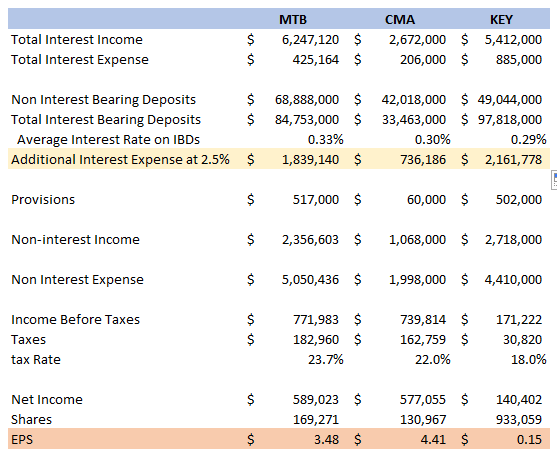
All I’ve done is taken the numbers from the 10-K, looked at the deposit distribution and added the additional interest expense from deposit rates going to 2.5%.
Of the 3, Comerica comes out looking the best. Earnings per share only fall from $8.47 per share to $4.41 per share. MTB sees earnings fall from over $11 per share to $3.48. KEY goes negative.
Comerica looks the best because they have so many non-interest bearing deposits. But is it really realistic that all these deposits stay in that bucket? What if 25% of them go interest bearing?
Those numbers are getting ugly. Key has a loss.
If you really want to get negative, just assume the overall deposit costs get to 2.5%. Each of these banks is suddenly deep in the red. Yikes!
Of course, whether that, or any of these scenarios, happen is up for debate. I’m simplifying a lot here – mostly on purpose to present just how sensitive these banks are to rising deposit costs. But there is bound to be a lot more going on than just deposit betas. And none of this happens overnight. Its gotta be at least another year before deposit costs creep up to this level.
But what happens if this, relatively benign scenario plays out: Inflation continues to come down but it is just a touch sticky. We can’t seem to sustain 2%. We start thinking 3% is best we can do. The economy doesn’t fall out of bed, it does what it has been doing, which is performing pretty, pretty good. The Fed funds is still at 5% in the summer of 2024 and there is no sign they are cutting any time soon.
Man, some of those bank earnings are going to look really bad if that happens.
And that makes me nervous. Because that doesn’t seem like a world in equilibrium.
After taking a month and a half off, I am going to get back to writing more regularly again. I took time off of more than just the blog. I really didn’t do much at all in my portfolio (which I will have updated in the next day or two). I can count my trades on two hands.
In mid-December I took new positions in Coveo Solutions and Sentinel One. In early January I took positions in CRISPR Therapeutics, Intellia and Crowdstrike. And for a brief period at the end of December I owned Tesla, but I chickened out and sold before the stock took off. I also doubled down on Eiger (more on that at the end).
That is about the extent of it. I mostly have sat on my hands, both through the down move in late-December and the recovery we have had in January.
This is consistent with my view. The market is not really cheap or expensive, it is somewhere in between, and that until we have a big event in one direction or another the market will probably range listlessly (but violently) around.
With that being my guide, we are now back near the top of the “do nothing” range, which means I should be more inclined to sell than buy. I started to do last week and will continue to do this week. Not existing positions, but making them a bit smaller.
With not much new to discuss, let me talk for a minute about a couple of stocks I bought back in November. Impinj and Identiv. Both of these names are part of a bigger idea I have about digital tracking. Tracking product more accurately seems like a natural win for efficiency and new tech seems to be making that tracking more feasible. Since I bought the stocks, PI is up a bit while INVE went straight down for a month and has since stabilized. Both stocks have not been big winners thus far.
But RFID tracking appears to be gaining traction and that traction makes sense to me so I have held on. Consider this bullish fireside chat with $PI from earlier this year.
PI has a platform for RFID called RAIN which includes one-time sales of their readers/scanners and recurring sales of RFID tags. About 75% of revenue is tags right now, 25% readers.
In the fireside chat Impinj talks about the opportunity. RFID in apparel/retail is about 25% penetrated. However about 95% of the companies are in at least early stage of deployment or better. In other words, most have started but few are at a mature stage of deployment. This bodes well for near-term demand as more companies ramp. Indeed, Impinj has had 6 quarters in a row where their demand has outstripped their ability to get supply of semiconductor chips needed to make their tags. While their mature customers are pulling back a bit with the economy slowing, this has been more than offset by the ramp of new customers. There are not too many businesses that can say they are legitimately accelerating right now.
Bigger than apparel is the supply chain opportunity, which is just starting to materialize. Supply chain is putting RFID tags on any goods or pallets along the supply chain. This is a $400 billion TAM vs a $80 billion for apparel/retail. 2023 will be the first year PI delivers tags for the supply chain vertical.
INVE manufactures RFID tags and readers, which is different than PI, which designs and develops a platform. That means INVE is not really as good of an idea as PI, in fact I’m not sure they have much IP in this space that really sets them apart. Nevertheless, INVE is much smaller in terms of market cap (~$180 million) and I think its found itself in the middle of something that could grow quite a bit.
The idea here stems around a partnership they have with an Israeli company called Wiliot. Wiliot has a lot of IP. They are a semiconductor designer focused on designing chips for RFID tags and they have come up with what seems like a prettybrilliant design.
Wiliot has figured out how to make an RFID device that works extremely well in the supply chain vertical. This device basically doesn’t need a battery and it doesn’t need a crystal, which makes it very tiny and also very independent. It is a sticker smaller than a postage stamp. It transmits and receives a bluetooth signal that allows it to communicate location, temperature, other important parameters.
They get into the whole idea of Wiliot, how they invented their product, which I think is totally fascinating, in this podcast called the Digital Supply Chain Podcast as well as on this interview with TechFirst.
While I’m still trying to figure this space out, I think that Wiliot is one of the early leaders in the supply chain tracking space. And Identiv is their manufacturing partner. INVE gets high-20c per unit price for each tag:
At 25 million units, that isn’t a huge amount. But Wiliot is talking billions over time, so that could scale quite substantially.
One other thing I did was double down on Eiger. I know its crazy and only losers average losers, but I also know this company quite well and while I recognize that they could completely destroy what is left of their value with an ill-timed and priced share offering and that because this is a money burning biotech there is a tonne of room for error, I also know interferon-lambda worked in COVID, I know that it has worked in HDV, and I know they have an approved drug that should be able to reach $40 million in annual sales over the next few years.
My guarded optimism has been confirmed, at least to a degree, by recent purchases by insiders. Here is my thought experiment on those purchases. You are the CEO or Director of a small biotech firm. Your firm is burning about $20 million a quarter. It has about $100 million of cash. Your firm just released crappy results from its lead program. The other drug, which had big potential for COVID , was just rejected by the FDA and you will need to run a big, expensive, lengthy trial before it ever has a chance of approval. Your former CEO was just turfed. You don’t have a significant readout until at least the end of the year.
Do you buy shares in your firm?
I think the answer here is pretty obviously no. Even if you like the longer-term prospects, you are likely going to need money and you might as well wait for that raise to buy because it will either be lower or come with warrants.
So why did they buy?
There was also a recent article in the WSJ talking about the efficacy of lambda and the variant agnostic nature of its action. The article questioned why the FDA would not approve such a drug. That reason could be getting more attention in the near future – the Project Veritas expose on Pfizer should bring attention to it again. While some of the Veritas work seems pretty sensational and some of the commentary about what the Pfizer executive did or didn’t say seems to be more hyperbole/fearmongering than reality, what the Pfizer exec did say quite clearly is that there IS regulatory capture of the FDA by Pfizer. This, IMO, is the reason lambda was not approved. I increased by share count by 5x which in dollar amount was a double-down.
(Note: I wrote this post last Sunday and never sent it out. Just got busy and forgot to. It’s kind of interesting for me to read over again in retrospect of another week. Wherever it says “Note:” is where I added some updated comments this morning)
Whatever success I have in the stock market generally comes from juxtaposing two opposing views at the same time: what makes sense that will happen and what actually is happening.
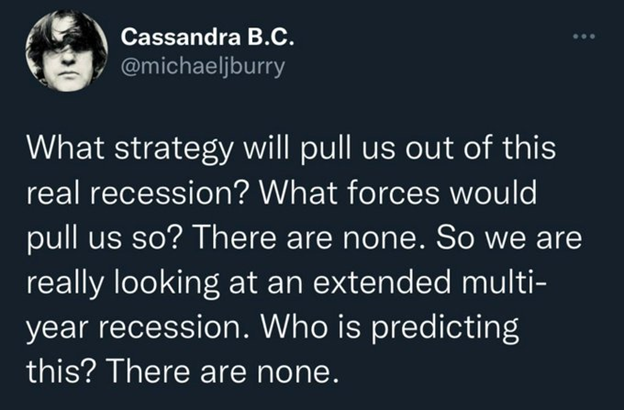
There have been plenty of bearish voices the last few months and they have been wrong. These are not your usual contras. One investor that I personally hold in high esteem, Michael Burry, tweeted this a week or two ago.
While Burry is not forthcoming on reasons (in fact we only get to see his tweets for a blink of the eye before he deletes them) others are more specific. One follow of mine that has been mostly right throughout this bear market put numbers to it:
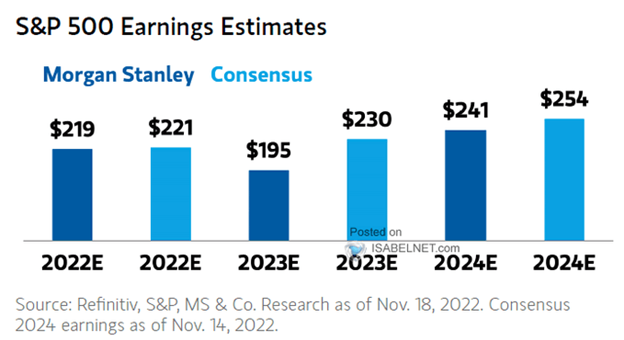
$230 x 17-18x = S&P 500 at 3,910 – 4,140. There’s your range.
So far, that is not bullish or bearish. But as he pointed out, there is plenty of downside to those assumptions. Earnings could easily come in much lower next year if there is a recession. A 17-18x multiple is quite high if rates are in the 5% range. It could easily be 14-15x – which would result in a pretty big drop from here.
This potential downside to 2023 earnings estimates seems be getting realized by the bank estimates.
On November 7th Goldman Sachs reduced their 2023 S&P earnings estimate from $234 to $224.
Last week Morgan Stanley reduced their estimates to $195 from $212.
This week J.P Morgan did it one better, reducing next year earnings to $205, down 9% from an earlier forecast of $225.
You kind of look at all this and can’t help but think, hmmm, this doesn’t seem like a great time to be going hog-wild risk-on here.
And yet….
Stocks go up. (Note: Maybe that is ending though?)
Let me tell you why I hate macro so much. It is such a waste of time. Yet it isn’t.
You do a bunch of work and you form an opinion that seems based in fundamentals and reason. And then the market opens up and does the opposite, so you dump all those thoughts for the time being and just trend follow the direction of least resistance.
Which makes it seem like a waste of time.
But acting on big picture macro isn’t really what it is for. I think it is more for reacting.
Your big picture assessment is sitting in the back of your mind. It informs you by degree. If you are bearish, it does not mean you don’t act bullish-ly if the market is bullish. It means you act less bullish. And you turn more quickly if the market turns.
Right now, while the market seems expensive, there are pockets that do not.
Consider Dicks Sporting Goods. I didn’t make a lot of trades the last 4 weeks (Note: 5 weeks now, still not too many trades). Less than 10. Dicks Sporting Goods was one of them.
Buying Dicks was a bit odd for me. Quite honestly, I thought these pandemic sporting good winners would go up in flames once we got back to normal (remember I used to own Big 5 Sporting Goods last year and I had revisited the stock a few times, but wasn’t convinced enough to buy it back).
I came across Dicks on the morning of their earnings release. Just going through my usual morning routine, reading the press releases of companies reporting.
Dicks reported and they were extremely good numbers. No real deterioration. A lot of free cash flow.
And the stock? Well, it is cheap… if those number are close to sustainable – which, with that earnings release, we know they are for at least another couple months.
Yet lots of investors are short Dicks. The short interest is 21%. I can see why – same reason I was thinking sporting goods was done. Collapse in sales, collapse in profits.
Except that hasn’t happened. At least not yet. Dicks did $1.3 billion of FCF in 2020. They did $1.3 billion of FCF in 2021. They are well on their way to doing a billion+ this year. The stock had a $8b market cap that morning I bought it after earnings. The market had bid it up a couple bucks but really not much at all.
So I don’t know. Maybe Dicks is still going to implode. If the recession is extreme enough, it probably has to. I feel like this is a favorite of hedge fund shorting, who certainly know more than me.
But this is a stock trading at 7-8x FCF on a FCF number they have hit for 3 years running now. It is a stock with a large, short interest that isn’t working out right now and is staring down being short a company at a single digit free cash flow multiple.
This is a trade and I admit I still don’t know what exactly is sustainable for Dicks so I don’t know how much patience I have with it. Dicks is a good example in another way – a stock I am long but don’t have a lot of conviction in. The reason you don’t see any real stock writeups from me (other than that Snap one a month back).
The point I’m making here is more general – that this a market that is expensive and in some ways it really isn’t. And there are a lot of people offsides the ways it maybe isn’t expensive if things don’t go down just right. (Note: still holding Dicks this week, still have very tepid conviction)
So I don’t know. I just don’t know…
Let’s see, what else… well, my Home Capital idea did not go well. I’ve said it before – I don’t make a short more than 0.5% because you just never know. Fortunately, I stick by this rule religiously, and so even when a huge premium takeover bid for Home Capital happened, I only took a small punch in the mouth from it.
To be honest, I cannot fathom an economic reason why you buy Home Capital now at the price it was bought for. It makes zero sense to me. You are buying it at a higher price than it has ever traded at, at a time when Canadian real estate transactions are at their lowest point in many major markets in 20 years?
It really is like, huh? As I made clear in my post on Home Capital, the business is probably not as sensitive to default as you might think because of the short-term nature of their loans and deposits, but it is extremely sensitive to transaction volume and those have fallen off the cliff. GTA home sales for November were down 54%. Vancouver home sales down 53%. Calgary sales down 20%. I mean this is not good for Home Capital.
Anyway, if you ask me the whole thing smells a bit odd. (Note: this whole situation still seems odd to me. The Canadian RE market looks worse today then even a week ago. I took a small put position bet on HCG as a low-probability bet that the deal falls through. If HCG falls back to its pre-deal level it will make ~30x. If it doesn’t, I lose the small amount I put into the puts).
Final thing I’ll mention is a second bet that hasn’t really worked out yet. I have still not given up on my SaaS bets but I have to admit, my patience is wearing thin.
A couple months ago I took bets on Datadog, Zoom and Adobe. They were all pretty bombed out and it just seemed to me like it was worth betting on at least a bounce.
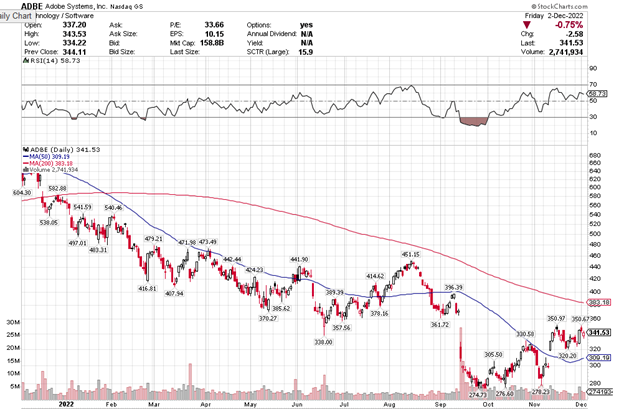
Of the three, only Adobe really worked. It worked because it was bombed out so bad. One thing that has worked pretty well in this market is to wait until a stock is absolutely decimated and hated and then buy it. It happened with Netflix. With Meta. And Adobe.
I bought the stock in the $270s and sold it in the $320s. That is a long way from where Adobe was a few months ago. But it is also a quick 15% gain.
With Zoom and Datadog though, it hasn’t really worked. I already sold Zoom after earnings. The trouble I had with their earnings is just that even though Zoom is a heck of a lot cheaper than it was a year ago or even a few months ago, its not really cheap, cheap. It is still a 19x PE, a 11x EV/EBITDA, and its not growing all that much at the moment. So its like, I don’t know…
As for Datadog, they are really not cheap, even still. I worked through a bunch of discounted cash flow scenarios for Datadog and I still only can get a fair value of $100 and that is even before you account for stock compensation dilution. So again, I’m holding it still for the moment, but I don’t know… (Note: still holding Datadog, also even though I was quite negative about SaaS last weekend, I also held onto SentinelOne and Twilio, at least for another week).
(Note: like I said at the start, I wrote this post last Sunday, so before the Eiger results came out. So these were my pre-results thoughts, which as I note, I unfortunately did not follow up on)
One last loser I will talk about. Eiger. I’ve talked about it a bunch and I’ve been basically wrong on it. And now, with a read-out coming up on their HDV program, I feel more like making sure I limit my losses than trying to make it all back. I plan to sell down my Eiger position by half and take the loss (Note: So, I didn’t actually do this. I took the loss).
This one is all about managing the risk. I guess-estimate that if the HDV numbers (which they are going to release sometime this month) miss, the stock is probably going to go down another $2. If the results are good enough, it could go up $2-$4. So I basically asked myself, how much risk am I willing to take on this. I have to size appropriately.
(Note: I wish I would have done the following but didn’t) I am actually considering dropping the position entirely to just buy some calls on the stock – to keep the upside but make the downside a fixed number. I may do that this week if the option prices make sense. It is a good situation for it because it’s a fixed event, a known timeline, and you can fix your loss.
(Last Note: So yeah the Eiger results were unexpectedly poor. I read the Citigroup note that came out Friday and they said that lonafarnib still will likely be approved, they gave it a 75% chance, but with a far smaller revenue potential – $250mm max.
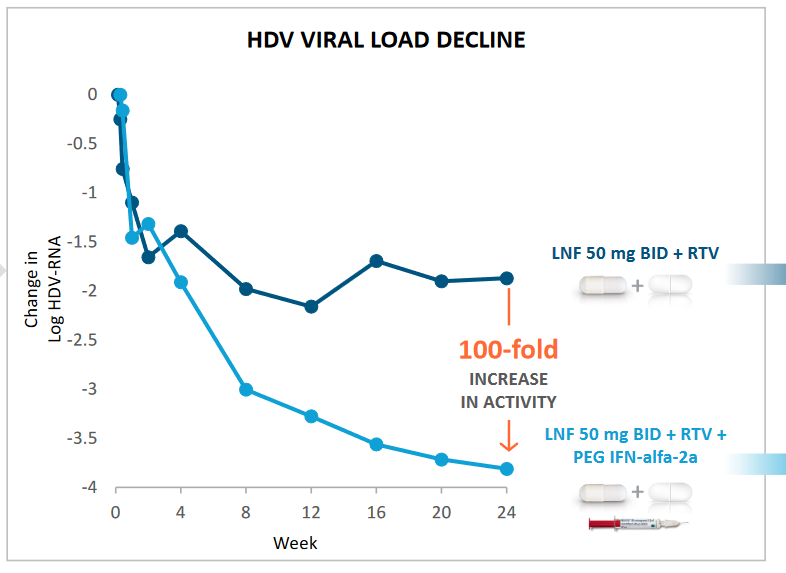
The problem essentially is that the drug works for about 16-24 weeks and then effect wanes. See the slide below, particularly the virological response:
Eiger doctors running the study were as surprised as anyone. If you go back to the Phase 2 trial (those results below) you saw the leveling out, but it wasn’t really evident that the effect would reverse like it did:
If the drug is approved it would be as a short-term stop-gap for 6 months or so. It has some value because its an oral drug with few side effects (compared to the other options) it does seem to work quite fast and the other drug is a daily injection that works more slowly.
Like I said above, even though going into the study I was wary, for some reason I held on to the stock, I guess showing a blind side of having held it so long, wanting to see it through.
For one, there is the whole losing money business. For two there is the increased difficulty of it all. For three, bear markets uncover truths that just make you tired.
In a bull market you can have a thesis and you can watch it play out. You can feel the exhilaration of being right as the market confirms what you knew (really suspected) all along.
In a bear market you realize that this is mostly hooey.
It is not that you can’t have a thesis or an idea. Bear markets are obviously great for the short-selling ideas. You can bet against a business and do wonderfully.
But even then, what underlies the win is the impermanence. Every short is just the broken thesis of a former long. While some longs may be scams that deserve to go down, most are not. A bull thesis that may have rightly been right for a month or a year or a decade now turns out to be terribly, terribly wrong.
So what was it? Right or wrong?
It is just circumstance. If circumstances had been different the perfect short may have been the perfect long, at least until those circumstances changed. Look at the group that has fought Tesla all these years.
The same goes for the bear market bear. You know your time is short. You know that your thesis is also built on sand that will harden fast if the business turns. A pivot, a return of dis-inflation, an acceleration of the business, a takeover, a sudden shift in strategy or even just a boat too heavy with other shorts, and all those arguments you have of why the stock should go down will be useless.
A bear market strips it all to the bone. It is just a game, with its own internal rules, and those rules are only loosely tied to daily workings of the companies at hand. If the rules were more closely tied to the business itself, stocks would never go up that much and not come down so much either.
The opportunity is just in the game and its rules.
Oh well.
We are a year and a half into this bear market, and I continue to mostly stand still. Had I just sat in cash for this time I would only be marginally worse off. In the accounts where I can’t short, I would be about the same. If you factor in the effort, the argument can be made that this would have been the better tact to take.
Where I can short, what is a bit frustrating is that, some 9 months in and 20% lower, I have actually been right about a lot of shorts, but that “right-ness” hasn’t been reflected as much I would have hoped in my overall portfolio performance.
Wondering how this happened, I took on the task of looking back. What I had shorted back in January, when the bear market was new and not really considered a bear market yet.
My shorts in January were inspired! Here they are: I went short Adobe at $515, Hubspot at $526, Cardyltics at $67, Salesforce at $218, Carvana at $157, Datadog at $144, Lightspeed at $40, BigCommerce at $33, Atlassian at $319, Fastly at $32, Open Lending at $19, OneSpan at $16, Daqo at $36, Tesla at $308 (split adjusted), Nvidia at $216, Sea at $128, Paycom at $312, Netflix at $400, Quantumscape at $21, Okta at $202, Silvergate at $137 and Amazon at $142 (split adjusted).
Quite honestly, on those names alone you would be hard-pressed to not assume I had shot the lights out this year. All of these stocks have been decimated.
Yet, I haven’t really shot the lights out. I’ve done okay, but not as well as it should have been given those names above.
<portfolio snapshot>
So why did my overall portfolio not kill it even when I had made a number of correct decisions like shorting all those stocks above?
That is really what I wanted to think about when I pulled up my short list from January. What exactly happened?
First, the obvious reason is that my longs did not do that well. Looking at January transactions, there are some pretty awful stock picks there. I went long Finance of America at $3, Precision Biosciences at $3.50, Smith Micro at $3.90, Checkpoint Therapeutics at $2.30. What in God’s name was I thinking! Yikes!
All these stocks were disasters that fell precipitously from where I bought them.
But this doesn’t really explain things in full, because in all of these cases I did not stick around for the collapse.
I sold all or part well before they could make too much dent in my portfolio. If there has been a savings grace for me in this bear market, it is that I have been quick to reconcile with my propensity to be wrong, and have taken action swiftly and without remorse.
But if I can only marginally blame my longs, what can I blame the rest for?
To get an understanding of what happened, I made a spreadsheet and ran the numbers and those January shorts alone.
If held all my January shorts until today instead of doing what I did with them, it would have contributed an extra 7.2% of positive performance.
While I did not run numbers on shorts I initiated for other months, I bet that in total my bypassed gains exceed 10%, maybe even 15%.
With most of these stocks I shorted I was quite confident they were going down. Yet all these gains were bypassed because I didn’t sit tight. Why?
Here is the crux of it I think:
Bear markets are a mauling. But not just for longs.
The mauling is far more general. Bear markets are made for a mauling of conviction. They are indifferent to whether that conviction is bullish or bearish. All preconceived notions of what the future may hold must be exterminated.
The reality is that if I had stuck with all of these shorts from January until today, they would have added a lot of gains. But the path from A to B was fraught with temporary losses that proved too great for me to take.
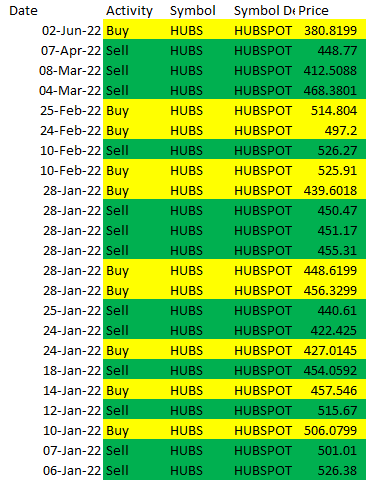
Let’s look at an example. Hubspot. I shorted Hubspot on January 6th at $526. I shorted again a few days later at $501.
Hubspot is a great example because it was such an overvalued POS in January. I mean, my goodness, it is just software. I was quite convinced in January that HUBS just had to go down. It was extremely overvalued on any metric, it was not really making any money, it spent gobs on stock-based comp that concealed real wage expense and from what I could tell it was not even all that great of a platform.
And in fact, HUBS has gone down. The stock price is $265 today. Had I just sat and held that HUBS short, for every $1,000 I had shorted I would have made $500.
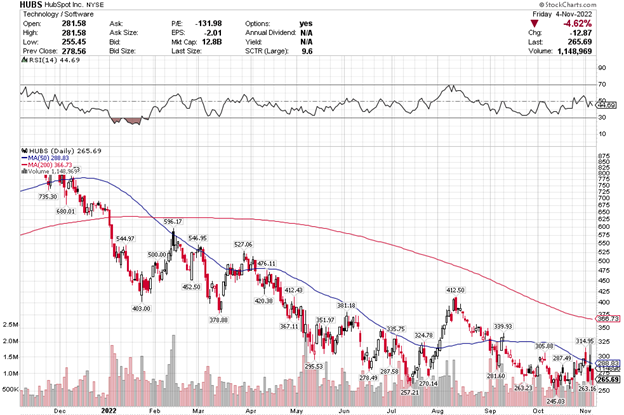
Sounds easy. But here is the trajectory of HUBS.
It is the path where it gets tricky.
Holding that short would have meant watching all my gains wiped away in an early February rally, watching all my gains again wiped away in a March rally, and then, after finally making a killing down to the July lows I would have had to endure a move back to $412 in mid-August, wiping out more than half the gains one last time.
This is not an easy path. It is a mauling of conviction.
What did I do?
A couple of comments about my actions above.
First, I was clearly skittish about this position. I was worried it might not work. More than once I covered only to re-initiate the short in days at basically the same level. This for a stock that I truly despised and that seemed horribly mis-priced to me.
Second, once it got to $380 in June, I did not short HUBS again even as it fell to $265. Why? The answer is in that last cover.
If you squint really hard at the chart of HUBS, you will notice that on June 2nd HUBS got to $381.18. This marked the short-term high before another leg down.
I covered my HUBS for the last time at $380.82. That is 36c below the high.
I don’t remember the particulars of that day, but I think it is safe to say that I panic-covered at the top. I was so disgusted with this decision that I stayed away from the stock from there-on even as it began to fall anew.
If I add it all up, I captured 44% of the gains with HUBS that I might have captured if I had just held the short from January 6th until today. When I do the same for my January short book as a whole, it is a little under 50%.
To say it one way, the bear market mauled me out of more than half my winnings.
It brings to mind a well-known quote from the actual Reminiscences:
“After spending many years in Wall Street and after making and losing millions of dollars I want to tell you this: It never was my thinking that made the big money for me. It always was my sitting.”
But there is a catch here. It is hindsight. In March I did not know that Russia would invade Ukraine and set forth a cascade of events that would lead us to 8% inflation and 4% interest rates just 6 months later. I did not know the Fed would tighten to this degree.
Most importantly, I did not know that my portfolio would stop going down in mid-June and recover through the summer.
While as I said, I don’t remember the specifics of June 2nd, I will tell you the generalities of where my headspace was.
On June 2nd the S&P had just finished a rally back to 4,100. I had been caught more-short than I should have been into that rally. At the same time, some of what I was long – a number of the biotechs, Finance of America (my god to think I went back to the well twice here!), some of the regional bank stocks – had not done all that well even as the market rallied. I felt horribly offside.
So I did what I always do when I feel horribly offside. I sold. I reduced my longs across the board and I reduced my shorts. Including Hubspot.
I did not cover Hubspot because I thought the bottom was in. I covered because too many things were not working and so I had to get back to a place of neutral and re-evaluate.
You could argue it was a mistake. I mean, from a strictly HUBS-centric point of view it was a mistake. From the Reminiscences point of view, it was a mistake. Again, quoting from the book:
“Men who can both be right and sit tight are uncommon. I found it one of the hardest things to learn. But it is only after a stock operator has firmly grasped this that he can make big money.”
But now we come back to the “game”. The concept of a “mistake” is premised that there was some sort of goal that was not achieved in part because of that decision.
What is the goal here? Is it to be right? To be able to say I rode HUBS all the way down. To brag that I nailed a big short? Who am I saying this to?
This is not a movie. And no one really cares.
I’m past the point of trying to “make big money”. The only goal is to keep on keeping on. Remember that the fate of Livermore was not a good one.
I want to come out of this bear market in the best position possible for the next bull market. The only scorecard is the roof over our heads the meals on our table.
It is a game. The bear market makes that plain. But the bear market also makes plain that the essence of the game is that it is not a game at all. So know your rules and stick by them, or risk getting mauled.