Skip to content

Trying to Decipher what the Syncora deal means for MBIA

Yesterday Syncora and Bank of America announced an agreement to settle outstanding litigation with respect to the residential mortgage backed securities (RMBS) originated by Countrywide and insured by Syncora.  The essence of the agreement was as follows:

In return for releases of all claims the Company has against Countrywide and Bank of America Corporation arising from its provision of insurance in relation to five second lien transactions that were the subject of litigation and all of the Company’s claims in relation to nine other first and second lien transactions, the Company received a cash payment of $375 Million.

Obviously the settlement has importance to MBIA.  MBIA is also in the middle of litigation with Countrywide to settle RMBS insured by MBIA.

The outstanding question is what Syncora expected to get versus what they ended up getting.  Now what they got is easy.  Its $375 million.  What they expected is a bit trickier.

Alison Frankel, with the help of Barclays, took a stab at this in an article today.  She wrote the following:

Barclays analysis of the Syncora settlement estimated that Syncora’s lifetime losses on all of the 14 mortgage-backed securitizations the deal addresses are as much as $1.4 billion, which would mean that Syncora’s cash award of $375 million represents only 27 cents on the dollar.

But there was the following caveat:

But there’s yet another wrinkle. Syncora, which is a successor to XL Capital Assurance, bought back a lot of its obligations in a 2009 remediation campaign. According to a corporate press release, the insurer “achieved 68.4 remediation points,” which apparently means it bought back more than two-thirds of its policy obligations. The Barclays analysis does not seem to discount its estimate of Syncora’s lifetime losses to account for the remediation, which means its cents-on-the-dollar analysis is probably low.

I’ve looked through Syncora’s filing and the press releases and I think the Barclays analysts have it right.  Here’s my reasoning:

On slide 13 of the Q4 2008 Syncora Guarantee Inc. Insured Portfolio Summary it states that Countrywide was the largest exposure with $2.607 billion.
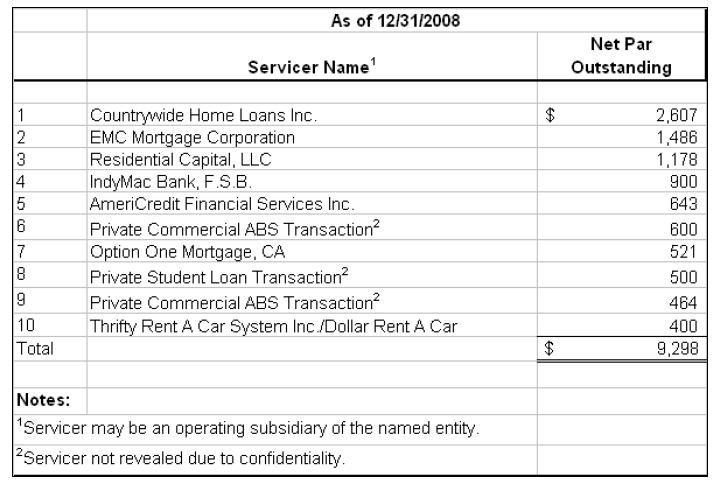
If I look back at the press releases associated with Syncora’s RMBS remediation campaign, Syncora was actually very forth coming and specified the total Aggregate Principle Balance being committed on a security by security basis.  That can be accessed here.

I parsed through these securities and filtered the Countrywide originations. Countrywide accounts for all of the Countrywide Home Equity Loan Trust and all of the Harborview Mortgage securities (for confirmation that Harborview was indeed a Countrywide entity, take a look at any of the SEC filings for Harborview, for example this one).   If you add up the aggregate principle balance of the Countrywide Home Equity and the Harborview Mortgage securities, it comes out to $1.258 billion.

Now the press release I got this data from was released before the tender was complete, but only by a couple of days.  If you add up the total committed principle specified in the press release you get $3.537 billion, whereas in Syncora’s final press release on the restructuring the amount was $3.8 billion.  So its close.

Subtracting the commuted exposure ($1.349 billion) from the total Countrywide exposure ($2.607 billion) you get $1.349 billion.  This is pretty much bang-on what Barclays had estimated.

Muddying Factors

What is less clear to me, and what I really have no way of determining, is whether the $350 million recovery should be compared against the $1.349 billion in securities, or against a much smaller amount.

As Frankel points out earlier in her article, the litigation that Syncora had against Bank of America was for 5 second lien transactions.

Syncora’s last amended complaint against Countrywide, filed in 2010, alleged that the insurer had paid out $145 million to policyholders in five Countrywide home equity-backed securitizations and had received another $257 million in claims from those five deals. That’s a total of $402 million

The complication is that in the press release Syncora talks about an additional 9 securitizations that aren’t a part of the litigation, but that are also part of the settlement with Bank of America.

…all of the Company’s claims in relation to nine other first and second lien transactions

Presumably the 5 plus the 9 securitizations add together to be $1.349 billion in total exposure.  And if all 14 securitizations are fraudulent, and Syncora could have expected to recover on all of them, then Syncora’s overall recovery is not that great.

But I’m not sure that is the right way to look at this.  There are a couple of considerations that paint a bit rosier picture of the settlement, and provide a bit more hope for MBIA.

First, having become rather familiar with MBIA and their history of litigation, its clear that MBIA was continually adding claims as they found them.  That Syncora did not do this, and instead limited the litigation to 5 of the 14 claims, suggests to me that perhaps the other 9 claims weren’t fraudulent.  If this is the case, that Syncora was able to release future claims on these additional 9 securitizations is actually a bit of icing on the cake.

A second point is that Syncora did not appear to be expecting anywhere near $1.35 billion in recoveries.  Going back to the lawsuit, Sycora was looking for a total recovery of $405 million.  In addition, taking a look at the last Annual Statement Syncora said it had put back $1.6 billion in total RMBS and that it expected to recover $212 million on these amounts (Page 14.35):

As of December 31, 2011 and December 31, 2010, the amount of mortgage loans that the Company is seeking sponsors to repurchase aggregated approximately $1.6 billion and $1.3 billion…As of December 31, 2011 and December 31, 2010, the Company estimated that it would realize a net benefit from such recoveries aggregating $212.1 million and $168.5 million, respectively.

These amounts included loans not only from Countrywide but from EMC and Greenpoint.  I imagine that these recoveries are in addition to the $405 million Syncora was looking for from the Countrywide litigation.  I also imagine that the 9 un-litigated securitizations would be included in this amount, which suggests that Syncora was not looking to recover very much from these 9.

A third and related point is that while the RMBS are experiencing default, it is unlikely that the entire RMBS is in default.  Claims will be lower than the total outstanding principle balance.  Taking a look at the notes to Syncora’s last quarterly statement, the company said that for the first lien securities:

A loss severity was applied to the first lien defaults ranging from 56.1% to 82.9% based upon actual loss severity observances and collateral characteristics to determine the expected loss on the collateral in those transactions.

For the second liens and HELOCs they did not break out the default so neatly into a percentage but still it could be said that th number will be somewhat below 100%.

Can you project to MBIA?

To sum it up, I don’t think that there was anything wrong with the Barclays analysis noted by Alison Frankel.  But I also think there are other mitigating factors that need to be considered before trying to project what this settlement means for MBIA.  Without more details as to which of the securities are fraudulent and therefore legitimate put-backs, and what the loss severity on each securitization is expected to be, its difficult to put a number to what the recovery is.  In the absence of such detail, I am inclined to take Syncora at its word, and assume that they expected recoveries of around $400-$600 million.  If this is the case, then the resolution was well within the range of what would be a nice payday for MBIA if they can settle on similar terms.
Why I am starting to like the Mortgage Insurers

The mortgage insurance business has been a tough business to understand.  I have been working for a number of weeks now trying to wrap my head around it, first with MBIA (which strictly speaking has a financial guaranty business not a mortgage business, but same diff), and then with Radian Group and MGIC.  Each company has unique intricacies that take time to work out.  Its been a slog.

But while the companies are different in their details, there are some common reasons for the difficulty:

  1. The accounting of the business (particularly in the case of financial guaranty) is complicated by derivatives that are mark to market and/or on the balance sheet but not fully recourse to the company
  2. The mortgage industry is soon to see regulations that will change its landscape (these go by the acronyms QM (quality mortgage), QRM (quality residential mortgage) and the future of the GSEs (Fannie May and Freddie Mac)).  The final details of these regulations are still very much up in the air
  3. The remaining legacy losses from the mortgage crisis are going to be determined by the future rate of default of the homeowners the companies have insured.  Given that what has occurred in the US Housing market is unprecedented, there isn’t a historical guide to help predict how those defaults are going to play out

Nevertheless, I am slowly working my way through each complication, and as I do the picture that is emerging is one that is certainly ugly but that also holds promise.  The reasons that make the mortgage insurance business difficult to understand are the same reasons the companies in the space are trading at bankruptcy like valuations.  To put this in perspective, Radian and MGIC both traded at $60 plus per share in 2007.  Today they are at around $3.  I doubt that either company is ever going to go back to its old high, but the basic business that led to those earlier valuations is essentially intact and with a few things going right, the stock price of each could be significantly higher than it is today.

That basic business, when you get past the accounting jungle, is really pretty simple.  These are insurance companies.  They write contracts where they agree to pay if a borrower defaults on their home loan.  In return they receive a fee (called a premium) either up front or on a periodic basic.  They are also required to have a reserve  put aside to pay out the claim  in the event that there is a default. Until a claim payment is required they earn returns on investing that reserve.  In the aggregate, as long that the cash that the insurer receives from its premiums and the returns on its investments exceed the amount that they have to pay out in claims, then the insurer will be making money.

Both Radian and MGIC are still performing that basic business.  What’s more, the volumes that they are writing, while down from their pre-crisis, pre-housing bust highs, remain substantial when compared to the current value of their equity.  Of late, these volumes are also showing substantial year over year increases.

To illustrate the potential, in 2011 Radian wrote new insurance that will provide $717M of premiums over its life time (compared to premiums collected on existing insurance of $680M).  Before the housing collapse caused claims to skyrocket, you could expect returns after claims of at least 10-15% on that insurance.  So maybe $70-$100M in earnings.  In addition Radian produced investment income of $225M in 2011.  Expenses and costs of the mortgage insurance division is about $150M.  Radian has about 133M shares outstanding.  Adding these elements together you can see that absent the legacy book of business, its not unreasonable that the company would be earnings over $1 per share.

Of course the problem with the insurers is the legacy book.  In the case of Radian, that legacy book produced $1.3B in provisions for loss and over $1.5B in actual claims paid.  These numbers dwarf the premiums Radian is receiving and any income its earning from premiums and on its investments.  The result is a massive loss, particularly on a per share basis.

You could run through the same analysis for MGIC and draw similar conclusions.

My thesis here is that the legacy book will not always be the problem it is now.  And it appears that defaults from the book have peaked.  House prices in many areas of the US have stabilized and in some areas they are rising.  And the regulatory framework being developed seems to creating more space for private mortgage insurance.

I’ll have more to write on both Radian, MGIC  and the current regulatory state of the US housing market in upcoming posts.  What I wanted to outline here is the potential.  It is the potential that makes these companies worth investigating further.  If the business does turn around, we are talking about multi-bagger potential.  Of course if it doesn’t… well they may be headed for bankruptcy.  Now I fully admit that I am still fuzzy on whether the business can turn around before the companies run out of cash to pay off claims in their legacy book.  But it appears that the carrot  is big enough to justify an attempt to figure that out.

Week 53: Betting on a Housing Bottom

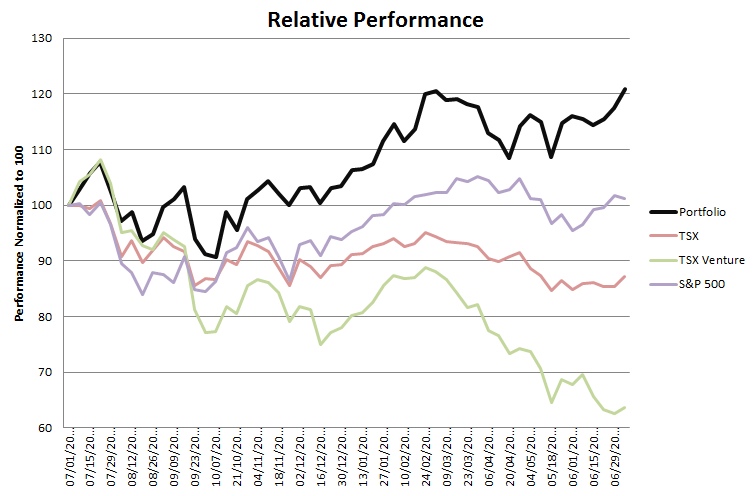
Portfolio Performance

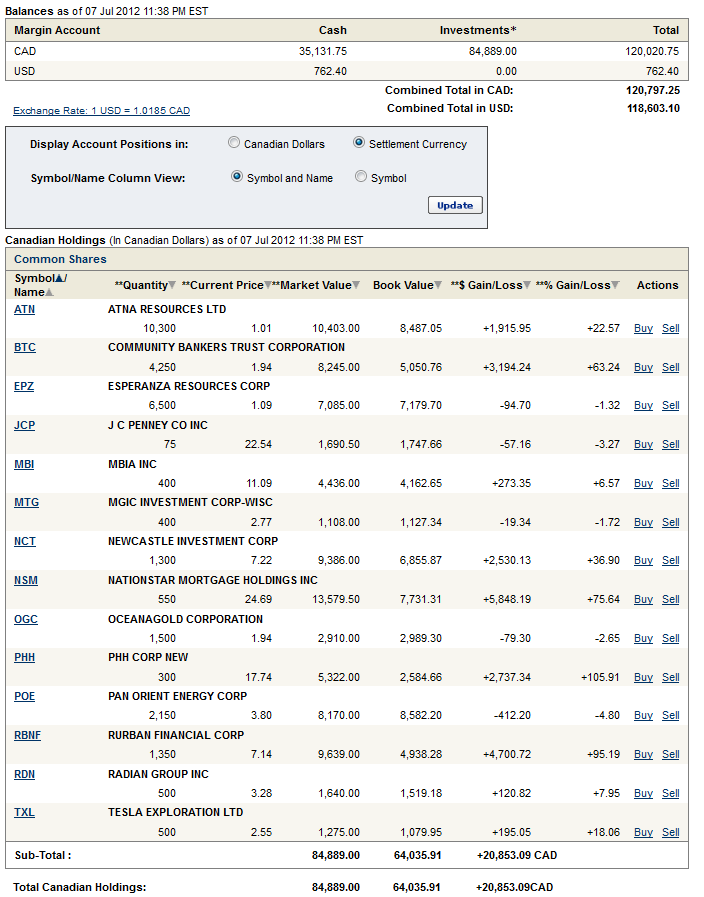
Portfolio Composition


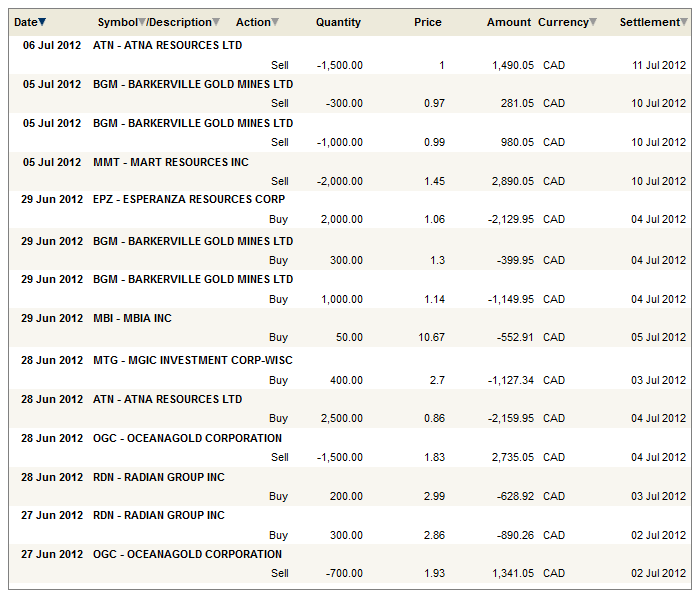
The trades that took place in the last two weeks can be viewed here.

Summary of Portfolio

There were a couple of positions that had big moves over the last few weeks.  The first is Nationstar Mortgage Holdings (NSM).  Nationstar is now more than a double from my original purchase and up over 75% for the entire position.  Both Nationstar and Newcastle Investments (NCT) have been strong of late, and I think that’s likely due to the expectation that they will win the ResCap bidding war.  According to an 8-K filing that Nationstar made on Thursday, their bid for ResCap was raised $125M. At this point the risk is that they don’t win the bid and that the stock falls back.  However, I bought the stock well before the Rescap sale and I still believe that there is some upside even ignoring Rescap.  Even without the Rescap deal, Nationstar has grown substantially through the purchase of the Aurora portfolio and Bank of America’s servicing assets. I’m reluctant to sell any shares yet.

Another stock that has had quite a run is Rurban Financial (RBNF).  The last time that I talked about Rurban was mid-May, and I haven’t mentioned them since because, well, nothing has happened.  The stock is boring and goes up. I like that.  However if you had asked me back when the stock was $5 when I would consider selling I probably would have said around $8.  We are getting close to that number now.

As I wrote about earlier this week, I added positions in two monolines, Radian Group (RDN) and MGIC (MTG).  Of the two, I am most inclined to add to Radian on any pull back.  I’ve been reading whatever I can get my hands on about the mortgage insurance industry over the last week and I think I have wrapped my head around most of it.  The regulatory landscape is really quite mind-boggling, the changes that have taken place since 2008 quite tectonic and there are about a million acronyms used with many of their definitions not easily found.

Nevertheless, out of chaos come opportunity.

I really like what I see in the insurers; the leverage to a housing bottom (just a bottom, not a barn-burning recovery), the cheap price (close to being priced for bankruptcy),  insuring what are probably some of the best quality mortgages they have ever insured, margins increasing as their government owned competition, the Federal Housing Authority (FHA) raises their prices in an attempt to limit the government market share, and the insurers stand to benefit from the general stance that seems to have evolved that government should limit their role in the housing industry and that private insurance should take more of a role.

What holds me back from making these insurers larger positions is the economy itself.  A recession would not be good for housing.  Nevertheless, I am somewhat emboldened by the fact that the stocks I own that are dependent on the US economy (in addition to those discussed already I would put Community Bankers Trust (BTC) , MBIA (MBI) and PHH Corp (PHH) into this bucket as well) have held up quite well in this latest downdraft.

What I sold

I sold Mart Resources (CA:MMT) this week (note that while I sold the stock in the portfolio I track here, I do still own a position in other portfolios).  When I originally bought Mart four weeks ago I wrote the following

The company has two news events that I suspect are going to occur shortly.  The first is the potential for an announcement of a dividend.  I believe that such an announcement could result in a significant pop in the stock, as it gives credibility to what is otherwise looked on warily as a Nigerian story.  The second is a pipeline deal with Shell, which would allow Mart to increase their production, perhaps substantially, and allow the brokerages that follow the story to up their targets based on larger 2013 volumes.  Again, I am looking for an event to occur in somewhat short order, but I am not holding this stock for the long run.

Mart released news earlier this week that they were going to provide a quarterly dividend of 5 cents a share and a special dividend of 10 cents.  They announced the pipeline deal  a week before that.  The stock is still cheap; it trades at maybe 4x cash flow (which does not consider the production expansion that will come in the next year) and at a rather silly 14% yield.  I’ll probably buy back in at some point, maybe even soon.  I just don’t love the way the market is behaving, in particular the way that Spanish bonds have jumped back to nearly 7% and so I am reluctant to .  I also don’t rally buy this oil rally; it seems prefaced on Middle East tensions and that is fickle mate.  Mart, having moved so much higher so fast, seems like it would be likely candidate for portfolio trimming if oil drops again below $80.  I’ll wait this out and see what happens over the next couple of weeks.

I sold some OceanaGold (CA:OGC) in the last two weeks.  Part of what I sold was because I thought that Atna Resources (CA:ATN) had gotten too cheap again at $0.85 and so I moved money from OceanaGold to Atna.  I have also been researching Esperanza Resources (CA:EPZ) and I thought that they, having been hit from selling after a share offering but now having plenty of cash and owning my preferred heap leach deposit that will be low capital expenditures and low cash costs, were in a better position in this uncertain environment.  The other reason behind the selling was that these gold stocks just aren’t working.  The jobs report on Friday should have sent gold flying, but it didn’t.  The thesis I have expected isn’t playing out.  Whether that is because the Rupee is so low that Indian demand is sluggish, because investors aren’t willing to think of gold as a safehaven just yet, or because there is a nefarious plot to undermine gold being played out in smoky dim lit rooms on the outskirts of Washington, the bottomline is that it hasn’t been working.   And I always try to do more of what works and less of what doesn’t.

Finally, my adventures with Barkerville ended on Thursday when I sold out.  The deciding factors were that the stock wasn’t behaving like a stock should if it truly had a 10 million ounce deposit (though the alternative explanation that the weakness is being caused by warrant holders cashing out could be contributing), and that the data that is available from the company just doesn’t look like 10 million ounce material (if you look at the 7 sections that Barkerville has on their website, it looks like Cow Mountain has a number of narrow (albeit potentially high grade) veins. It also looks like the veins are somewhat sparsely populated across the length of the intercepts.

I honestly have no idea what Barkerville does or doesn’t have and so I have decided to make discretion the better part of valor until such time that I do.

Adding more Mortgage Insurers

I have already written about how I stumbled upon MBIA Inc. (MBI) as I was researching mortgage insurance companies and in particular MGIC.  My interest in the mortgage insurers has been brought about by my desire to seek out companies that might benefit from a turn in the housing market.

I am not looking for a hockey-stick-like turnaround in housing.  I don’t expect to see prices or new constructions having a significant rise any time soon.  But I do think its  plausible that we are at a point where things no longer get worse.

How to play the bottom

Thus far, I’ve looked to play this bottom in a couple of different ways.

My foray into the servicers has been an attempt to capitalize on the premise.  Nationstar Mortgage (NSM), Newcastle Investment Corp (NCT), Home Loan Lending Services (HLSS), PHH Corp (PHH); all are examples of companies that should benefit from a stabilization in the mortgage market.  So far the thesis has paid off and I am up (since my purchases at the beginning of the year) well over 50% on Nationstar, about 30% on PHH Corp, and 15% on Newcastle (not counting the dividend).

I have also been able to capitalize on the trend by jumping into select regional banks that had exposure to the mortgage market turnaround.  Both Rurban Financial (RBNF) and Community Bankers Trust (BTC) have been big winners for me here, returning thus far 50%+ since the beginning of the year.

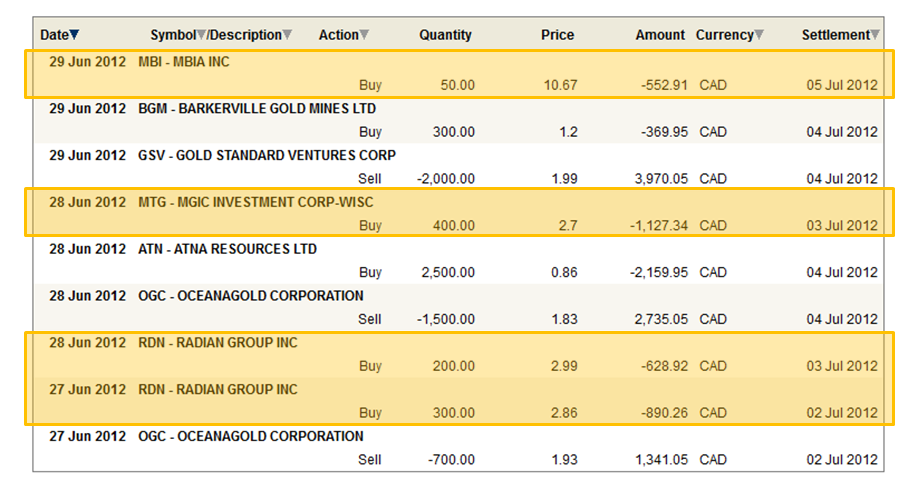
I now have have a third business for playing the housing bottom.  The insurers.  In addition to MBIA, last week I bought a fair position in Radian Group (RDN) and a lessor position in MGIC (MTG).  I also added a little to my position in MBIA (MBI).  In the case of Radian I unfortunately didn’t catch the bottom in the stock, but at least was fortunat enough to have gotten in well before the week long run ended, and I am actually seeing quite a profit on the position already.   Trades in my practice account that I track here are shown below:

Why Insurers?

I tend to have a lot of significant thoughts on my bike ride home.  It must be something about the state of semi-awareness that biking down major thorough fares in rush hour does to one’s brain.  On the one hand, what with cars whizzing by you and changing lanes and pulling out you are always on alert.  On the other hand, its the same ride you have done hundreds of times and so it is easy to day-dream yourself into a whole other world of thoughts.

It was about a month ago that I was biking home from work and thinking about what other businesses could benefit if the housing market in the United States just stopped getting worse when it occurred to me that I really should be looking at the mortgage insurers.   If ever there was a business whose livelihood was dependent not on a robust recovery in housing but instead an end to the continual decline, it was the insurance business.  As a mortgage insurer, you are less concerned if prices rise or new sales increase than you are that people don’t default on their loans.  Clearly, people not defaulting on their loans is  the necessary condition to any housing recovery.

This appears to be happening.

The most recent Home Price Index (HPI) report, put out by CoreLogic,  said the following:

“We see the consistent month-over-month increases within our HPI and Pending HPI as one sign that the housing market is stabilizing,” said Anand Nallathambi, president and chief executive officer of CoreLogic. “Home prices are responding to a restricted supply that will likely exist for some time to come—an optimistic sign for the future of our industry.”

Meanwhile, according the CoreLogic Shadow Inventory report, serious delinquencies in some of the hardest hit areas are showing big year over year declines:

Serious delinquencies, which are the main driver of the shadow inventory, declined the most in Arizona (-37.0 percent), California (-28.0 percent), Nevada (-27.4 percent), Michigan (-23.7 percent) and Minnesota (-18.1 percent).

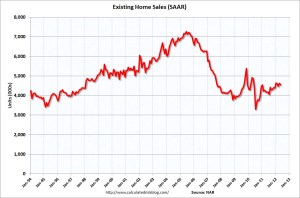
A look at charts of new home sales and existing home sales (taken from CalculatedRiskBlog) show a pretty clear bottom.

My thesis was echoed by Radian management on their Q1 conference call.

We believe our core mortgage insurance business is attractive with strong returns, outstanding credit quality and sound pricing.We continue to capture a much larger share of new mortgage insurance business today than ever before in our history in an extremely competitive but high quality market.

Radian further echoed the sentiment that defaults are declining at the KBW Mortgage Finance conference:

You saw our press release this morning. In addition to the strong level of NIW, delinquencies continued to decline. So in May they declined again. Primary delinquencies fell below 100,000 for the first time in quite some time. In addition, the new default line, which really drives the incurred losses, was down 25% from May 2011. So year-over-year on a monthly basis down 25%, and that is a greater reduction than our projections have shown.

Insurers like Radian and MGIC stand to benefit from another trend that I called out in my post Pounding the Table on Mortgage Servicing Rights a few months ago.

Now we have the opposite scenario.  Lending standards are so tight that only the most fool-proof borrowers are able to get loans.  The risk of default should be greatly reduced.  The result again is for the MSR to stay on the books, paying out cash, for longer.

When I had looked at Radian and MGIC last year, one thing that made be skeptical was that they weren’t writing enough new business.  The same can’t be said any more.  In particular in the case of Radian,they are writing significant new insurance:

In fact, our market share of this profitable new business is double what it was in the challenging underwriting years of 2005 through 2008 and this increased volume is improving the overall credit profile of our MI portfolio. In the first quarter, we again wrote $6.5 billion of new mortgage insurance business and our pipeline remains strong with new insurance written (NIW) reaching approximately $2.6 billion in April.

Again at the KBW Mortgage Finance Conference, Radian provided at update that in May saw an additional $2.7B of NIW.  They also put some numbers to the exposure to the legacy book of insurance, versus the newer insurance written:

With our increasing market share we have grown the composition of the higher-quality books 2009 and subsequent at a much greater level than some of the other MIs that have legacy exposure. So as of March 31, we are up to 31% of our risk in force. That is from the 2009 and subsequent books. And, importantly, the 2006 and 2007 vintages, those poorer vintages, are down to 31%. By the end of 2012 at the rate we are going, the 2009 and subsequent are likely to be in the 40% range of our risk in force.

More to Come

These are complicated businesses and it is going to take me some time to fully wrap my head around the potential.  My positions thus far are reasonably small because of this.  As is often the case for me, my initial investment provides the incentive  to investigate further, and if I like what I see I buy more.  I just hope that the stocks don’t run away from me before that happens.  I expect to come up with more detailed write-ups  about both Radian and MGIC in the near future.