Radisys stock has been pretty flat since it announced its first quarter results, and while I can understand that lack of interest, I nevertheless was pleased with what I heard on the call.
The first quarter was on the low end of guidance. Revenue came in at $37.6 million, while the company had anticipated a range of $37-$41 million. Guidance for the second quarter was $41-$47 million, which is pretty close to my expectation, though maybe the top end is a couple million higher.
The stock didn’t move on any of this and it shouldn’t have. There is nothing surprising. The Radisys story continues to be a wait and see one. We wait for announcements of new DCEngine, FlowEngine, and MediaEngine orders and we’ll see if they materialize.
There was lots of qualitative progress on this front but not much quantitative in the way of meaningful orders yet.
Here are the highlights:
Verizon announced their Exponent platform in February. The platform allows carriers to deploy off-the-shelf(ish) next-gen solutions using technology Verizon has developed. Brian Bronson (CEO) said that DCEngine and FlowEngine are designed into the Exponent solutions and that they have seen incremental customer relations develop. While this is very new and the relationships are mostly still in the early stages, Bronson did say that “a couple of engagements are fairly close”.
A second partnership was announced with Nokia. This one revolves around MediaEngine and to me seems very significant. Nokia will be marketing MediaEngine as their single MRF solution. The Alcatel-Lucent MRF will be mothballed in favor of the Radisys product. The partnership is expected to open access to new CSP customers. They expect that given Nokia’s customer base, MediaEngine will be the MRF in 3 of the 4 CSPs in North America, and that there are opportunities in Asia/India as well (beyond Reliance). In the past there were a number of MediaEngine deals where MediaEngine saw a half share win (with the Alcatel-Lucent MRF picking up the other half) but will now have the full deal go to MediaEngine.
They are close to closing 3 new carrier wins with DCEngine. First, they are pretty close to signing a master agreement with a US Tier 1 CSP. They said this wasn’t Verizon (already the primary DCEngine customer) so I think it has to be AT&T (??). They were confident enough to say that they expect purchase orders this quarter from this operator.
Second, Reliance Jio is trialing DCEngine for a single use case and they expect orders with respect to this use case in the second half. Third, a South East Asian CSP has received proof of concept DCEngine units to in the first quarter for a use case that has a revenue potential of around $20 million.
They formally announced the new FlowEngine, called TDE-2000, in the first quarter. Management provided color around a strong response and the initiation of trials and proof of concepts but nothing specific. They did say that Verizon is using the older version of FlowEngine for a new packet-inspection use case (they have used it in the past as a edge-router) and that they expect “incremental deployments in the second half” for this use case. Bronson also said that by year end he expects that at least one of the DCEngine wins will incorporate FlowEngine.
With MediaEngine, the big news is the Nokia partnership that I already mentioned, but there also appears to be some progress around transcoding. They are still looking “to disrupt transcoding”. I talked about how MediaEngine provides an alternative to session border controllers (SBC) to perform transcoding operations in this post (there is also a good youtube video on how MediaEngine can save money on transcoding) The punchline is that Radisys can offer a solution that is 3x to 5x cheaper. On the call they disclosed that MediaEngine is already deployed to a small extent performing the transcoding function with a couple of operators, which is new information. They also have a new “in” with operators, as they can leverage the Nokia-ALU relationship. Nokia-ALU is the number two SBC provider in the world. Bronson said there are a couple of operators that have “strong interest” and that they are looking to a 7-figure deal.
So is it good or bad?
You can look at this one of two ways, You can optimistically count up all the engagements, trials, proof of concepts and agreements on the verge of being signed and think that the second half of 2017 and 2018 are going to be a great ramp. Or you can pessimistically point out that nothing has been signed yet, there is still very little incremental revenue beyond Verizon, Reliance Jio and some piecemeal one-offs and that the clock continues to tick.
Both of these perspectives seem perfectly valid. I prefer to take the first, mainly because I believe the upside in the stock is significant if it turns out to be right.
I was bracing myself for a beat down when Radisys reported their fourth quarter earnings. And I was right!
There were two problems with the quarter:
Guidance was poor
The signs that guidance would be poor were ignored by analysts.
Let’s take a look at the signs.
On the third quarter conference call Brian Bronson, the company’s CEO, talked about having low $40’s (in millions) of revenue in the first two quarters of 2017. In January Radisys disclosed an updated credit agreement where they made reductions to the EBITDA covenants for the first and second quarters that were consistent with a level of $40 million of revenue. Finally, if you took in the color around trials from the third quarter call and the Needham conference, you would be led to conclude that material revenue was unlikely before at least the second quarter, more likely the second half of the year.
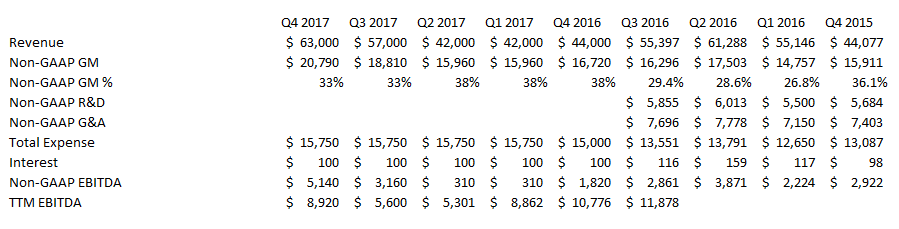
So it was actually pretty easy to see what the guide would be for the first quarter and full year. I made the following estimates after reading through the EBITDA covenants of the credit agreement (but before the guidance was announced). I shared these thoughts in the comment section here.
My estimates turned out to be pretty close. They would have likely been even closer if it hadn’t been for the fall off in the legacy business (which I will get to in a minute).
Nevertheless analyst estimates heading into the quarter were much higher. Most had $50 million of revenue for the first and second quarter. So when the first quarter number came in lower, the estimates were slashed.
So that was a big part of why the stock has done poorly. But it’s not the only reason. The company also announced news that the legacy business revenue, referred to as embedded systems, would decline more in 2017 than previously anticipated. Embedded systems revenue is now expected to be $55 million in 2017. As recently as January Radisys had said it would be around $75 million.
Its unfortunate. But not crippling. The embedded systems business is not a reason to own Radisys. Its just a distraction.
The reason to own Radisys are the new products and services offerings. And here the company did okay, though not enough to offset guidance revisions and the negative perception around embedded.
My hope for the quarter was a firm new order for DCEngine. Given where Radisys had stated they were in trials I knew this was a long shot. Indeed, no such big announcement came to pass.
Instead they gave a positive but mostly qualitative update. Here’s a summary:
Making progress with their North American Tier 1 communication service provider (CSP) that is in trials with their DCEngine rack – they have three DCEngine units in the lab and Radisys expects commercial revenue could begin as early as the third quarter.
A second DCEngine trial with a customer that will be, in turn, selling to a Tier 1 customer who I am guessing is AT&T, giving Radisys a foot in the door there.
A new FlowEngine use case for an existing customer (Verizon?).
In Europe, an expansion of the existing hardware and services contract with the Tier 1 (this was a contract related to the open-source Central-Office-Redesigned-as-a-Datacenter or CORD initiative that I wrote about in my earlier post on Radisys)
Also in Europe, a new Tier 1 engagement again revolving around CORD.
Overall the company said they were ahead of their plan to have 10 tier one engagements by the summer.
It’s all directionally positive, but as of yet there has been no big win to add to Verizon and Reliance Jio. And its clear that color alone is not going to move the needle unless revenue can be tied to it.
So what do you do from here?
I’ve waffled a couple of times but in the end have added a little to my position. I think the bad news is most likely out. We know from the Needham conference that the European CSP engagements are initially targeting professional services around CORD but that they will likely include a DCEngine component as well (if you go back and listen to the Needham conference again the language is pretty clear: expect that little can be announced by the February earning call but that more engagement with this CSP, around DCEngine, is to come).
We know that the new FlowEngine product will be launched mid-year and in fact a press release just came out today that it is now available for field trials (this is ahead of the end of March date they had previously suggested). We know that Verizon (and likely others?) are waiting on the new version before purchasing more FlowEngine products. Interestingly, Radisys mentioned Gigamon, F5 and A10 as competitors whose space they looked to infringe on with this new product.
There was a press release earlier this month describing a partnership with China Unicom to build open-source PODs for mobile 5G. If this is successful one would expect follow-on orders for DCEngine. China Unicom is a very large service provider.
And finally there was a second press release today describing a new 5G RAN version of Cell Engine. It is probably not coincidence that also today CORD and xRAN announced project alignment. Three large telecoms, AT&T, Deutsche Telekom or SK Telecom, are all mentioned in the release. Radisys mentioned that the new Cell Engine was “developed in close collaboration with a leading mobile operator”, likely one of the three mentioned in the CORD/xRAN collaboration.
Away from the news flow and looking at numbers, when I parse the guide for 2017 it’s not hard to spin it bullishly. We all knew the first and second quarters were going to be poor, low $40s revenue at best. But given $40/$40 (million) in Q1/Q2 the implied Q3/Q4 guide is a range of $55/$55 to $70/$70 (million). These are solid revenue numbers particularly given that they are going to be more heavily weighted to the new products than in the past.
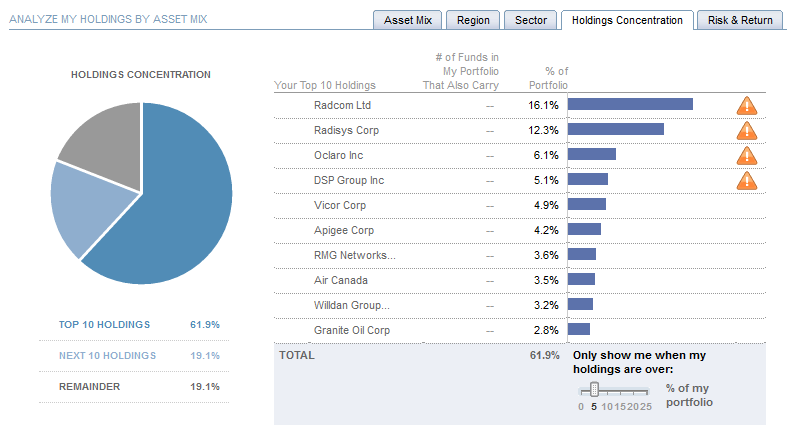
So I’ll wait. Some more. But as so many of the other positions in my portfolio scream higher (Identiv, Combimatrix, Hortonworks, Ichor and Attunity of late) and I still sit with a decent percentage of my portfolio tied up in Radisys, I certainly hope it’s worth it.
It’s been a while since I gave a single company write-up. For the last couple of years I’ve kept to monthly write-ups that are mostly short introductions to new positions and piecemeal updates of stocks I own. This write-up started out as a summary of an investment idea to a friend. It became an involved description of my second largest position, Radisys (it is second next to my biggest position Radcom, which is also a play on NFV uptake). So I decided to post it.
Radisys has been around for a long time providing networking solutions. They have a pretty mundane history of very little growth, mostly fluctuating between the $200 to $300 million of revenue mark for the last number of years.
The unexciting legacy business is a host of networking products (a segment they refer to as embedded products) such as blades, COTS racks, and COM boards. This segment has a declining revenue profile that is expected to deliver around $85 million this year and $75 million next year. It is expected to stabilize thereafter at around that range.
The legacy products aren’t the story. The story instead revolves around 3 new products that are designed to serve the next generation telecom build-out. Integral to this build-out, and to the differentiating features of the products, is a new way of designing and deploying telecom equipment, called network function virtualization (NFV).
The Network Function Virtualization Opportunity
NFV decouples hardware from software. Rather than purchasing proprietary hardware/software packages to fill specific tasks (and getting pigeon holed under a single vendors product umbrella), communication service providers (CSPs) can populate their central offices with off the shelf “white box” equipment. Software functions will be “virtualized”, installed and deployed off of the generic hardware as required.
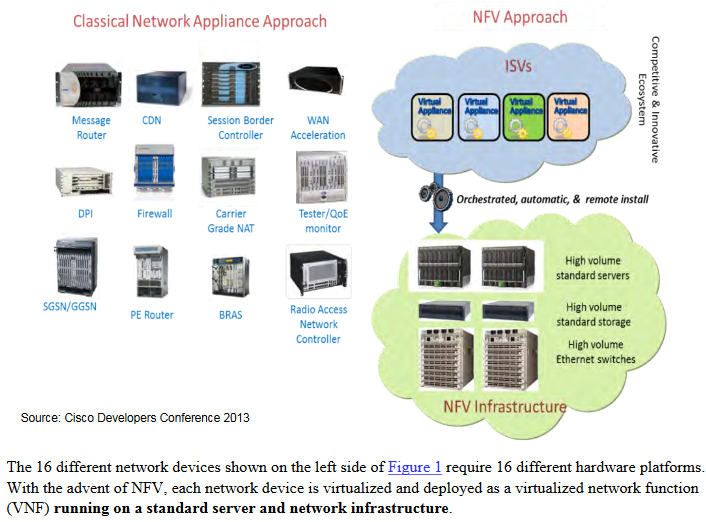
I took the slide below from the EZchip white paper on the NPS 400 network processor (which happens to be the processor being used by Radisys in the hardware enabled version of the next-gen FlowEngine). It illustrates the range of proprietary telecom equipment that will eventually be replaced by virtualized functions.
The decoupling of hardware from software affords a number of benefits. First of all, upgrading is made easier, as swapping out software is a lot faster than swapping hardware. Second, adding capacity means acquiring additional licenses and installing additional software, not the physical installation of more appliances. Third, costs should come down, as the physical appliance is a cheap white box brand and it doesn’t have to be replaced with each upgrade.
There is no question NFV is gaining acceptance among Tier 1 CSPs. AT&T, which has led the charge this year, expects to have 30% of their network virtualized by the end of the year and to be 90% virtualized by 2020. A number of open source initiatives to standardize architecture have been started with names like CORD and ECOMP.
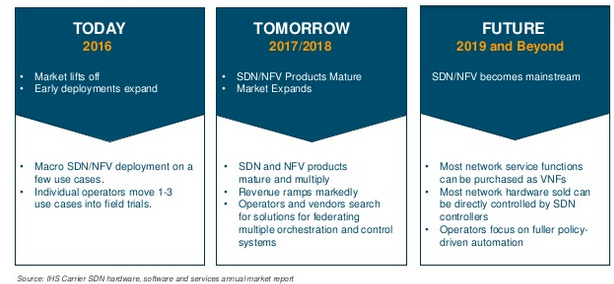
But we are still in the very early stages. IHS provided the following evolution roadmap over the next 5 years.
Its important to point out that NFV is not in the best interests of the incumbent telecom vendors. Part of the value of NFV is that it will lower capex and opex, and make the network more open, meaning that existing vendors will lose leverage in both volume and pricing. Mike Arnold just provided a great post parsing through the color provided by many vendors on their third quarter calls and how it illustrates the early stages of this trend.
Radisys offers three point solutions, DCEngine, FlowEngine, and MediaEngine that fill niches in the NFV world. They offer professional service specifically for the implementation of NFV solutions. And they are a member of the NFV initiative CORD (central office redefined as a datacenter), where they can influence NFV evolution and cultivate a position of technical leadership in the process.
DCEngine
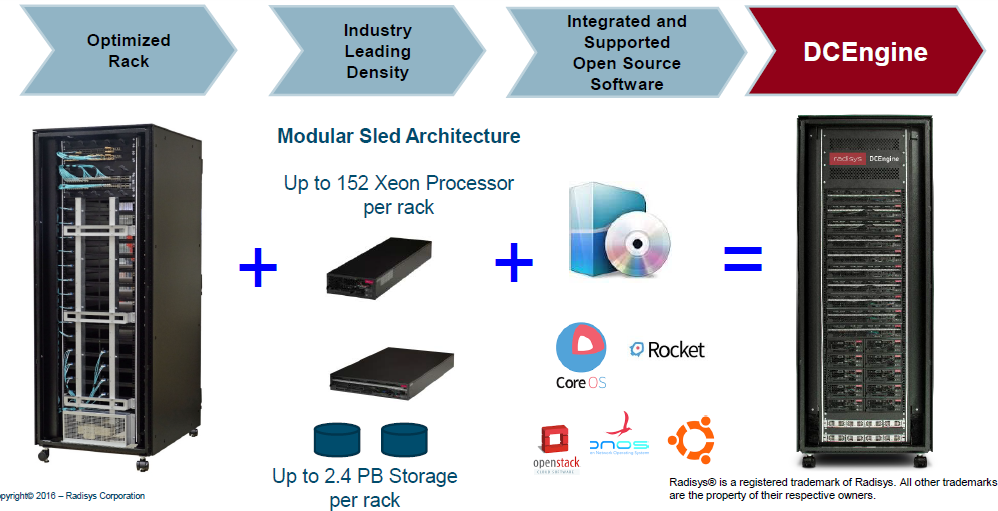
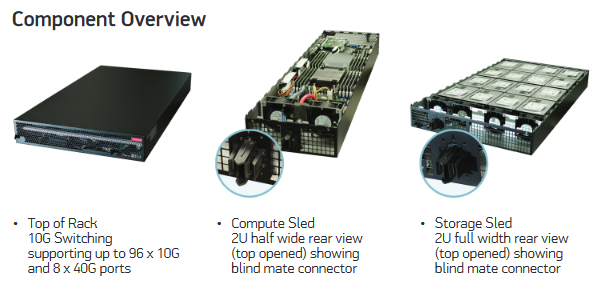
DCEngine has the most revenue potential of the 3 products. DCEngine is also the most straightforward of Radisys’s offerings to talk about. It’s basically a rack populated with white box hardware. This presentation, given at the July CORD summit, provided a nice illustration of what the rack is:
The hardware is mostly off the shelf. It includes switching, compute and storage sleds though some proprietary hardware may still be required for more complex use cases.
Radisys hopes to act as a system architect on many of its DCEngine implementations, meaning that they would be responsible for the procurement and implementation of the software (note that this expectation is very closely aligned with their CORD participation, which I will discuss below). Depending on the application, Radisys expects that software integration could be up to 25% of the DCEngine selling price.
DCEngine is designed to perform high end workloads, give a high density footprint, and fill the new central office environment that will be performing more (virtualized) computing tasks at a faster pace. The opportunity is filling out these central offices with racks, and taking a 20% gross margin in the process.
DCEngine has a large total addressable market. Verizon was the first customer to order DCEngine from Radisys. They have placed 3 orders over the past 9 months. Those orders, which were described as being for “one application” and were for less than 200 racks, brought in $65 million of revenue this year so far. I have heard that each rack sells for around $300K.
The application that Verizon used DCEngine for was described as “a rounding error in the context of what they need to build out” by by CEO Brian Bronson. Radisys gave more color at the B Riley conference (I have a copy of the audio if anyone wants it), saying “AT&T for example has 4,500 central offices with 100 years worth of gear stocked on top of each other, working with them to build out telco version of a datacenter, 2x as dense as typical rack providers, 50% cheaper than competition on storage side of things”
As sales of DCEngine begin to pick up, and as it begins to be sold in conjunction with their professional services for more specific NFV use cases (again I will talk a little more about this below when I discuss the CORD initative), the product will start to pull through other products, in particular FlowEngine and MediaEngine, in some applications.
On the third quarter call Bronson said that DCEngine was already “beginning to provide opportunities to pull-in FlowEngine and MediaEngine”. You won’t see FlowEngine and MediaEngine slotted into every DCEngine rack, but in appropriate applications Radisys will have the authority to choose their own solutions.
FlowEngine
FlowEngine provides flow management, high performance switching, load balancing and routing. Radisys put up a pretty good video (embedded below) describing how FlowEngine is used in an NFV architecture to facilitate network flows of all the various types (video, audio, internet, streaming, etc) and distribute those flows to the proper virtualized network function (VNF). The VNF then processes the flows before returning the packets back to FlowEngine to be passed back down the proper network path.
FlowEngine is specifically designed to direct packets in an NFV environment. As this article describes:
Network traffic distribution today typically requires a complex integration of discrete load balancers, edge routers, and data center switches. As service providers virtualize more of their data plane applications, they find themselves having to choose between suboptimal fixed-packet processing rules, or incurring higher capex and opex costs to deploy load balancing products that can’t handle high data plane traffic volumes.
Providers need service-aware traffic management where SDN capabilities orchestrate data traffic and NFV resources process it. FlowEngine uses service function chaining under open SDN policy control to classify millions of data flows, then distribute the flows to thousands of virtualized network functions (VNFs) or physical network functions (PNFs). Specifically designed for the challenges of large NFV deployments
Radisys gave the following example of the price advantage of FlowEngine at the B.Riley conference back in May:
We are in the middle of bidding a deal in Asia with an operator and in this example it is for FlowEngine and the traditional competition incumbent is providing a product that clearly is capable, we think we have better technology, but let’s just say we are the same, it’s a seven hundred and fifty thousand dollar box and we are selling it for two fifty. We’re not short changing ourselves but the point is that telecom equipment manufacturers have been gouging the operators for decades, software and hardware acceleration have brought disruptive products to the point where we can deliver a solution that is as good or better at a fraction of the price.
Verizon was the initial customer for the product, as announced in June. Verizon used FlowEngine for “new services that have large and small traffic flows, including cloud-based applications, video optimization and IoT”.
On the third quarter conference call Radisys announced that a US Tier 1 had agreed to further FlowEngine orders that would commence in early 2017, and importantly that the orders were not through channel partners, meaning Radisys will have a more direct line of site and hopefully influence into the CSP implementation. I am assuming this Tier 1 is Verizon though its strange that they didn’t name them, since Verizon has been a named customer for FlowEngine in the past and I wasn’t aware they had done so via a channel. It’s possible that AT&T is the Tier 1 and that they have previously ordered product through a channel partner. If anyone knows the answer to this drop me a note.
Radisys also announced that they have a FlowEngine proof of concept (POC) underway with another Tier 1 service provider and expect to be able to announce other POC’s in the fourth quarter.
The company also announced that the next-gen FlowEngine appliance and virtualized software is in beta trials at service providers right now and will be ready for general availability mid-2017. This next gen version will be highly scalable, SDN enabled and will deliver twice the throughput of the existing FlowEngine product. As I alluded to at the beginning of the post, the hardware enabled version of the new FlowEngine will use Mellanox’s (formerly EZChip) NPS 400 processor, which is expected to deliver 3x the through-put at a third the price. The virtualized version will continue to run on 3rd party Intel x86 platform.
FlowEngine will do around $10 million of revenue this year and it pulls in about 60% gross margins. This is up from $5 million in 2015.
When talking about where they want to see FlowEngine in the next year, on the second quarter conference call Bronson said what he expect was:
It’s at least half a dozen if not 10 operators that we’re doing business with on the FlowEngine side of things in one way, shape or form. They may not be as big initially as Verizon but it’s our job to just get the door open with one particular application. The nice thing about FlowEngine is there is many, many use cases for FlowEngine.
At the B.Riley conference in May Bronson said that FlowEngine “has the opportunity over time to be a hundred million dollar business”.
MediaEngine
MediaEngine facilitiates the processing of new digital data stream protocols such as VoLTE, VoWIFI, and WebRTC (the coding of these streams into a protocol is called a codex). Importantly it also provides backwards compatibility between older codex’s and newer one’s so that all parts of the network can talk to one another. This process is called transcoding.
Past MediaEngine orders, which of note have been to Reliance Jio, which is an Indian carrier, and to a North American Tier 1 which I’m not sure but I think might be AT&T, and have been deployed to some degree in over 30 networks. These deployment have generally been to free up spectrum by providing processing for VoLTE. Mitel, for example, has been a key channel partner for MediaEngine, and they sell the product for VoLTE processing to facilitate their video and audio conferencing products.
Based on the language Radisys has used to describe the Reliance Jio wins, it appears that Reliance is using MediaEngine in a function beyond simple VoLTE, though I’m not entirely sure what the use case is (there is however a good SeekingAlpha article on this win here). Radisys has shipped over $20 million of MediaEngine product to Reliance.
As a VoLTE product MediaEngine has never been that exciting in terms of growth potential. The product did about $45 million of revenue in 2015 and is expected to do about the same in 2016. Most of the recent revenue has come from Reliance.
However that may be about to change. As I mentioned earlier, at the core of an NFV deployment is the desire to break up previously proprietary system hardware solutions into their constituent software components, in other words their network functions. One proprietary component is called a session border controller (SBC). The session border controller performs two functions, call control processing and transcoding. Depending on the type of networks that are talking to one another the capacity of these two functions does not always align. In particular, the call handling capacity can often exceed the transcoding capacity. The result is that the CSP has to purchase more SBC’s than their call capacity warrants to achieve the transcoding that they need.
MediaEngine essentially provides a cheap transcoding centric solution. In the NFV world, where MediaEngine is not tied to hardware, a CSP simply deploys the product as required at network boundaries as additional transcoding capacity is required.
This is a new use case for which Radisys has only recently announced a new MediaEngine version, called TRS. As far as I know they have yet to win business for this. But management alluded to the potential on the third quarter call, saying it “has a much bigger market opportunity than the current construct of MediaEngine”. In a bit of candor later in the call saying that in “transcoding what we’re trying to do is trying to beat the shit out of the SBC guys”.
Radisys put out a video that does a good job describing the disruptive nature of MediaEngine in the transcoding market.
Also on the third quarter call Radisys did announce a Tier 1, NFV based, win for conferencing services using MediaEngine. I believe that the carrier is AT&T, and the win is significant as it was a direct sale not through channel partners, which will allow Radisys to influence further business more easily.
CORD
Radisys is not an incumbent equipment provider to Tier 1 CSPs. So as the company tries to capitalize on the NFV opportunities, getting a foot in the door is an important first step.
CORD stands for Central Office redefined as a data center. Radisys gave the following description of CORD on its third quarter call:
The mission of CORD is to advance an open source service delivery platform that combines SDN, and NFV, and elastic cloud services to service providers. Or said differently, the mission is to facilitate the replacement of telco central offices and the big, proprietary, expensive equipment that gets installed in them with new solutions that leverage data center economics and cloud flexibility across the entire network.
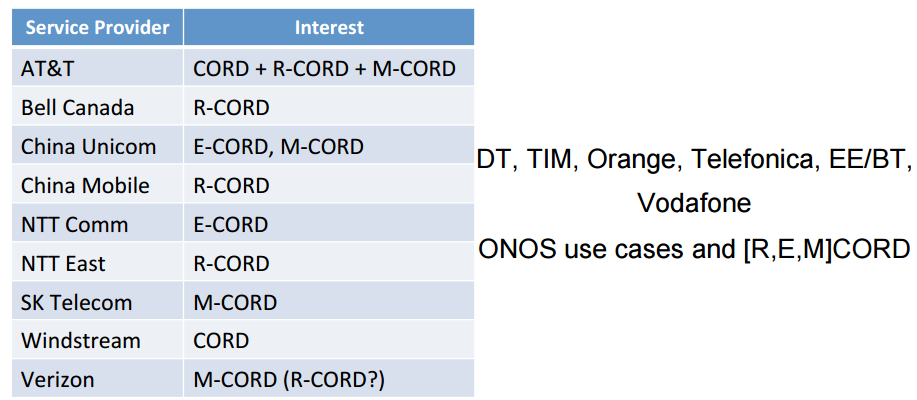
CORD actually consists of three distinct flavours, mobile (M-CORD), residential (R-CORD) and enterprise (E-CORD). Radisys is primarily involved with R-CORD and M-CORD though they do have some involvement in E-CORD, I’m just not sure what.
The involvement in CORD has the potential to drive a lot of customers to Radisys. Many of the Tier 1 telecom players are involved in CORD. This presentation, given at the CORD summit in July, gives an excellent overview of what the initiative is trying to accomplish. It also provides a list of the major CSP’s involved in the initiative:
For more detail on how the CORD initiative is redefining individual hardware components, see this presentation by AT&T.
In March, when Radisys announced that it was collaborating on CORD, they described their role as a “leading system integrator”. In particular Radisys would:
…help service providers and the community turn Residential, Enterprise and Mobile CORD proofs-of-concept into deployable carrier-grade solutions by offering end-to-end world class support for CORD integration and commercial deployment on Radisys’ DCEngine™ hyperscale data center product.
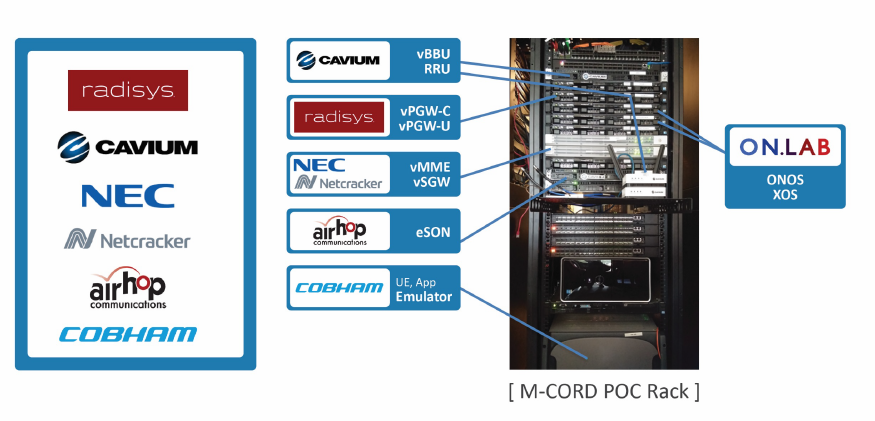
The CORD involvement also encompasses FlowEngine. FlowEngine has been offered “as a key data/forwarding plane component” into the mobile version of CORD, known as M-CORD. Below is a slide taken from this presentation that shows FlowEngine being used within the M-CORD proof of concept rack (vPGW-C and vPG-U describe dataplane component that FlowEngine will be providing).
With CORD Radisys can establish itself as an NFV expert, and cultivate expertise deploying NFV use cases and cultivate a closer relationship with CSPs. We began to see the first fruits of this in the third quarter, as they announced they had “entered into our first CORD integration proof-of-concept with a European Tier 1 service provider.” and that the “same thing is going on with other customers that we have in the funnel that I can’t talk to you guys about right now”.
To sum up the opportunity in CORD and how Radisys is using it to position themselve as the vendor of choice for NFV implementation, I will turn to one last short comment provided by Bronson on the last call:
…someone has to bring all this largely open and accessible software and hardware together to deliver a pre-integrated and tested solution. And while our competition is motivated to continue to push their own proprietary solutions, Radisys is embracing the infrastructure revolution and positioning to provide service provider with open source set of integrated solutions.
The Opportunity
Radisys has about 37 million shares outstanding. At the current share price the market capitalization is a little over $150 million. Their debt and cash flow about cancel each other out. Revenue this year is going to be around $215 million, which means they trade at less than 1x EV/Sales.
Analyst revenue estimates for next year are $229 million. But in my opinion this number is not worth a lot, as I will describe below.
NFV is in an early stage and, as such, is advancing in fits and starts. Apart from AT&T, which expects to have 35% their network virtualized by the end of 2016, other CSP’s are still in the lab running tests or at best looking at single use cases in the field.
The stock sold off heavily after earnings because of this lumpiness. It is leading to good quarters, precipitated by a big Tier-1 order, followed by lulls as new trials and proof of concepts are completed.
As such, while Radisys made it clear on the third quarter call that its in the middle of trials and proof of concepts, they are unable to provide definitive guidance for 2017. Orders from the next line of trials are still a few quarters off.
The size of these orders is also difficult to pin down. But the potential is for some of them to be very large.
Take for example DCEngine. Orders in the first 3 quarters of this year totaled $65 million. Remember that this was “one customer” (Verizon) “deploying one application” (likely storage) and this application is “a rounding error” compared to their overall network requirement. As I mentioned earlier, DCEngine is being tested by two other CSP’s, and the language Bronson used around these trials was ”when successful”. Next year, if these trials are successful, it does not seem unreasonable to expect at least similar deployment levels from these CSP’s as what Verizon has done, nor does it seem unreasonable to think Verizon will have more orders at a similar level to this year. If all that came together it would mean more than $150 million in revenue from DCEngine alone. That would blow out of the water any of the current analyst estimates of revenue in 2017. Radisys has also said they have a full funnel for DCEngine, and on the second quarter call said they expect at least 6 Tier 1 customers by the second half of 2016.
So the problem with estimating Radisys revenue for next year is that its more of a probabilistic exercise than is usually the case. We are too early to know just how big these products can get. Yet analysts are constrained by their job requirement to provide a quantitative estimate of the future. They have to come up with revenue numbers for 2017 when the reality is that even the company can’t come up with a reasonable revenue estimate right now.
When asked to give some revenue color on the third quarter call Bronson said he didn’t want to “put bounds on it”. I think the language was intentional, that the number could be absolutely huge if you get, for example, DCEngine orders from AT&T (who I am guessing is the North American Tier 1 in trial) Verizon and the Asian trial customer, maybe others, and additional orders from the new FlowEngine, or MediaEngine TRF orders from CSPs looking to virtualize more of their network.
Yet an analyst can’t create estimates based on conference call color, trials and “the funnel” of potential customers. They have to put out of firm model with numbers. And so Radisys growth looks rather mundane for the next year.
I think there is a reasonable chance its explosive. The company is in the right place at what is probably a bit too early time. This makes the business lumpy, but the stock an opportunity.
See the end of the post for my full portfolio breakdown and the last four weeks of trades
Thoughts and Review
I made a grand total of two transactions this month. I think that might be a record low for me.
The dearth of transactions is that it is not by design. It’s the result of a shift I made back in February when the market was crumbling. I decided I would get away from anything that looked like a swing trade.
In the past I’ve taken positions in stocks not because I see strong fundamentals or a particularly good event horizon or an industry development. Instead I’ll take it as a trade because the stock has sunk down to what looks like the lower level of a range and I think I can catch a bounce as it traces back.
Its a strategy that I think, overall, has been profitable. Over the years I’ve done it with success with companies like New Residential, Northstar Realty, Brookdale Senior, various oil stocks, and with the tanker stocks.
But its a strategy that expends a lot of brain power and it drains a lot of emotional capital without the opportunity for a big upside. It also tends to put me into positions that I don’t have a lot of conviction in, and when a market event like what happened in January and February occurs, I end up selling stock at the wrong time.
So I’m not doing it any more.
For example, even though the tankers have traded down to what is really very cheap levels, I’m not playing a bounce. I didn’t buy into any of the REITs that have recovered since earlier this year.
For what its worth, its probably saved a few grey hairs as I watch Teekay Tankers and DHT Holdings flounder with no appreciable momentum even as the market as a whole rises. While some REITs have done well, others continue to flounder at lower levels.
It makes for a more boring and arguably slightly less profitable portfolio, but also for one that is easier to stand by through the market gyrations. As Brexit hit and the market tanked for a couple days it didn’t even occur to me to sell any of my positions even as I lost a few percent. The stocks I own I do so because I like them and I want to see them through to the events that I believe will result in their upside.
Without many trades this month I will talk about a stock I bought the previous month but haven’t discussed yet (BSquare), one event worth mentioning (Empire Industries spin-off) my investigation into cybersecurity stocks, and an update on what has been happening in the world of NFV/SDN.
BSquare
I’ve owned Bsquare once before but under a different auspice. The first time around it was because of a good earnings report that made it look cheap. But I didn’t have a lot of conviction in the business so I sold it soon after for a small gain.
This time I’m buying BSquare for the potential that they may be on the cusp of some growth. This is another one of those stories like Radisys, like DSP Group, where you have a so-so legacy business and company that has traditionally floundered but there is a new product coming along that might be able to change that.
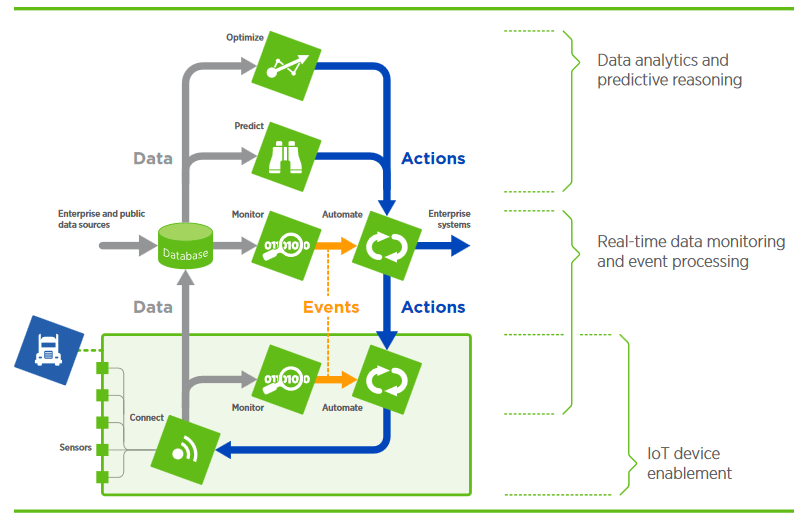
In BSquare’s case that product is DataV. DataV is a software application that collects device data, performs monitoring and analytics on the data, and applies rules for predicting future conditions and failures and automating corrective processes within the device.
The product is an example of an Internet of Things application, where a companies assets are connected to the network, information obtained from the asset is used to quickly identify problems, and solutions and operational changes are pushed back to the asset through automated routines.
DataV operates both on the asset and in the cloud at the data center level. The figure below illustrates the functionality at each. The green boxes represents a feature set provided by DataV. At the asset level monitoring and automation of simple rules are performed for time critical conditions. At the data center level further monitoring and more complicated and less time sensitive automation rules are performed, as more complicated analytics like predictive rules and optimization routines are performed.
Unlike some of the IoT solutions I researched, I feel like DataV is going down more of a solution specific path. Rather than providing a platform to be implemented across an company’s asset base like some of the bigger IoT names, DataV is being targeted to customers to deliver specific solutions where there is an existing issue that it can solve. It seems like the right strategy, especially since their target market for DataV is the smaller end of the Fortune 500, who are less likely to invest large amounts of capital up front for a platform solution.
BSquare announced their first DataV contract with a major industrial company back in June. The company described the use cases to be addressed as follows:
Predictive failure. The use of data analytics and real-time device information to accurately predict problems that could impair asset uptime, as well as prescribing remediation steps.
Data-driven diagnostics. Further use of data analytics and historical repair information in order to speed diagnostic and repair time, getting vital assets back in operation more quickly while reducing service and warranty costs.
I also found the following quote from the press release useful for understanding the product:
“This project is emblematic of what is truly possible with IoT: real-time data analytics applied to very large data sets in order to predict future conditions, prescribe corrective steps, and accelerate repair times. Collectively, these DataV capabilities can dramatically improve uptime while reducing cost. We look forward to a long-term relationship with this customer, working closely with them as they leverage IoT to achieve business objectives throughout their organization.
The contract is for $4 million over 3 years.
My hope here is that this is the first win of many. While the company has only one win, they did make the following comment in one of their job postings, which gives me some optimism that there will be further wins:
Bsquare is investing significantly in marketing demand generation tied to its industry leading DataV IoT platform. Market response has overwhelmed our current sales capacity, and we are looking for proven inside sales dynamos to join our team.
I would say my conviction that this works out is medium at this point, so like many of my positions I will start small and build as positive data develops. Given the size of BSquare, a $66 million maket capitalization with $27 million of cash on the balance sheet, there is plenty of room for upward appreciation if the product takes off.
I have also looked closely at the legacy business and while I don’t want to spend too much time on it here, I will say that it gives me pause. The company is almost wholly dependent on Microsoft as a reseller and the contract terms with Microsoft have recently tightened. It doesn’t feel like a very comfortable position to be in. Please contact me if you want more of my thoughts on the legacy business or if you have any insights into it yourself.
Empire Industries and their Hydrovac spin-off
In February Empire Industries announced that they were spinning off their Hydrovac business into a separate company. The transaction makes Empire more of a pure play on their amusement park ride business and creates a new hydrovac focused entity.
Both sides of the spin-out look pretty interesting.
Dynamic Attractions, which is the existing Empire business, is still very cheap, trading at around 3x EV/EBITDA with a market capitalization of about $25 million. There is a healthy backlog of $107 million though that is down from year end of $130 million.
There is some talk that the next step will be the divestiture of the steel fab business, which would be another step towards making Empire a pure media attraction product company. The company still has the telescope business and the 30m telescope contract, though recent setbacks make it unclear whether a new site will have to be found for the project before it can proceed.
Equally interesting is the hydrovac spin-off called Tornado. As part of the spin Empire partnered with a Chinese company, Excellence Raise Overseas Limited, who injected a little under $10 million into Tornado. $6.9 million of that is equity, $2.5 million is debt (it was supposed to be $7.5 million but the injection was done in USD and Reminbi and the Canadian dollar has gone up since the original agreement). The equity portion gives the Chinese firm 45.5% of the new hydrovac entity. If you do the math on that the Chinese entity paid about 25c per share. The stock is trading below 15 cents.
Tornado is going to use the cash to set up an operating subsidiary in China and offer Hydrovac services there. In Canada they just sell the trucks. The business in China will be more akin to Badger Daylighting; contracting out the usage of the trucks and personnel.
Here is what the Tornado management said about their new business endeavor in their first ever MD&A:
What I find interesting about Tornado is that at the current price the market capitalization is $9.5 million you are only paying a little more than what the Chinese partner invested in the company. Yet you are getting both the existing hydrovac manufacturing business in Canada, and the new Chinese expansion. While the truck manufacturing business has been poor of late, basically delivering flat EBITDA for the last year, before the collapse in oil prices this business generated $2.5-$3 million of EBITDA.
So there is plenty of upside from the existing business that is arguably not priced in. In addition you have a stake in what happens in the China segment, which is admittedly uncertain.
In addition to what I received with the spin-off, I bought a little bit of the stock because it seems cheap. I would like to buy more but its hard to get a real sense of how substantial the opportunity in China is.
I have no idea if this is a huge market that they will win big with, or whether this is going to be an uphill battle. It seems somewhat positive that the Chinese company wants to take a big slice, presumably they are doing so because they see the market opp, and the Empire management has been pretty astute, but who knows for sure.
So we’ll see. Management is making some interesting moves, they may have some more up their sleeve.
I’m not smart enough to invest in security companies
I spent quite a bit of time over the last month trying to familiarize myself with the cyber security universe. I went through transcripts, listened to conference calls, read presentations and 10-Ks. I looked at Palo Alto, FireEye, Proofpoint, Rapid7, MobileIron and Qualys in some detail and more briefly at Tanium, Imperva and Splunk. I come out of the whole thing still feeling like I only have a foggy understanding of the space.
Of all the firms I think I understand the biggest, Palo Alto and FireEye, the best. Palo Alto is a firewall company and FireEye is an intruder detection and mitigation company. I think on the most simplistic level, Palo Alto is trying to stop an intruder whereas FireEye is trying to detect and stop one once one gets in.
Both companies and for that matter most cyber security companies, provide an appliance (which is essentially a server blade that goes into the stack) supplemented by one or more subscriptions (along with maintenance and support which may or may not be bundled into the subscription price, depending on the company). The appliances sit on premise and perform the basic protection services. Some of the subscriptions are attached to the appliance, and some are not.
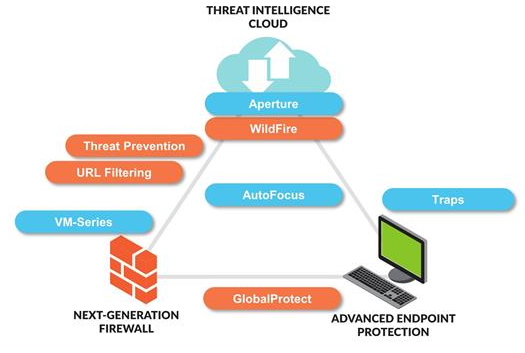
For example Palo Alto, to the best of my understanding, offers an appliance and 8 subscriptions. These are shown in the diagram below. The red boxes are subscriptions not attached to the appliance while the blue one’s are stand alone
Just to give some color on what these do, Wildfire updates the firewall appliance with new emerging threats, Aperture provides the ability to monitor SAAS applications, Traps, is installed at the endpoint that prevents untrusted apps from operating. GlobalProtect extends firewall capabilities to mobile and offsite devices, Autofocus allows you to access a database of threat tags that help you identify the source and nature of a threat you’ve discovered, and Threat Prevention and URL Filtering provide some of the basic data required for performing the firewall functions.
So that’s Palo Alto. If you go through the universe of companies you will find something similar in terms of an appliance with subscription services and/or stand-alone subscription services.
Where things begin to get fuzzy for me is once we get into the smaller players. So Proofpoint software is primarily geared towards email protection. Rapid7 and Qualys provide data hunting and analytics that try to aggregate and streamline the vast amount of data coming down to what is relevant. Mobileiron’s platform manages security for mobile devices. Imperva provides security to data centers and to a lessor degree to cloud applications and websites.
What I can’t figure out is how it all plays out between these niche companies and the larger one’s like Palo Alto and FireEye. Is there room in IT budgets for all of these products? Do the niche players get bought out by a consolidator? Or does revenue growth start to slow for some of them?
Another question that isn’t clear to me is how the move to the cloud impacts these businesses. Some of these companies still generate a significant amount of revenue by selling the appliances. As those appliances become virtualized and sales are software only, I wonder how margins and revenues will be affected?
In this regard, one of the most interesting things I listened to was this discussion at the Bank of America Global Technology Conference with former FireEye CEO, now Chairman David Dewalt. Dewalt makes a number of very strong comments; that security is going to move to the cloud, that this will be disruptive, that this will change the landscape of what products and services are required, and that it will move dollars from a product or appliance bucket to a subscription bucket.
The final piece is whether spending has been artificially heightened by a few outsized threats. There were some significant breaches in 2014 and even some of the company executives I listened to described the following period as being one where companies were throwing money at the problem without discretion. That appears to be changing now. We just saw Imperva issue pretty dismal guidance. Qualys recently characterized the environment as “much more rational” and that we were seeing more caution on the part of customers, that they were looking to consolidate vendors, etc.
Finally, I don’t really understand the growth expectations behind all the names I looked at. For example, the Stifel universe has 22 cybersecurity companies and the average revenue growth of those companies is 19% for 2016 and 2017. Yet the cybersecurity market as a whole is expected to grow at 6.9%. So who are all these low growth or market share losing companies?
It all sounds like one big bucket of uncertainty. Which is hard to stomach when you are paying the multiples you are for these companies. So the research has been interesting, but I’m not sure I will be adding any of these names soon.
Whats Happening in the NFV/SDN World
There are a whole lot of datapoints hitting the presses in the world of NFV/SDN. Here’s a brief run down of what I have come across.
In the last week AT&T announced that they will offer the code to their SDN platform into open source, that they will be introducing virtual security functions for their virtualized network, and that they will be launching network functions on demand starting with 4 virtualized functions. Of this news, the second may have relevance to Radcom, where there have been hints that their contract with AT&T could be expanded to some sort of security application. The third piece (more details here) refers to a 3rd party server vendor for the white box back end, which certainly could be something Radisys provides.
Along the lines of the third news item, Radisys and AT&T held a joint presentation demonstrating their Mobile-CORD initiative and how you can monetize SDN and NFV. Some more circumstantial evidence of the relationship developing between Radisys and AT&T.
This article (here) compares the move to NFV as being the equivalent to the datacenter move to cloud over past decade. The key difference is that enterprises moved apps like Oracle, Exchange and SAP, CSPs are moving network functions that deliver wireless and wireline calls, text messages, and streaming media, along with services such as VPNs and firewalls. This article specifically highlights service assurance as one of the two most important attributes of software defined infrastructure:
The second important characteristic of a software-defined infrastructure is service assurance. Customers expect seamless voice, video, and media quality and data protection. A truly carrier-grade infrastructure will deliver on these expectations by quickly analyzing the root causes of component failures, remediating those failures before they impact subscriber services, and ultimately, predicting and avoiding outages and performance issues before they occur. All of this can only be accomplished through automated software.
Another article I found interesting was this one, which exposes 10 myths about NFV. Two important points made are that encumbents will have to rebuild from the ground up to make their app virtualized:
The best way to build a carrier-grade virtual network function (VNF) is to take a ground-up approach, starting with a purposefully designed modular architecture that addresses performance, scalability and other important requirements, Luxoft recommends.
And that Verizon is looking to share risk with vendors, also move might be to subscription type of relationship with vendors:
Verizon, for example, proposes a new business model in which its vendors share the risk in the introduction of new services. If a service succeeds everyone will make money. If it fails everyone shares the risk…Furthermore, virtualization lends itself to usage billing models, not only for consumer services but for business to business services.
I also found this article that talks about the need for both SDN and NFV being brought on by the amount of data that will be travelling the network as the Internet of Things grows:
As the Internet of Things (IoT) becomes more of a reality, and as these companies look to deploy 5G and reap all its promised benefits, most realize that they need to revamp their networks in order to deliver value and to compete (with you-know-who). These trends will result in significantly more data of widely different types traveling across their networks, and to retain service agility on a more-or-less static infrastructure, these operators need NFV and SDN, along with “cloudification” and advances in distributed computing.
This article gives the rather impressive 116% CAGR for NFV and SDN from now until 2021:
Spend on NFV and SDN ramped up in 2015, with analyst firm TBR forecasting the market reach nearly $158 billion by 2021, representing a 116% CAGR.
And finally Mark Gomes gave some interesting scuttle about Radcom in a conversation with an industry contact that he posted over the weekend.
Reluctantly exiting Photon Control
There is nothing more fun than getting this kind of press release about one of your companies while being on vacation with limited internet access.
I have absolutely no insights into how this plays out. Maybe the loan gets repaid and the company puts itself up for sale at a premium. Maybe the company rights itself and gets on with the business of delivering sensors. No idea.
What I do know is that when I don’t know what is going to happen, I am more often than not better off selling first and asking questions later. So I sold my shares.
I note two things since that time. First, the shares have held up reasonably well, so there is clearly someone willing to buy into the panic. Second, there hasn’t been any news that the money has been paid back.
I continue to watch the story because the company valuation is compelling. The market capitalization is $73 million and the company holds $27 million in cash. After subtracting cash, the stock trades at only about 3x free cash flow.
This is too cheap if the business is viable and there isn’t any overhang from executive malfeasance.
The sensor business hasn’t grown like I had hoped, but that still may come and even in its current state it remains nicely profitable. I’d love to get back into the stock, but I need to remove the uncertainty before I do.
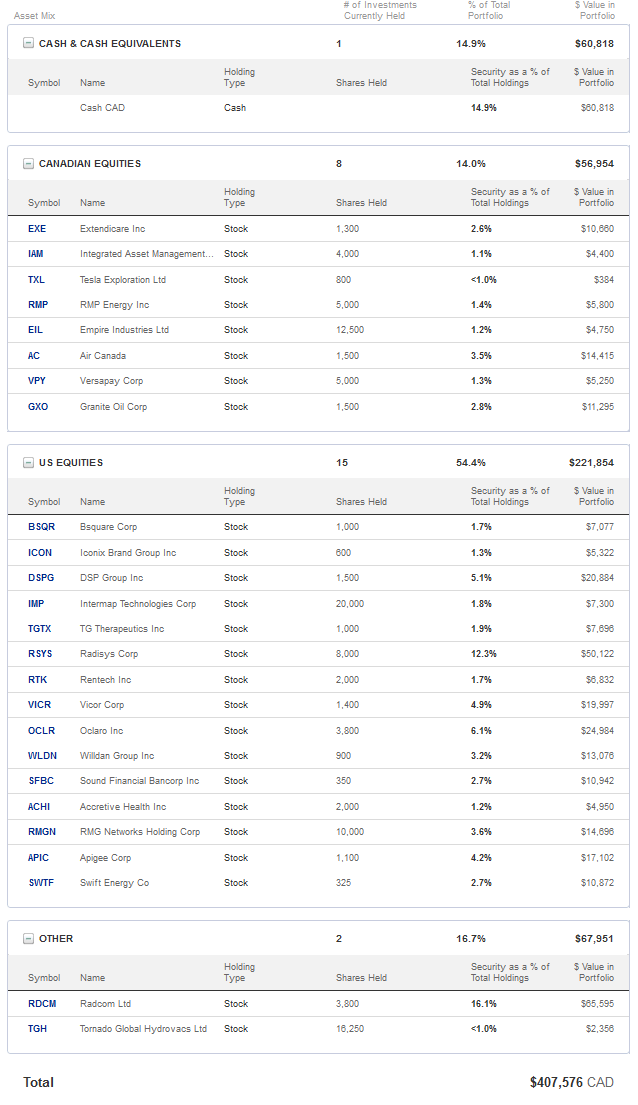
Portfolio Composition
Click here for the last four weeks of trades. Note that the two transaction labeled Adj are me manually readding the Empire Industries and Tornado shares. When Empire did the stock consolidation and spin-off my shares were lost in the practice account.
Also note that I bought RMG Networks stock, which I talked about already owning last month. This was another unfortunate example of me forgetting to take a position in the practice account, and as a result having to buy the stock later at a higher price. Oh well, if I am right about RMG Networks the upside will make 20 cents more I paid irrelevant.




 Reminiscences of a Stockblogger
