Skip to content

Identiv

In the fourth quarter of 2016 I was fortunate enough to catch the inflection in Identiv.  At the time the stock was an unloved perimeter security play that had recovering from the aftermath of a minor RFID mania.

A few years prior Identiv had been named supplier to Disney for RFID transceivers that went into their Infinity toy line.   Unfortunately for Identiv, the stock crashed and burned as Infinity turned into a bust and Disney discontinued the product.

The Disney carnage took the stock from $12 to $2.  The latter is about where I bought the stock. Like many of my stock picks, I had an admittedly fuzzy idea of how Identiv might play out to the upside.

My long thesis could be summarized in two points:

  1. Their former CEO, Stephen Humphreys, had returned in September 2015 and seemed to be righting the ship, reducing costs and stabilizing the business to the point where at least they wouldn’t go bankrupt
  2. At a market capitalization of less than $20 million it was trading at under 0.5x sales and it wasn’t that far from profitability.

As it was, in part because of the turnaround and in part because of a mania in stocks brought on by the election of Republicans across the board, Identiv ran up to $7 before all was said and done.

Since that run up, the stock hasn’t done much of anything.  It quickly backed off an admittedly high valuation and since that time has mostly bounced around the $4 to $5 mark.

Identiv reports earnings today after the market closes and I have taken a position going into that report.   Not because of the report mind you, I don’t know if the third quarter will have anything special and, having taken a position, I fully expect a 20-30% sell-off on earnings before I have a chance of being proven right on the name.

Two questions here that I want to answer: 1. Why has Identive done nothing for two years and 2. Why am I buying the stock now?

Answer #1:  Identiv hasn’t done much for the last couple of years because the company’s business has kind of stagnated.

While Identiv has made a few cheap acquisitions that have helped increase revenue (and in all honesty these acquisitions look pretty decent to me), organic revenue growth has been absent.

The company’s Premises business, ex-acquisition, hasn’t been doing all that well.

The Premises business sells on-premise security solutions to government and private business.  This means cameras, keypads or card readers, credentials, locks, and then the hardware and software to control and monitor the premises.

If I understand it right, up until this year the business consisted of two product lines.

  1. A very robust, federal government certified (the certification is called FICAM – Federal Identity, Credential, and Access Management) security system powered by their Hirsch Velocity software.
  2. A commercial grade, Cisco partnered system called Identiv Connected Physical Access Manager (ICPAM)

In addition to these full solutions, they sell card readers, credentials, and other physical hardware piecemeal.

My sense is that the Cisco partnership, where Identiv provides the edge hardware and software platform while Cisco provides the network infrastructure and video surveillance piece, has been less than ideal.

Partnerships between a behemoth like Cisco and a minnow like Identiv, have a tendency of not working out all that well for the minnow.  I don’t have any specific evidence but based on the lack of mentions of ICPAM since the first half of 2016 I am led to believe ICPAM sales have disappointed.

The other hint is that the acquisitions Identiv has put together are puzzle pieces that Cisco was delivering.

There have been 3 acquisitions that Identive has made.

The biggest of these was 3VR.  3VR is a video surveillance company.  Identiv bought them in February 2018.  Identiv picked them up on the cheap – paying a little over $6 million for a company expected to generate $10 million in revenue in 2018 and that had over $60 million of venture capital ploughed into it over the past 10+ years.

A second acquisition, in December of 2018, was Viscount, which added two products.  Viscount’s Freedom platform is a software-defined physical security perimeter solution, while the Liberty platform is a lower-end, entry-level security perimeter solution.  The important piece of both of these solutions is that neither is tied to Cisco servers and video surveillance solutions.

Freedom and Liberty are similar monitoring and analytics platforms to what Identiv has in their own platform Hirsch Velocity (for government, but they address different parts of the market.

I suspect the most important thing about these platforms is that they aren’t tied to Cisco’s gateway, server or video solutions.  Hirsch Velocity is a high end solution, used by government, its great for winning government deals but its too expensive to compete commercially.  Freedom and Libery provide options for commercial applications that don’t involve Cisco.

Also worth noting is that Freedom is certified for FICAM.  Between Freedom and Hirsh, Identiv owns 2 of the 4 solutions that can bid on Federal government security contracts.

Thursby was a third acquisition in November 2018.  Thursby added mobile security solutions, including apps for accessing secure data on mobile devices, and dongles and readers used with mobile devices for verifying credentials of the user.

Together these 3 acquisitions and the existing platform of identity cards, scanners, controllers and software give Identiv a complete physical security solution, applicable to government, but also to most levels of business.

While the Premises business has been rather blah for some time, Tthere are some hints it is about to gain traction.

First was the announcement in the first quarter of a fairly large Federal win.

One was a multiyear federal program award to one of our partners for FICAM deployments at over 500 sites worldwide. This is a good indicator of the increasing commitment to FICAM, and it’s really an endorsement of our Velocity software – Q119

– on the 500 sites in the federal government, roughly how many doors per site would that be? Steven Humphreys, Identiv, Inc. – CEO & Director [5] It varies dramatically. It’s anywhere from a couple of dozen to a couple of hundred

I remember back to when I first looking at the stock in 2016, Humphreys said that their FICAM solution would cost around $1,200 per door.  If you do the math on 500 sites with maybe 75 doors on average, that would be a $45 million opportunity.  Not inconsequential for a Premises business that is doing around $40 million a year.

That win was followed up by this news last week.

Hirsch Velocity Software is the physical access control system (PACS) platform specified in a recently awarded multi-year, $150M blanket purchase agreement (BPA) for the National Physical Security Program (NPSP) Maintenance and Installation Program. As part of the contract, the United States Marshals Service (USMS) is deploying Hirsch Velocity Software at more than 900 facilities across the country to deliver mission-critical security and protection to USMS facilities, visitors, and employees.

Don’t get too excited about the $150 million – I don’t think all of that purchase order is going to Identiv.  They are specifically referring to their software getting the win, not the entire platform.  But 900 facilities with even 20 doors per facility is still a good sized win for a company this size.

Then yesterday another U.S government agency selected Hirsch for their locations, which are home to 100,000 employees.

There was also this news today that an RFID tag collaboration between NXP and Identiv would be used on a scratch and reward game on Kraft cheese slices.

I’m not sure how material the revenue would be on this application, but Identiv has been trying to gain traction with their RFID products for years now, and this and another recent application in Hot Wheels cars could (and I emphasize could) indicate a turning point.

Identiv isn’t particularly cheap, but its also not pricing in a lot of success.  It trades at 10x this year’s EBITDA.  A couple of these government wins could tip the scales on that EBITDA number so we’ll see, I’m willing to brave the earnings storm.

If it’s true…

So first of all, my blog is private again.

Second of all, Mission Ready is moving a little this morning because this was posted on the Federal Procurement Data System.  The second one down is a $US200 million contract award.

In typical Mission Ready and TSX Venture fashion, there has been no confirmation, no press release and no halt of the stock.

If this is what it appears to be, it is quite significant to Mission Ready.  Consider that this is a ~CAD$35 million company, give or take.  Even assuming a 10% margin on these dollars, they represent a significant influx of cash.

Is it true?  Or is there some sort of gotcha that is not evident?  It would be nice to know with a bit more certainty.

Week 432: Where My (tenuous) Conviction Lies

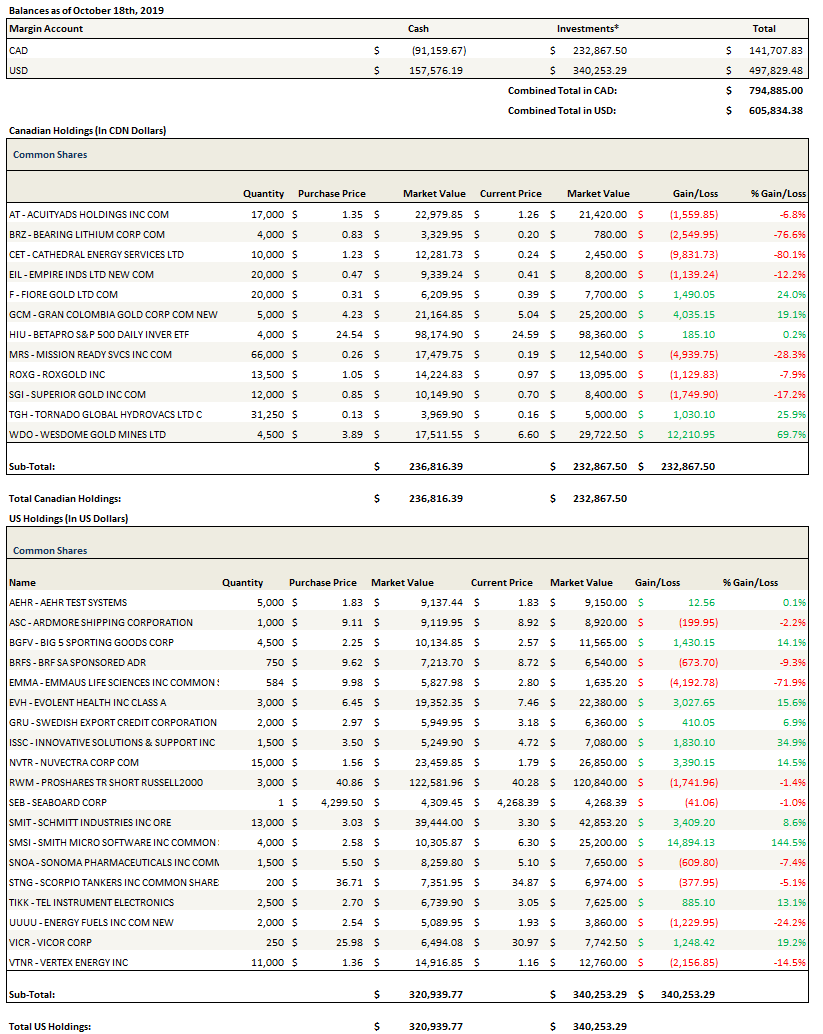
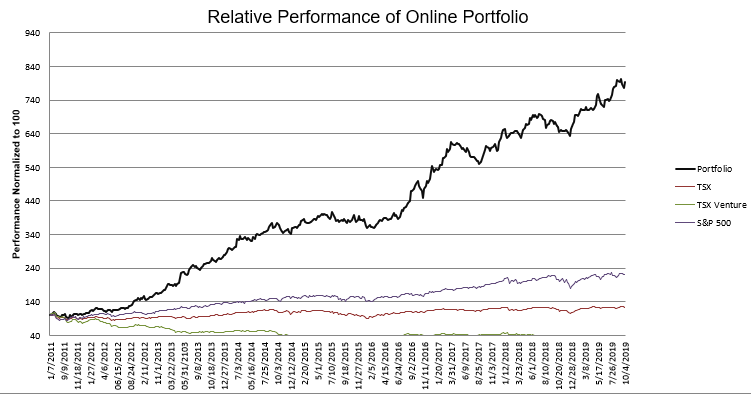
Portfolio Performance

Thoughts and Review

Writing about the broad market makes me uneasy.  I fully admit I do not have any edge to it.

Yet I necessarily have to take a position on the broad market, and this blog is about why I make the decisions I do.  So regardless of whether my point of view is naïve or uneducated, I still need to describe it.  If only for my own posterity.

With that disclaimer, I want to briefly explain why I continue to be cautious on the market even as we approach new highs.

First, caution is different than being bearish.  I am not bearish right now.  I’m still long many stocks.  My longs are roughly double the value of my index shorts.

I am probably not enough of an expert about the macro-drivers of the market to be truly bearish on it at this time.  Its too ambiguous to me.

Instead I stick to my knitting – I go long individual companies that I can definitively say I am bullish of.   At times, depending on my level of trepidation in the market, I hedge the overall exposure to varying degrees. The bigger the hedge, the more cautious.

Right now, I’m more hedged than usual.

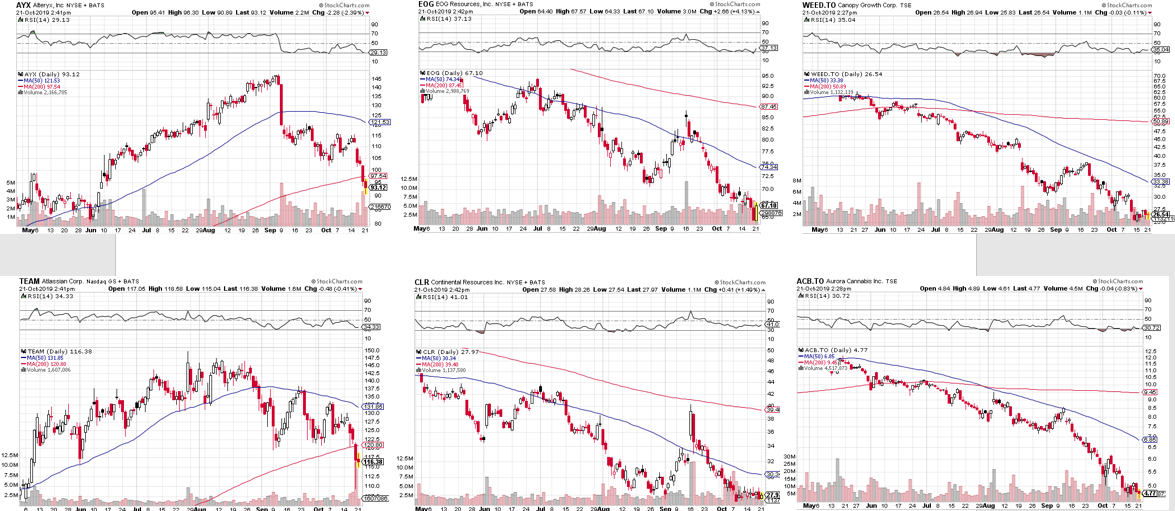
Consider the charts of the following stocks:

When I look at the three sectors that underlie these six charts (SaaS, pot stocks, oils), I don’t see much in common.

Debt issuance is a priority for oil companies.  Stock issuance for pot stocks. Most of the SaaS names are self-sufficient.  None of the sectors these companies operate in have much in the way of overlapping fundamentals.

The only thing I see in common is A. the chart pattern.  The charts are all miserable, and B. these are the sort of stocks that are driven more by speculation than most.

Of course, I am cherry picking sectors that are under-performing.  I could take the charts of Texas Instruments, Taiwan Semiconductor or even Apple and paint an entirely different picture about the market as a whole.

But that is kind of the point.  It is my suspicion that these poorly performing, uncorrelated sectors are signs that liquidity is a little more scarce than it typically is, but not necessarily scarce enough to a worry the whole market just yet.   We are left with rolling bear markets in some sectors, while the overall market holds up.

I have been railing on about tightening liquidity and worrisome economic signs for some time now.

Maybe I shouldn’t.  I certainly don’t understand all the machinations.  But there are a few general principles I have learned, and that I will continue to stick by so long as they work more often than they don’t.

My first five years of investing were from 2004 to 2008.  During that time my Dad was a BMO client and as such I was a faithful listener and reader of their head strategist – Donald Coxe.

Coxe put out a monthly publication called Basic Points and did weekly calls each Friday.

Donald Coxe was quite a good strategist.  He wasn’t perfect of course, and some of his views have turned out to be wrong, but many were right and he caught a number of very good investing trends.

One of Coxe’s favorite metrics to gauge the state of the financial system was the TED spread.  This was the difference between interest rates on three-month futures contracts for U.S. Treasuries and Eurodollars with identical expiration months.

Coxe followed this spread with interest, and when it rose unusually high, he said it was a time to exercise caution in the market.

He did not pretend to understand all the dynamics that may be moving the spread.  In fact, he often admitted it was an opaque market.

What he did know was this – that the spread was correlated to liquidity, and when liquidity was less abundant bad things were more likely to happen than if liquidity was loose.

What bad things?  Who knows!  It was and is (I think) kind of futile to try to predict what might be the lynch pin.  You just look silly most often.

The lesson here is more about the concept and less the particular indicator.  The TED spread doesn’t seem to work like it once did and I am not entirely sure if there is a single indicator that has taken its place.

Nevertheless, there are some signs the last few months that suggest liquidity is less abundant that it was 6 or 9 months ago.

One of the signs are these rolling bear markets that are hitting sectors that you might consider speculative.  In my experience rolling bear markets in such sectors can preclude downturns in the index as a whole.

We saw something of the sort in 2015.  In August of 2015 I wrote:

When I raise the question of whether we are in a bear market, its simply because even though the US averages hover a couple of percent below recent highs, the movement of individual stocks seems to more closely resemble what I remember from the early stages of 2008 and the summer of 2011.

The move down in the index didn’t occur until late 2015 – early 2016.

In all honesty, it doesn’t feel quite as bad now as it did in mid-2015.  So we are likely further away from a move of the averages, if it happens at all.  Nevertheless, the chance that something like this may occur again has been my caution since the late spring.

There are reasons to believe my caution will turn out to be wrong.  Some have talked about signs that the economies of Europe and China are bottoming.  There is maybe some sort of trade deal in the works between China and the United States.  The Fed is loosening in one way or another. So is the ECB.  The weekly leading indicators in the United States have been trending up of late.

Nevertheless, I still think I am more comfortable taking a cautious bent.  When I look at the performance from the funds letters I have read, I see some numbers that, while very good so far this year, showed -15%, -20% or even -25% in the fourth quarter last year.  I would not handle such losses well, so I prefer to take the cautious road.

If I am wrong it will hurt my performance a bit.  But if I am right in my stock picking, that should more than compensate for the mistake.  Thus far, it hasn’t really helped my performance, but it hasn’t hurt it either.

It is the individual positions that will make or break my portfolio which is how I want to position things.  So, let’s talk about a few of those ideas.

Tankers – I waffled back and forth a bit, but I finally sold the last of my tanker trade this morning.  I unloaded most of my position a few weeks ago, but as seems to be the case with ideas I’ve tied myself to for a while, its never a clean split.  It may still not be, but I want to see an entry that is not so elevated and over-bought to interest me.

Schmitt Industries – My most recent purchase.  I wrote about it here.  This stock has been slowly working higher, but my best guess is that it does nothing until the next step in their restructuring is announced, which could be months away or could be tomorrow.  I do not know if or when more assets will be sold but given the activist nature of the new CEO, I suspect they will be at some point.  With cash still making up most of the capitalization I will patiently wait.

Evolent Health – I wrote about here.  We will likely get some resolution on Passport Health Plan in the next few weeks.  Interestingly, Piper wrote their thoughts on Passport a couple weeks ago.  They were quite positive.

Nuvectra – I wrote about here.  My entry in this one was poor, but I added to it after it fell into the $1.30’s and I am now in the black on the stock.  I am hoping (this one indeed has a bit of hope involved) that we hear a positive outcome of the strategic review in the next few weeks.

Vertex Energy – I most recently wrote briefly about Vertex here.  There is always at least one position in my portfolio that confounds my expectation.  Vertex is it for now.  In short order they should be a beneficiary of falling HSFO prices (the futures curve, where prices were as high as $50-something per barrel as recently as September, is setting up just as I had hoped) and that should mean blow-out margins.  However, one might expect the market to anticipate this and it is not.  So I am puzzled.

Gran Colombia Gold, Roxgold, Wesdome – My primary gold stock holdings.  They have all corrected over the last month.  Roxgold in particular has seen a rather dramatic plunge.  They all have their own nuances, but they will all move up or down along with gold and the state of the financial system which I guess is a hedge in itself.

To balance my long portfolio, I am keeping a higher than usual level of hedging by way of inverse index ETFs.  As well I remain short a few individual names.  My shorts are the same as they were at last mention – a few SaaS names, a couple biotech’s with questionable histories, a couple of cannabis names that are levered to a Canadian extraction market that appears to me to be very oversupplied, a couple of US shales that are seeing their access to debt dry up and that I believe will struggle as a result, and a couple of Canadian banks that I will continue to be wrong about.

Portfolio Composition

Click here for the last five weeks of trades.

Back Online

I have had the blog private for the last 4 months.  During that time there were no emails sent out and only those that requested access could view the blog.

I did this after getting some odd emails and being linked to by a short report.

I enjoy writing this blog and explaining my decisions.  I enjoy getting feedback from the core group of readers that find some of the ideas worth investigating themselves.  I love going back over my own historical record and seeing what I thought at various times and how I was wrong and why.

In the last 4 months while the blog has been private, I realized what I did not like.

I did not like the email blasts that went out to followers every time I posted.

I found it kind of stressful to have a write-up sent out to what had become a significant number of accounts.  Of course, I don’t know how many people read them.  But nevertheless, the email blasts bothered me, and I have come to realize that they made me reluctant to write.

Therefore, before opening the blog up again, I have deleted 95% (or more) of my followers.  The only one’s that remain are emails or monikers that I recognize from some interaction.

I’m not selling a service, nor do I have any intention to, so I really don’t care if I have a large following or not.

What I value is if someone reads something I wrote and sends me useful information about it or strikes up a healthy debate.

My basic assumption going forward will be: if you find my stock and portfolio write-ups worth reading, you will be inclined to visit the blog from time to time.  If not, then it probably isn’t that useful for you anyway.

For those of you who didn’t request access to the blog over the last 4 months when it was private, I invite you to go over the last 4 months of ideas and thoughts.  I’ve had a few interesting picks over that time.

With all that said, I am working on a portfolio update that I will have out in the next day or two.