Skip to content

Week 425: A few good moves

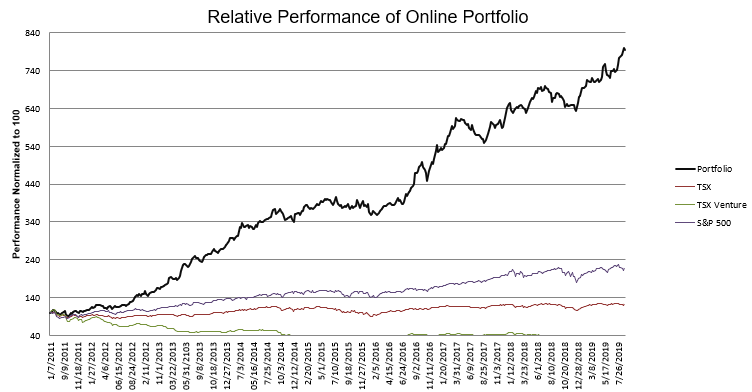
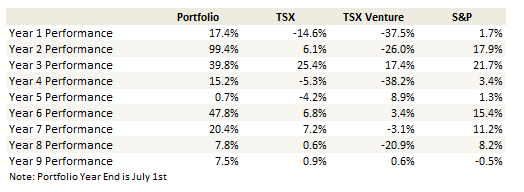
Portfolio Performance
Thoughts and Review

The last six weeks saw the sudden move up a number of stocks I own.

The biggest move was by Smith Micro, which went from $3.23 to over $6 on a great second quarter.

Then there was the near doubling of Moneygram which I bought at $3.06 and it has moved to almost $6 itself.  There has also been a nice move in Evolus, though I’m not sure anything Evolus stock does matters until we get a resolution on the status of Passport.

There’s Overstock, as there is always Overstock.  It moves up and down like a crazy Byrne but in the last 6 weeks it has been mostly up and who knows what the hell is going on there (by the way did you know that Marina Butina, who is Byrne mistress and the reason he stepped down as CEO is portrayed on an episode of the Family on Netflix-great show-for having been caught infiltrating the Christian prayer breakfasts in Washington.  No joke, it gets weirder and weirder).

Gold stocks also moved up (though they gave up some of those gains these last couple of weeks and according to most of fintwit I would qualify as a “bagholder” now), as did, miraculously, oil (of which I am, of course, a bagholder).

All in all, it was a good 6 weeks for the portfolio.  If I were to have a complaint it was that I continue to make too many mistakes and piss away dollars on stupid purchases, which have eaten into what should have been a better period of performance.

I’m going to use this update to talk about one of those losers that I own, Mynd Analytics, now Emmaus Pharmaceuticals, and one idea that I have been in and out of – the swine flu trade.

Emmaus Pharmaceuticals

This has been a bit of a bust, to say the least.  The merger between Emmaus Pharmaceuticals and Mynd Analytics was completed in July.  Though it was first announced in January, it seems as though both of these companies were completely unprepared for it.

I say that because as things stand now the old Mynd tele-psychiatry business remains unlisted and Emmaus is trading, but they received a ruling of delisting from the Nasdaq on Tuesday, which I doubt was part of the plan.

The stock price of Emmaus has been on a rollercoaster since taking over the Mynd listing and changing the symbol to EMMA.  It started out trading as high as $11.  In all honestly, I knew that was crazy high.  But I was lulled into holding on the speculation that the stock might pop really high due to lack of float and lack of sellers.  There’s some saying about pigs that applies here…

As a consequence I blew the chance to sell out my shares at a nice price – it would have meant a 15% gain on my Mynd purchase and I’d still have the free-bees of the standalone Mynd Analytics once (if?) it began trading gain.

Instead I watch Emmaus fall precipitously, all the way down to $2.50, where it was back to yesterday.

I wasn’t compelled to buy down there the first time, but I did this time, adding to my position on Tuesday.  It remains quite a small position and this is a very speculative stock.

So why double down?  Remembering back to my thesis on Mynd/Emmaus, the premise was that the growth from Endari, a sickle cell immunity drug that Emmaus is launching, could more than justify the share price of Mynd at the time.

Indeed, the SEC disclosures from Emmaus have put out some pretty stellar looking forecasts that back up the potential if this thesis plays out.
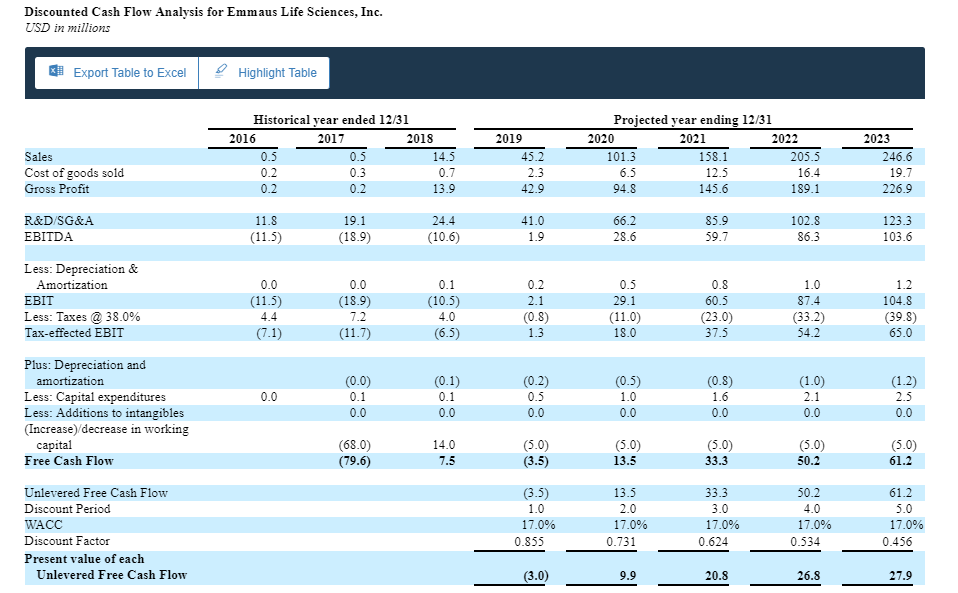
Clearly if Endari hits these sorts of numbers over the next few years, the stock is going to be worth more than what it is currently trading for.

So far Endari has seen moderate results.  I had hoped for more. Sales in the second quarter were only $500,000 higher than the first quarter, so 11% sequential growth.
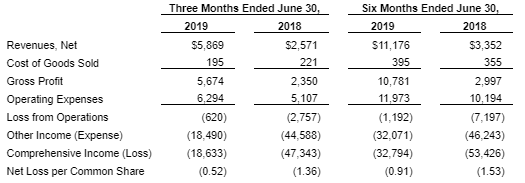
The company forecast is predicting $45 million of revenue for 2019.  I’m not sure that they can get there given the results through the first half.

But having said that, there are some positives.   For one, Emmaus is getting close to cash flow neutral.  The first half showed a moderate $2 million cash burn.  There aren’t many pharmaceuticals in the middle of a launch that are that close to break-even.

Also, the company has $15 million of cash on the balance sheet.  On top of that there is another $37 million in Telcon stock, a Korean company that is a supplier of L-glucosamine for Endari (this stock is pledged right now to the supplier but I think that is a technicality as long as Endari is a success)

At the current price of $3 the stock has a market capitalization of under $150 million, which mean a little less than $100 million for the Endari business.

Second, when Emmaus stock collapsed the insiders really stepped up with their purchases.  In fact there were shares bought the day before the delisting notice. There was another 20,000 share purchase yesterday that is not in the table.  Oops!
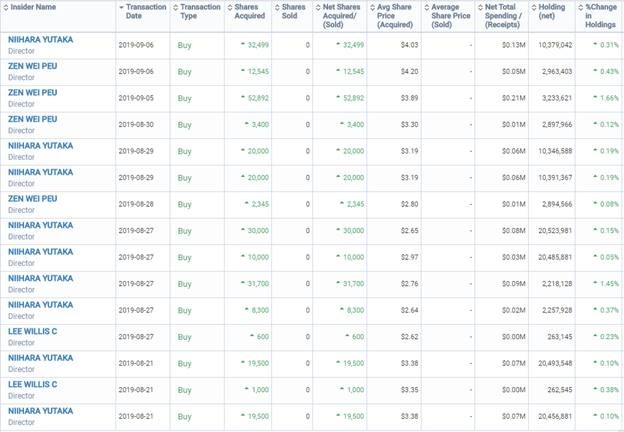
At the very least, no one can say insiders are using the public listing as a way of unloading their shares.

The other part of the deal, the old Mynd Analytics tele-psychiatry business, is not trading yet.  It has a symbol (PSYC) and the last quarter of financials show a bit of progress with revenue but still nothing to write home about.   That business is what it is.

Anyway, I kinda like Emmaus.  I get that Endari is nothing really that special, it is a medical grade version of an over-the-counter product.  And doctors could decide to go with the cheaper, albeit less regulated and less convenient OTC option if they wanted.  But I think this price is reasonable and I don’t believe the insiders are throwing good money after bad.

Swine Flu Trade

I stepped back into the swine flu trade by buying back BRF SA and adding a new position in Seaboard.  Both of these positions are relatively small and to be honest I don’t know how long I will hold them.

At 30,000 feet the swine flu trade makes a lot of sense.  The news from China just keeps getting worse.  The disease has spread to Vietnam, Mongolia, Cambodia, Laos and North Korea.  It was just reported in the Philippines a few days ago.

To recap, swine flu causes death to hogs within 10 days.  It is highly contagious can be found in food and water.  It has spread to every province in China, and they have slaughtered 35% of their hogs.

Those numbers may even be higher. As the NY Times points out:

Farmers and industry observers in China say that large numbers of African swine fever cases have gone unreported to the authorities, and that many infected pigs end up sold into the market as a result.

In a funny way, the disease kept a lid on pork prices until fairly recently.  Because so many pigs were being infected, farmers in China were culling their herds early (and likely killing known diseased pigs that they could sneak into the supply before it became apparent).  This surge in slaughter, as well as just the loss of pigs to the disease, led to a dramatic drop in Chinese inventory.
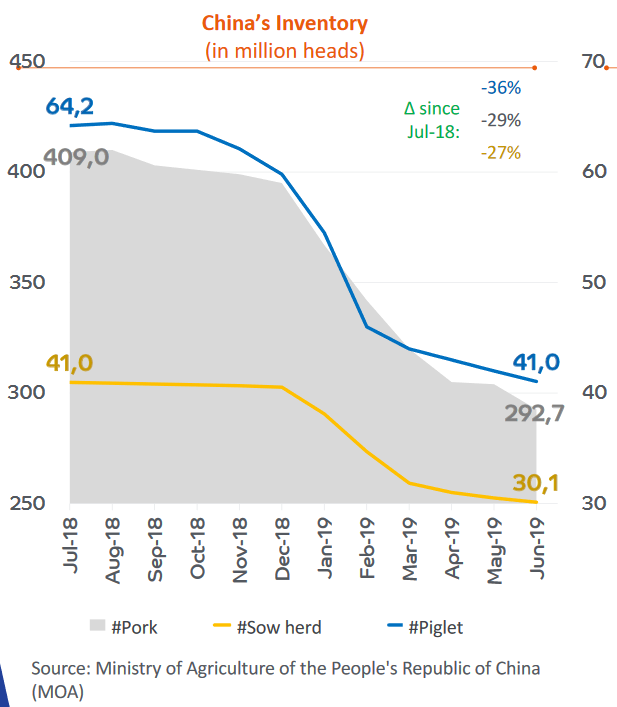
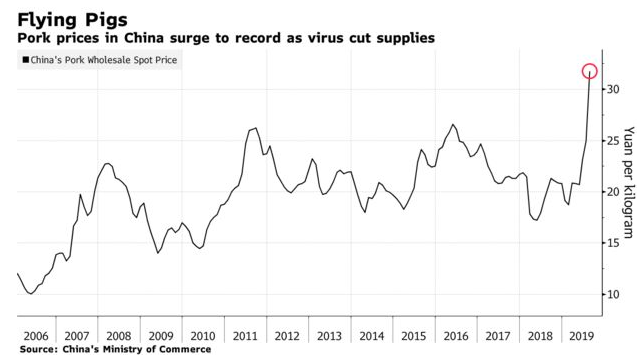
But prices could only be held down so long.  In the last few months we are seeing skyrocketing pork prices in China.

The price of pork has been rising for months, and it is now nearly 50 percent higher than it was a year ago, data published on Tuesday showed.
With such a large drop in Chinese supply, China’s imports of pork, beef and chicken are rising.
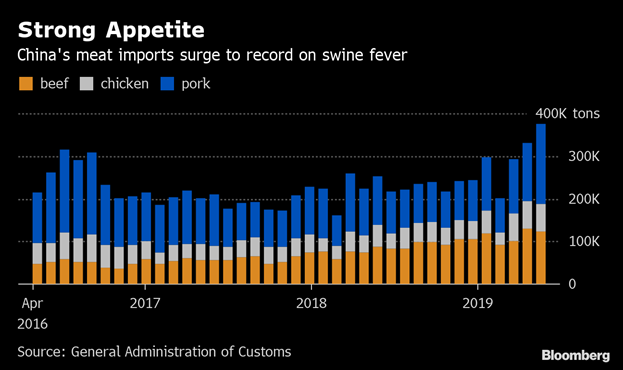
These extra imports of pork should be beneficial to BRF SA, which is a Brazilian pork producer.

Consider this article, which is titled: “Will pork imports from Denmark and Brazil save China’s bacon after African swine fever hits supplies?”.

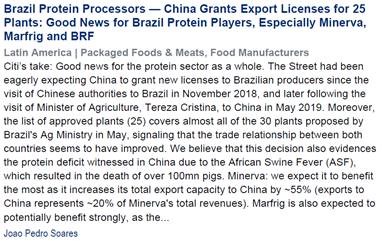
On Monday [September 10th], China added 25 Brazilian meat plants to its list of approved exporters, bringing the total to 89, according to Brazil’s Ministry of Agriculture.

Citi had a positive take on these additional export license grants:
BRF SA reported decent results in the second quarter.  Revenue was up 7% to $2.13 billion.  Gross margins were up 4.5% sequentially to 25%.  Adjusted EBITDA was $317 million versus $104 million a year ago and $195 million in the first quarter.

With all this in mind, BRF SA is not a perfect vehicle for this trade.  The company seems to perennially disappoint, it does have a lot of debt and so far in the first half of the year the company hasn’t done a very good job of converting EBITDA into cash.

BRF SA is fairly highly leveraged with Debt/EBITDA of 3.7x.  What’s more the leverage is expensive, with an average interest rate of over 10%.

The second half should see better EBITDA than the first half as exports rise along with prices.  Average estimates are for $1.04 billion of EBITDA.  This would value BRF SA at a little over 10x EBITDA.  That’s probably a fair valuation.

My hope here is that swine flu gives us another bottom-line boost in the second half that is not yet priced into the stock.

With that in mind I decided to take a second position in the swine fever trade with the purchase of Seaboard.

Seaboard is not the perfect vehicle either, but at least it diversifies my single company exposure a little.  It should benefit from their pig business (about 9 million hogs) and their turkey business (they own 50% of butterball).   The downside of Seaboard is that they own a bunch of other non-hog related businesses, many of which are in questionable countries (like Argentina) and they don’t really have a great record of generating cash.

Retailers Running

I took back a position in Big 5 Sports this week.  I owned the stock a couple months ago (it was a stock in my last update) along with Dean Foods.  I was waffling on the retailers at the time, even having looked at Francesca Holding which I held for all of one day.  But I had no conviction in the idea and sold them all.

With the rotation we are seeing out of tech and into pretty much anything else that has been weak, retail plays like these are starting to make big moves.

Of course, I bought back Big 5 Sports so Dean Foods, not to mention Francesca, have went on a tear.  Oh well.  I like Big 5’s chances better in the long run.

Not that those chances are all that stellar.  This is a beleaguered retailer without a doubt.  Big 5 has a market capitalization of $50 million and even including debt the enterprise value is only $114 million.

For that price you are getting 433 store locations with an average size of 11,000 sq. ft.

Of course, you are also getting stagnant sales and precipitously falling EBITDA.  Last year Big 5 did $20 million of EBITDA. The year before that they did $41 million. The year before that they did $50 million.  Notice the trend…

There are plenty of negative articles on Big 5 on SeekingAlpha.  This Detroit Bear guy does a good job of explaining the bear thesis, which is not without merit.

Yet the last quarter was not terrible.  And when you have a $2 price tag on a stock that used to be well into the double digits, not terrible is not all that bad.

The company increased revenue marginally, dropped operating expense by a percentage and generated an extra million of cash flow before working capital.  It’s moving in the right direction.

I have no grand plan thesis here.  It’s simply that with the rotation going on, moving in the right direction might be enough.

After all, look at FRAN.

Portfolio Composition

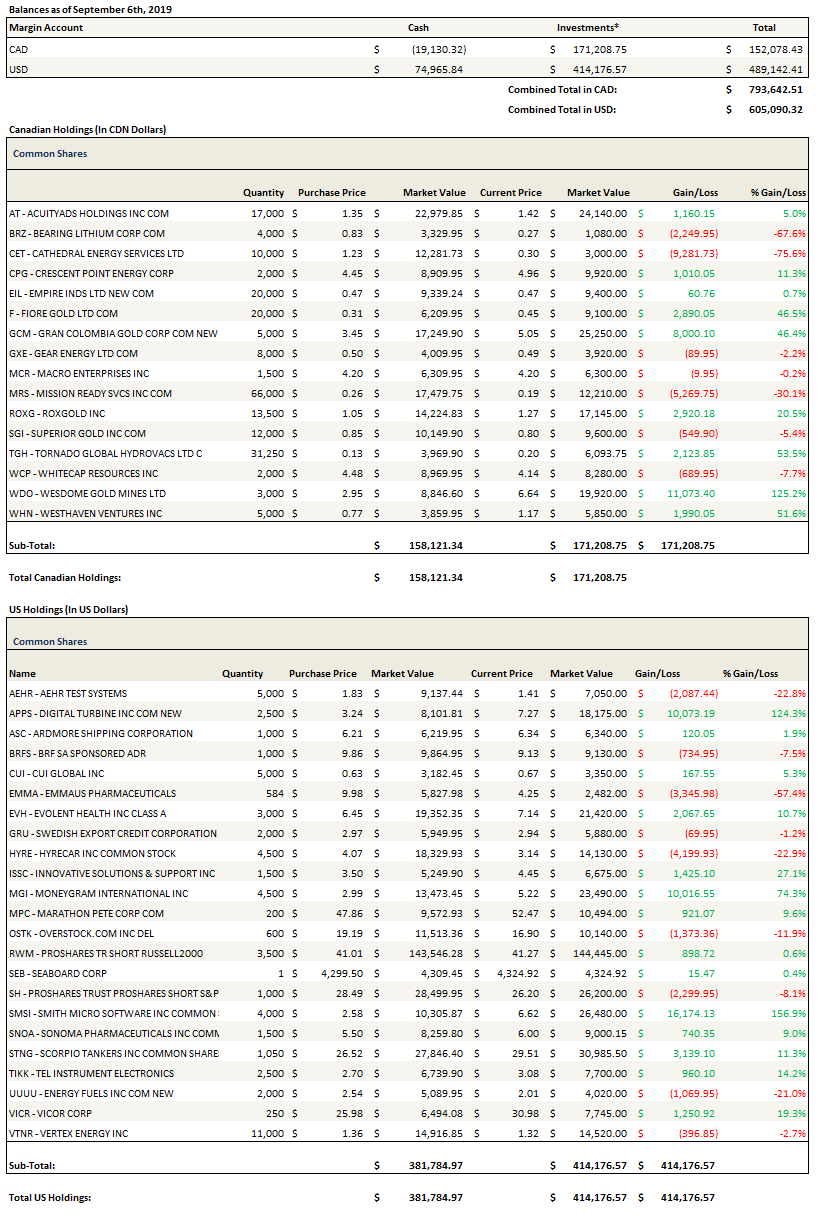
Click here for the last six weeks of trades.  Note that when I did this update I realized I hadn’t bought Nuvectra or sold Marathon Petroleum in the tracking portfolio.  I have made both moves this week but they are not reflected below.
Nuvectra

I am going to start this post with all the reasons I can think of to not buy Nuvectra.

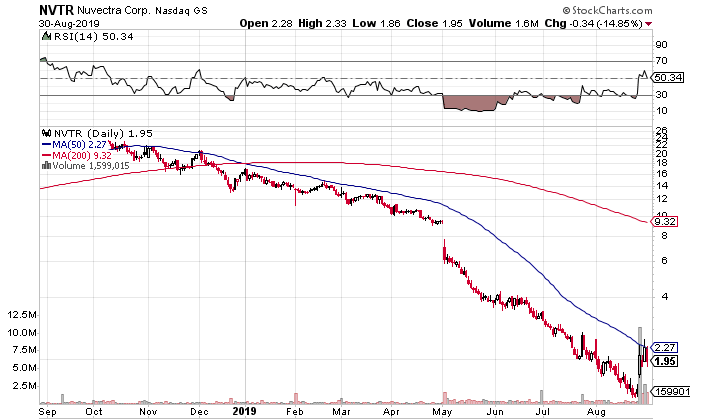
That list has to start with the chart.   This was a $20 stock less than 12 months ago.  Now its barely $2 and only a few weeks ago it flirted with $1.

The collapse of the stock coincided with the resignation of most of the C-suite that had run the company since going public.  The CEO Scott Dree resigned in January.   This was followed up by the departure of the COO/CFO in May.

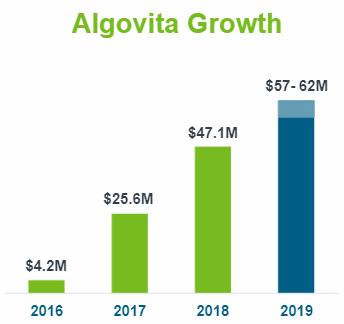
The collapse has also coincided with the demise of the Nuvectra growth story.  Prior guidance of $57 – $62 million was reduced to $50 – $55 million in August.

In the second quarter year-over-year revenue growth fell to 7%.  This is way down from 80% growth average in 2018 at odds with the increasing salesforce that the company has put in place.

In fact, Nuvectra has long said that they believe their salespeople can generate $1 million to $1.5 million of sales.  The current 60 person sales team should be able to achieve $60 million to $90 million of revenue.  Yet the company recently reduced guidance to a range of $50 million to $55 million.

Even more disturbing, Nuvectra is having trouble keeping their salesforce.  On the last couple of calls they have mentioned sales attrition as a factor limiting growth a number of times.

The sales attrition could be due to the fact that the salespeople aren’t selling.  On the last quarterly call new CEO Frank Parks admitted that in some cases as much as 75% of the salespersons time is spent non-selling.

One flaw in the product that has come to the attention of management is the charging process.

In part, selling (inaudible) have been impeded by some reports of patient frustration with the Algovita charging process.

Our core technology continues to function as designed and labeled, repeating, our core technology continues to function as designed and labeled, but we believe the ergonomics of the charging process sometimes creates frustration amongst patients.

The slowdown is not just a company specific hiccup.  The industry that Nuvectra is in (sacral nerve stimulation or SCS) appears to be slowing as a whole.  Competitor Nevro has seen revenue decline over the first 6 months of the year.  Boston Scientific said this on their second quarter call:

In SCS, we continue to see some softness in the overall market, and we face tough comps as mentioned due to our WaveWriter spinal cord stim system launch in the U.S. early last year. While we continue to be optimistic about the long-term 7% to 10% growth potential of this market, we do expect some continued softness in 2019 given the 21% second half comp.

What makes the growth situation more dire is that the company is burning cash.  Nuvectra has burned on average $11 million of cash per quarter for the last 6 quarters.  There is very little in the trend to suggest it is coming down.  Cash levels sit at $69 million at the end of the second quarter.

Last week the company announced that they would be “implementing a force reduction plan” that will “result in the termination of approximately 20% to 25% of the Company’s employees during the third quarter of 2019”.

While the cuts will reduce cash burn by $5.8 million in 2020, they aren’t going to do much for guidance or employee moral.

Finally, Nuvectra’s second product, the Virtis system, which is a neuromodulation system intended to address the sacral nerve stimulation (SNS) market, has been held up by FDA requests.  The FDA has asked for additional supplementary data on Virtis leads with chemical composition and biocompatibility studies.  This has pushed out Virtis approval until mid-2020.

So there you have it. Cash burn, slowing growth, terrible chart.

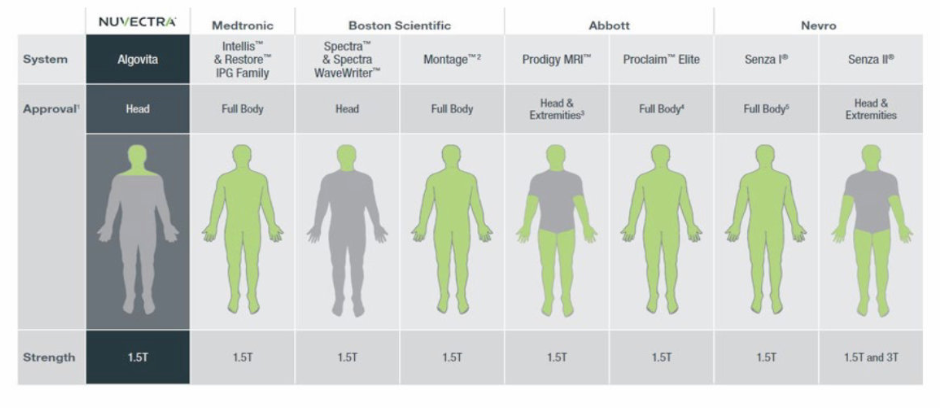
Yet as far as I can tell, Nuvectra has a real product.  Their Algovita system, which is approved for SCS by the FDA, is a legitimate alternative to competitive products from Nevro, Boston Scientific and Medtronics.

The competition trades at a significant premium to Nuvectra.  Nevro, which is the only pure play competitor, trades at nearly 7x 2019 sales and that is on declining revenue.  Boston Scientific and Medtronic, which are much larger multi-product companies with competitive SCS offerings, trade at 6.2x and 5.1x revenue respectively.  Nuvectra trades at under 1x revenue based on their market cap and well under 1x if you include their net cash position.

The slip in Algovita sales is fairly recent.  Up until the last quarter sales of Algovita had been growing at a rapid clip with expected 2019 growth of 29%.

The product has been available for 3 years now.  It would seem to me that if it was truly not competitive, we would have seen an indication before this.

Algovita has a small slice of the SCS market.  This is in part because of its relatively recent release.  It is also in part because the product only has approval for head-only MR.  This limits the market compared to the competition.

The company has completed regulatory submission for full-body MR which will strengthen the products competitive position.  The approval, which is expected to come in the fourth quarter, would be a catalyst for the stock.

At the same time that Dree resigned the company named Chris Chavez to the board of directors.  From everything I have read Chavez has a very strong background, is a pioneer in the neuromodulation industry and that he would put his reputation on the line again with Nuvectra is a vote of confidence for the company.

He served as President, Chief Executive Officer and Chairman of TriVascular Technologies, Inc. from April 2012 through its merger with Endologix, Inc. in February 2016.  Following the merger, he served as an Endologix Director from February 2016 through June 2018.  Mr. Chavez also served as President of the Neuromodulation Division (NMD) of St. Jude Medical Inc. from 2005 through 2011 following the acquisition of Advanced Neuromodulation Systems Inc. by St. Jude Medical in 2005.  Prior, he served as CEO, President and Director of ANSI from 1998 through 2005 and led ANSI/NMD through 14 years of profitable growth and innovation.  In 1997, Mr. Chavez served as Vice President, Worldwide Marketing & Strategic Planning for the Health Imaging Division of the Eastman Kodak Company.

Finally, Nuvectra has formally announced a strategic review.

The combination of a management team overhaul, an interim CEO, the addition of Chavez as a board member and the reduction in staff all suggest to me that the company is on the block and ready for sale.

It seems to me that in a sale the combination of cash, Agovita revenue and growth and Virtis potential should be worth more than $12 million.

Anyway, that is my contrarian thesis in the face of an admittedly long list of negatives.

Sonoma Pharmaceuticals

These last few weeks have resulted in only a few changes to my portfolio.  All of these changes are at the margin.  I added back part of the tanker position (Ardmore Shipping) and the refiner position (Marathon Petroleum and PBF Energy).  I subtracted and then added back some oil stocks as I waffle in my view on whether we are headed into a recession or not.  I added back some Overstock.  I reduced positions in the gold miners, mainly because its been a good run.  I sold my position in BRF SA as I struggle to understand whether African Swine Flu is a big deal or not.  Nothing major.

I haven’t been adding many new positions.  I mentioned Evolent and Moneygram in previous posts.  One other that I added just last Friday was Sonoma Pharmaceuticals.

Those of you that have followed this blog for a while may remember an ill-fated post I wrote last April about Sonoma.

The idea back then was that Sonoma was a relatively cheap ($24 million market capitalization) pharmaceutical company that had a growth business (a U.S dermatological segment comprised of 6 products) that was obscured by other slow growing businesses and divestitures.  I argued that the market was not correctly pricing the dermatology business.

It seemed like a reasonable thesis at the time, but it didn’t work out very well.  In fact, only a month later the company reported their fiscal year end results and the story unwound completely.

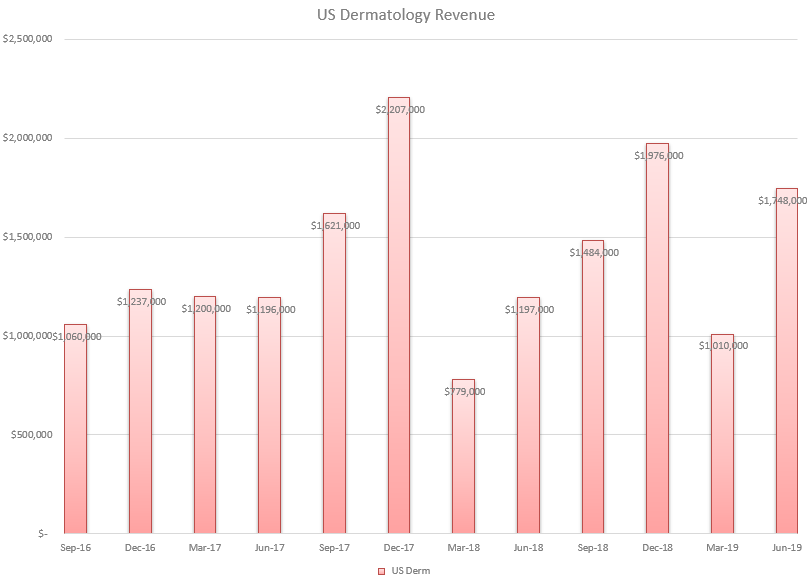
In the first quarter of 208 growth in the US dermatology segment stopped abruptly.  Revenue for the March 2018 quarter was $780,000, down from $1.2 million the previous year.

Needless to say, I put my head down, took my loss (which if I remember right was substantial) and went home.

It was lucky I did.  The stock continued to fall through to the end of the year.  I got into the stock at a split-adjusted price of about $36.  I exited in the low $20’s.

It traded down to $10 in November when the company did an equity offering (at $9 with half warrants at the same price).  It fell further to the $7’s as Sonoma replaced their CEO and CFO in mid-December.  It is bottoming (maybe?) now at a little over $5.

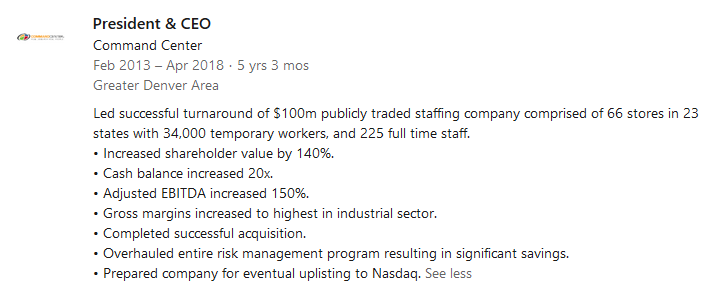
The new CEO is Bubba Sandford.  Sandford’s previous gig was with Command Center (CCNI), which is a publicly traded temporary staffing company.

His track record at CCNI is mixed.  The stock price treaded water for a number of years but it is worth noting that shortly after Sandford came onboard in 2013 there was a noticeable rise in the share price from $2.50 to $8+.  It seems like he did the job cutting costs but was never able to follow through with growth.  Things went south for a while in 2016 after a restatement of results.  There are some vocally displeased shareholders on this call in particular.

Sandford describes his role with Command Center as a turnaround on Linkedin:

New CEO or not, this year the share price of Sonoma has continued to fall, albeit at a somewhat slower pace.  It was trading at pretty much the low of $5.50 when I bought stock on Friday.  It popped after that, but I have no idea why.  It wasn’t me buying it up.

So what is the story now?

I’m almost embarrassed to say.  It’s basically the same as it was.  But with a better breakeven and bigger discount.

In March Sandford announced that there would be cost-cutting measures to bring the business closer to profitability.  In the press release Sandford said:

“Our chief goal is to allocate our resources in a manner that maximizes shareholder value.   While we are pleased with the direction of the 3rd quarterly results, we are not yet finished with the process of accessing ways to grow revenues, reduce expenses, and improve gross margins. This process takes time and can be painful, and we recognize that personnel reductions are difficult for our employees, their families and the community. We value the dedicated team at Sonoma for working hard towards this goal.”

This was followed shortly after with the sale of their animal health business in May for $2.7 million.  The sale gives them a bit more cash which means a bit more runway which is something they need because they are not breakeven yet.

Their fiscal fourth quarter, which is for the quarter ended June 30th, was announced this week and it looked to me like the company made progress.  Operating expense for the quarter was $4.1 million.  This is the lowest operating expense I’ve seen for the company since I started watching them back in 2016.  The reduction in SG&A for the quarter was $1.2 million year over year.

Equally positive was that U.S dermatology sales were up 46% year over year.

In fact, apart from that disastrous first quarter of 2018, dermatology sales in the US have been doing pretty well.

But the second quarter was a blow-out.  If it continues the company may be closer to cash flow breakeven than you think.  It’s a seasonal business with sales typically being highest in the fourth quarter which will be a wind at their back for the rest of the year.

With better sales and improved costs, I calculate that operating cash flow before working capital changes was still a drain of $1.4 million.  While this isn’t great, it is much improved over the $2.5 to $3 million burn they were doing a year ago.

While operations appear to be moving in the right direction, what really got me interested here is the price tag.  At $5.50 and with a little over 1.3 million shares outstanding the market cap is only $7 million.  There are another 446,000 warrants and options, but these are priced significantly higher at $10 and above, so I’m not considering them.

While I realize the cash on hand is fleeting given the cash burn, this means the enterprise is trading at under $3 million as of the end of June.

That seems pretty cheap given what is a legitimate product line that is demonstrating growing sales.

Of course, unless they have more cost-cuts up their sleeve or another big bump in revenue, they will have to raise cash one more time.  An ill-priced predatory offering and all that potential value could be out the window.

On the other hand, a fair offering and another good quarter could represent a turn in the stock.

So there is unquestionably a lot of the risk here.  We’ll see.  Bubba Sandford seems to have them on the right track here.  If the next quarter can bring another uptick in sales and/or further cost reductions, we may see the cash burn contract further.  Or some other positive event may occur.  Sandford is acting in what appears to be shareholder interests.  Given the price and the recent trends, that is reason enough for me to take a small stake.

A Change in the Oil Narrative (and I bought Moneygram)

With the market finally correcting as I had hoped I am sitting in the fortunate position of having large index shorts (via RWM and SH), a few individual stock shorts, a large position in gold stocks and lots of cash.

I am looking for names to add though I won’t rush into it.  I don’t really understand the significance of what is occurring in Hong Kong.  Until I do, I feel like I am best suited sitting pat.

I did add one name that I spent the weekend reviewing.  Moneygram.  Unfortunately, the stock is up today even as the market is down, but I decided to take that as a positive sign and bought a starter position anyway.  Moneygram fits the bill as being a bombed-out stock with an intriguing upside.  In particular, their partnership with Ripple: if Ripple is truly a faster settlement technology it could be quite meaningful to Moneygram.

I will talk more about Moneygram later.  What I wanted to write about here was something totally different.  Oil stocks.

Its been a while since I’ve taken a meaningful position in an oil producer as anything more than a trade.  I took positions in a couple of oil service stocks back toward the December lows that I thought I would hold for the long-run but didn’t (Tetra Technologies and Superior Drilling, both of which worked out temporarily but which I skedaddled from when it became clear the rig count was going to keep falling).  And of course, there are the forever fledgling positions in Cathedral Energy Services and Energy Services of America, which I basically don’t look at anymore and just hope for a takeover at some point.

But I have for the most part stayed away from buying oil producers.

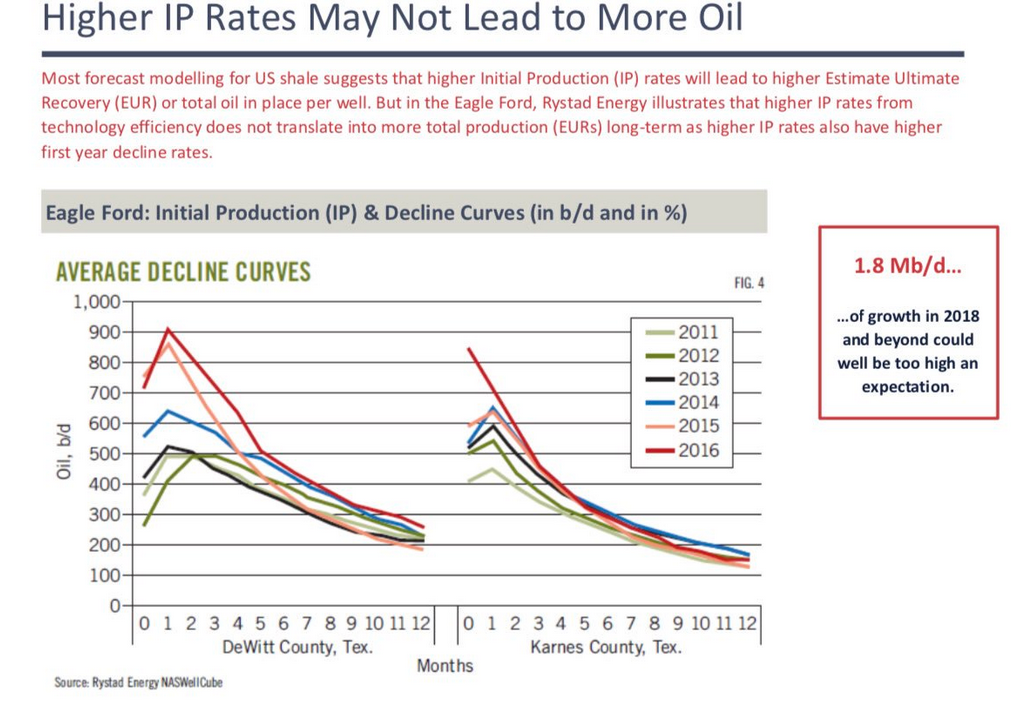
The ones in the United States have not made much sense to me as they continue to outspend their cash flow and I remain suspicious about the long-term productivity of the high IP wells from the US shale plays.

The oil stocks in Canada are far more interesting.   I’ve watched them all year and they just keep getting cheaper.  Recently, I decided to take positions in a couple.

It seems to me that, rather ironically, the Canadian producers are ahead of the curve.  They have been forced by pipeline constraints to change their business model from growth to one with a focus on free cash generation.  While for the last few years this has led to dismal performance by Canadian oil stocks, I believe that it could soon start to bear fruit.

Why?  Well there seems to be a change in narrative taking place in the oil market.  If it takes hold it could usher in a new perspective for investors of energy equities and in particular for Canadian equities.

The oil market is complicated, and data is incomplete.  As a consequence, the market is usually dominated by one or two narratives that determine the sentiment of investors in the sector.  As long as the data is not too much at odds with that narrative, the narrative will determine the trajectory of the commodity and industry that supports it.

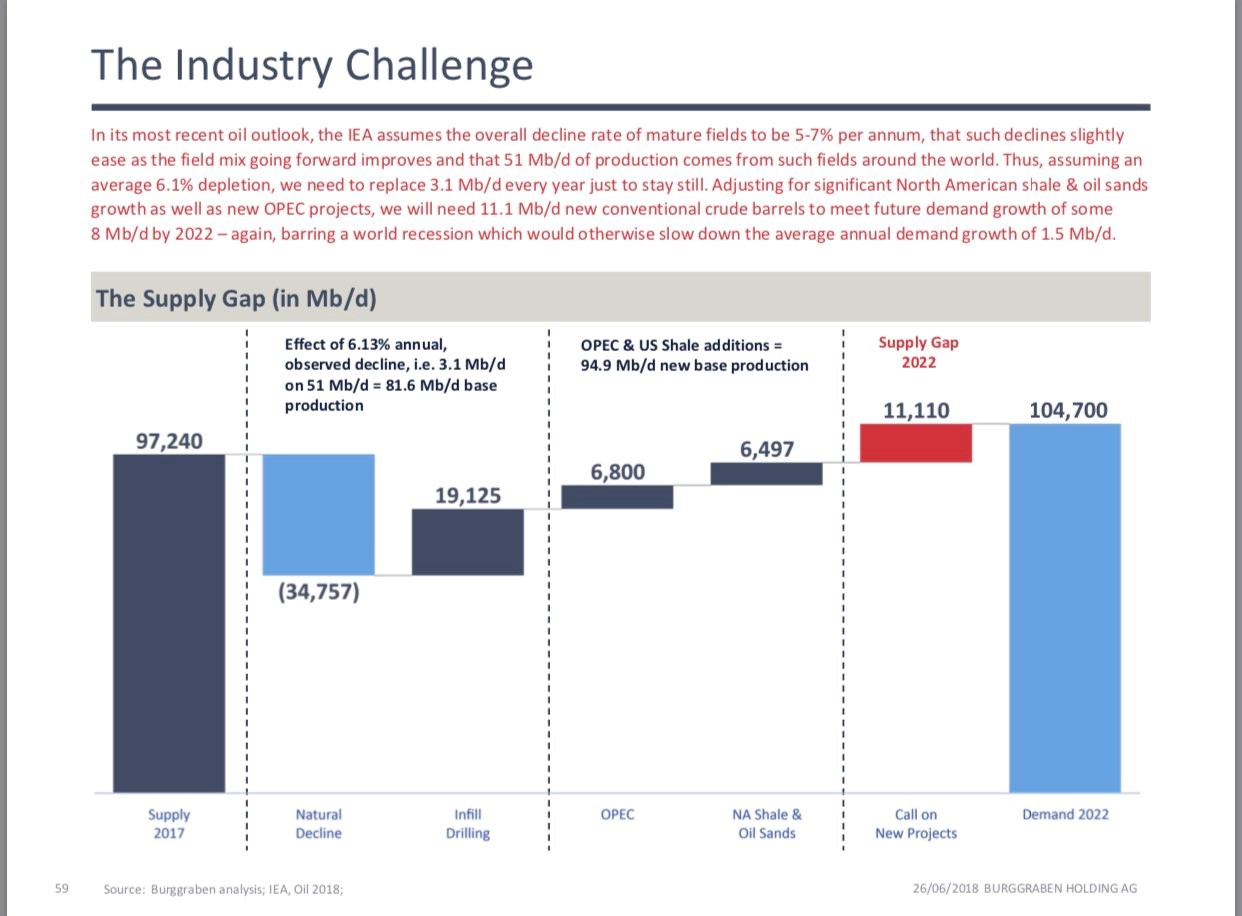
The dominant narrative for some time has been that US shale growth will sop up any demand growth the world requires.  Maybe even more negatively, the belief has been that the Permian is so productive, so unstoppable, that producers will continue to increase production unless oil prices are so low that oil stocks are basically worthless.

Thus, it has been that even though the medium term supply gap looks fairly constructive, the believe has been that shale and in particular Permian production will make up any short fall.

While there are several reasons that oil equity prices have been terrible for the last few years, the big one is simply the corollary of this narrative: there is no upside in the price of oil.

The reason that any of us invest in commodities is for the possibility of a big “pop” in the commodity. I sat in gold for nearly a year waiting for the “pop” that we are now experiencing.  If there was no opportunity for such a surge, I wouldn’t have bothered.

That is where we are with oil equities.

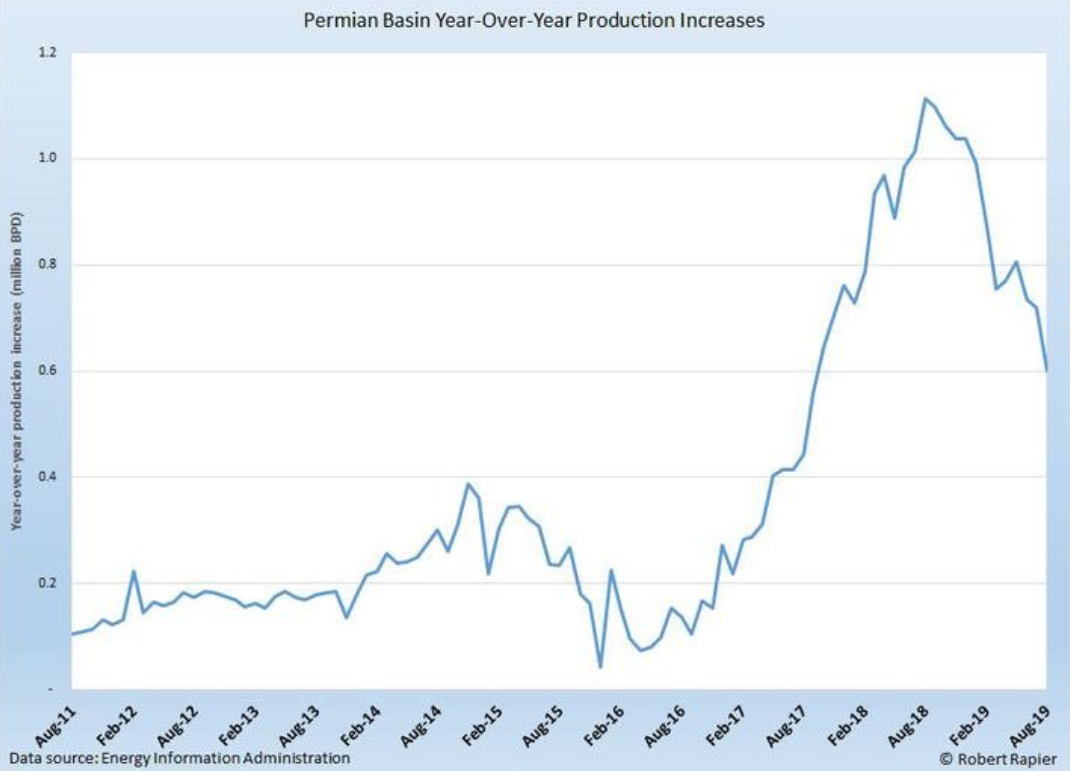
So that has been part of the story that has gotten us to this.  And you can see how important shale additions are and the thought has been that shale will adjust to fill any of the supply gap.

That is the narrative and I think it might be changing.  I’m starting to see articles and comments that question shale.  Articles that ask whether the “technology” that is supposedly so productive has just been pushing production forward and that the wells drilled are not what was expected once you get past the first 12, 24 or 36 months, particularly in acreage that is not of the highest tier.

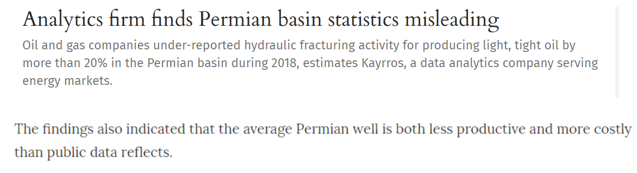
There has also been news that the Permian statistics aren’t quite as compelling as thought, that a lot more wells have been drilled then originally thought, and therefore that the efficiency of the overall field is not as strong as maybe it was originally thought to be.

At the front lines what we are seeing are questions about the long-term production of shale basins.

Other articles suggest that the “inventory” of wells is not the vast sea that it was thought to be, that more wells may be producing than originally thought, and that therefore the productivity of basins like the Permian are not as strong as originally thought.

Of course, take all of this with a grain of salt.  The Permian remains an extremely productive field and holds many years of growing oil production in the ground.  Also, the Permian is pipeline constrained right now so we need to see what happens when those constraints are removed in the second half of this year before drawing too firm a conclusion.

Nevertheless, there is some reason to believe that at the margins, shale is not the panacea it was thought to be.

On top of that US oil companies are beginning to be forced to follow their Canadian cousins and cut back on their unconstrained growth model.  Production continues to grow, but that growth rate may have peaked.

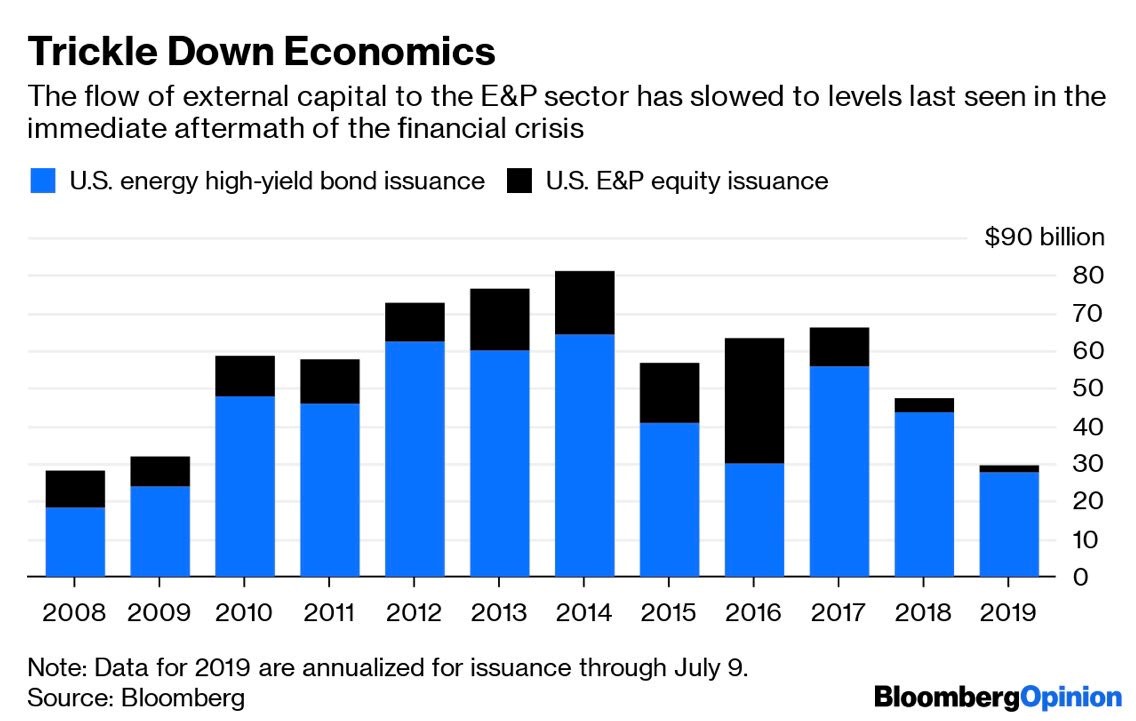
The rethinking of growth seems to be happening because A. the results of non-Tier 1 acreage aren’t as strong as had been hoped and B. because capital is drying up.

Both equity and high yield bond issuance of E&Ps continues to shrink.  Private equity, which has been going into the secondary basins and buying up fringe lands, appears to be stepping back and in some cases looking to sell.

The fly in the ointment is of course the global economy. If demand fails to grow all of these signs could turn out to be moot.

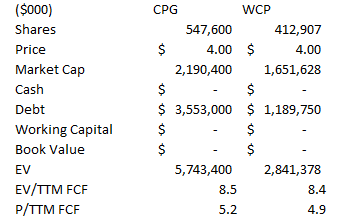
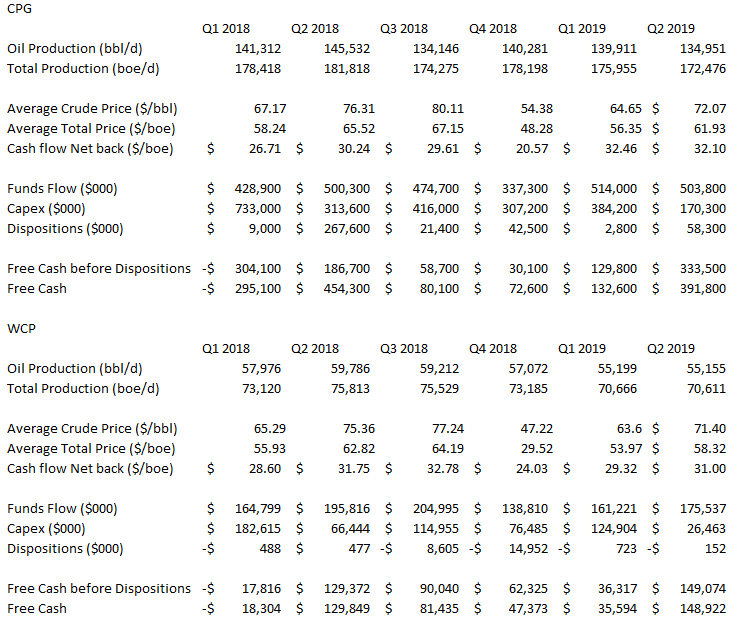
I understand that and will keep this position, like all my positions right now, small.  But Canadian oil equities are compelling from a value point of view.  Consider the tables of two that I decided to wade into, Crescent Point and Whitecap.

To be sure, there is very little growth here and in Crescent Points case they have been selling off production. But both companies have figured out how to generate free cash (not operating cash, free cash) quarter after quarter for the last year.

While it may seem totally unrelated at first, I was looking at the quarter of Texas Instruments (mainly because it is a stock I am short) a couple of weeks ago.

I was struck by the similarities of the business model of Texas Instruments to the business model of Crescent Point in particular over the last 4 quarters.

Texas Instruments trades at a 4.8% free cash flow yield, so basically 21x free cash flow.   They don’t get the valuation because their business is growing at leaps and bounds.  In fact, revenue is expected to decline from $15.8 billion to $14.7 billion in 2019.   Even looking longer-term, revenue was close to $14 billion back in 2010, which means growth since that time has been minimal.  At best this looks like a 5% growth business over the long-run.

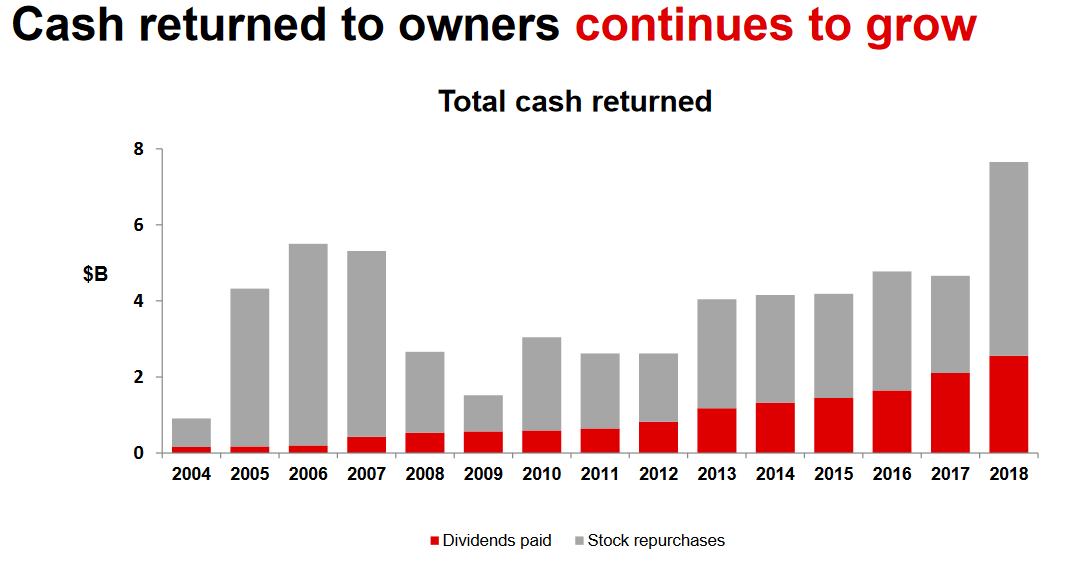
But Texas Instruments gets a reasonably strong valuation because the company has been very good at returning cash to shareholders.  In particular, Texas Instruments is excellent at repurchasing stock.

I realize that the comparison is far from perfect.  Oil is not technology.  But see my point. The Canadian oil producers have transitioned to a business model that emphasizes free cash flow.  Now they are beginning to return that free cash back to shareholders by buying up their shares.

This combined with a change in narrative to one where shale is not going to produce unlimited oil, and it could be enough to change the fortunes of Canadian oil stocks.

We are still very early in the narrative change, and as I said it could be totally derailed by a global recession or some other trade induced calamity.  So hold your breath.

But if this change in narrative has legs, it, in combination with the newly found free cash flow generation of Canadian oil equities, is worth a bet. I’ve made a small bet and will be watching closely to see how it evolves to determine whether it warrants a larger one.