Skip to content

New Position in Evolent Health

I have a couple of resolutions for my new portfolio year:

  1. More concentration in the few names I really believe in
  2. More bottom-picking for lows

I think back to the years where I put in the best performance.  The winners those years were primarily less-than-stellar stocks that had been out of favor.

MGIC and Radian. YRC Worldwide.  Pacific Ethanol. Impac Mortgage.  IDT.  Yellow Media.  Heck, even very recent winners like Digital Turbine and Smith-Micro were scrap heap pick-ups when I started looking at them.

These were all stocks I bottom-fished on.  They were not picked from a list of 52-week highs.  They all gave me some pain before working out.  They all were big winners eventually.

Thus, a goal of mine this year is to spend more time looking for bombed out stocks and less time looking at 52-week highs.

I’ve taken a couple very small positions in struggling consumer products businesses in that regard (Big Five Sports and Dean Foods).  I’ve also bottom fished a couple Canadian oil stocks (Crescent Point and Whitecap).  But my largest endeavor by far into the world of beaten down tickers is Evolent Health.  The chart is a poster-boy for such a move.
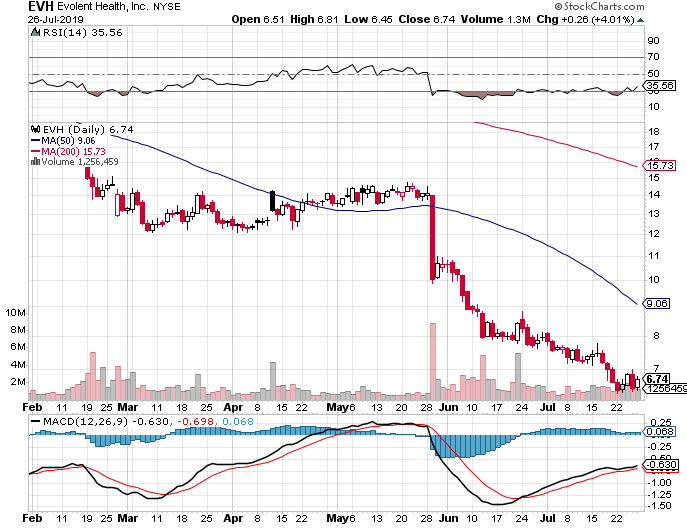
From what I can tell, the collapse of the stock can be attributed to three things:

  1. Revenue growth from the platform business has stalled
  2. Distressed conditions of a few customers have raised alarm bells
  3. Evolent has taken on an operational role and staked capital into its largest customer (Passport)

Let’s examine each.

The Platform Business

Evolent Health provides a platform that helps health plan providers manage the clinical and administration side of the business.  The platform specifically is geared at providers looking to take advantage of Medicare and Medicaid value-based care programs.

Value-based care are a series of relatively new initiatives created by state and federal governments in an attempt to better align the interests of health care providers with outcomes.

What is driving the change is the recognition that government needs to be more effective in their health care spending because the funding dollars aren’t there.

There is a long-term funding shortfall in health care.

Evolent provides the following slide in their Investor day.  It illustrates the relatively flat revenue available from the Federal government (from taxes) and the increasing costs of Medicaid, Medicare and other government health programs.
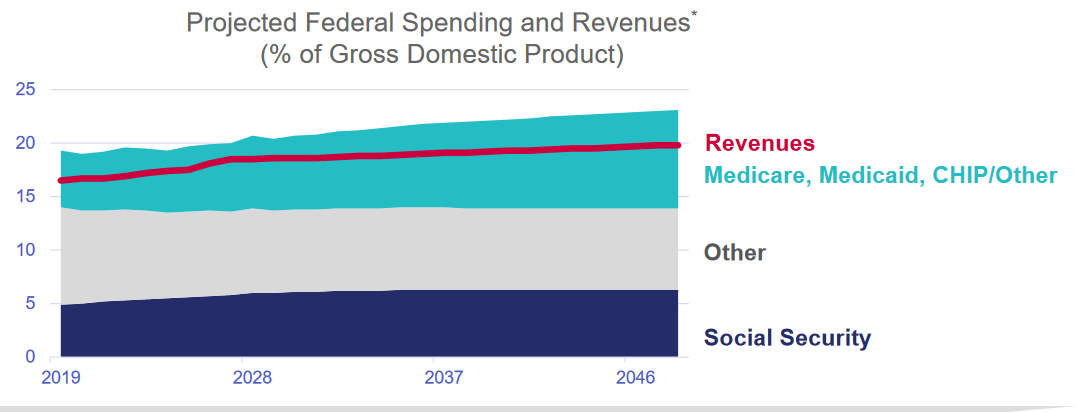
This disconnect has led government to look at different reimbursement models than just simply paying fees for services.

It is a priority.  In fact, value-based health care is considered one of the three top priorities by the Trump administration’s HHS secretary Azar.

The problem is that value-based health solutions are complicated. They require that hospitals incorporate data analytics, automation and a level of administrative, clinical, and financial risk assessment that they are not equipped to handle.

Evolent provides the platform to bridge that gap.

Where Evolent Sits

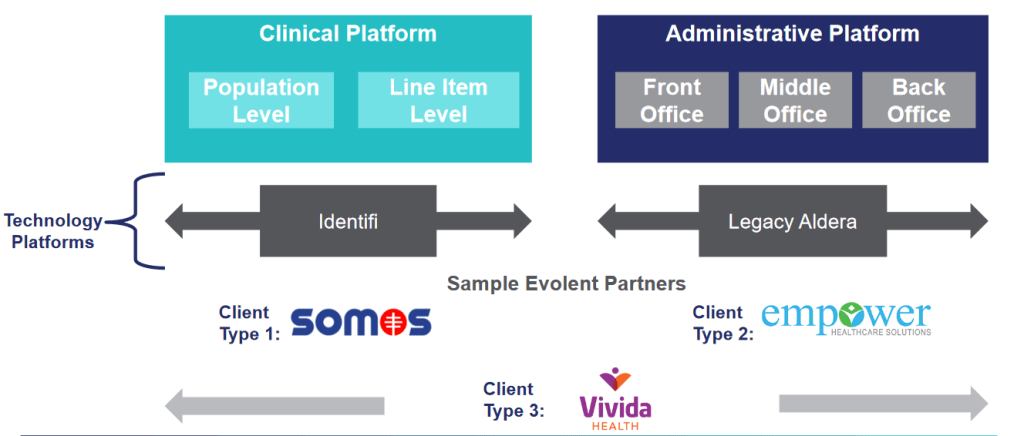
The Evolent platforms handle the clinical, administrative and financial side of the business   They integrate all available data to assess risk and provide a course of action for each life covered by providers and payers.

There are really two connected platforms.   The first, called Identifi, handles the clinical side , while the Aldera platform handles the administrative side.  The platforms can be integrated and customers that use either or both.
The valuation proposition behind the platform is simple:

  1. Medicare and Medicaid programs are available that can allow providers to improve their compensation from these programs.
  2. To capture that margin providers need to be armed with better data and tools.
  3. Evolent can be the middle-man to provide the data and tools.

What adds value to providers?

With each client Evolent asks the following questions:

  • how do we drive clinical value working with very engaged providers, leveraging all the tools that you need?
  • how do you help to monetize that?
  • how do we get paid for it?

One of the focuses of the Evolent platform is prevention. Engage the patient before they even get sick, engage the provider, and provide resources around the provider to help predict the outcomes before they happen. They call themselves “the best in the industry at determining who is going to get sick”.

Evolent has measured their performance against control groups and estimated that they kept their patients out of the hospital for 41,000 days in 2018.

When you think about the cost of a hospital stay, that is significant for a payer.  They reduce total medical expenses by 24% per life covered.

Another value proposition is as a single touch connection between providers and payers – rather than each provider having to handle 5 different platforms from 5 different payers, they can use the Evolent platform and handle one that has portals that integrate with all the payers they deal with.

What happened to the business?

The first reason Evolent has sunk is because revenue from the platform business has stopped growing.

Looking at the financials is a little misleading because Evolent completed an acquisition in the fourth quarter of 2018 – New Century Health. The acquisition added about $50 million of quarterly revenue and makes things look a bit rosier than they actually are.

Without it, we see a decline in platform revenue the last couple of quarters.
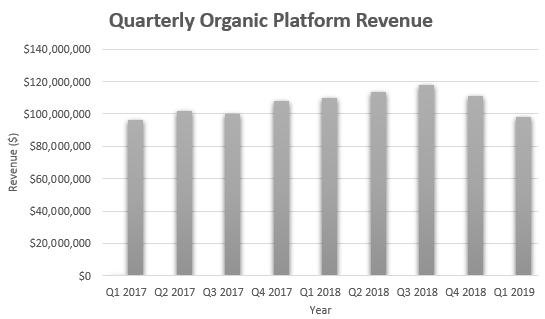
The company outlined the reason for the decline on the fourth quarter call.

First of all, the wind down of our early provider-sponsored Medicare plans combined with McLaren’s decision to in-source MDWise’s health plan operations will drive lower same-store revenues in the first and second quarter.

The decline will likely continue into the second quarter.  The provider-sponsored Medicare plans were high revenue per patient, which hurt margins as well.

The loss of the MDWise business is because they were acquired by McLaren, which now is integrating them into their own system.  MDWise is significant, with 360,000 Medicaid patients.

Together MDWise and the provider-sponsored Medicare plan losses are about $55 million of annual revenue.  A significant hit to a $450 million business.

Is this a read-through into Evolent’s performance going forward?  Here is what William Blair thinks:

Making up for the revenue loss, Evolent has signed 3 significant new deals (with RCMG, Premera and Empower).  These will begin to ramp up but not until the second half of 2019.

While we have one of the most robust pipelines in our history, our new expected deal start dates are more back weighted to the second half of this year. This is largely the result of CMS’s July start date for its Pathway to Success program, which impacted our Medicare line of business as well as New Century’s sales cycle relative to our October close date. The good news is we start the year with 2 closed deals in California and Arkansas, which we expect to fully ramp midyear and several late-stage deals, which are consummated would drive growth in the second half of 2019.

Concern #2: The Customers

The second concern is customer solvency.  Evolent Health has a short list of customers.  While they cover 3.1 million lives (after removing MDWise) they only have 30 or so partner organizations.

A few of these customers are experiencing a degree of financial duress.  Most notably is Passport Health, which made up 17% of Evolent’s revenue in 2018 and is expected to make up 10% of revenue in 2019.  Passport has been on the verge of insolvency this year.

A second Evolent client that has been in the news (negatively) is Cook County’s CountyCare.  They were highlighted as a partner in Evolent’s May investor day.
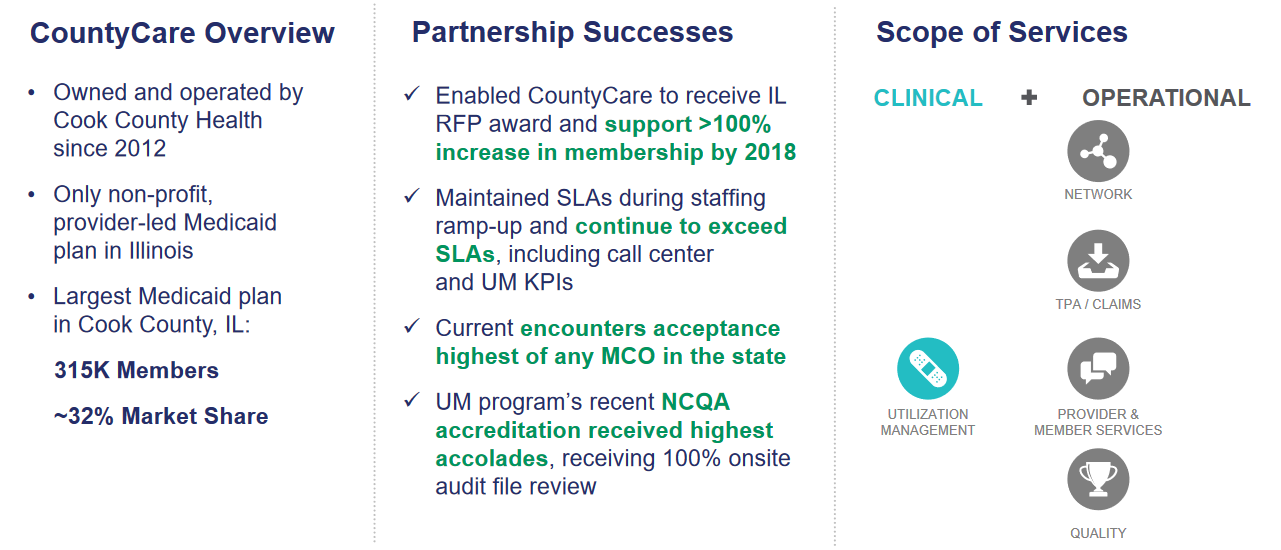
According to this article, CountyCare is far behind on payments and owes $700 million to providers.

Cook County’s Medicaid health insurance plan is so behind on paying vendors that there’s a shortage of pacemakers and anesthesia for surgeries – and some doctors even refuse to treat patients covered by the plan, according to a watchdog report released Friday.

CountyCare, however, refutes the claims.

The Passport Situation

Of the distressed customers, Passport is the immediate worry and the source of the third investor concern – Evolent’s ownership stake in Passport.

Passport is the second largest provider of Medicaid plans in the state of Kentucky. They have 315,000 lives under their coverage.  They are a non-profit.

Passport has run into trouble because of rate changes in Kentucky and inefficient operations.

There was a retroactive rate reduction last year that squeezed revenue.

Second, as a non-profit Passport is not as efficiently run as they could be.  Evolent described Passport as having “less urgency” than a for-profit company may have.

This combination of factors put Passport on the brink of insolvency this year.  They began looking for a partner that could help them both run the plan and be a capital partner.

Making the urgency of situation more immediate, Passport is up for renewal on their Medicaid license in Kentucky.

While the new Kentucky Medicaid contract, which runs through 2025, won’t take effect until next summer, bids are due on July 5.

In all likelihood Evolent was not keen to be a part owner in a health plan.  They implied that it was, at the very least, a process on their investor day call.

But Passport represents a lot of revenue to Evolent – over $100 million.  That revenue has a significant contribution margin.

Evolent probably felt they couldn’t afford not to take the risk.  This comes at a time where Evolent is already facing revenue losses from MDWise and some Medicare Advantage accounts.

The Market Reaction

The market didn’t like the decision to take ownership in Passport.  The stock fell 30% on the announcement.

A few reasons for the response.  The market does not like that Evolent is getting into the plan operations business.  It does not like that the business they are getting into is a money-losing plan.  It probably doesn’t love that they are essentially providing financing to one of their customers.

The market is looking at this as risk – to the existing revenue stream that Passport represents and to the $70 million that Evolent sunk into Passport for the ownership stake.

Evolent is supposed to be a platform provider, collecting fees and maybe performance incentives from plan providers.  Investors bought the stock to participate in that.  Not to see them run a plan themselves!

All fair points.  But when I dig into what they are doing with Passport, what seems to be missed is that there is an upside here.

The Upside

Passport is, rather obviously, a money-losing business right now.  They have lost $164 million in the last three years, including $60 million last year.

It’s a health plan in need of a turn around.  If Evolent really is what they say they are, they should be the ideal partner to create that turnaround.  This is a showcase for the power of their platform.

Not to mention a potential windfall if the business turns.

Consider the following:

  • Passport’s premium revenue from the 315,000 members is about $1.95 billion right now
  • Evolent believes they can take Passport’s medical expenses down to 90-91%
  • They also believe they can take Passport’s administrative expenses down to 8-9%
  • Together they see operating margins stabilizing at 1-2%
  • They also believe they can drive the base revenue of the services they provide to Passport (so essentially the platform services) by 50-75%

Let’s just entertain the crazy idea that Evolent can actually accomplish what it wants to do.  In such a scenario Passport would deliver $20-$40 million of annual operating income.

If that happens, Evolent’s 70% stake in the health plan is worth a lot.  Wellcare, which is albeit a large plan provider of Medicaid as well as Medicare plans, trades at 20x earnings.  Humana trades at 16x earnings.  UnitedHealth trades at 17x earnings. Molina Healthcare, which is the smallest of the group at $8.8 billion, trades at 13x earnings.

It’s easy to see how this could explode. If Evolent succeeds, let’s take the high end just for blue sky, is it absurd to think that Passport is worth 10x operating income or $400 million?   That would put Evolent’s stake at $280 million, or nearly half the market capitalization right now.

On top of that there is the benefit to the base services business.  Platform revenue increases by $50-$75 million as a result of increased integration with Passport.

The Risks

There is, of course, a lot that could go wrong.

In the short-run, there is a reasonable chance that the second quarter is bad.  The stock may still have another leg down.

Looking longer-term, the Passport experience may fail miserably and Evolent may end up losing not only its $70 million investment but the $100 million of revenue they currently get from Passport.

Maybe even worse, Evolent’s focus on Passport distracts management team and deals elsewhere fall through.

The other risk here, and it’s a legitimate one, is that the platform business slowdown is not just a one-time hit caused by MDWise and a few other customers.

The cynical view is that the acquisition of True Health New Mexico, the acquisition of New Century and now the ownership stake in Passport are really just smoke and mirrors – intended to obscure the revenue decline of the platform.

I, of course, cannot rule that out.

What I can say is that if the negative assumptions don’t play out and the platform business returns to low-double digit growth (management did a soft-guide to “teens growth” at the analyst day in May), there is really no reason the stock should be in single digits.  If they execute successfully on Passport, it could be much higher.

Evolent trades at under 1x EV/Sales.  Margins aren’t as high as most platform plays at around 40% (this is something I have to admit I haven’t quite wrapped my head around why) so they shouldn’t get the sky-high multiples that you see with some.  But under 1x has to be too low if the business isn’t on the verge of an implosion.

So that’s the opportunity.  I think it’s miss-priced.  I understand why its miss-priced.  I also understand that how it could be fairly reflecting what is to come.  But I think the risk is worth the reward.  I’ve made Evolent a pretty big position but I will double down if it tanks on earnings, but my thesis is intact.  I’m willing to take some risk here.

Week 419: Picking my spots

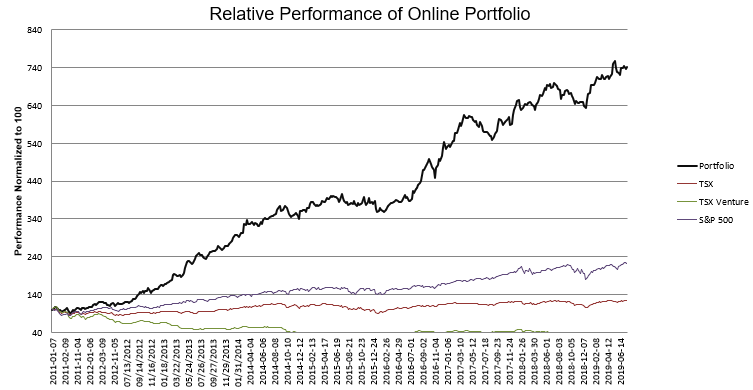
Portfolio Performance

Thoughts and Review

While the prior few months were characterized by performance that was better than it should have been because of the fall in the Canadian dollar, the last month and a half has seen the opposite.  My portfolio has done reasonably well, particularly the gold stocks, but I am about flat because of Canadian dollar strength.

Be that as it may, I suppose you could argue that gold stocks would not be performing so well if the Canadian dollar weren’t strong, as the two both move in tandem with the US dollar and that either way I would be standing still.  So I might be better to think of it as a hedge than a missed opportunity.

The rest of my portfolio, the non-gold side, is quite dull.  I expect that to continue until we get a correction.  I have a high level of cash in my account.  That cash level is even higher after taking into account the sizable hedges I have in place via a Russell index short and an S&P 500 short.

With flat or down being my tentative conviction, I expect to continue to under-perform the market if it moves higher unless one of the small, strategic positions comes through as a big win.

There are a few signs that maybe I am wrong to be so hedged.  The leading indicators have stopped falling, though they are still kind of flat-lining.  The Baltic dry freight index has experienced a big bump, though that may just be due to iron ore exports from Brazil coming back.  It is tough for me to make a call here, and tough for me to be terribly long when so many stocks seem to trade at valuations that I can’t make sense of.

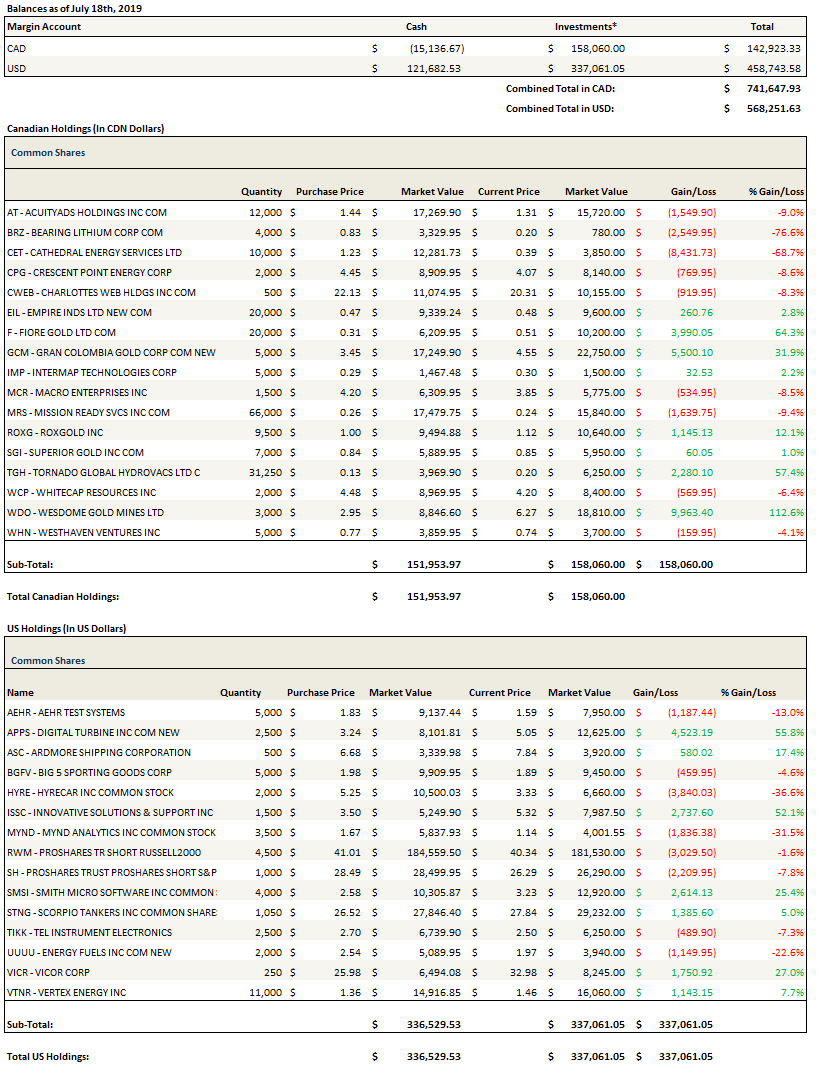
The easiest thing for me to own have been gold stocks.  I don’t feel like they have recovered to reflect the current move in the price of gold.  Many of the juniors I am in still look very cheap on $1,300 gold.  I added a couple of gold names in the last few weeks: Superior Gold, Westhaven Ventures and Argonaut Gold (I seem to have forgotten to add Argonaut to the practive portfolio though).

I did sell a little Gran Colombia Gold and Fiore Gold this week just to get my overall exposure down.  The one thing that worries me with gold (in the short run at least) is the Fed.  Gold has a terrible tendency to be smacked on Fed days, and we have one of those coming up.  Is gold assuming a 50 bps cut or a 25 bps cut?  What Fed speak is gold pricing in?  Does any of it matter and will gold simply be sold by shorts because it can?  All questions that lead me to not want too much gold heading into next week.

I sold out of most of my IMO 2020 trade for the time being (I sold some STNG this week so that isn’t reflected in the portfolio update data).  I expect to re-enter the trade.  A couple of things led to my departure.

Regarding the refiners, I just feel they are so volatile, and as I said when I wrote about them, there are a lot of elements in addition to IMO rule changes that will lead to spreads.  PBF Energy and Marathon both had nice pops after I bought them (after the obligatory post-purchase slide of course) and I thought I would get another opportunity at some point.

As for the product tankers, I was surprised to see that spot MR and LR tanker rates had fallen below $10,000/day.  This simply didn’t make sense to me.  These rates held up through the height of refinery maintenance season and I just don’t understand why they are as weak as they are now, with most refineries coming back online.  I don’t profess any knowledge here other than simply “not getting it”, so I decided to exit these stocks until I understand what is going on.

With all that in mind I kept all of my Vertex Energy.  This is probably my highest conviction name, as they seem so perfectly situated to take advantage of what has to a surplus of high sulphur fuel oil with nowhere to go.

The only other real change to my portfolio is that I added to HyreCar when the company was offering stock.  I don’t know why they are offering stock.  There are folks that say they are in discussions with large OEMs that want to see more cash on the balance sheet and that may be the case.  It would align with their comments last quarter.  But it seems to me that doing a raise here, especially one without a warrant overhang or any other gotchas, makes this a reasonable place to take a position.

Finally I’m starting to add a couple of oil stocks.  I see the start of a change in narrative.  The neverending shale growth narrative appears to be wobbling.  If it topples, it would be good for Canadian energy stocks.

Portfolio Composition

Click here for the last seven weeks of trades.

What To Do With Gold Now?

Gold had a big move last week.  We had a similar move in gold stocks.  A number of the names I owned moved quite a bit.   As is usually the case, I own a lot of gold stocks.  I am left with the question: what do I do with them now?

On the weekend I went back to look at the big picture.  After looking at gold supply and demand trends I am left drawing the conclusion that it is a mixed bag.   It really comes down to this: the direction of gold will be determined by investment demand for gold, which is largely speculative.

What I do with that – I’m still not sure.

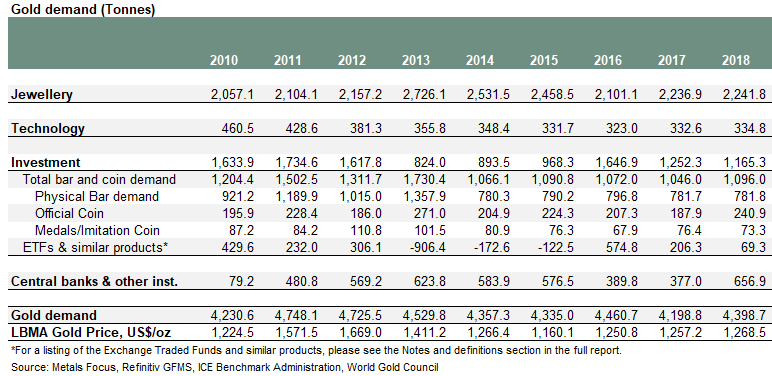
Here is the breakdown of gold demand from its major sources over the last 9 years.

The largest source of demand for gold is from jewelry demand.  It makes up a little over 50% of overall demand at 2,241 tonnes last year.

Within that tonnage, China and India make up a large chunk – 743 tonnes and 598 tonnes respectively.

That means that over 30% of gold demand comes from consumers in China and India that are buying it as jewelry.

I would contend that these consumers are most influenced by the price of gold in their local currency.

I suspect that when Chinese or Indian consumers purchse a gold piece, they have in mind a fixed monetary-value they are will to spend, not a specific amount of gold.

So for these buyer what matters is the price of gold in their currency.  Thus the US dollar price movements with respect to gold and with respect to their currency are the big drivers of how much volume they purchase.

The second consideration is going to be the economy.  Clearly, in better years there will be more money to buy gold jewelry.  In this regard, the trade wars and the slump of the Chinese stock market may not bode well for Chinese jewelry demand.

I think this is something that is often overlooked.  It is why gold is not quite the counter-cyclical trade it is made out to be.  Too much demand comes from jewelry, which is really the ultimate discretionary purchase, one that is correlated with the strength of the economy.

More generally, emerging markets are the big buyers of gold as jewelry, much more so than developed nations.  The United States only bought 25 tonnes of gold in the quarter while Europe was only 13 tonnes.  These developed regions have a fraction of the demand of China and India.

That makes me wonder about the long-term – will demand in India and China face headwinds as these countries continue to develop?

The US dollar performance is important.  Something we already knew.  But thinking through how local purchase volumes will rise and fall with the relative strength of the US dollar, it makes sense that gold prices fluctuate with this as well.  It doesn’t necessarily have anything to do with the relative faith or lack of faith in the monetary system.  It is likely just the anticipated fluctuations in gold jewelry demand.

Overall, I’m left feeling that jewelry demand is going to depend on how well the emerging market fairs economically, and how well their currencies fair compared to the US dollar.  That tells me that jewelry demand is not likely going to be a tailwind.

I’m going to ignore technology demand, which has flattened in recent years and I don’t see as a big influence to the upside or downside, and move onto investment demand.  Investment demand was 1,165 tonnes in 2018, which is down 7% year over year, up quite a bit from the trough years of 2014 to 2016, but down significantly from its peak.

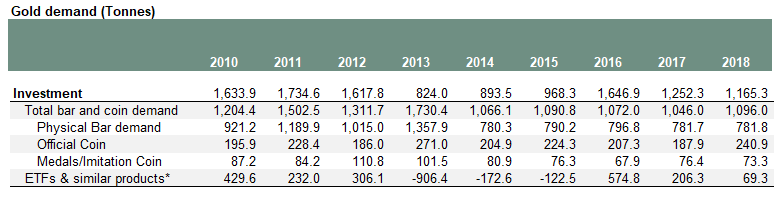
I’ve broken out investment demand with more granularity because I think its interesting to see how different physical demand and ETF demand behave.

Clearly all types of investment demand can fluctuate wildly.  Just looking at it peak to trough, it moved 800 tonnes.  That is nearly 20% of gold demand.

But ETF demand is particularly volatile.  Between 2013 and 2016 it fluctuated almost 1,500 tonnes.  That is just a massive amount.

It is a wonder to me that the price of gold doesn’t change more dramatically.  Consider that oil can go down $20-$30 a barrel on a ~1-2 mmbbl/d change in supply/demand in a market of 100 mmbbl/d!

Investment demand is really what gold is all about right now.  Its a wildcard for the reason that unlike other sources of demand, it is self-reinforcing.  Generally, demand self-corrects with price.   Investment demand doesn’t.  It can actually increase with price, particularly if we get a speculative bubble.

Probably the most important point with this regard is simply that investment demand makes up 30% of overall demand.  That is a lot.  It means that gold is unique to other assets were so much of underlying demand is made on the basis of price expectations.

If you are betting on gold to go higher, you are betting that investment demand takes off.  Considering what seems to be happening with monetary policy, that we are moving back towards something like quantitative easing, and that an active currency war doesn’t seem impossible, maybe this isn’t that farfetched?

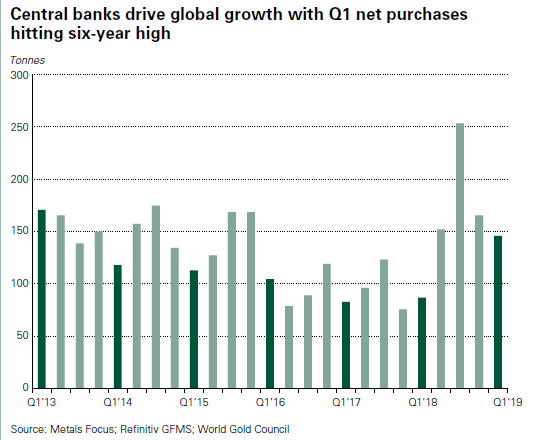
Related to this thesis would be that Central banks step up their purchases.  Central banks purchased 145 tonnes in the first quarter.  They account for roughly 15% of purchases.


Central bank purchases have been bouncing around without much of trend until recently.  But maybe, if you squint enough, you can see that purchases have ticked up over the last year and a half.

It makes sense.  A consequence of Trumps trade war should be that Central banks look to diversify currency holdings outside of US dollars.  At least at the margin.  That should add incrementally to gold demand.

So that’s it for demand.  On the supply side, I read lots of talk about peak gold.  But to be honest, I don’t see it in the numbers yet.

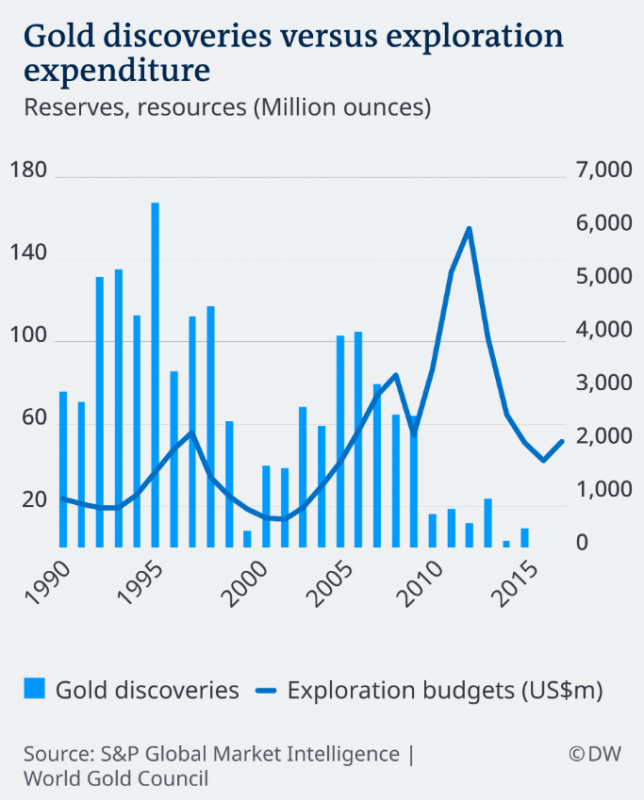
There is a good basis for peak gold as an idea.  Gold discoveries have seen a significant slide over the last few years.

The natural consequence is that we should see a drop in gold supply.  There are analysts forecasting this to begin this year.

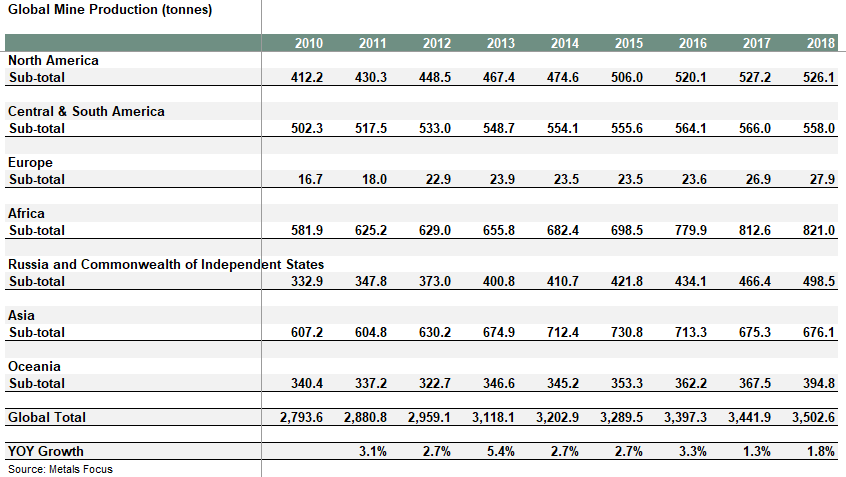
The problem is I don’t see it yet.  Here is a closer look at gold production over the past 5 years.  Gold production may be slowing, but its to early to say that its definitively rolling over.

In the first quarter of this year, gold production was up about 1%.

The last piece of the equation is the gold stocks themselves.  Where are they in comparison to the price of gold?

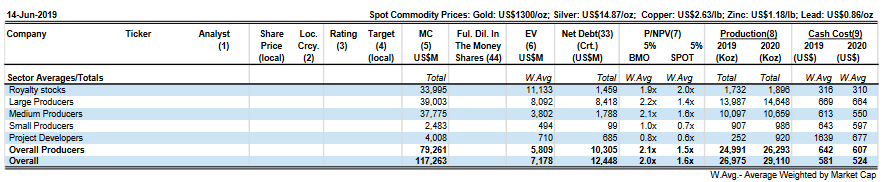
It looks to me like there is a big variation between the larger cap stocks and the smaller ones.  Take the following table from BMO, which is looking at that net present value (NPV) of large, medium, small producers and developers at $1,300/oz gold.

Small miners are trading at half the multiple of the larger ones.

I can pick out small miners I own that are even less than that.  Argonaut Gold is at about 0.5x NPV.  Superior Gold is at 0.3x NPV.  Even Wesdome, which would be considered the darling of the junior gold stocks, is only at 1.1x NPV.  I haven’t done the NPV math on Gran Colombia, Roxgold, or my most recent purchase, Fiore Gold, but I am pretty sure these names are all well below the average.

A last consideration is that Australian traded producers get a premium to those listed in Canada.  BMO did a piece on this recently.  They pointed out that the average Australian name trades at 10x cash flow at $1,300 gold, whereas the average Canadian name trades at only 6x cash flow.  Again, the junior companies that I am invested in are even cheaper.

This combination, both relative value compared to larger producers and relative value compared to their Australian counterparts, should set the table for trans-ocean M&A.  We already saw the first arrow across the bough with the acquisition of a name I owned, Atlantic Gold.  Even as I have reservations about what drives the price of gold higher, and how sustainable that is, I’m inclined to hold on for now.


Another way I’m Playing IMO 2020

I’ve spent a lot of time digging into IMO 2020 over the last couple weeks.  This is on top of all the time I spent late last year and early this year.  So sum total its been a lot of digging.

The conclusion I’ve come to is that its complicated.  Its not really clear how many elements of the crude complex (a catch-all name for every producing, storage, transportation and refining piece that plays a part in getting crude and refined oil products to customers) are impacted.

The two things that seem most certain to me are:

  1. Heavy sulphur fuel oil spreads are going to widen
  2. Demand for distillates will increase

So how do you invest in those most likely outcomes?  The best I can come up with is to A. buy product tankers that will ship the distillate from one place to another and B. buy refiners that can take high sulphur oil and convert it to light products like gasoline and diesel, and to.

I’ve talked about product tankers before.  So let’s focus on the refiners.

I actually feel more confident that heavy sulphur fuel oil spreads will widen then any other outcome from IMO.

Why?

With IMO 2020 sulphur becomes the enemy.  In the past, refiners would use high-sulphur fuel as feedstock, make money off the light products and sell the bottom of the tank high-sulphur dregs into the bunker market.

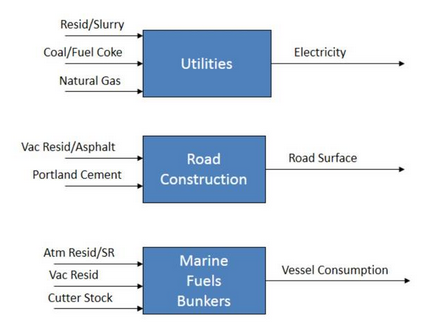
Apart from ships with scrubbers and some non-compliance that will no longer be the case.  The only remaining markets are asphalt and low-end power generation.  Those markets aren’t big enough to take over the nearly 1 million barrels a day of HSFO that will need to find a home.

The price just has to come down.

I’ve listened to a lot of conference calls from refiners.  The most interesting comments came from PBF Energy CEO Tom Nimbley.  He answered a number of questions on the topic on PBF’s fourth quarter call. I’ve put those comments together here to form the narrative.

First, he frames the issue at hand that we are all aware of.   If a refiner doesn’t have complexity (cokers or hydro-crackers), they can’t turn HSFO into light products.  Thus they are producing high-sulphur fuel as a product:

There’s over 4 million barrels a day of distillation capacity that  has low complexity and significantly more than that doesn’t have coking capacity.  So on paper, if you lose the outlet for your high sulfur fuel oil bunker market and that stream is still there…

The “…” is the trailing off of the thought “what happens to all that high sulphur product?”

Second he puts some numbers to the problem.  HSFO prices are going to fall.  Spreads will rise.

If indeed, you’re on the margin going to the power sector [because there is no bunker market], then you are going to end up with these $30, $40, $50 clean/dirty spreads, which will push coking economics to be very attractive

Third, he explains what refiners with complexity (ie. cokers and crackers), are going to do if spreads get to that point.

Personally I think you’re going to see an opportunity or a shift, a wave of perhaps going from a filling your cokers on the margin from crude to filling your cokers on the margin from somebody else’s stranded feed stream [HSFO].

we’ve got to be ready to be able to have the catcher’s mitt to take somebody stranded oil and not necessarily just fill the cokers with crude.

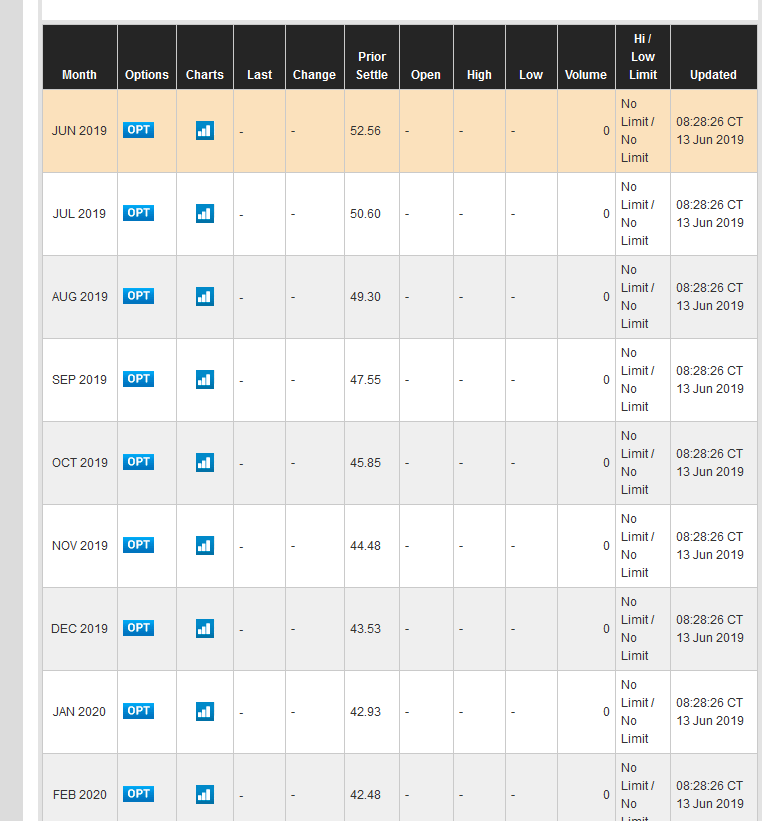
We are starting to see the market price in some, but not all, of this in the futures.   HSFO futures are up to a $10 spread between now and January 2020.  That is up about $3 from a few weeks ago.

The tough part with buying refiners here is that there are a lot of other variables that determine the share price.  I’m still waffling because they are anything but recession proof.  Crack spreads are volatile.  This isn’t as clear cut as product tankers.

A weak economy is going to hurt them.  Increased gasoline exports out of emerging markets are going to hurt them.  Tight heavy oil supply out of Venezuela, Saudi Arabia, Iran and Alberta is going to hurt them.

These are all considerations that (I believe) are responsible for their dreadful performance this year.  These stocks are way down even with the prospects of IMO on the horizon.  It’s my (albeit tentative) conclusion that the downside risks are priced in whereas the upside one’s are not.

My biggest refiner position is Marathon Petroleum.  It seems relatively safe because of its size.  It has complex refineries that can take advantage of high sulphur crude, in fact it has the largest capacity of coking and hydro-cracking capacity of any independent refiner.  It has two very large refineries in the Gulf and a bunch in the North that are destinations for Canadian heavy crude.

The second position I’ve taken is PBF Energy.  I bought a little of this one a week ago but added to it after the stock swooned on news of an acquisition.

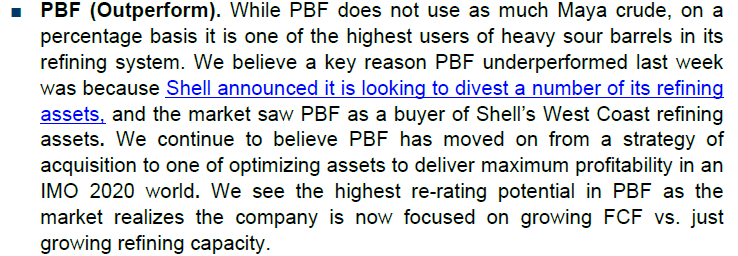
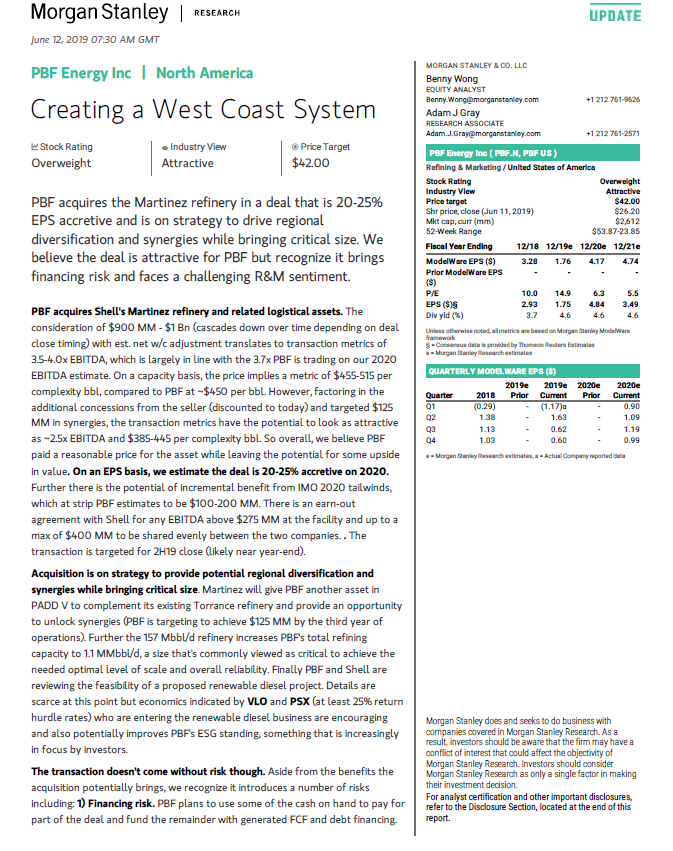
PBF announced on Tuesday that they were buying the Martinez refinery from Shell.  I guess the stock slid because of worries about debt.  Some analysts were also taken by surprise, having not expected PBF to make an acquisition.  Consider this piece from Credit Suisse a few weeks prior:

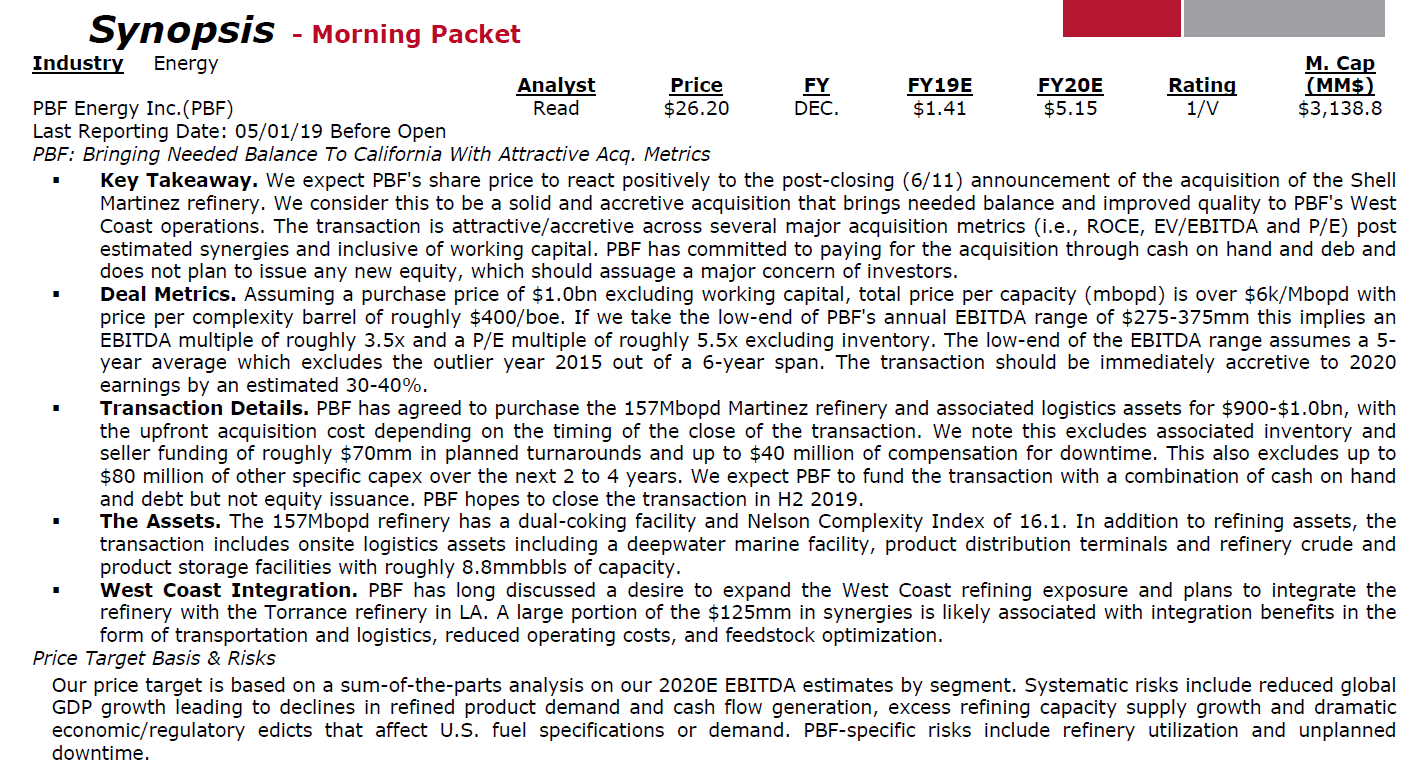
I believe that PBF got a fair deal and the upside from IMO 2020 is significant (I have pieces on the deal from Wells Fargo and Morgan Stanley).  On the call the analysts seemed to want to discount the IMO upside.  In an RBC note they said that their discussions with long investors gave “feedback on PBF’s Martinez acquisition [that] was exclusively negative.”

That’s fine.  If I’m right then it will be an upside surprise.

PBF Energy has some of the most complex refineries in North America.  They will benefit if HSFO spreads rise significantly.  As I quoted above, Tom Nimbley, their CEO, is ready to switch their cokers to HSFO if prices dictate the move.

But PBF is also one of, if not the, most levered refiners to spreads and that goes for the downside as well.  I have to be careful with this position.  A recession will send the stock tumbling.

The third position I’ve taken is a much smaller refiner called Vertex Energy.  Vertex has some hair.  They have debt that needs to be refinanced.  They have a messy share structure with convertible preferreds.

But they are perfectly positioned for IMO.  Vertex runs odd little refineries that take in used motor oil (UMO) as feedstock.  It just so happens that UMO is benchmarked off of HSFO prices (#6 fuel oil).  The discount for UMO is typically between 70% and 90% of HSFO.

Vertex laid out the scenario in this white paper last summer.  The numbers seem legit to me.  For every $10 move in HSFO, all else being equal, Vertex adds around $12 million of EBITDA.

Vertex is a play that things get silly on the HSFO side of things.  The $10 drop we see in the curve is nice, and it will help Vertex, but it isn’t what I’m looking for.

I think there is a chance where there is simply too much HSFO and no where for it to go.  In that case the price change is more like the chart in the white paper.  Or better.

In addition to its existing capacity, Vertex is expected to re-open their TCEP refinery in anticipation of IMO.  The company said they have been working on developing products from their TCEP refinery that will be blend stocks for IMO compliant fuels.  The Marrero refinery, which is operating, already produces a compliant low-sulphur (~0.1%) fuel.

The product slate from these refineries means there is some chance of upside pricing on that end as well.  But we’ll see.  I’m less certain that there is a significant pricing change on the low-sulphur fuels.  It’s the drop in high-sulphur fuel that seems most likely.