Skip to content

Buying into US Cannabis legalization with C21 Investments

I missed out on the rise of Canadian cannabis stocks.  It was my own fault. I didn’t do the research, didn’t really understand the valuations, and the stocks moved so fast that I was always scared I would be catching the top.

But it made me watchful.  When I saw companies listing on the junior Canadian exchanges with expanding operations in the US I was immediately interested.

I was introduced to C21 Investments (CXXI) by a friend who mentioned it to me when it was doing a private placement back in March.

The stock started trading in June.  I’ve been watching it since.  It started off above $2 and traded almost to $3 at one point before recently collapsing back to a little over a $1.  It’s been crazy volatile.

My guess is that the move down has been precipitated by anticipation and the subsequent end of the lock-up period of the March private placement, which ended on July 27th.  There are also probably sellers from the reverse takeover shell (called Curlew Lake) that C21 inherited.

C21 raised $33 million in March through the issue of 33 million shares. The price was $1, which is not far off from where we are now.  They raised another $5 million in July at much higher prices.

I’ve taken a position at this level.

Why am I buying?

Well the first reason is that it looks pretty cheap compared to its peers.

Before I give that peer comparison, let me give this caveat.  The one conclusion that I’ve drawn in researching the US cannabis sector that there are a lot of projections, but not a lot of operating history.  This goes for C21 as well as every other cannabis company on my list.  This is a reason to be at least somewhat cautious with all of these names.

There are two reasons for the lack of history:

  1. Apart from a few small states (Oregon, Washington and Colorado), recreational cannabis has only been legalized in most states recently
  2. Most these names have gone public in the last year to raise capital and consolidate existing, smaller businesses that were previously private and that therefore did not report publicly

C21 is no different.  They have made 6 major acquisitions.  All those acquisitions were done in the last 6 or so months.  While the company has actually provided more trailing revenue numbers then most, a valuation still has to be based on their future projections for these businesses.

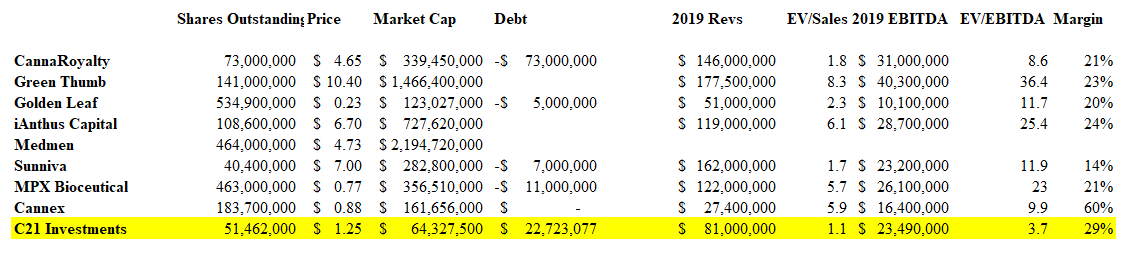
Below is a comparison using 2019 projections for each company.   For the other companies in the list I’ve found brokerage coverage (in most cases Canaccord but also GMP and Beacon Securities) for the revenue and EBITDA estimates. C21 is my own estimate which is primarily based off of the company’s own projections.
peer_comp

I’ll get into how I came up with the market capitalization, enterprise value, revenue and EBITDA estimates for C21 shortly, but first let’s talk a bit about the US cannabis market.

US Cannabis Market

The US Cannabis business is a different beast than Canada.  US cannabis is legal at the state level but not the federal level.  This means that you can’t have an operation across multiple states or if you do, each needs to be separate, as cannabis cannot cross state lines.

It makes the business inefficient, but it also provides the opportunity for small players.  The lack of federal legalization keeps larger players from entering the business.  There is still the threat (though this might be receding with soon to come legislation) that company management could go to jail for selling something that is a crime federally.

Each state is an island, with their own laws, their own implementation and probably most importantly, their own licensing structure.

Therefore, it’s important to evaluate the specific states that a US cannabis company is operating in.

C21 is operating in two states: Nevada and Oregon.

These two markets could not be more different from each other.

C21 has made 6 investments in Oregon and another in Nevada.  But the Nevada acquisition is larger then all the Oregon investments combined, and probably the bigger generator of value in the short term, so lets talk about that one first.

Cannabis in Nevada

Nevada passed the legalization of cannabis as part of a referendum on the 2016 election ballot.  Recreational sales began in July 2017.

Nevada is not the largest state to legalize cannabis.  That honor goes to California.
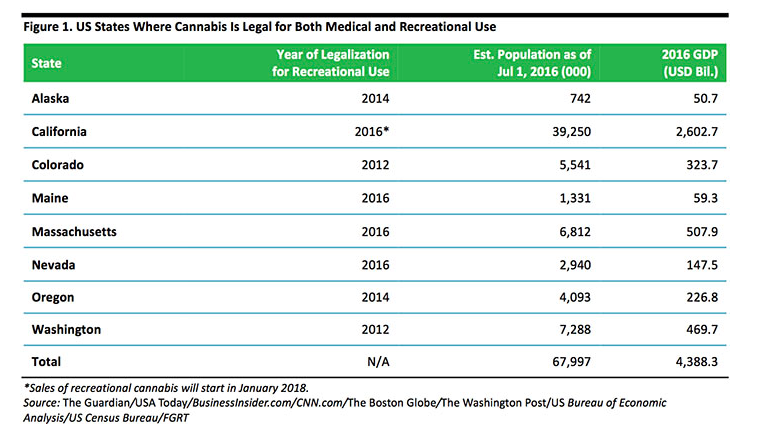
However, Nevada has a significant number of tourists visit the state. There are over 40 million tourists a year that come to Nevada.  So, the market is much larger than the population implies.

Nevada, like other states that have only recently legalized cannabis, has been more cautious in their licensing approach than earlier adopters such as Oregon, Washington and Colorado.  These early adopting states flooded the market with licenses.  The table below compares licenses per population for various states.
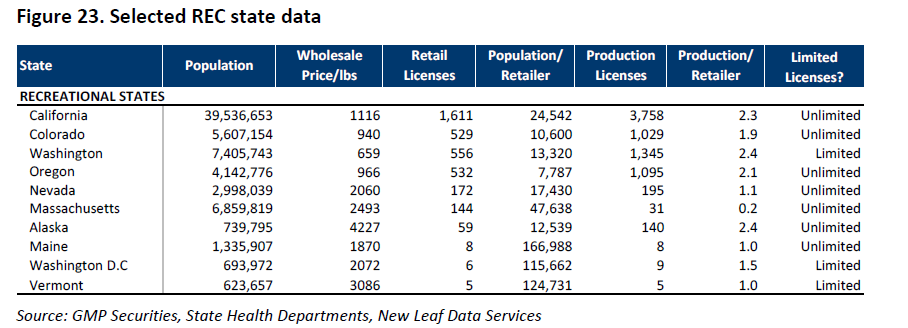
Nevada looks middle of the pack, but after considering the much high tourism, the licensing looks conservative.  The consequence is that Nevada is considered by many to have one of the best potential cannabis markets.

The limited number of licenses have kept wholesale prices at reasonable level so far.

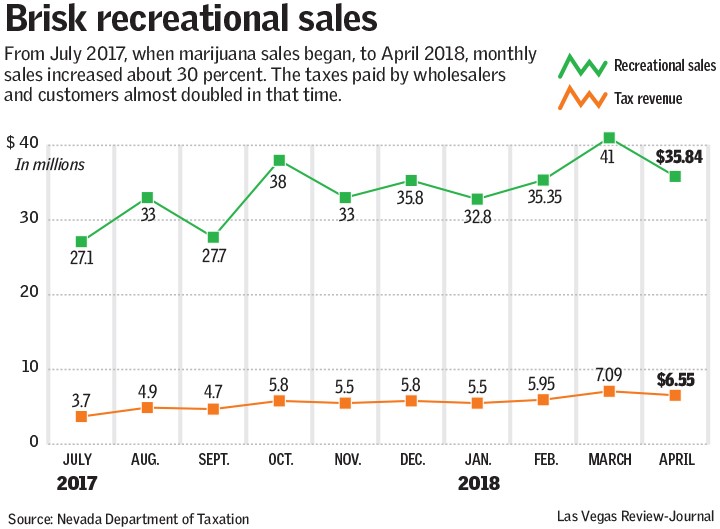
The Nevada market is growing.  Total sales of recreational and medical cannabis in the first year were $500 million.  Sales have been trending upward.  The last available data point I see is for May, where sales were $48 million, which is up from the prior peak of $41 million in March.
Existing medical cannabis license holders have an advantage in the Nevada market. The state has limited new license applications to open to existing holders.

Nevada is in the process of accepting applications for another round of license approvals right now.  Existing holders will be able to apply for licenses from a pool of 44 cultivation, 23 processing, three retail and one lab license.

Perhaps the only downside to Nevada is taxes.  Cultivators pay a 15 percent excise tax on wholesale cannabis sales. Retail stores pay a 10 percent excise tax on each sale to a retail customer.

Silver State Relief Nevada Operations

C21 Investments added Nevada to their footprint with their purchase of Silver State Relief.  The purchase price was $20 million USD of cash, $14 million USD of 3% interest bearing debentures convertible at $3.50 per share and 2 million shares.

The purchase price was for the business and associated licenses of Silver State.  There is a separate option to purchase the real estate (the cultivation land and Sparks, Nevada dispensary location) for an additional $14 million (payable in shares).   There is a separate option to purchase the real estate of a Fernley dispensary for $750,000.  I don’t believe that they have exercised these options.

Silver State Relief has been around in Nevada since the legalization of medical cannabis.  They were one of the first two companies to receive licenses in Nevada and the first company to sell an ounce of cannabis in the state.

Silver State Relief owns and operates a 125,000 square feet cultivation and processing facility in Sparks Nevada, which is part of Reno.   This facility, which is 20% utilized, is producing 5,500 lb/month of cannabis flower.

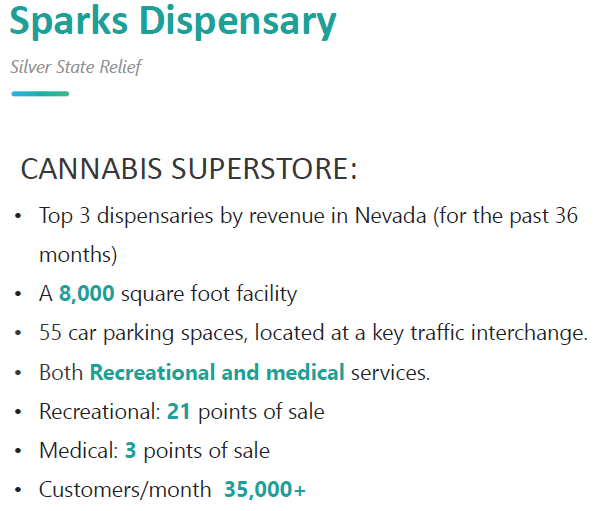
Silver State also owns a large dispensary in Sparks.  They describe this facility as a cannabis superstore:
The second dispensary is in Fernley, about 30 miles east of Reno.  It is under construction and scheduled to open later this year.

Here’s what gives me comfort with C21.  The Nevada operations has tangible trailing revenue that allows some confidence in a valuation of C21.  Silver State did $17 million of revenue in 2017 (in a half year of recreational sales) and is expected to do $28 million this year.  This article says that sales in the first half of 2018 were $15 million.

Revenue is expected to jump again in 2019 once the Fernley location is open and further expansion is finished.
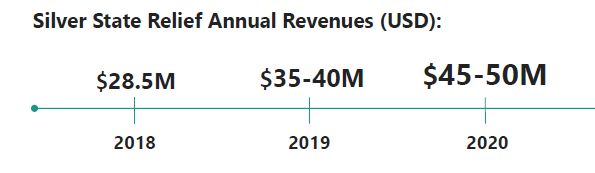
Silver State margins are quite good.  In 2017 Silver State had $7 million of pre-tax profit, or about 40% operating margins.  Assuming similar margins in 2018 Silver State pre-tax income should exceed $11 million in 2018 and $15 million in 2019.

We can’t be sure how the Nevada market will evolve.  It’s possible more licenses will saturate the market. So far that hasn’t proved to be the case though I have read a few anecdotes that wholesale prices in Nevada are starting to fall.  As I mentioned Nevada is opening additional licenses to existing holders only, so C21 and Silver State should be able to participate in that expansion.

Perhaps the biggest negative about Silver State is that, at least so far, they are not operating in Las Vegas.  Nevertheless they have the 3rd biggest store in the state and Reno is a tourist destination in its own right.

I don’t think there is any doubt that Silver State Relief is the crown jewel of the portfolio so far.  But C21 has made a number of other interesting acquisitions outside of Nevada as well.

Oregon Market

Oregon was one of the first states to legalize recreational cannabis in 2014.

As with other earlier implementers of recreational cannabis laws (Washington and Colorado are the others) Oregon flooded the market by giving out licenses to anyone with a dream, and is now experiencing an over-supply of product.

Oregon put very few limits on licenses when they legalized cannabis.  It’s been easy to get a license and as a result far too many licenses have been granted.  By some counts Oregon has over 2,000 producer licenses and 550 retail licenses (I believe the data from the GMP table I posted above is somewhat out of date and thus the higher numbers mentioned here).

Compare that to Nevada, which about one-tenth of the production licenses with a larger population and way more tourism.  You can imagine what transpired.

Last year Oregon consumed somewhere around 400,000-500,00 pounds of cannabis.  By some estimates (here and here) Oregon has been 1 million and 1.4 million pounds of product stockpiled.

With such massive inventory it is not surprising that wholesale cannabis prices have tumbled.  Last year cannabis was selling for more than $1,500 per pound. This year it’s closer to $400 per pound and there are some accounts of product being sold for as low as $200 per pound.

Those are prices that can only be profitable for the most efficient producers and those with a brand that gives them leverage to hold firm.  The mom and pop businesses are failing en masse.  I’ve seen estimates that up to 150 dispensaries could close in Oregon in the next year, and that 30-40% of cultivation acreage have gone unplanted this year.

So Oregon is not a great market for commodity unbranded cannabis.

C21’s strategy appears to be:

  • picking up established brands in Oregon
  • focusing on organic, indoor, high quality cannabis cultivation that receives a premium in the market and is not over-supplied
  • acquiring operations that allow them to produce value-added products like vape, edibles, CBD products, etc.
  • Creating a vertically integrated chain of production

In total C21 has made 5 investments in Oregon so far:

  1. Eco Firma Farms
  2. Phantom Farms
  3. Swell Companies
  4. Gron Chocolates
  5. 7 Leaf/Pure Green dispensaries

These investments are complimentary of one another.  Phantom Farms and Eco Firma are well-known and high quality producers of flower and rolled products.  Swell Companies is an extraction and processing company, producing oils and consumer packaged goods.  Gron has a focus on chocolates, and with 80% of the edibles market in Oregon.  And 7 Leaf/Pure Green give C21 their first 3 dispensaries.

Together the acquisitions represent the entire supply chain, from production to retail sales.  They give C21 a suite of 50+ SKUs to offer dispensaries.  I think the weakest link is on the dispensary side.  I wouldn’t be surprised to see more dispensaries added in the near future.

Let’s dig into each acquisition a bit more.

Phantom Farms

C21 bought Phantom Farms for $15.5 million.  As with most of the Oregon acquisitions C21 purchased the company using in large part a non-interest convertible notes that have a conversion at a much higher price ($3.50).

Just a quick thought about the convertible and the Oregon acquisitions.  C21 has been using non-interest-bearing convertibles for their Oregon acquisitions.  In recent cases the conversion price was $3.50, which is well above the current share price.  In the case of their two biggest Oregon acquisitions, Phantom Farms and Swell Companies, the convertible is structured to have a cash value much lower than the share conversion value ($8 million for Phantom Farms and $5 million for Swell Companies).  This seems like a smart way of providing upside to these companies but protecting their own investment at the same time.

Each of these Oregon acquisitions also has a fairly significant earn-out if they can hit targets on EBITDA.  So the structure does mean there could be further dilution in the future, but only if the company is succeeding.  I’m okay with that.

Anyways back to Phantom Farms.  They have 80,000 sqft of outdoor cultivation and another 5,000 sqft indoor facility, including a lab and warehouse space.  I believe they are adding indoor grow space this year.  Phantom is producing 5,200 pounds of cannabis annually.  They have historically sold cannabis flower and pre-rolls (apparently they have very good pre-rolls).

The Phantom Farms brand is well recognized and highly rated. They’ve been around for 10 years.  They sell their pre-rolls and flower into 175 dispensaries.  They expect to sell oils by the fourth quarter.

Revenue is expected to grow significantly next year as C21 adds an extraction facility and another 40,000 sqft of (indoor?) cultivation.

Swell Companies

Swell sells a number of processed THC and CBD brands into the Oregon market.  They sell products via their Dab Society, Hood Oil, Quill and Swell brands.

Swell is extraction and processing company.  While I believe they have some of their own growing capacity, the primary business is on processing THC and CBD extracts and manufacturing of the resulting oils into vape cartridges, capsules and tinctures.  Their website gives some information about the specific products available in each brand.

Swell delivers 50 distinct SKUs and has products available 275 retail locations.  They shipped 500,000 product units into the market in 2017.

According to C21’s presentation Swell had $6.5 million of sales in 6 months of operation in 2017.  C21 says monthly revenue from Swell is $1 million.

While it’s impossible to know the composition of their sales, I did dig a little into what some of the more popular product lines sell for.  Dab Society products go for $25 to $50 per gram.  Hood Oil sells for $20 per gram.

Those are interesting price points because they illustrate the value add of branding and processing.  I mentioned earlier that commodity flower is $200-$400/lb.  The processed products from Swell sell at an order of magnitude higher price.

Eco Firma Farms

The first acquisition made by C21, which coincided with the reverse takeover and initial stock offering, was Eco Firma Farms.   They purchased Eco Firma Farms for a little over $4 million, again payable via convertibles.

Eco Firma produces about 2,500 lb of cannabis per year from 23,000 sq ft of grow and processing space in Canby Oregon.  I believe much if not all of this space is indoor.

If you google Eco Firma and their owner Jesse Peters you will find a lot of articles, videos and interviews with the company.  They are well-known in Oregon for their organic and environmental production practices.

They are also one of the lowest cost producers in the state.  According to this article “it costs Eco Firma $189 to produce one pound of cannabis. (That comes out to $11.81 per ounce, or $0.43 per gram.)”

Eco Firma sells the flower and a rolled cigar-like smoke that they call Pachecos.  They list 41 dispensaries across Oregon on their website and have been selling the 19 strains they grow since 2012.  Eco Firma has won a number of awards for their strains:
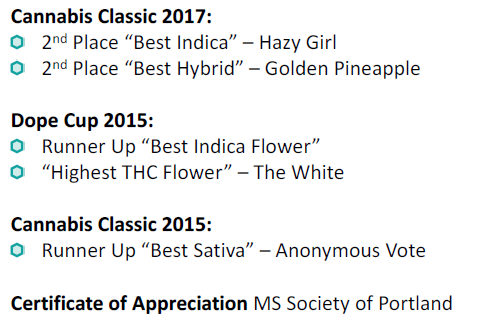
Part of the acquisition stipulated a $5 million investment in Eco Firma.  So there are significant expansion plans.

Like Phantom Farms and Swell, Eco Firma products appear to command a premium price.    Here are a couple of sales ads I found for Eco Firma product.
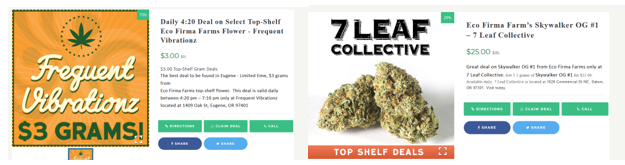
Even on sale, we are looking at prices that translate to $1,300-$3,200 per lb.  Much higher than the commodity wholesale prices quoted in the articles I’ve read.

C21 is projecting $12-$16 million of revenue from Eco Firma in 2019.  This is probably the revenue estimate that I find most uncertain.  I’m not entirely sure how they get to such a big number.  In the presentation they point to the $5 million investment in retail and indoor grow operations.   So there is a lot of growth expected.

Nevertheless, it seems that in the past Eco Firma had relatively modest revenue.  So I’m taking their estimates with a grain of salt for now.

Gron Chocolates

Gron Chocolates was the latest acquisition of C21, being acquired a little over a week ago. The purchase price was $6.8 million with an additional $4.4 million potential earn-out.  The price was paid via cash and convertible but I’m not sure about the weighting of each.

There wasn’t a lot of information available about Gron so I called the company and asked a few questions.  Gron has 80% of the edibles market in Oregon and, according to the website, are in 400 dispensaries in Oregon (there are ~500 dispensaries in total in Oregon).  They are expected to deliver $4-$5 million in revenue this year, and that is expected to increase to $8 million in 2019.   In 2019 they will be expanding the brand to Nevada, where it presumably be available in the Silver State dispensaries.

One other point is that Gron makes both THC and CBD products.  The CBD products are interesting because they are considered “non-hemp” and do not have the same state constrained laws.  A Gron CBD chocolate can be sold nationally, which gives it more potential.  I don’t totally understand how big this opportunity is but it is interesting.  When I talked to the company they seemed to be pretty excited about the CBD angle.  So we’ll see.

Capitalization

C21 has about 51 million shares outstanding.   I say about because there are so many transactions and so many convertibles that it’s a bit of a rat’s nest to come up with the final tally.

Here is how I came up with it.  As of the date of the July 10th MD&A there were 42.8 million shares outstanding.  There are another 4 million shares issuable to Eco Firma as part of that acquisition that are part of in the money convertibles (these are in-the-money), and another 2 million issuable to Silver State. Another 2.1 million shares were offered as part of the July capital raise.  There may be shares issuable to Gron but I don’t know if they are priced in-the-money or at a higher price so I just included that $6.8 million purchase price as additional debt.

There is about $33.7 million of debt if I add up the cash redemption value of all of the convertible debentures and the Gron acquisition on top of that.  Like I said earlier the cash value of the debentures issued to Phantom Farms and Swell Companies is less than the share conversion value.  Only if the share price gets above $3.50 do I need to consider dilution of the convertible from these acquisitions.

I think there is also roughly $5 million USD of cash remaining on the balance sheet. The cash number is also tricky to estimate, but I know that they had $27 million CAD of cash at the end of April and that their acquisitions (Silver State Relief) included a $20 million USD cash payment.  They received $4 million USD from the July raise.  So that’s how I’m coming up with the $5 million number for cash and as a result the $29 million of net debt (all in the form of the convertibles).

Conclusion

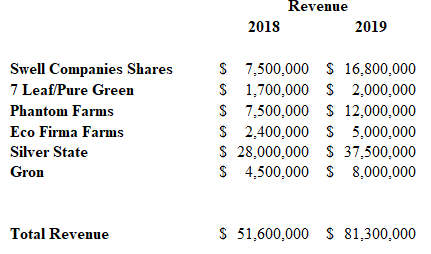
Below are the combined 2018 and 2019 projections for each of the acquired companies.

Apart from the dispensary revenue from 7 Leaf and Pure Green and the Eco Firma revenue, all of the estimates I used are from the company’s own presentation.

In the case of the 3 dispensaries, I used the purchase price of each and assumed a 1x revenue multiple (this is about the going rate of a dispensary acquisition in Oregon) to come up with a revenue estimate.

For Eco Firma, I wasn’t sure how the revenue estimates from the company could be so high, so I took them down to be conservative.  I took the latest production estimate (2,400 lb per year) and assumed they can sell that for on average $1,000 per pound.  Maybe I am being too conservative but I need more information to be comfortable with the Eco Firma projections.  For 2018 I doubled revenue to $5 million, which is far less than the $12-$16 million the company has pegged in the presentation.
EBITDA Margins are tougher to peg.  I know that Silver State operating margins have been in the 40% range.  I don’t know what the margins on any of the Oregon operations should look like.  I basically made a simple guess – I used 40% EBITDA margin for Silver State and 20% for each of the Oregon operations (20% is on the low side of what Canaccord and GMP have been using for the companies they cover), which gives the blended 29% margin that I showed in my original comp table.

Getting back to the comp table, if the numbers and my assumptions are okay, its clear that C21 Investments is at a pretty significant discount to the other companies in the list.

Why is that?  Honestly my best guess is that each of the other companies is covered by Canaccord, GMP and/or some other brokerage.  I think that investors are familiar with these other names but not C21.

Its also possible that some discount could be attributable to having some of the operations in Oregon. But both Golden Leaf and Cannex are in Oregon so that doesn’t totally ring true.

At any rate, from what I can tell C21 has acquired a good operation in Nevada and some pretty solid brands in Oregon that should be able to survive the headwinds and likely come out the other end stronger.  What’s more, they’ve put together a very complimentary suite of assets that allows them to produce, process, and manufacture a wide range of THC and CBD products.  Some of these brands can be expanded into Nevada, which you are already seeing with both Phantom Farms and Gron.

Anyways, based on my research so far I don’t see anything wrong with the businesses acquired.  I think its more likely a supply/demand problem with the shares.  You take the lack of promotion and exposure, you add to it holders from the original shell that are probably happy to get out at this price and maybe some holders from the original private placement that don’t like the price action so far.

If I’m right, maybe the biggest negative with the stock is how long this overhang lasts.

The other possibility is that I am missing something here.  Which can never be ruled out.

Another risk has got to be further dilution.  I suspect that C21 isn’t done with the acquisitions.  At the very least it would make sense to add more dispensaries in Oregon to fill out the vertical chain.  How this plays out and whether stock is offered at these lower prices is a fair question.

Nevertheless, if my numbers are accurate then the stock is reasonable at these levels.  I’m used to waiting for something to work.  So I’ll be patient.  I’m keeping my position on the smaller side simply because, as I mentioned earlier, everything right now is a projection and so this feels like a risky position even for me.  But as we get firmer numbers and especially if the stock starts to work, I won’t hesitate to add.
Catching the knife with Gran Colombia

This has been just a brutal week for my portfolio.   I have been sliced and diced by the commodity bear market.

I was prudent enough to exit all of my base metal positions and that saved me through the early part of July.  But this week oil stocks and gold stocks joined in the carnage and I was not well positioned for that.

I admitted defeat on a few of my oil stocks.  I sold Zargon, reduced Gear Energy and reduced GeoPark.  I don’t have the conviction.  The second quarter has not shown the inventory draws that I had anticipated.  I’m worried about what happens as inventory builds begin.  What if Saudi Arabia decides to direct more oil towards the US?  Even if overall supply remains constant, the market seems to react with blinders to the weekly US storage numbers.

On the other hand I have held onto my gold stocks.  Until this week they had been holding up pretty well even as gold fell.  I even had a big winner in Wesdome and a little winner in Golden Star Resources. But this week the bottom fell out of all of them, in particular Roxgold, Gran Colombia, Jaguar and Golden Star got creamed.  I sold a bunch of Jaguar because it just isn’t operating well but have kept the rest.

The irony of Roxgold, Golden Star and Gran Colombia is that each released second quarter results and they were really quite good.  But the market doesn’t care much about results when it is busy panicking.

I’m going to focus on Gran Colombia right now because that stock has gotten into the “this is pretty insane” territory in my opinion.

Gran Colombia Second Quarter

Gran Colombia released second quarter results on Tuesday.  Since that time the stock has fallen almost 20%.

When a stock falls 20% in the days immediately following earnings you would expect to see an earnings miss, a reduction in guidance or an increase in costs.  Here is what Gran Colombia gave us:

  • Raised production guidance to above 200,000 ounces for the year from previous guidance of between 182,000 and 193,000 ounces.
  • Produced 52,906 ounces of gold in the second quarter up 15% year over year
  • Total cash costs and all-in sustaining averaged $696 per ounce and $913 per ounce, well below the company’s guidance of $735 per ounce and $950 per ounce

If there is a negative side to the results, its that costs were up a little over the first quarter and earnings were down a little, mainly because the price of gold was a bit lower.  But the company’s measure of free cash flow was up to $11.4 million USD for the second quarter, up from a little over $2 million the previous quarter.

Anyways those are the results.  Next let’s consider the valuation of Gran Colombia.

We can look at the stock two ways.  Either using the current share count and debt levels, or assuming that the warrants get converted, increasing the share count but also increasing cash on hand.  Because the current share price is below the warrant strike, I am not including the warrants in the calculations below.

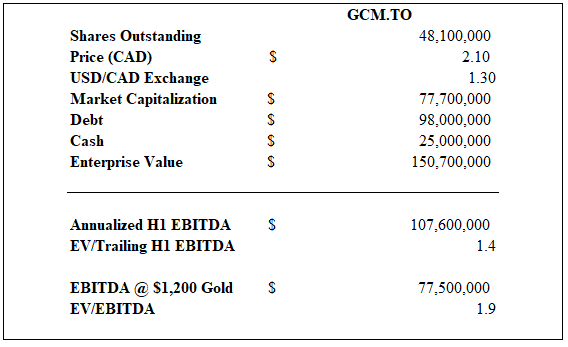
After full conversion of Gran Colombia’s 2018 debentures (which happened on August 13th), the company had 48.2 million shares outstanding.  So at the current price the market capitalization is $100 million CDN or $78 million USD.

Gran Colombia has $98 million USD of senior Gold notes and $25 million USD of cash.  Net debt is $73 million USD.  EBITDA last quarter was $26.5 million.  EBITDA in the first quarter was $27.3 million.  Below is what the company is trading at currently if you annualize first half EBITDA as well as what it’s at based on my estimated EBITDA at $1,200 gold.

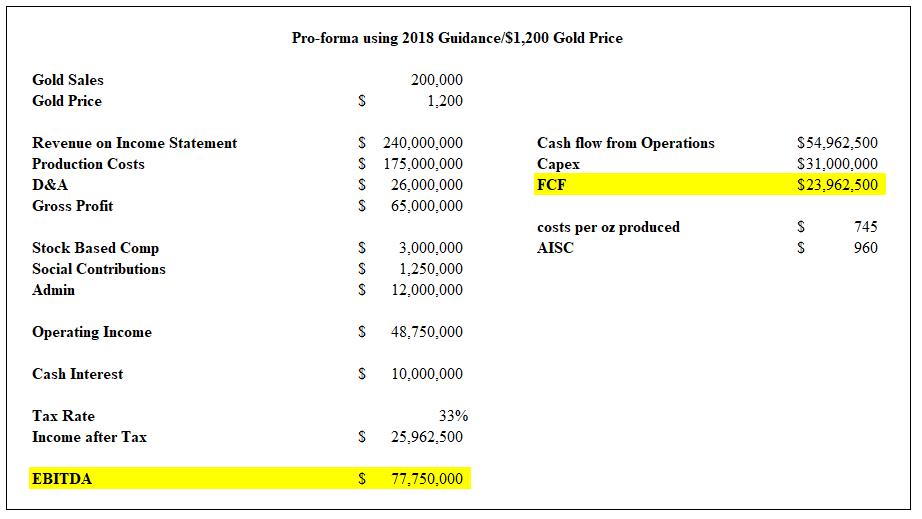
Below I have tried to work out a simple pro-forma model of what EBITDA and free cash look like at $1,200 gold.  I’m using the company’s own production and cost guidance.  They have been consistently beating the cost guidance and are trending above the new production guidance in the first half.  I’m also assuming the tax rate for 2019.

So the stock is trading at a little over 3x free cash flow using the company’s own guidance.  That seems a little crazy to me.  I’ve added to my position here and am hoping the carnage ends soon.

Week 366: The Wishy Washy Portfolio

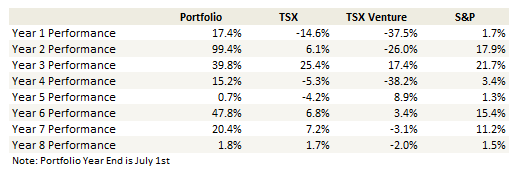
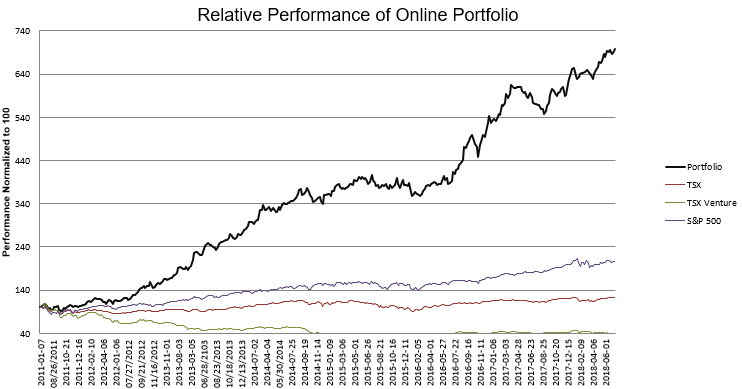
Portfolio Performance

Thoughts and Review

I’ve done a lot of flip-flopping over the last 6 weeks.  I couldn’t get comfortable with certain oil producers, I couldn’t get comfortable with oil servicers and I couldn’t get comfortable with the copper stocks.  I also owned and then sold Cameco and Energy Fuels before settling on buying the debentures for Energy Fuels.

These transactions weren’t trades.  I don’t really trade in my portfolio.  But I often buy into ideas that I am not completely committed to.  Having a position clarifies my conviction.  If I don’t have it, I’ll sell a few days later.

As it turns out it probably wasn’t a bad idea to step away from these ideas.  The oil servicers, which I will talk about below, have done little.  Copper stocks, which I talked about here, have done even worse.    Cameco has floundered.

What I have added and stuck with over the last 6 weeks is RumbleOn and Smith Micro, both of which I have already talked about, GeoPark, which I’ll talk about another time, and Overstock, which I’ll talk about right now.

Overstock

When I first wrote about blockchain I said I found it interesting because: “it’s a way of dis-embodying trust into technology. The middle man disappears. The skim shrinks. Everyone (other then the middle man) benefits.”

Since that time crypto has gone to the moon and crashed again.  While its easiest to base an opinion on the latest bitcoin price, I don’t think that is necessarily correct.  I still think the premise of what blockchain promises has value.  It just has to find ways of being integrated into applications that have broad usage. If I were to bet, I would say that the current lull in sentiment will pass and that blockchain will come back into vogue in some new form relatively soon.

So let’s talk about Overstock.

I bought the stock two weeks ago after tZero announced that they had received a $100 million letter of intent (LOI) from GSR Capital.

Like most things with Overstock, its a fuzzy data point.  First, its an LOI, which doesn’t really mean anything is certain.  Juniors on the Canadian venture exchange love to use LOI’s to put out big numbers and generate big hype (coincidentally I will talk about a situation like that shortly!).  The deals often don’t amount to anything.

Second, GSR Capital looks a bit sketchy.  This post from CoBH kind of makes that point.  Of course you can dig in the other direction and find less bearish takes on what GSR is doing.

I’ve always thought of Overstock as a stock that has an asset value with a huge standard deviation.   You can create a legitimate case that the stock is worth $30 or $80. There is that much uncertainty about outcomes.

It’s all about buying it at the right place within that band.

Being able to buy the stock in the low $30’s (I got a little at $31, more at $32 and the rest at $33), especially after there was incrementally positive news, seemed like a reasonable proposition to me.

The GSR investment, if it is followed through, represents the first time in a while that something Byrnes has hinted at actually happened.  So I’m getting it at the bottom of the band and with a positive data point to boot.

When I sold Overstock in January and February it was because the projections Byrne had made a quarter before were not coming to fruition.

  • He had said the stock lending platform had billions of inventory and would start making money shortly.   But in the tZero disclosures in December there was no mention of the stock platform at all!
  • He had talked about partners knocking at the door.  But all that materialized was Siebert and a couple of other tiny acquisitions.
  • He talked about the mysterious man in the room and one other big opportunity he had.  This turned out to be De Soto, a very interesting idea but something that he himself has said that he only “thinks” can make money.

Byrne also talked at length about the Asian money that was interested in tZero.  That was another strike out.  Until the GSR investment.  Now its not. So something actually panned out.

Its clear that the advanced state of tZero that was described at the end of last year was exaggerated.  It also seems likely to me that Byrne was not entirely aware of the state of the software.  Witness that the CEO of tZERO was replaced by Saum Noursalehi, who was moved over there to add a “Silicon Valley” mindset to tZero:

But I think this is going to become an innovation game. I think that by putting Saum there, I mean he’s extraordinarily able as an executive anyway, but in terms of managing innovation, Saum and I have a decade’s history of working together on [O lab] And other things that have changed our company and I don’t think anyone I’ve met in New York was going to be able to compete with what I know Saum has in mind.

tZero was supposed to offer a stock lending platform and would be on-loading inventory they had accumulated. That didn’t happen and they are now in the business of licensing it out.  The software also probably wasn’t all that functional; on the first quarter call Noursalehi said they were (only now) building out the functionality to allow you to carry the digital locate receipts for intra-day periods.  That this wasn’t available in the original software is odd.

They are also only in the process of building out the token lending platform, which is to say there is nothing operational yet (one of the first major red flag I mentioned from the tZERO memorandum last December was that the security token trading system was described as something that still needed to be built!).

Of course the sale of the e-commerce platform, which was supposed to be done by February-March, is ongoing and now more of a “souffle”.

So there are lots of negative spins you can make here.  On the other hand they are forging ahead with the tZero platforms, they have over $250 million of cash on the balance sheet and another $320 million from the tZero token offering (if you count GSR and all the executed SAFEs), and the sale of e-comm is still ongoing, so there is the potential for a positive resolution there.

There is also the initiatives to transform e-comm into something that is growing.  While these are still in the early stages it seems to be working.  So that’s just another probability to add to the list.

Most importantly, at a little over $30 buck a lot less of the positive potential is priced into the stock then at $80.

Look, Overstock is what it is: a stock with a lot of optionality, a lot of uncertainty, operating in an brand new industry that I don’t think any of us know how it will play out in the next 5 years.

So speculators pretend that the price of bitcoin is somehow a proxy for the state of blockchain. It’s probably not.  I didn’t buy Overstock as a quick trade to capture a short pop on speculation of GSR.  I actually think at $33 it represented a fair value for all the risks and rewards.  So I’ll see wait for the next data point how and evaluate from there.

Wanting to Buy Oil Services but can’t

I’m not a trader.   When I get into a stock its with the intent of sticking with it for 6, 12 or 18 months or however long I need to in order for the idea to play out.

So when you see me in and out of a stock in a short time frame it usually has nothing to do with trading.  Its just indecision.

Such has been the case with the oil services stocks where I’ve been in, out, back in and back out again.

What’s going on?  I’m being torn between two sides.

The bull side is simply this: oil is up, growth in production needs to come from the US, and oil servicers should benefit.  The stocks are extremely cheap if their businesses are on a growth path.

The bear side is that all of the on-shore servicers are exposed to the Permian, Permian capacity constraints are going to kick in this summer, and volume and pricing of drilling and completion services are going to get squeezed.

I should probably just walk away from the idea.  The stocks don’t act well.  Considering that this should be a bull market, the action is even worse.

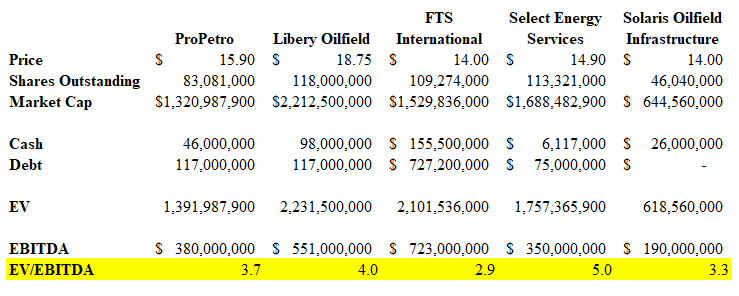
What keeps me interested is just the absolute valuations.  Below are 5 companies with average EBITDA multiples for 2018 and 2019 (these prices are from a week or so ago but I don’t think anything has moved much since then so I haven’t updated them).

Seems cheap?  That’s what I thought.

But when I buy any of these stocks, all I do is fret about them.

The problem is the Permian.  RBN put out a really good piece describing how the infrastructure bottleneck in the Permian is likely to play out, and what the alternatives now.  Unfortunately it’s behind a pay wall.

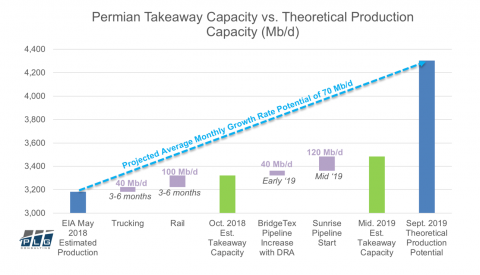
The issue is that there isn’t enough pipeline capacity to get the oil out and new pipeline capacity won’t be finished until the second half of next year.  So you have about a year of constrained takeaway.

Source: PLG Consulting

As RBN pointed out the alternatives to pipelines have their own constraints.  Rail can only carry as much as the available tankers and loading capacity.  This is less than 100 thousand barrels a day.

Trucking is theoretically unlimited but the logistics of bringing in trucks and truckers caps it in reality.  A single truck can carry about 180 barrels a day.  So for every 10,000 barrels a day of production you need to add 100 to 150 trucks and drivers.

The Permian accounts for about 50% of activity in the United States onshore.  As an oil servicing business its hard to avoid the Permian.  Exposure of the companies I’ve looked at varies from 30-60%.  Solaris has about 60% of their fleet in the Permian.

But just how much of a hit will these companies take?  That is the other big question.

According to the company’s themselves, they are insulated.  They talk up their long-term contracts, how they are dealing with the stronger operators in the region, and how these operators have secured takeaway capacity and hedged their exposure and thus will be able to keep drilling.

But are they really?  I don’t trust them.  We won’t really know until the second quarter calls start hitting and they have to fess up about the state of their operation.

So what do you do?

For now I’m back out.  I think.

The only exceptions are a couple of non-Permian related servicers that I own.  Cathedral Energy, which I don’t believe has as much exposure to the Permian (though they do have some), and Energy Services of America, which is a pipeline builder in the Marcellus/Utica that has a host of their own problems but the Permian is not one of them.

RumbleOn

I was worried that my lead touch was failing me.  I am resigned to the fact that I take positions in stocks where I will have to endure months of it  doing nothing or going down before it actually begins to move as I suspect it should.

RumbleOn moved as soon as I bought it and before I was even able to get a write-up out.

<sarcasm>Fortunately</sarcasm>, that situation was rectified as the company offered a little over 2 million shares at $6.05.

In retrospect, the entire move to the mid-$7’s and back to $6 was probably bogus.  I don’t understand all the in’s and out’s of these share offerings enough to be able to tell you why, but I’ve been held hostage to enough of them to know that this sort of activity seems to be part of the process.

So what do I think of the move to raise cash?  I don’t see it as a big deal either way.  I had thought they might use their recently created credit facility to bridge the gap to profitability.  I figured given the management holdings they’d be reluctant to dilute.  But whatever.  If the business works the 2 million shares is not going to matter much to where the price goes.

I used the opportunity to add more.

Mission Ready

I have been patiently waiting for 9 months for something to happen with Mission Ready. I haven’t said much (anything?) about the company since I wrote about them last September.  That is because essentially nothing has happened.

Nine months with no news (after announcing a massive LOI) is pretty ridiculous.  There is a valid argument that I should have walked away.  But something about the company made me think its more than just a hyped up press release with nothing behind it.  For sure, the stock price has held up incredibly well since September considering that nothing has happened.   So I have stuck it out.

Now maybe we get some news?  The stock is halted.

Is this the big one?  And is the big one a rocket or a bomb?  No idea.  But I am excited to find out.

Gold Stocks

Back in May when I last talked about the gold stocks I own I wrote:

…these stocks are more of a play on sentiment. I think all I really need on the commodity side is for gold not to crash.

I should have knocked on wood.

That said, the gold stocks I own have held up pretty well.  Wesdome is up a lot.  Gran Colombia is up a little (albeit it was up a lot and has given back most of those gains).  Roxgold is roughly flat, as is Golden Star.  Jaguar Mining is down a bit.  Overall I’m up even as the price of gold is down over $100.

I still like all of these names.  But whereas my original thesis on each name was based on the micro – I simply thought each stock was cheap given its cash flow and exploration prospects, I am actually getting more bullish on the macro.  Even as gold has fallen.

This tariff thing is becoming the shit show I thought it would be.  I expect further escalation before any agreement.

There are a lot of US based commentators that think other countries will be rational and give in to their demands.  I really don’t buy that.  I think its got to get worse before that happens.

I’m Canadian.  So I am on the other side of the tariffs being introduced.  My visceral reaction when I hear of a new tariff being introduced against Canada or I hear Trump make some inaccurate or at least unbalanced comment about Canadian subsidies, is “screw them – I would rather go into a recession than give in to that BS”.

Now you might say that is an irrational response, that it is not reasonable, and point out all the reasons it is wrong.  Sure is.  Doesn’t matter.

If that’s my response, I bet that is also the response of a lot of other Canadians, and of a lot of other citizens of other countries.  We would rather see our government’s stand up for us then be pushed around.

You don’t think that all the other foreign leaders don’t realize that?  Look at what Harper just said: that Trudeau is manipulating the NAFTA negotiations because he can gain political points.  Maybe, maybe not.  It wouldn’t be that surprising.  Does Trudeau get more votes next year if he can say he stood up for Canadians or if he says he buckled under because it was the right thing to do?  You think the European leaders look stronger if they give into US demands?  Same thing for China.

My point is we are all going to stand up for ourselves.  It won’t be until we all see (including the US) what it feels like to be sinking in the boat that we reconsider.  Right now this is a matter of principle and what is rational is irrelevant.

I expect the trade war to escalate.  And gold to eventually start going up.

DropCar, Sonoma

I sold out of both DropCar and Sonoma Pharmaceuticals.

DropCar has been a disaster. When I wrote the stock up I said it was highly speculative, even for me.  But I have to admit I didn’t expect it to crash and burn so quickly.

I don’t like selling a stock just because its just dropping.  If there is a negative data point that comes out, then sure I’ll dump it in a heart beat.  But random drops are frustrating and I often will hold through them.

But the DropCar collapse was too much and I reduced my position in April.  That turned out to be a good idea.  I sold the rest of the stock after the first quarter conference call.  It was just such a bad call.

During the Q&A they were asked about gross margins.  They could have provided a long-term speculative answer, talking about how margins are being pressured because of their growth and the drivers they are hiring, and how long term they expect margins to settle in the mid-teens or low twenties.

They didn’t have to be specific, they just had to spin it positively.  Instead they basically deferred the question.  We aren’t going to talk about that.  You can maybe get away with that answer when things are going well, but when you just announced a negative gross margin quarter you just can’t.

Anyways, I sold.

The other stock I sold was Sonoma Pharmaceuticals.  Sonoma had what was just a really bad quarter.   Sonoma had been growing consistently for a number of quarters and much of my thesis here was simply a continuation of that trend.  That didn’t happen.

The problem is if they don’t grow they are going to have to raise cash again.  They have a limited run way.  The company kind of implied on the call that this was a blip, but it wasn’t enough to convince me with certainty.  So I figured I better sell and wait to see what the next quarter brings.  If they are back on track, I will add it back.  There is still a lot I like about the story.

Portfolio Composition

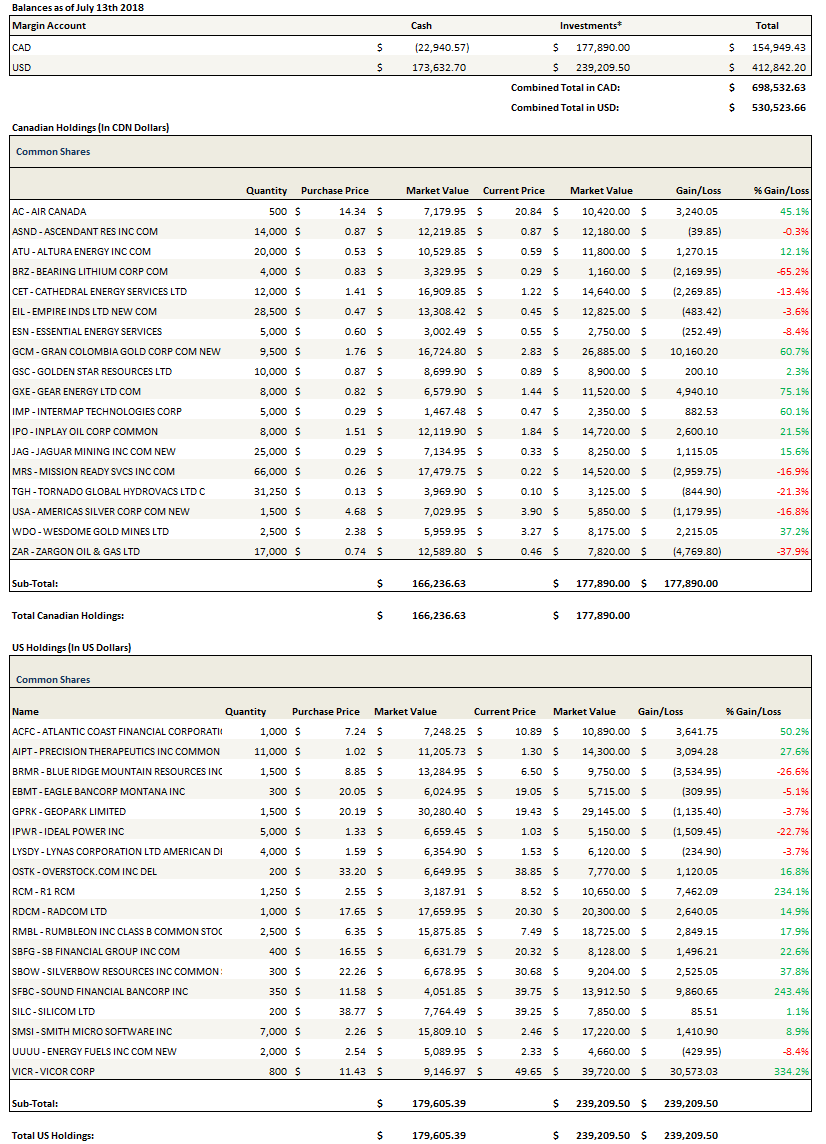
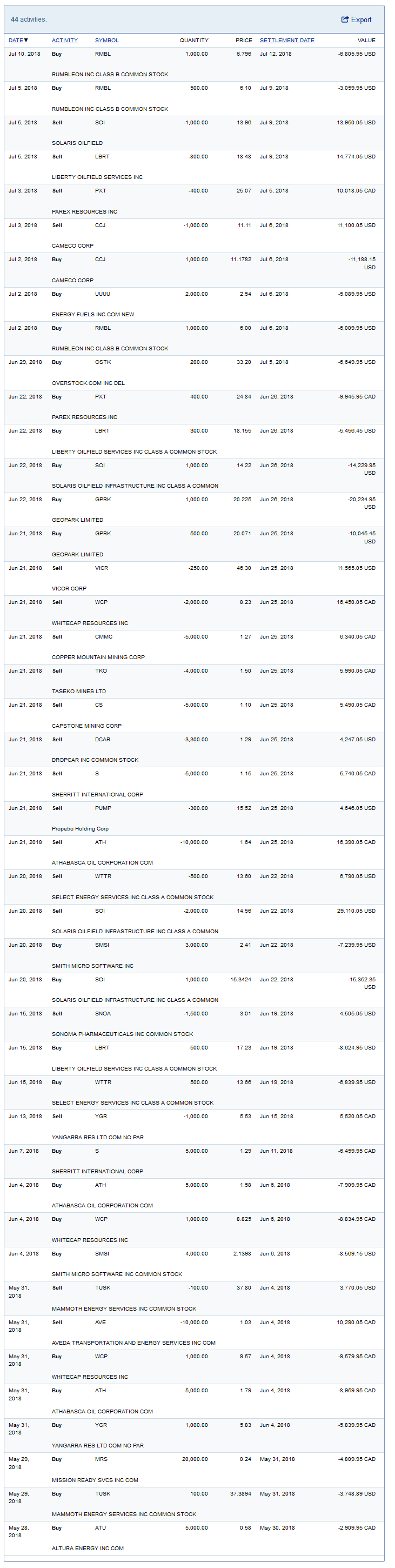
Click here for the last six weeks of trades.  Note that I added Energy Fuel stock to the practice portfolio because I couldn’t add the debentures (a limitation of using the RBC practice portfolio).  Also note that Atlantic Coast Financial was taken over and my shares converted but this didn’t happen in the practice portfolio (they just stay halted in the RBC practice portfolio).  That’s another change I will have to manually make before the next update.

New Position in RumbleOn: Selling Used Motorcycles Online

I wish I had finished this write-up a day early.  I do not like writing up a stock that just went up 15%.  But that’s where we are with RumbleOn.  I’ve been working on the research and writing all week and then the stock goes parabolic today.  I see no news to speak of.  Anyways it is what it is, and like all my ideas I’m in this for the long term (insofar as the thesis holds up).  Having said that, buying a stock up 15% the previous day is generally not a great idea.

I got the idea a month or so ago from a search of stocks at their 3-month high.   When I’m bored and looking for ideas I will go to the 52-week highs or 3-month highs or some other simple price movement screen that gives a signal of strength and I’ll dig into some of the names.

I’ll look for a name that I haven’t heard of, usually keying on one that is small, and I’ll do a bit of work to see if its worth a closer look.

Anyways that’s how I found RumbleOn.

What was fortunate about the timing was that I had just been looking at Carvana.  Carvana operates an online used car business that is similar to what RumbleOn does for motorbikes.   When I looked at Carvana I couldn’t believe how expensive it was.  When I looked at RumbleOn, I couldn’t believe how cheap it appeared in comparison.

Having dug into it further I’m still of that mind.  In fact it seems to me that RumbleOn has a better business model than Carvana.  I’ll give that comparison in a bit, but first let me describe what RumbleOn does.

An Online Motorcycle Marketplace

RumbleOn operates an online marketplace for buying and selling used motorcycles.  They have a website (rumbleon.com) as well as an iOS and GooglePlay app.

The company makes cash offers for bikes to individuals looking to sell.  If accepted, the bike is shipped to one of their regional partners (dealers), inspected and reconditioned and then put up for sale on the site.

Anyone can sell their bike to RumbleOn.  Upload the vehicle info, fill out a form, add a few pictures and RumbleOn will make you a no-haggle offer.  Its good for 3 days and you either take it or leave it.

It’s meant to be the opposite of going to a dealer or selling the bike yourself.  There is no haggle, no pressure tactics, and you won’t deal with tire-kickers or nitpickers.

For a while RumbleOn also bought bikes through auction and had dealer inventory on their site.  However they’ve stopped both as their retail acquisition channel has become self sufficient.   They do buy bikes via some auto-dealers that take them on trade but don’t have a marketplace and just want to get rid of them.

Early on the goal was to insure that the site had adequate inventory.  So the company reached for it from other channels.  They are now focused entirely on generating inventory through consumers.

Buying a bike on RumbleOn is geared to be just as simple.   Pick a bike from the available selection and put down a $250 deposit.  The full price of the bike is paid in cash or financed through an unaffiliated bank or credit union partner shortly after.

Unlike most of the online used car dealers (like Carvana), RumbleOn is agnostic to who they sell the bikes to.  Most of the car selling sites are focused on the consumer channel.

RumbleOn does that, but they also sell to dealer and auction channels.  At the moment dealers are most of the business (via online and through auction).  They made up 91% of sales in the first quarter while consumers made up just 9%.

The company expects to build out the consumer channel as awareness of the brand grows.  This is a new business, a little over a year old.  Marketing of the app and website should grow the percentage of sales coming from consumers.   I expect all the channels will grow but that consumer sales will grow the fastest.

Margins on consumer sales are higher so they are the preferred customer.  With a dealer sale RumbleOn has to share the margin.

In the first quarter dealer sales had an average selling price of $8,874 at a 7.8% margin while consumer sales had a $12,207 selling price and 13.7% margin.

Gaining Traction with Consumers

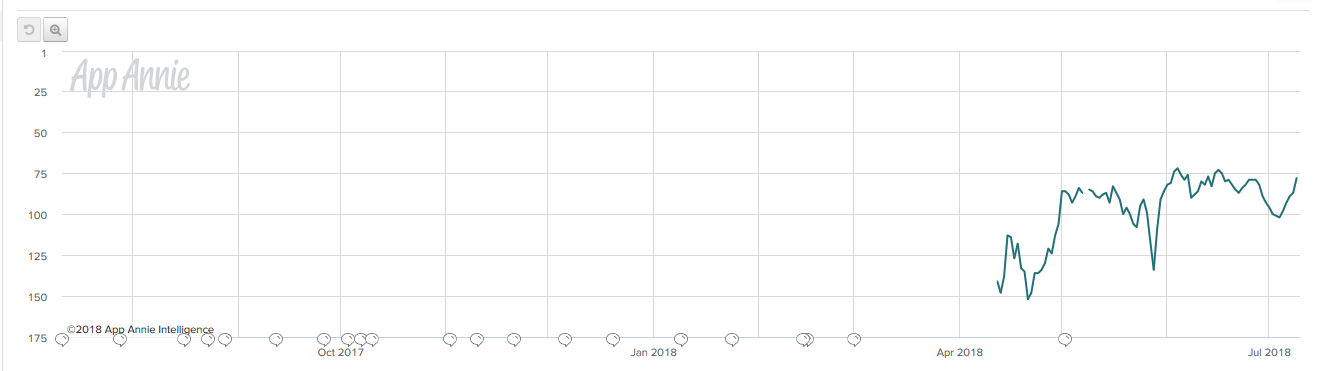
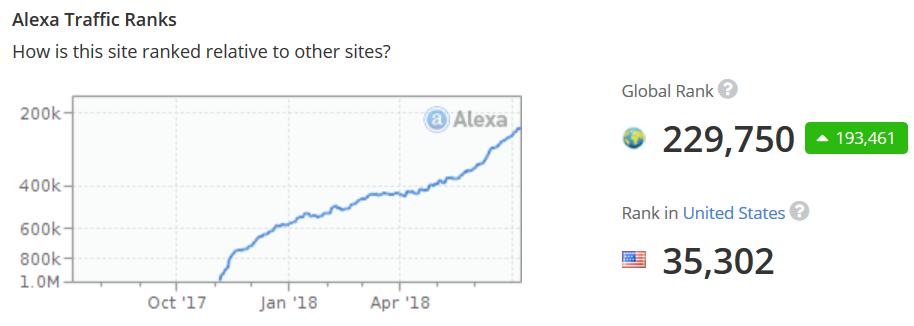
The website and app are only about a year old.  Consumer momentum takes time.  AppAnnie and Alexa show that both the website and the app are growing in popularity.

AppAnnie Ranking

Alexa Traffic Rank

Bringing retail owners and buyers to the site is all about experience.  RumbleOn needs to make the experience, both for buying and selling a bike, as painless as possible.

Buying or selling a bike is not a lot of fun.  The alternatives to RumbleOn are selling your bike yourself or selling to a dealer.  If you sell yourself then you will inevitably “suffer the tirekickers and hagglers and deal with shaky payments”, in the words of one Harley rider commenting on a forum about the service.  Selling to dealer likely means haggling, waiting onconsignment or a lower price than what RumbleOn can offer.  Buying a bike offers the same problems in reverse.

What RumbleOn has to do is make the experience so effortless that its worth your while to give up a little margin.

It’s a trade-off to bike enthusiasts.  Reading the reviews of RumbleOn and reading through forums where bike riders talk about buying and selling their bikes, its something that potential bike sellers are very aware off.

The most common complaint you hear about RumbleOn is that their offers are too low.  But most bike owners also understand what they are getting in return for the margin they lose (which amounts to maybe $1,000).  They get guaranteed cash and no hassle.  They do not have to live for weeks or months with strangers coming over to their garage, trying to push a lower on price, and dissing their bike on minor issues.  They also recognize that the offer price is usually better than what they’d get from a dealer.

Sales Growth

So far the model is working.  Bike sales went from 355 in the fourth quarter of last year to 878 in the first quarter.  The company said they expected that to double again in the second quarter.

I was a bit worried about how they could double sales when the website/app bike inventory seemed to be stagnating.  At the end of the first quarter inventory was a little above 1,000 units, whereas now it is slightly below that number.

But it turns out this isn’t the case.   Inventory has been rising.  The appearance of stagnant inventory is because of the removal of dealer listings.

Adding Bikes

If you go back to the first quarter call management was asked about the disappearance of the dealer listings:

And then just as a follow up, it looks like you’ve taken the dealer listings off the site, is that a temporary thing or is that a permanent change?

Marshall Chesrown

Yes, I wondered if someone is going to say that. We have a plan – we’re getting ready to launch as we said some really, really interesting enhancements, I will be interested to get everybody’s feedback on them with regards to the website and we do see a huge opportunity to be a significant listener of vehicle both for consumers and dealers but we want to do it in a different format and I won’t get into all the details of it but I would tell you that before the quarter you will see what that plan is as it’s rolled out.

Excluding dealer listings, inventory has grown from ~125 in November of last year, to ~300 in March and now to a little over 1,000 today.

My take is that inventory procurement is the gating factor.  The company has said that themselves.  On the fourth quarter call CFO Steve Berrard had this to say:

This is really a buying product challenge. It’s not selling it. We proved we can sell it by the fact you know, when is the last time you heard a vehicle retailer have days-turns in the 20s, because the market is there to sell it.  It’s buying of it, that’s the bigger challenge for us.

A key metric to watch will be how well they continue to acquire inventory.  The ramp over the last 3 months as well as the confidence they showed by removing dealer listings are positive data points.

Acquiring inventory is all about making lots of offers and getting the owners to accept them.  To expand inventories RumbleOn needs to:

  1. ramp offers
  2. improve acceptance rate

The ramp of offers is all about using technology to streamline the process:

We already which is very early in the cycle earlier than we anticipated we already do not have data people but data is being produced by our system and the data that we have we simply have a supervised whether it is released in those vouchers if you will, those cash offers. We have gone from being able to do about 20 an hour with the new technology enhancements, a single supervisor can do about an 100 an hour

Cash offers were 3,900 in the fourth quarter.  That improved over 200% in the first quarter to 12,000.  On the last call they said they were on pace to double cash offers in the second quarter.

Acceptance rates on those offers have been trending in the right direction as well.  Acceptance rates were 12% in the fourth quarter rising to 14.9% in the fourth quarter.  Chesrown thinks they can get this as high as 20% over time.

So all good signs.  Even so I feel like obtaining the right inventory at the right price is going to remain the big challenge for the business.

Reviews

Case and point: if you look for negative reviews of the company, what you find will almost inevitably be a bike owner complaining that the offer RumbleOn made for their bike is too low.

The business is based on the premise that you are saving enough in terms of time, hassle and getting a guaranteed cash payment to make you willing to give up the $1,000 that you might get if you sold the bike yourself.  And this is an equal or better price, all with less hassle, then you’d get if you went to your local dealer to sell.

You can find reviews of RumbleOn on BBB, Facebook, GooglePlay and on the Harley Davidson forums.

Other than the complaints about the offer prices the reviews are almost all positive.  Customers get paid for their bikes on time, they receive their bikes quickly and they are consistent with what was ordered.  The app is easy to use, it’s a simple process to get an offer on your bike and likewise it is easy to purchase a bike.

Guidance for the year

The company reiterated their full year guidance.  They expect $100 million of revenue in 2018 and “in excess” of 10,000 units for the full year.

They changed the way they are getting to the $100 million from what they said on the previous call.  Management had previously guided to $100 million but on 8,100 units sold.  Their mix has changed. Rather than expecting sales would be dominated by Harley’s they now expect a better balance between Harley’s and non-Harleys.  Harley’s are higher price, lower margin units.

This is a really new business and I don’t feel like management (led by CEO Marshall Chesrown and CFO Steve Berrard) know exactly how all the levers will play out.  They’ve been surprised by the number of non-Harley’s, surprised by the number of dealers buying, and surprised by the strength and margins they are getting from the auction channel.

Nevertheless I’m pretty confident that Chesrown will navigate his way through this.  The guy has a impressive background.

Management

Chesrown started off selling cars first in San Diego and then in Colorado, where he was managing 17 dealerships by the time he was 25.  He started his own dealership chain soon after which was eventually bought out by AutoNation for $50 million.  He has been called the “best used car salesman in the country”.  There is a great biography of his early life in this article in the Inlander.

After making a fortune in the auto business Chesrown tried his hand in real estate development and lost it all in the crash of 2008.  But not to be deterred he went back to his roots and founded Vroom in 2013.

Chesrown was COO and a director of Vroom until 2016, when he left to start RumbleOn.    Though Vroom has hit on harder times this year, it was valued at over $600 million last year.

There are some similarities between the model used by Vroom and RumbleOn but there are also differences.  I get the feeling Chesrown learned there and the learnings are now being applied.  There have also been a number of executives that have left Vroom for RumbleOn.

Steven Berrard, the CFO, also has a pretty crazy history.  He was the CEO of Blockbuster in the 90s, left there to work with (his friend?) Wayne Huizenga as COO of AutoNation, and from there took over Jamba Juice and eventually became CEO.  He also led Swisher, which eventually ran into accounting problems but that was all after he left.

It’s a little nuts to me that these guys are leading an $80 million market cap company.

The management team and directors own a lot of shares.  Together its about 75% of the Class A and Class B shares.  Chesrown and Berrard own 36.5% between the two of them, and together the two own all the (1 million) Class A shares, which have 10:1 voting rights and effectively give them full control over the direction of the company.

Profitability

Buying and selling motorbikes online is new but buying and selling vehicles is not so much.  In addition to publicly traded Carvana and Vroom, there have been Beepi, Shift, Fair, Auto1, Carspring and Hellocar and a bunch of others.

These companies haven’t all been successful.  From what I can see Beepi, Carspring, and Hellocar all ran out of money.  Shift and Fair seems to be doing ok, though Shift has had some bumps in the road by the looks of it.  Auto1 is a German company that seems to be doing well.

I think the basic problem with theses businesses is what you see in Carvana’s financials.  It takes a long time to get cash flow positive.  Carvana has already been around for 5-6 years and yet when I look at the estimates it doesn’t look like they are expected to generate positive EBITDA until 2020.

So these companies need a source of funds to keep themselves going.   When those funds dry up, like they did for Beepi, the business goes away.

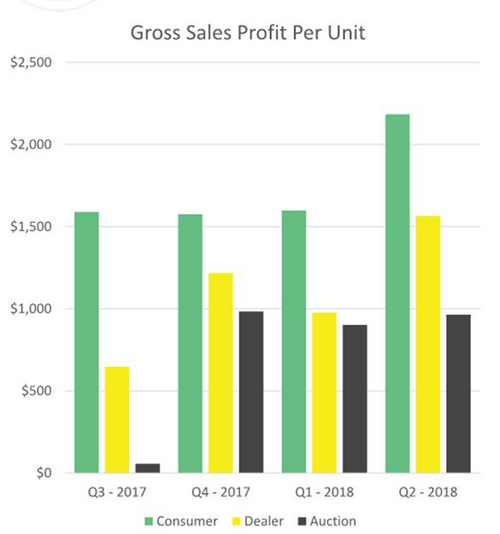
RumbleOn has similarities and differences here.  This is low margin and always going to be.  In the first quarter RumbleOn had gross sales profit, which is defined as the difference between the price RumbleOn bought the bike and the price they sold it at, was $1,132 per bike, or 12.3%.  Gross profit, which includes costs associated with appraisal, inspection and reconditioning, was $788 per bike, or 8.6%.

The average margin on a Harley was 7.5% while for non-Harley Davidson’s it was 13.1%.  Non-Harley’s seem to have a higher gross margin than Harleys, which has to do with their lower price point.

So it’s a low margin business and always will be. So RumbleOn needs to be tight on expenses and focused on volume.

That’s why I think the thing I like best about what I hear from Chesrown and the RumbleOn management team is their focus on getting to profitability and inventory turns.

They want to get RumbleOn to cash flow positive quickly.

Breakeven

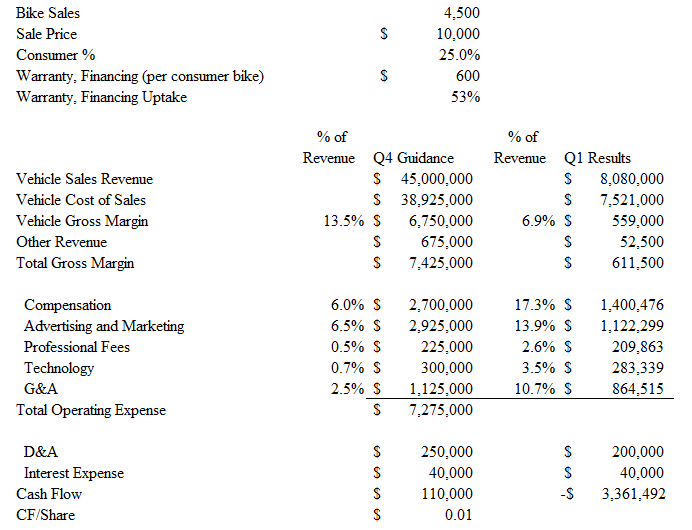
Berrard laid out where they would be in terms of costs by the fourth quarter.  They also said the goal is to be cash flow positive by the fourth quarter.  Guidance for the year is $100 million of revenue, 10,000 bikes sold.

To get to the unit sales guidance they need to sell 4,500 bikes by the fourth quarter, up from 878 in the first quarter.  I’m assuming they hit their second quarter guidance of doubling bikes sold in the second quarter.

I took all the guidance information and made a few assumptions around consumer sales (expecting it to rise from 9% in Q1 to 25% in Q4) and their warranty financing (expecting uptake/dollar value to rise from 35% in Q1 to 53% in Q4), and I came up with a break-even model (thanks to @teamonfeugo for helping me work the kinks out of the model).

So I don’t know if this model with be accurate.  The business is new, there’s some guessing on my part and I’m just going on what we know from the calls.  But what is clear is that the growth is significant and if they can get there by Q4, then 2019 should be the year of cash generation.

It’s also worth noting that margins so far are primarily driver by the vehicle margin.  Companies like Carvana are generating about half their margin from financing and warranty sales.

Comps

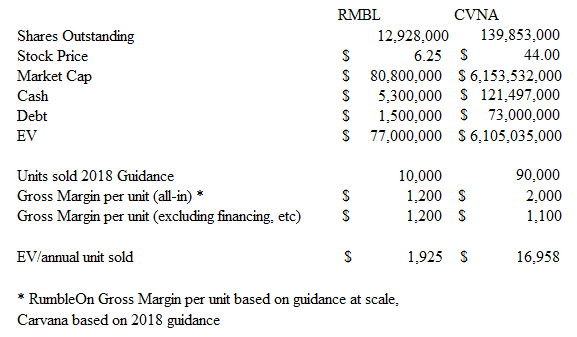
RumbleOn has 12.9 million shares outstanding.  So at $6.25, which is roughly the average price I bought the stock at (I know its ran up the last couple days but I don’t want to redo all of this again), the market cap is about $80 million.

Compare that to Carvana, which has a market capitalization of over $6 billion.  Carvana is of course much bigger.  But on a per unit basis, RumbleOn looks very reasonable.

Carvana has higher gross margins per unit than RumbleOn but that is because of financing, service contracts and GAP waivers.  As sales to consumers grow RumbleOn can expand these other offerings.

On just a pure selling price minus purchase price basis, once scaled RumbleOn has pretty comparable margins to Carvana.  It also took them a lot less time to get there (Carvana vehicle unit margins were only about $600 as recently as last year).

It’s hard to look for comparisons from the other online car companies.  Vroom, Shift and Fair.com are all private and I can’t find much information on valuation or how many cars they sell.   The only somewhat interesting observation I can make is that in terms of unit inventory (this of course being cars for these three companies versus bikes for RumbleOn), they do not appear to be significantly larger.  Vroom has about 2,500 cars on their site, Fair has a little over 7,000 and Shift only has about 800.  RumbleOn was a little over 1,000 at last glance.

Multiples

Here’s a table of what RumbleOn’s market capitalization looks like at different revenue multiples and $100 million of sales.  The 3.4 multiple is based on Carvana’s forward 2018 revenue multiple.

I realize the numbers are high, but it is what it is.  I’m using the company’s guidance and Carvana’s multiple.  Consider that RumbleOn is growing faster than Carvana at this point.

What sort of multiple does RumbleOn deserve?  I’m sure you can make an argument that because the margins are low, the multiple should be low.  That’s one perspective.  But they are also growing like a weed.  And then there is Carvana.  If Carvana gets almost a 4x multiple, I don’t see why RumbleOn shouldn’t get at least something above 1, probably more.   That multiple should grow as they become more established.

I realize that the used car market is way bigger and so maybe there is a premium for that.  But used bike sales aren’t exactly small themselves, especially compared to RumbleOn’s size.   According to their S-1 there were 800,000 motorbikes sold in 2016 and 50% of those are done on a peer to peer basis.  Then there is the eventual expansion into other sports vehicles.   RumbleOn also doesn’t have the 5-10 online and gazillion bricks and mortar competitors fighting with them for share.

What to look for

First, I want to see the website inventory continue to expand.  Offers should continue to grow and acceptance will hopefully increase.  At the same time their days sales are equally important.  That number was 42 in the first quarter versus 38 in the fourth quarter.  Carvana days to sale were 70 in the first quarter, down from 93 year over year.  RumbleOn has focused on turns and needs to continue to do so.

Second, I want to see consumers comprise a greater percentage of sales, and (ideally) I want dealer sales to take place more and more through the website.  But most of all I just want to see sales grow.

Third, I don’t want to see their costs blow up.  Costs are going to increase as the business scales but they should also come down to their targets in terms of percentage of revenue.

Fourth, at some point I expect they will expand into other sport vehicles.  They’ve mentioned expansion into ATV’s, UTVs, snow machines and watercrafts as other targeted areas.

Conclusion

Online used vehicle selling is a tough space to be in.  Carvana has a great chart this year but there was a lot of skepticism (and a high short interest) when it went public.

A lot of other players have ran out of cash.  Beepi, Carspring, Hellocar and now Vroom have all struggled.

But all these guys are all selling cars.  I think RumbleOn has some advantages selling bikes.

  1. They are much easier to transport.
  2. They are a niche market compared to used car sales and thus more difficult to sell yourself via Craigslist or Kijiji.
  3. They don’t have the same level of competition online. And their traditional dealer competition is arguably less savvy than the used car dealer incumbents (remember that a lot of used car dealers take bikes on trade but don’t want to sell them, so they are actually a source of inventory to RumbleOn).

They are also offering a quick cash, no haggle, simple model for buying and selling bikes in a business that has traditionally relied on squeezing extra margin by making the process as difficult and opaque as possible.

The other advantage here is that RumbleOn is 100% online.  On the last call they talked about how they can scale without adding to headcount outside of marketing and technology.  They basically operate out of a single building.  They aren’t even touching the inventory themselves.

The other advantage RumbleOn has over most (not all) of the online car players is that they’ve involved the dealers.  Like I said earlier they are agnostic on the distribution channel.  They will sell to consumer, dealer and auction.

This allows them to ramp sales (albeit it at a lower margin) much faster than if they had to rely exclusively on consumer marketing of the app and website.

Finally, I think these guys have the right idea by focusing on inventory turns.  They don’t care who they are selling to, and they aren’t trying to squeeze every last bit of margin out of the sale.  They just want to get that inventory in and ship it out as quickly as possible.

When they get into power boats, snow machines and ATV’s I think most of these advantages are amplified.

If I’m thinking about this right, growth is gated by how quickly they can acquire inventory.  Given the rate at which cash offers and acceptance are increasing, I think that is well under control.

So it looks pretty interesting.  Nevertheless its a tough business because gross margins are guaranteed to be low. Its all about driving volume, keeping costs down and where possible upselling through warranties and financing.

So far they doing all of this quite well.

As you know I usually take a small position (usually 2% or a little higher) in a stock and then if it works I start adding as it rises.  With RumbleOn, I’m excited enough about the idea to make that higher right from the start.  I think if this works it will have some legs.  So we’ll see.