Skip to content

Smith Micro: Stealing a Good Stock Pick

So I can’t take credit for this idea.  I also don’t have much to say that hasn’t been said already.  But I added the stock to my portfolio a couple weeks ago so I need to talk about why.

Smith-Micro is a Mark Gomes stock pick.  In fact if you go to his blog you will find so many posts on Smith-Micro that reading them all would keep you busy for a few days.

I’m not going to repeat all the information he provides.  I’m just going to stick to the story as I see it, the reasons that I took a position and what makes me both optimistic and cautious about how it plays out (this is just a typical 2% position for me so I’m not betting the farm).

Yesterdays Smith Micro

Smith-Micro has been a bad stock for a number of years.  But it used to be worth a lot.  This was a $400 million market cap company stock back in 2010.  Revenue in 2010 was $130 million.

At the time revenue relied on a suite of connection management products called Quicklink.  This suite of products maintained and managed your wireless connection as you moved around with your USB or embedded wireless modem (remember those!).  They also had a visual voicemail product that transferred voicemail to text and provided other voicemail management features (in fact they still do have this product).

From what I can tell it was Quicklink that was driving revenue.  They had 6 of the 10 big North American carriers onboard and 10%+ revenue contributions from AT&T, Verizon and Sprint.  It was a cash cow.

Now I haven’t figured out all the details of what happened next, but the short story seems to be that the smart phone happened.  Smart phones had embedded hot spots or mobile hotspot pucks for accessing mobile broadband services.  No more dongles, no more laptops looking to keep their connectivity.  And the connection management product was no more.

That was pretty much it for Smith Micro.  The company never recovered.  2011 revenue was $57 million.  2012 was $43 million.  By 2014 it was down to $37 million.

Today’s Smith Micro

The struggles have continued up until today.  Over the past few years the company has had a difficult time creating positive EBITDA and revenue growth has been in reverse.  Revenues bottomed out at $22 million last year.   It’s gotten bad enough that the company included going concern language in the 10-K.
The company currently has a suite of 4 applications.

CommSuite is their visual voicemail product.  It is still used after all these years and generates about 60% of revenue.  QuickLink IoT seems to be a grandchild of the original Quicklink products but with the focus on managing IoT devices.  Netwise seems like another Quicklink spin-off, managing traffic movement for carriers by transitioning devices from expensive spectrum to cheaper wifi where they can while insuring that an acceptable connection is maintained.

So those are the other products.  But there is only one that is really worth talking too much about and that’s SafePath.

SafePath is a device locator and parental control app.  With the app installed on all devices in a household a parent can keep track of their kids or the elderly (or spouse for that matter) as well as control and limit what apps and access each device has.

Smith Micro gave a rundown of the SafePath functionality in their latest presentation, comparing it these app store based competitors.
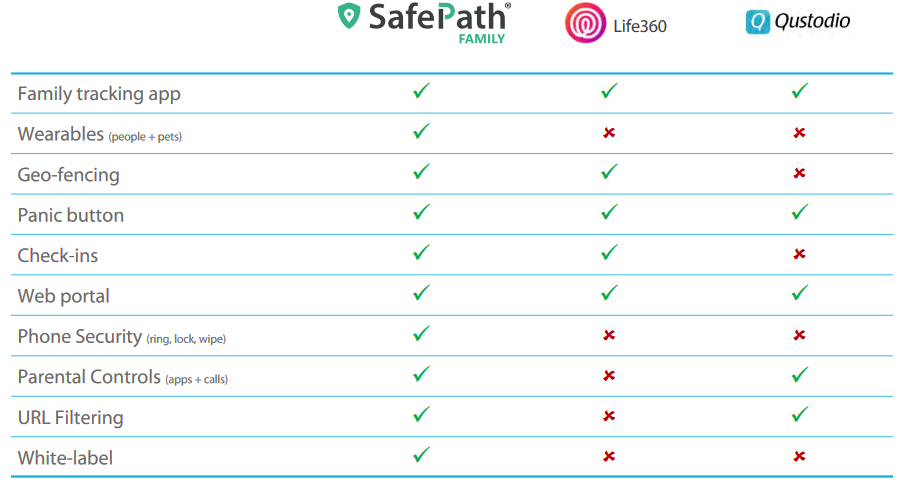
Essentially what these apps let you do is a combination of:

  1. Keeping tabs where all the other devices in your network are including geofencing alerts if the location is unexpected (ie. children not in school)
  2. Panic button if a family member is in trouble
  3. Content constraints on what apps can be downloaded onto each device, what websites can be visited
  4. Time constraints and time limits on when apps and web content can be accessed
  5. A history of device usage, location

I think it’s a pretty useful product.  I actually didn’t know that so much functionality was available for parents to control what their kids have access to (my kids aren’t at that age yet but I could see a product like this being a purchase for me one day).

SafePath isn’t a unique offering.  There are several apps on the market that offer a combination of the features.  Each carrier seems to offer some sort of flavor.  And there are freeium products available at the app stores, such as Life360 and Qustodio which are the comps used in the table above.

Both the Life360 and Qustudio apps are not associated with any carriers.  You get them via the app store and you get some reduced version of the product for free (can only track a couple member of the family, don’t have all the controls, etc).  You upgrade to the premium pay version if you want all the features.

For the premium version the pricing on the Qustudio app is between $4.50 to $11 per month depending on the family size.  I believe the Life360 app costs $5 per month but I can’t really find recent information on that, and I would need to sign up to get pricing via the app itself which I can’t do here in Canada.

Before I talk about the SafePath pricing, I want to mention that maybe the most important differentiator for SafePath is the white label.  Rather than providing a product into the app stores, Smith Micro licenses the app to carriers.  They put their own labeling on it and offer it to their clients.

That’s where Sprint comes in.

Why SafePath?

Last fall Smith Micro added Sprint as a SafePath customer.  Sprint obviously is a huge win, with 55 million wireless customers.

Sprint has named their version of the app Safe & Found.  The product was launched near the end of 2017 but didn’t really accelerate until the last couple of months.

Prior to Safe & Found Sprint offered a product called Family Locator that provided location detection for families.  They had a separate app for parental controls called Family Wall.  These products didn’t work at all on iOS.

Combining the functionality into a single app that’s available on all operating systems is likely part of a bigger strategy.  At the LD Micro conference William Smith, the CEO of Smith Micro said this:

[Safe Path is] an enabling platform for a carrier that is looking for a strategy to grow their consumer IoT devices… [such as] wearables, pet trackers, a module that goes in your car and lets you track your teens driving, a panic button that you give to your parents…

Putting together a single product geared at families is about attracting families to the carrier.  Families are low churn and high dollar value customers.

Sprint is selling the Safe & Found app for $6.99 per month, so in-line with the other apps that are available.  Smith Micro has a revenue sharing agreement, taking a cut on each customer.  Apparently, Smith gets about $3/customer/month from Sprint (though I haven’t been able to verify that number).

The Sprint Bump

Ok so now let’s throw out some numbers.

Smith Micro has about 24.5 million shares outstanding.  At $2.50 that gives it a market capitalization of $61 million.  There is about $10 million of cash on the balance sheet (maybe a bit more but they are still burning cash so call it $10mm) and $1.5 million of debt.

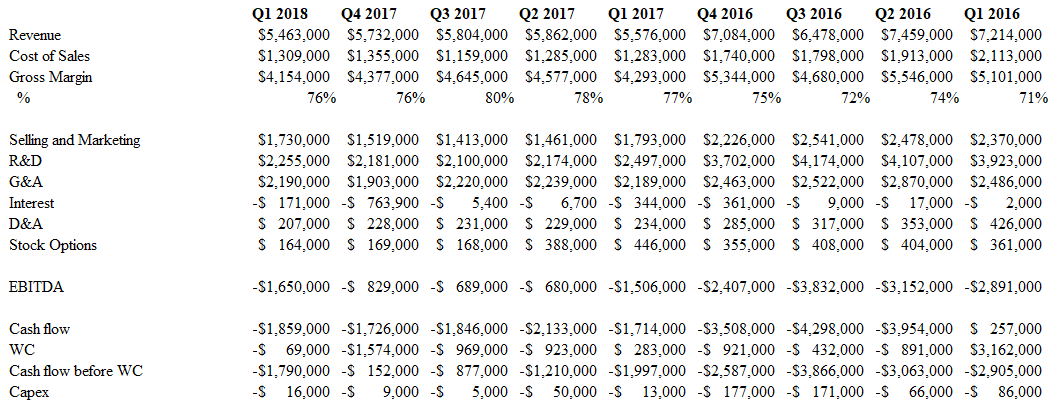
TTM revenues were about $23 million and gross margins are 75-80%.

Now let’s look at what Sprint does to those numbers.

On the fourth quarter conference call Smith said:

While the conversion of Sprint’s existing customer base is still underway, it will equal approximately $3.5 million in additional quarterly revenue for the company once it’s completed.

That’s including breakage.  So this is a $6 million revenue per quarter company that is guiding that it can add $3.5 million a quarter on a Sprint ramp?  Obviously, that’s the opportunity here.

The company said that margins on SafePath will be around 80% and that almost all that margin should fall to EBITDA.

Not surprisingly, if you model this out the company becomes much more attractive.
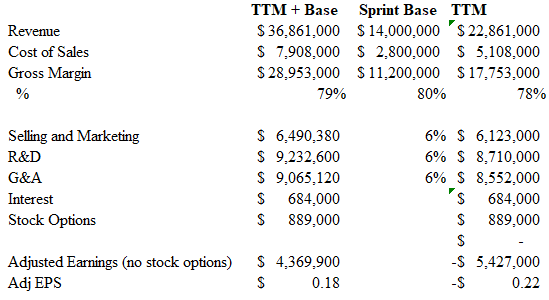
The above assumes 6% operating cost inflation (gets you to $6.2 million per quarter).

An analyst on the fourth quarter call said Sprint’s installed base was about 300,000 customers, so the above would assume a ramp of those customers (with breakage) to Safe & Found (I would really like to have this number verified though, I can’t find evidence of how many Sprint’s Family Locator subscribers there are anywhere else).  Its worth noting that if the 300,000 subs is accurate it is is less than 1% of Sprints installed base.  So there’s clearly lots of blue sky if all goes well.  On the fourth quarter call Smith said that:

I think it is the goal of not only Smith Micro but also of Sprint to see millions of subs using the SafePath product and that’s a goal that, I think, would be echoing in the executive aisles of the Sprint campus as well.

So we’ll see.  The numbers can get quite big when you are dealing with 80% margins and a large installed base.

Can Reality match the Model?

That’s the big question.  Are these numbers achievable?

Look, I take small positions in a lot of little companies that give a good story.  I tend to take management at face value.

This is a bit unconventional.   I get called out for it by more skeptical investors.  When these investors are right, which is more often then not, then they get to gloat and I get to look like a naïve fool for trusting management.

But bragging rights aren’t everything.  There is a method to my madness and that method is that when I am right, I sometimes get a multi-bagger out of it.   The big wins drive the performance of the portfolio and while on a “naïve-fool-basis” I come out looking poorly, I also come out profitably.

Nevertheless, I always try to keep it at the forefront of my mind that there is a pretty good chance that this isn’t going to end well.

With Smith Micro I’m taking management at face value.  If they say they can do $3.5 million a quarter from Sprint, then okay, I’m buying the stock on the basis that they do $3.5 million a quarter from Sprint.  They say the goal is for millions of subs then I say, okay, lets see that happen.

But I also recognize that might not happen.

My Concerns

Honestly my biggest hang-up with the stock right now is the reviews.  The reviews on Google Play could be better.

I recognize you have to take these reviews with a grain of salt.  First, they make up a very tiny percentage of the total downloads so far.  Gomes put together a very helpful table of his estimated downloads and the reviews that have been added.  Reviews are much less than 1% of downloads.

Second, its not clear that the reviews are all legitimate.   I haven’t done this, but some others have dug into the reviews and questioned that they are often coming from locations that aren’t even in the United States.

Third, apart from a few legitimate concerns like battery drain (which other reviewers actually contradict), most of the reviews seem to be more about complaining that the Family Locator app they were used to is gone.  Fourth, the trajectory of the reviews has been getting better.

Nevertheless the reviews are a datapoint and right now a somewhat negative one.

My second hang-up with the stock is that, at least from what I can tell, Sprint hasn’t completely shelved their legacy Family Locator app.  On the first quarter call Smith said this:

The legacy product was originally due to sunset in the first quarter of 2018, but has subsequently been delayed for several months. This change was based solely on Sprint operations and was not a result of the SafePath application or change of our contract status.

Why has Sprint delayed the sunset?  I have no idea.  It could be (probably is) a completely benign reason.  But again, it’s a bump in the road to weigh against the $3.5 million a quarter that I am taking at face value.

My third concern is that management hasn’t been on target with their projections.  Originally they said the ramp on the Sprint installed base would be complete by the first quarter of 2018.   That turned out to be way off. They were also positive on a Latin America carrier win that doesn’t appear to have panned out.

Finally, concern number 4 is that we are dealing with a service provider.  These guys are A. Slow to adopt, and B. not at all loyal.    We’ve already seen point A prove itself out as the ramp has lagged.  Point B is something I’ve already experienced with Radisys, which was dumped unceremoniously by Verizon.  Smith Micro has had this experience multiple times in its history, most recently by Sprint themselves when they dumped their NetWise product after what Smith Micro called a promising launch.

These are all reasons this is a 2% position for me.

On the other hand, Sprint does seem to be moving ahead.  There was a big promotion in May including a joint deal for AAA members (talked about here), reps have been visiting stores and getting the sales staff up to speed, and stores are promoting the app to varying degrees.

One other potential positive is that Sprint might not be the only Tier 1 win.  The CFO, Tim Huffmyer, presented at the Microcap conference in April.  He mentioned a second win with a Tier 1 European carrier.

Huffmyer said that they had already been selected as the family safety application for this carrier but that the contract process was still ongoing.  If they get the contract finalized it would be rolled out to Europe, Asia and the Middle East where this carrier operates.  He didn’t give any more details on size but presumably it would not be a small rollout.

I know from painful experience how slow Tier 1 wins can be.  But quite often they get around to it.  It’s a good sign that they are moving down that road with others.

A Typical Stock for me

This is a Mark Gomes pick and I am stealing it.  But I am stealing it because it fits right in my wheel house.

There is no question the stock could be a dud.  The Sprint ramp might stagnate, Sprint might walk away and go back to the incumbent or to some other option, and then there is the merger with T-Mobile that throws yet another wrinkle into the equation.  Who knows what’s in store?

The one thing I do know is that if the launch is successful and Smith hits their targets, the numbers are big enough to justify a higher stock price.  Viable growing businesses with 80% gross margins and a recurring revenue model don’t trade at 1-2 times revenue.  Simple as that.

So this is a classic stock for my investing style.  An uncertain opportunity that has some positives, some negatives, no sure thing, but an upside that is more than large enough to make it worth throwing your hat in the ring.

How often do these sorts of opportunities pan out?  Definitely somewhere south of half the time.   If it doesn’t then I get to look like a naïve fool for trusting management.  But if it does I get a big winner.  It’s these sorts of moonshots where the 5-baggers come from.  And that’s what drives the out-performance.  Crossing my fingers that Smith-Micro will be next.
Copper stars not quite aligned

Sometimes all the stars align for a trade.  And sometimes there is one star that is way off in its own orbit, throwing off the whole picture.

That’s what I’m thinking about copper right now.

There is a lot I really like about this idea:

  1. The demand picture is premised on what seems like the inevitable adoption of electric vehicles and increasing electrical infrastructure
  2. The supply picture paints a scene of depleted reserves and an empty pipeline that will lead to significant deficits for years to come
  3. The prices of copper equities are reasonable, if not downright cheap, and certainly not pricing in the upside of a rising copper price

It all fits.  Except for one thing.  These damn tariffs.

In my opinion there are reasonable odds that what is to come is more brinkmanship, more anti-ups, and maybe even some sort of climatic event ala Nixon in 1971 that changes the way the world operates for good.

Of course maybe not.  The market is certainly saying its all good.  But the market also rose right after Nixon put a 10% surcharge on imports and pulled the rug out from under Bretton Woods.

The 70s didn’t really go all that well.

I don’t know what is going to happen.  But it’s uncharted territory and it wouldn’t surprise me if the market is as clueless as I am.

Consider the following:

  1. We have a President that was elected, in part, by folks who lost their jobs or had their communities disrupted by the relocation of industries that were allowed to leave because of free trade (yes its complicated and there were other causes, but free trade was definitely part of it).
  2. The President has made it clear he will do whatever it takes to make good on his promise to fight for these people and communities and get those jobs back (whether or not what he is doing is actually going to be in their best interests is not clear but also not really relevant to the line of reasoning here)
  3. It’s not really clear if anything can be done to turn back the clock on these cities, counties and communities that have had the industries they were built on stripped from them, so perhaps regardless of what the President does, the outcome will disappoint

Those 3 points suggest that it is at least possible that we spiral into a vicious circle of escalating actions that don’t have the intended effect and therefore lead to even more escalation.

I’m just not sure I want to own a lot of copper in that environment.

With that all said, the picture for copper supply and demand assuming a “steady as she goes” economy is pretty enticing.

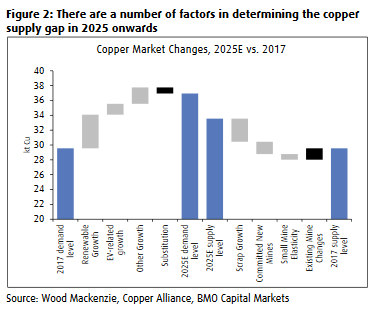
BMO put together a long and very interesting research piece describing the supply and demand dynamics of copper over the next number of years.

The demand side is being driven by electric vehicle demand and the grid infrastructure required to move to a higher amount of renewables.

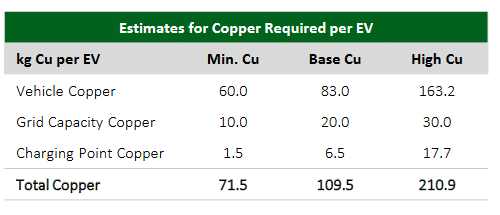
The simplest explanation of why this will increase the demand for copper is this: An internal combustion engine contains 23kg of copper for wiring, whereas a battery electric vehicle and plug-in hybrid contain between 60-83kg of copper.  On top of that another 20kg of copper is needed for grid capacity and 6.5kg for the charging point.

On the supply side, a combination of declining grade, rising capital costs and a number of years of depressed copper prices have left us with a depleted pipeline of projects.

The conclusion, which is hard to find fault with, is that there is a significant shortage of copper projects in the development pipeline and projects will only be added if the price of copper rises enough to incentivize them.

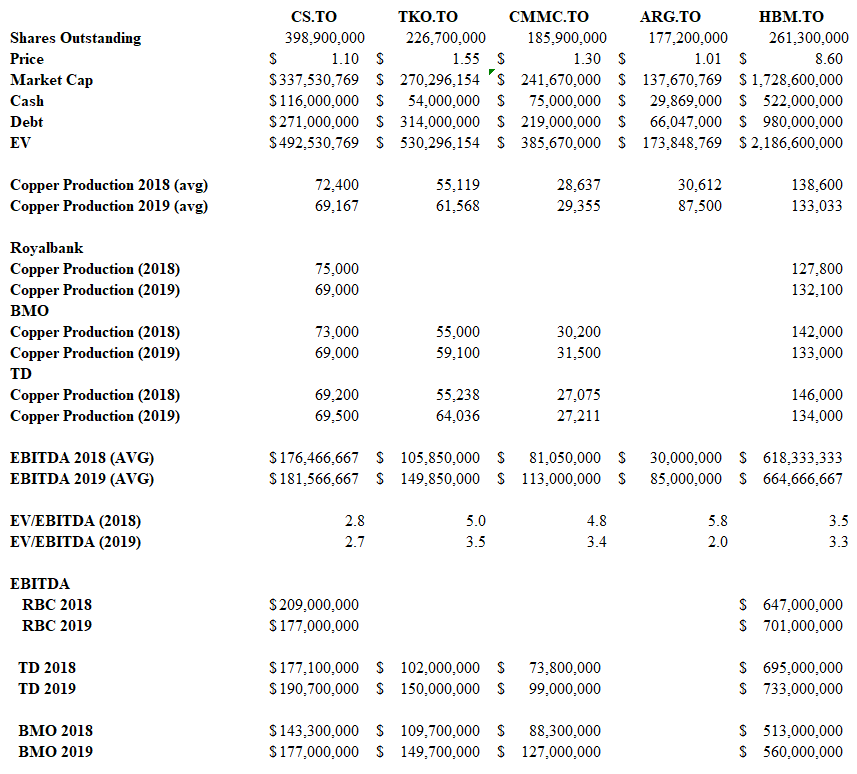
So how do you play this?  Well maybe you don’t because there is just so much risk in the world.  I’m still trying to figure that out.  But if you do, I certianly think the copper stocks are reasonably priced for it.  Below is a comparison of a few that I have dug into where I just took analyst EBITDA estimates and averaged them to get a rough idea of the EV/EBITDA multiple these companies trade at (note that because Amerigo isn’t followed by any brokerages I have reports for I used the companies own estimates that I found in their presentations).

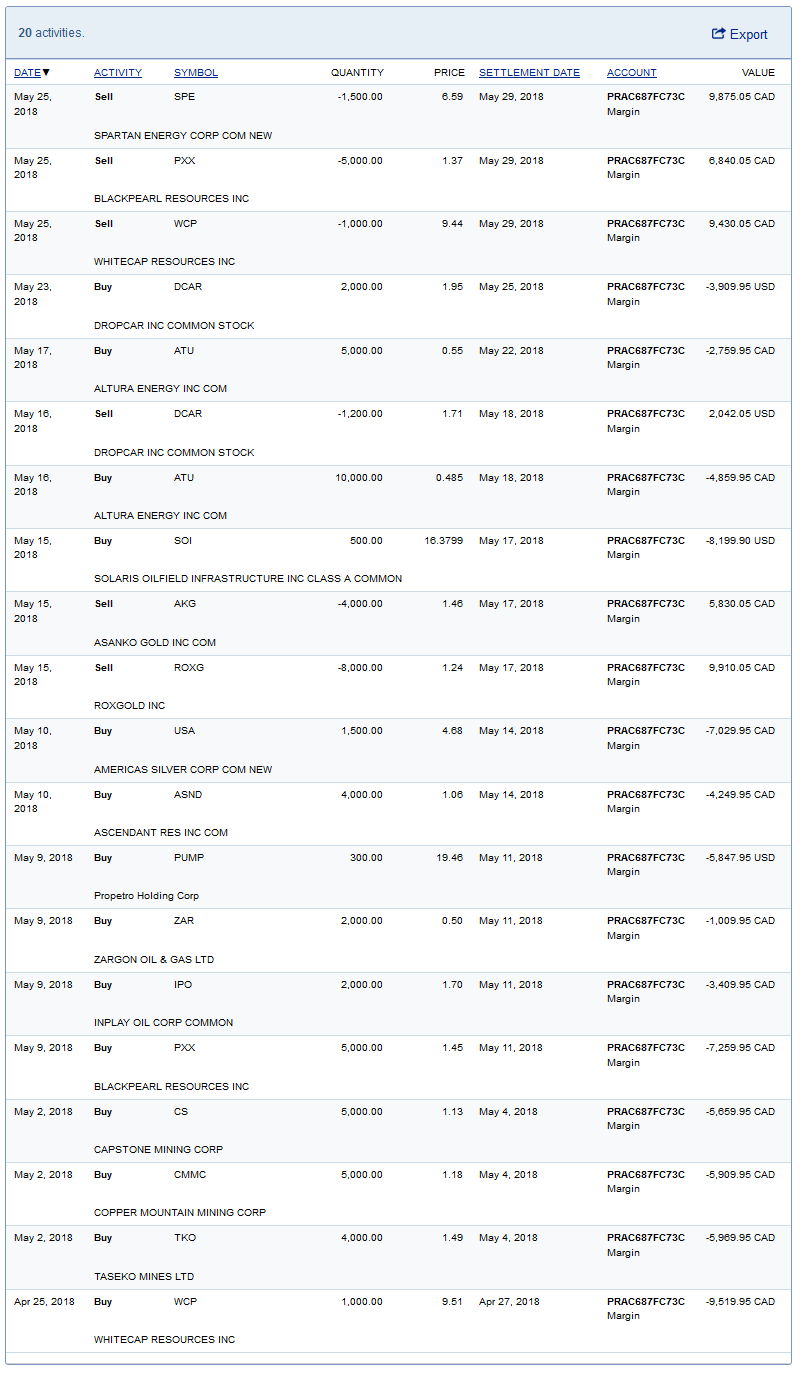
At the moment I have taken positions in a couple: Copper Mountain and Capstone.  But these positions are really, really small (<<1% each).

For now they are going to stay that way.  I’m just too uneasy about where all this trade stuff is going.

Week 359: Buoyed by the CAD

Portfolio Performance

Thoughts and Review

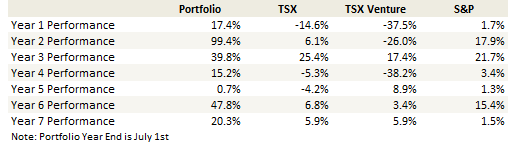
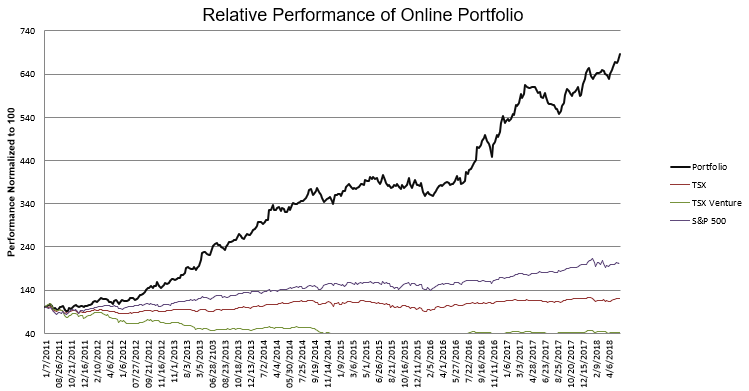
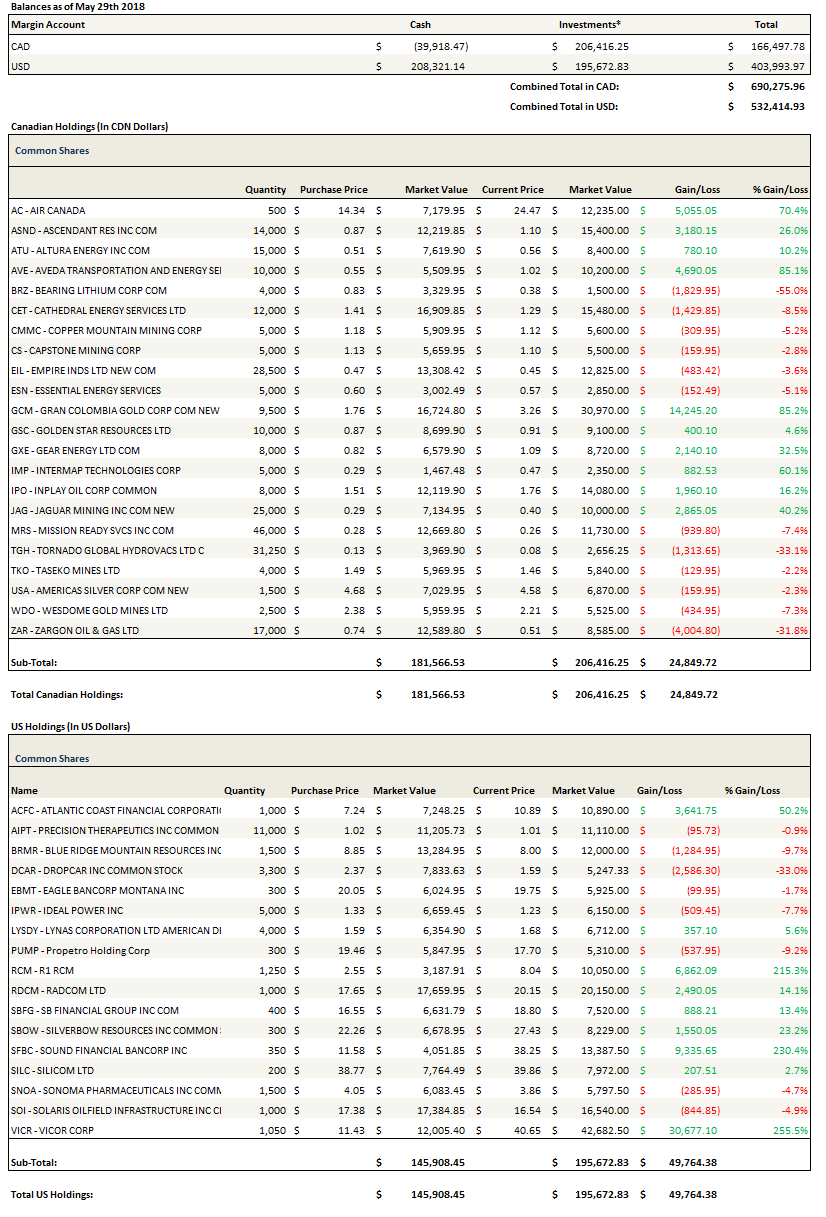
Another quiet month for my portfolio as I only added and subtracted a few stocks around the edges.  But I had quite a good month.

I can’t take credit for all of it however. I have been getting a boost from the Canadian dollar.  Since March the dollar has fallen from 81c to 77c.  Last spring I talked about this when I was going through a period of massive headwind from a rising Canadian dollar. Now it’s the opposite.

If you do the math, the move in the Canadian dollar has added about $25,000 to the tracking portfolio totals since the beginning of March.  So I’m looking somewhat better than I actually deserve (which is quite the opposite of last spring, when I looked like a schmuck as the CAD rose some 15% in a few months!).

Much of the rest of the move (which I can take credit for) is the move in Gran Colombia Gold.

Gran Colombia

In the last 5 weeks Gran Colombia completed the redemptions of their 2020 and 2024 debentures and announced first quarter results.    The results were great.  AISC of under $900/oz and EBITDA of $27 million.

After accounting for debentures redemptions and share conversions (including all the in-the-money warrants and the not yet converted 2018 debentures) I get about 60 million shares.  So that’s a market capitalization of about $200 million (CAD) or USD$153 million at the current conversion.  There is another USD$98 million of the new debt and they should have about USD$41 million of cash once all the warrants are converted.

The company did USD$27 million of EBITDA in the first quarter.  It seems pretty reasonable that they should do at least USD$100 million of EBITDA in the full year.  So even after the big jump in the stock price, Gran Colombia only trades at 2x EBITDA.  I realize the gold stocks are cheap and unwanted, but even the most unloved get at least 3x EBITDA and some are getting 6-7x.

I think the re-valuation still has a ways to go.

Tornado Hydrovac

Here’s a stock I haven’t talked about in a while.  I took a closer look at it after the first quarter results and had someone on Twitter ask about it which got me thinking about the stock a bit more.

Tornado is a $6 million enterprise value company with almost $5 million of cash.  However, most of the cash ($3+ million) is in China and not readily available for the North American business.  They have an established hydrovac business in North America, and one they are trying to get off the ground in China.

These are the same trucks that Badger Daylighting rents out.  But Tornado’s business is not quite like Badger, as they are primarily building the trucks not renting them out.  Tornado has had a few rentals (1-4 trucks per quarter) over the past year, so its not a significant business.

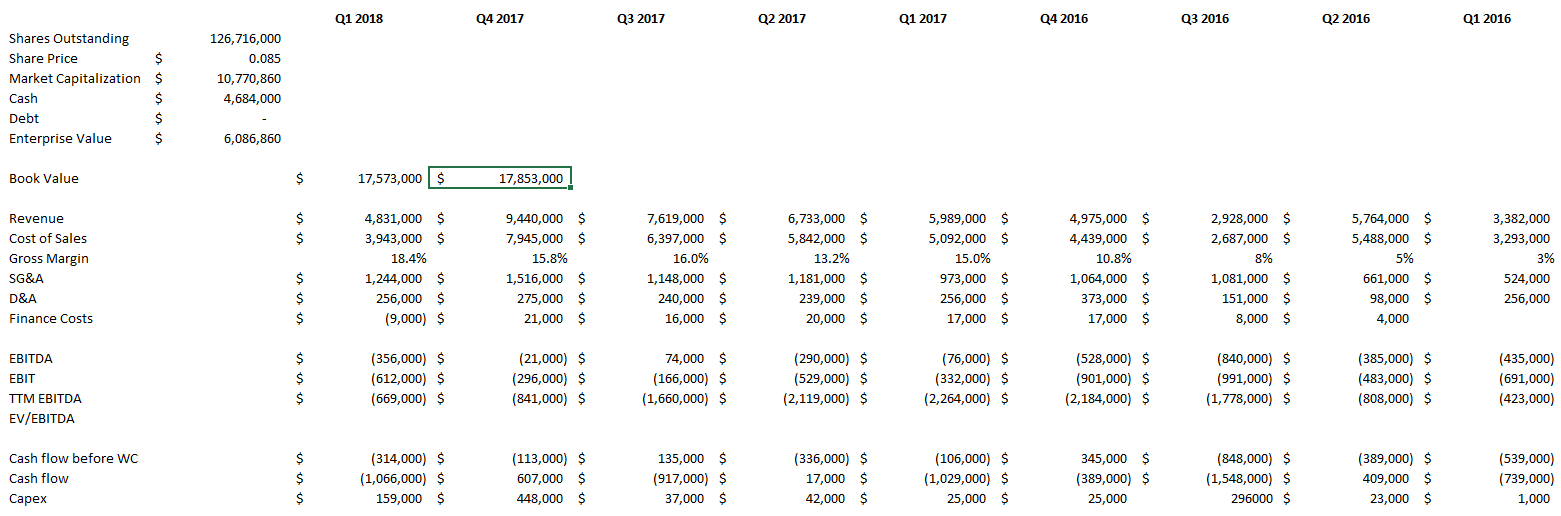
The first quarter wasn’t great.  I had been hoping for a follow-up on the fourth quarter, where revenue hit a 3+ year high at $9.4 million.  But they only had $4.8 million of revenue in Q1.

So it was disappointing and the stock hasn’t really done much.   But to be fair, the stock has never really done much so let’s not read into that too much.  Still I’m inclined to think the business is turning for the better.

The poor results were partially seasonal – in 2014, 2015, and 2016, there was a significant slip in first quarter revenue from Q4 to Q1 (2017 was a bit of an anomaly because the industry was recovering from the downturn).

Also, inventory ticked up from $6.49 million in Q4 to $9.1 million in Q1.  Inventory has been a pretty good indicator of the next quarter revenue, which I imagine is because of the part procurement and build cycle.  The company said the following in the MD&A.

For the three months ended March 31, 2018, inventory was $9,072 compared to inventory of $6,490 as at December 31, 2017.  The increase in raw materials is due to stocking up for production ramp-up in the second quarter.  The increase in finished goods is due to 3 completed trucks held in finished goods as at March 31, 2018 that were not delivered and sold to customers until early Q2 2018.

The other angle with the company is China.  They are getting closer to generating revenue from China.  Tornado expanded into China over a year ago.  Since that time most of the efforts have been establishing a footprint, starting up a manufacturing operation and developing relationships.

In the first quarter they sent out their first three demonstration units in China.  Overall, China has overhead of $300,000 per quarter and no revenue.

The inventory related to the three demo units was $1.14 million.  Assuming 15% gross margins (margins for the company are around this level), they need to sell about 5 trucks per quarter in China to break even.

But that’s only assuming sales of trucks.  The model is China is both sales and services and I’m not sure about what the economics of the services side will look like.

Bottom line is that the stock is reasonable and I think its not a bad bet that they can have a breakout quarter one of these days.   Book value is over $17 million while the enterprise value is $6 million.

On the other hand, margins are super-thin and the operating history isn’t exactly stellar.  This remains a pretty small position for me, but an interesting one and one worth reviewing from time to time.

Oil Stock sales

I sold out of a few oil stocks last week.  I can’t say that I had foresight into the carnage.  A lot of my selling was done on Friday, so after the plunge had occurred.  I sold Black Pearl, Whitecap and Spartan.

I have to admit, having missed a better opportunity to lighten up earlier in the week, I was a bit reluctant to do so after these stocks sold off.  Nevertheless I had a couple of reasons that led me to decide to sell anyways.

First, I was just getting a little too overweight into oil.  In particular, I took on a big position in Altura, which I wrote about, and hadn’t really sold anything.

I was getting particularly uncomfortable with my exposure to heavy oil.  The Western Canadian Spreads are looking good but I was long Gear, Zargon, Black Pearl, and now Altura.  It was a bit too much exposure.

Spartan was really now a bet on Vermillion and I don’t really know enough about Vermillion to want to take a position there.

Whitecap was just because I was nervous about Canada and Transmountain.   I know Whitecap isn’t heavy oil so maybe my logic doesn’t string together that well, but I didn’t want to sell Gear, Zargon or Altura and yet wanted to get my Canadian exposure down a bit more, so there you have it.

The other consideration I weighed was the build in crude last week.  It was a surprise, to say the least.  It could be a one-off and there seem to be indications that this week will look much better.  My thought was that the crappy number last week puts a lot of pressure on this weeks numbers.   What if, for whatever reason, its another surprise build?

With the Trans-mountain decision out of the way I might look at buying some of these names back.  But I think I will wait until after the Thursday numbers (delayed a day because of Memorial day) come out before doing anything.

Solaris Infrastructure

My services companies aren’t doing that well.  Cathedral has been terrible, down to almost $1.20 and if it goes much lower its going to hit the 52-week lows of when oil was $20 less.  I already gave up on Essential Energy.  Energy Services of America is always a next quarter story.

The problem is that none of these service companies can seem to generate any gross margins.

One story that is not a problem for is Solaris Infrastructure, where gross margins are a pretty amazing 60%.  But the stock is suffering nearly as much as these other names anyways.

Solaris provides a last mile solution for storing and delivering frac sand.  They don’t actually sell sand.   They rent out silos and conveyor systems that are installed on the well site and act as a sand buffer during the completion process.

The silo solution seems like it’s a big improvement over the Sand King trucks that are typically used.  Costs are lower, trucks don’t have to sit and wait, and the footprint on the well site is smaller.

Solaris builds the silo units and rents them out on a monthly basis.  The gross margins are as high as they are because of the rental model of the business.

Solaris is growing like crazy.  Revenue grew at over 205% in 2017.

Here’s my back of the napkin math for a theoretical 2018 exit.  At the end of the first quarter they had 98 systems in operation.  On May 9th, the date of the conference call they had 108.  They are adding systems at 8 per month.

So lets say they have 170 systems at year end.   Solaris gets roughly $100k per month of rental revenue per system so that works out to $204 million of annualized revenue.

There is no reason to think they don’t maintain their EBITDA margin of 60%, which would mean they are annualizing $122 million of EBITDA by year end.

In the first quarter they had $3.2 million of depreciation on an average of roughly 90 systems in operation during the first quarter.  That works out to $142,000 D&A per system or on 170 systems $24 million annually.

There is no debt so that means income before tax is $98 million and after tax is $77 million at a 21% tax rate.   On 47mm shares that would be $1.63 EPS.

If I assume they slow down their build to 6 systems per month in 2019, I get EBITDA of close to $180 million and EPS over $2.50.

None of this includes their new sand terminal in Kingfisher.  Or their sand supply chain management tool Propview.

There are a lot of things I like about Solaris but the one thing that I don’t like, that actually gives me a lot of pause, is the stock performance.  It is such a good environment for oil stocks and here is a fast growing service company right in the middle of it. And the stock price is as dumpy as can be.

That makes me think that maybe I’m wrong about it.  I’m hoping the market is just slow to jump on board, but its also possible that I’m too optimistic.  Maybe margins will decline and growth vanish as competition comes on the scene.  I have to think that’s what the market is worrying about.  Because otherwise the current share price doesn’t make a lot of sense.

One last Buy

The last thing I did was buy a small position in 3 copper stocks.  I’m not quite ready to talk about these, meaning I’m not sure I should have bought these stocks or not yet.  So I’ll leave that for now.

Portfolio Composition

Click here for the last five weeks of trades.

A Game Changing Disposition for Altura

I mentioned Altura last week in a comparison table I made to Zargon and Gear Energy.   As I noted in the comments, I had a position in the stock in another portfolio (my RRSP and my wife’s account) but not in the portfolio I track online so I haven’t talked about the stock outside of that reference.

Well that changed today.  I added to the stock in all my portfolios even though I was getting it up 20% on the day.

I want to give a big hat tip to @BrownMarubozu for bringing my attention to Altura a month or so ago.

Altura announced first quarter results after the market closed last night.  The results were fine, maybe a little weaker then expected actually, but the real news was the announcement of the sales of their Eye Hill, Macklin, Wildmere, Killam and Provost Minor assets.

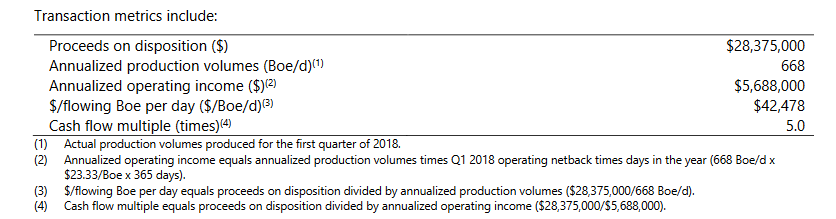
Altura sold the assets to Surge Energy (here’s their press release on the transaction.  The transaction metrics the company provided are below:

The sale of these assets leaves Altura with about $20 million of cash and no debt.  With the rest of their properties sold off, they are a pure play on their remaining asset: Leduc-Woodbend.

Leduc-Woodbend

They are going after the Upper Mannville formation at Leduc-Woodbend, which is about 1,300 meters deep.  They have amassed 65 sections (41,000 acres) in the area, with 40,000 of those acres considered undeveloped.  The formation produces 17° API heavy oil.

The Leduc oilfield has been around forever and is a well drilled out area using conventional vertical wells.  Given that its not a new area (Altura themselves says there are over 700 vertical wells in the area) I’m not sure if Altura discovered something new here or whether this was a previously uneconomic pool for vertical wells that is now being unlocked by better technology.  At any rate Altura described the pool as “one of the largest conventional oil pools identified in the Western Canadian Sedimentary Basin within the last 20 years” in their initial press release on the prospect.

This is early in the game in Leduc-Woodbend.   They have only drilled 5 wells in the property so far.  But these wells look quite good.

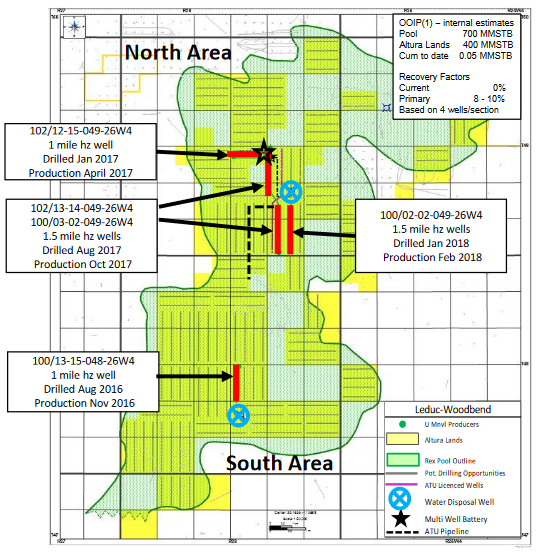
They started drilling into the Mannville formation in early 2016.  The first well, the 13-15 (see the map below), produced 230 boe/d over the first 30 days and was producing 160 boe/d after 5 and a half months.  It was producing 70 boe/d in July, after 8 months of production (from this news release).

The 13-15 was a one-mile horizontal and cost $1.7 million to drill and complete.

Their second well, the 12-15, was another one mile lateral drilled at the beginning of 2017 and place on production in April 2017.  This well was a full 6 sections north of the initial discovery well but production was inline with the 13-15 (this press release).

You can get an idea of how far apart these wells are in the map below (the 13-15 is the well furthest to the south while the 12-15 is the northern most well).

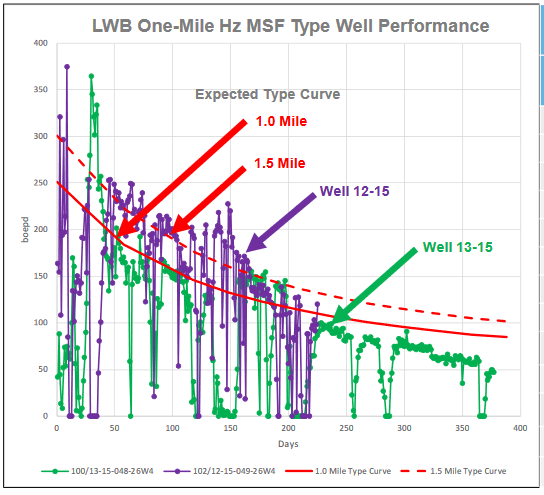
In their November presentation Altura detailed a reasonably steady decline profile from both wells (they are both one mile laterals):

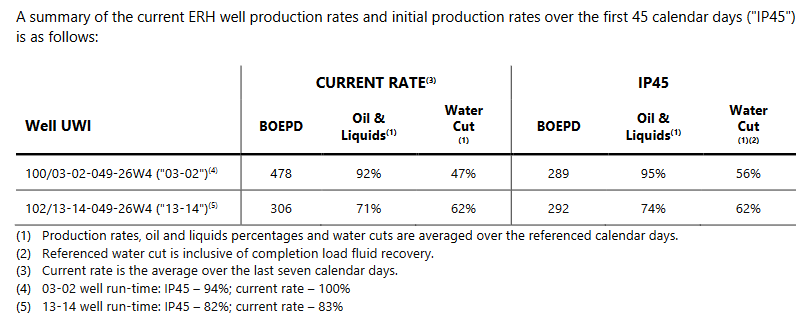
Since the beginning of the third quarter Altura has followed up with 3 more longer wells, 1.5 mile extended reach horizontals (ERH).  The first two (03-02 and 13-14) were placed on production in October (from this press release).

The third ERH well (02-02) was drilled in January and placed on production in February.  This well averaged 334 boe/d in the first 26 days of production (from this press release).

In the May 15th release the company said the well had produced 10,626 bbl of oil in the first 45 days, which equates to a 236 bbl/d average before being shut in for a month to replace a broken rod.

The company went on to say that they expected 150-175 boe/d over the first 12 months for all 3 of the ERH wells.

My takeaway from all this well data is that the results are consistent.   We only have 5 data points but so far the repeatability looks excellent.  Its particularly exciting that the original discovery well is so far away from the others and yet has yielded comparable results.

I was cautiously optimistic about Leduc before the quarterly release but the numbers presented have added to my confidence.

Guidance

The company obviously has confidence.  In addition to focusing entirely on Leduc they raised guidance significantly even after divesting over half their production.

Right now Altura is producing around 550 boe/d from Leduc, 80% oil.  They expect to exit the year at 1,900 boe/d.

To do this they are increasing their capital budget from $15 million to $33 million and expanding to an 8 well program.  So the cash they are getting on this transaction will be put to use drilling out Leduc.

Based on their presentation it looks like the wells cost $2.65 to drill, complete and tie-in.  They also spent $7.3 million already in the first quarter.  That means the company is spending roughly $7 million on infrastructure at Leduc.

The infrastructure money is going towards a larger oil battery.  They are increasing the size of their oil battery to 3,000 – 3,500 bbl/d.  So that gives you an idea of where they are expecting to take the property to.

They seem undervalued to me

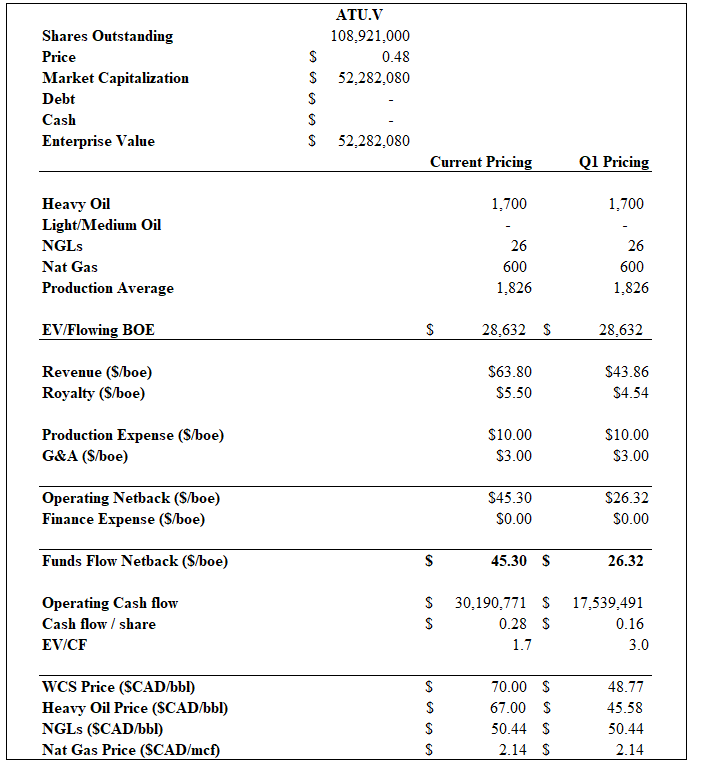
When I forecast ahead at what Altura looks like at year end using the company’s guidance, it looks cheap to me on most metrics.

Here are my estimates of cash flow and EV/CF using their guidance.  I am assuming they use all the cash to complete the drill program which should be conservative.  I looked at two scenarios:  A WCS price consistent with the first quarter (so a low price) and the current WCS price (a high price).

Apart from the valuation, what’s interesting is that at roughly $70/bbl WCS, Altura can cash flow $30 million based on their exit volumes.  So they should be able to fund a similar sized capital program in 2019 (actually a bit higher because they wouldn’t be building an oil battery) without adding at all to debt.  If they get similar production growth from that budget (based on exit guidance growth in 2018 is 1,250 boe/d), they’d grow over 60% and be producing over 3,000 boe/d by the end of 2019.

Considering that sort of growth runway, the company seems extremely cheap to me.  The risk of course is whether the oil price holds up and whether they can meet their target.

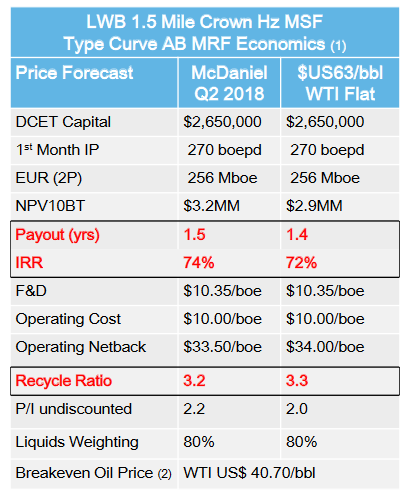
It’s still early days so we’ll have to see.  The economics that they present for these wells is impressive.

The wells have IRRs of close to 75%, which is pretty good.  But it looks even better when you notice the price forecast these are based on:

They are essentially using $55 WCS prices for 2018, followed by $61 for 2019 forward.  At last look WCS stood at $74/bbl.

Conclusion

One question that might be asked is why the stock didn’t move even more?  One answer is that I’m totally missing something.  Maybe, but I don’t think so.  Another is that the market isn’t going to de-risk Leduc until they drill more wells.  That definitely accounts for some of it.

A third reason has to do with liquidity.  I know that one of the reasons I didn’t buy more Altura before today was because it was so hard to buy.  The share volumes were anemic and it seemed like my bids would sit for days some times before getting bought up.  The Level 2 liquidity was usually equally sparse and it seemed like I would quickly move the price up to 44c or higher if I bought too much.

With that in mind I wonder how many sellers today are just liquidity sellers.   This is a liquidity event, lots of volume, so it’s a chance to unload shares.  If you have a very big position, you probably want to take some off.

Whatever the reason I took advantage of the volume and bought a decent position.  I’m looking forward to the next operations update.