Skip to content

Posts from the ‘Vicor (VICR)’ Category

Comments on RumbleOn and Liqtech, also Smith-Micro and Vicor

I wrote a couple of lengthy responses in the comment section that I have reproduced here.  One was on RumbleOn (here).  The other was about Liqtech (here).  I also comment on Smith-Micro and Vicor briefly.

Liqtech

1. Isn’t the installation of scrubbers self-defeating if too many ships continue to use HSFO?

A couple points. First, assuming that there is a point where its self defeating to install scrubbers (which I am going to raise a question about in a second) I believe that its far enough away that if it happens Liqtech will have benefited well beyond what is justified by the current share price. Consider that right now we are talking a couple thousand ships getting scrubbers out of a 70k fleet. And my numbers are assuming Liqtech only gets a fraction of those ships (ie. I don’t have the latest framework agreement modeled in there, I don’t have direct to shipowner sales, no sales from the other 4 scrubber manufacturers they are working with). Second, are we sure it would be self-defeating? Consider this – What are current HSFO to LSFO equivalent spreads (you have to use a gasoil equivalent for LSFO because there isn’t a true LSFO right now) and what would be the payback on scrubbers at those spreads? I was looking at this a month ago and thinking that at current spreads (so right now, with all ships still using HSFO) scrubber payback would still be pretty good. Isn’t this the worst case scenario for spreads after 2020? To put it another way, the reason ships aren’t installing scrubbers right isn’t because spreads aren’t favorable, its because they don’t have to.

2. What is a fair multiple for Liqtech given that their growth is concentrated on the next seven years and will massively flatten or even be negative thereafter?

While it’s hard to predict that far out in the future, there are opportunities that could result in significant earnings even after the retrofit opportunity has passed.  First there is the new build opportunity – 60% of new builds are being installed with scrubbers. 1,000-1,500 ships a year get built I believe (I’ve never been able to pin that number down exactly, its always given on a DMT basis, not ship basis) and Liqtech is dealing with 7 of the 10 largest scrubber manufacturers. So the opportunity is quite large.

Second, I think the upside from the ramp could far exceed the current share price on its own. While its tough to project because we don’t know yet whether Liqtech will hold its market share through the build, how many scrubbers will be closed-loop or hybrid, etc, if an optimistic scenario holds then the cash they taken in should exceed the existing share price by quite a bit.

Further off there are other verticals where the exposure from being used in a large number of ships will help give them credibility to expand into – such as scrubbers for power industry, oil and gas flowback filtering, and maybe further inroads into DPFs.

But the main answer i that I think the new build opp is going to be large. The bigger question is what does the regulatory regime look like in 7 years and have even stricter environmental regs come in and how do scrubbers fit into that.  And the other obvious big question is whether there are more hiccups in the implementation of the regulations between now and 2020.

3. Will we see lower revenue because the latest framework agreement is for lower ASP systems?

No, I don’t think that’s right. Consider that the new framework agreement is entirely incremental to my model. You can basically add 80-100 units at $230K and 70% margin (they said higher margin and we know existing units at scale are 65% with the Mark 6 design so 70% is my guess). So I think my numbers actually change pretty dramatically for the better with the new agreement. Also consider that the number in my model (80) is actually less than the other two framework agreements. I conservatively said 80 but if you read the transcripts Liqtech said they expect 120 from these two framework agreements.

4. How likely is another capital raise?

Liqtech came out last week and said they don’t need to raise capital this week. They said they had more cash then they had at the end of the second quarter. And soon they are going to be getting a tonne of cash from orders. I agree $4 million doesn’t seem like a lot but given their comments it would definitely be a surprise to me if they raised at this point.

What I think of the IMO 2020 meetings

This wasn’t a question but I had commented last weekend about IMO 2020 here.   This is obviously the big weight on the share price.  I think the upside based on what can happen is a pretty clear picture.  It’s what will happen that was thrown a curveball when the US threw its hat in the ring leading up to the MEPC meetings.  But since that time the IMO approved the fuel carriage ban and basically told the flag states that if you want us to consider a proposal for a more gradual approach we want to see more details.  So the result was constructive for Liqtech.

The risk remains, but in my opinion the risk specific to Liqtech falls as time passes.   The implementation of the fuel carriage ban was the last step for enforcement and that was passed.  The rebuke of the flag state proposal says to me that the IMO wants any proposal to clearly state that they are asking only for waivers when compliant fuel is not available and not looking to delay enforcement generally.  While the clarification comment that the flag states made leading up to the meetings (which I mentioned in my previous comment) said as much, the actual proposal being voted on last week (which was what the flag states wrote at the end of August and had been interpreted by some as “an attempted coup”) sounded like it was more vague.  I don’t think the IMO wants to implement a vague proposal that might open other doors.  So they closed the door on that.

At this point the IMO meets next May.  That meeting might have a clearer proposal for waivers on the table but I think it’s less likely that some sweeping change comes out of the blue and derails the whole thing.   Barring an unforeseen event in the interim, shipowners are going to have to move forward with what they know.  I think this means scrubber purchases move ahead.

RumbleOn

I was also asked what I thought of the Wholesale acquisition by RumbleOn.

I was initially skeptical about the deal.  RumbleOn’s third quarter numbers, on the surface, weren’t very good. The reulsts matched what I had suspected when I was watching inventory on a daily basis – in September the numbers flattened out/turned down.   As a consequence they missed the unit number. I was surprised that ASP was down too. So when I saw the acquisition my first reaction was: hmmm, are they just trying to paper over a bad quarter and slipping growth?

But since then I’ve listened to the conference call a few times, read through all the documentation and I’m coming around to the deal.  The quarter was still not very good though.

Let’s talk about the quarter first.

While the third quarter results and guide are disappointing I’m not sure that they are as bad as they appear at first glance.  If you take management at their word, they changed their acceptance criteria for making cash offers, basically limiting offers to cases where they thought they could make at least $1,000/bike. Their “terminated” offers (meaning offers that they didn’t decide to make after the seller went through the trouble) went up from 2% to 15%, which is a big increase.  They said this resulted in a 700 bike slip in inventory.  That slowed unit sales, which is what I saw on the site myself.

Now you can believe them or not here.  Maybe this is an excuse and the business just slowed.  But what I have seen on the site is consistent with higher margin bikes being available.  They said that their ASP has been much higher in Q4 (anecdotally I saw that too at the end of quarter – that ASP of inventory has definitely gone up).

Maybe the bigger negative about the quarter is that the SG&A as a percentage of revenue did not come down.  It was up a little from the second quarter.  I had been hoping it would come down soon as the company moved towards profitability.  But this didn’t happen, which is a negative.

When I look at the Wholesale acquisition, I understand why the market was lukewarm to it. Wholesale gross margins are tiny, like 4.3%, so even with the volumes (they are expected to sell 2,000 cars a month next year) and even growing 15-20% that’s tough. Carvana has double the margins and the story there is margin expansion as they layer on services. But Wholesale can’t really layer on services because they are selling wholesale, not to consumers.

Therefore on the surface the acquisition kind of looks not that great.  What you can say is that it wasn’t expensive (as one analyst on the call pointed out they are getting the business at 12x income and asked why the owners would sell so low).

So that was my first take.  But I’m more constructive as I’ve thought about it some more. Here’s how I’m thinking about it now:

How much would it take RumbleOn to create a platform and distribution network to populate their new car and truck online portal with 2,000 vehicles available to consumers from the go, ramp their sales to dealer/auction up to 20,000 per quarter (which is the current Wholesale run rate), building out that network in the process, and build a distribution network to manage the supply chain? I don’t know that number but I think its higher than $23 million.

For $23 million they get immediate inventory that can go to the soon-to-be launched consumer facing site, they get a built and operating distribution network for deliveries and dealer network, and they get to layer on their consumer cash offer business.  And yes they also get the dealer purchasing vertical that Wholesale excels at as well as a couple of retail locations.

Yes margins at Wholesale are really low, but it’s because they buy from dealers, refurbish and sell to auction/dealer. Wholesale seems to me to be essentially an arbiter.  But I don’t think RumbleOn bought Wholesale because they were enamored with this dealer to dealer business.

To put it another way, Wholesale also has an existing network and inventory that can be leveraged to more quickly build the higher margin consumer purchases and higher margin consumer sales that RumbleOn has always planned.  RumbleOn has the automated cash offer system to drive consumer purchases which will be better margins. They have their site/app/brand to drive consumer sales.

I think that looking at Wholesale’s business as-is or trying to think about how RumbleOn will improve Wholesale’s existing business is probably not paramount to how Chesrown and Berrard are thinking about it – yes, RumbleOn should be able to make incremental improvements on what Wholesale does through data analysis that improve decisions but that’s not the primary motive for the acqusition – the point is layering on the consumer online buy side with the cash offer model and consumer sales through the website, and leveraging Wholesale’s existing dealer network to maximize turns right from the start. Improvements to Wholesale’s existing business are peripheral to what they are really going for here in my opinion.

They said it multiple times on the call – RumbleOn is creating a supply side solution – they are demand side agnostic – consumer/dealer/auction – whatever. They need to be able to access each vertical and the more they can sell to consumer the better but unlike Carvana, Vroom, et al the focus is not sales to consumers. Its closer to the other way around – the focus is buying from consumers. They will sell whereever they can sell fastest to maximize turns. It’s the buy side that matter, procuring as much inventory from as possible from consumers while insuring it’s the right vehicle at the right price. If they get the buy side right the sell side sorts itself out. Wholesale fits nicely into this IMO.

So I like the acquisition. But I also think the logic behind it is complicated and I’m not totally sure the market will agree with me right away. I also think the quarter was not so good and you have to buy into management’s explanation to be okay with the results.  So we may get more pain. Nevertheless, I did buy back a position on Friday.

A couple other things

I bought back Smith-Micro after the earnings report.  I had said in my update that I was worried they would miss estimates.   They did, kind of. I could have sworn the Roth estimate (the only analyst) was $6.7 million of revenue for the quarter.  The company came in at $6.5 million. But when I looked after earnings it appears the estimate was actually $6.1 million.  So I don’t know if I imagined that $6.7 million number or whether Roth changed it at the last minute.

For what its worth it means they beat, but the stock fell anyway.  I didn’t think it was a bad quarter at all though.  Safe & Found adoption at Sprint continues at a steady pace, there are overtures of a second carrier in the next 6-9 months, and it appears that the sunset of the legacy product used by Sprint customers is coming.  These are all positives and really the only negative had to do with the peripheral Graphics business, which saw a steep revenue decline but is now at the point where it can’t hurt the company going forward.  So I bought.

Vicor stock action remains a gong-show.  I’m holding on (pretty much HODL at this point) and I did think their quarter was fine.  There is weakness in the legacy business but the new products bookings were up 20% sequentially, which is a great number.  Apparently there is a negative report or article on Vicor that has been out for a while that could be the basis for some short selling of the stock.  John Dillon mentioned it on SeekingAlpha.  If anyone has the report I’d really appreciate seeing it.
Week 279: Cautious on trade(s)

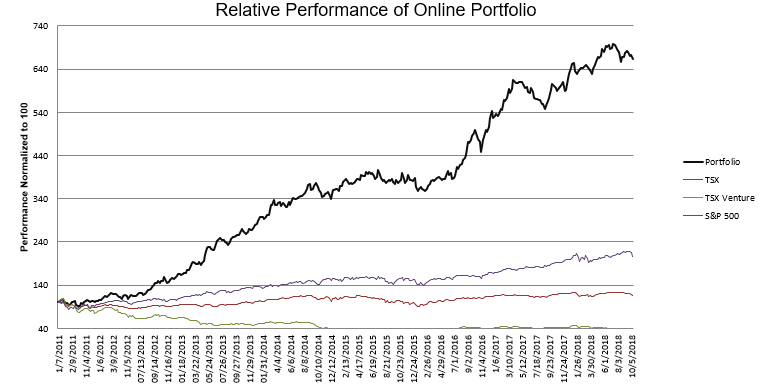
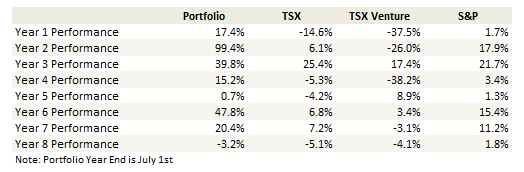
Portfolio Performance

Thoughts and Review

I haven’t written a post since my last portfolio update.  Up until this last week I did not add a new stock to my portfolio.  I have sold some stocks though.  Quite a few stocks really.

I have been cautious all year and this has been painful to my portfolio.  While the market has risen my portfolio has lagged.  I have lagged even more in my actual portfolio, where I have had index shorts on to hedge my position and those have done miserably until the last couple of weeks.  In fact these last couple of weeks  are the first in some time where I actually did better than the market.

My concerns this year have been about two headwinds.  Quantitative tightening and trade.

Maybe its being a Canadian that has made me particularly nervous about the consequences of Trump’s protectionism.  With NAFTA resolved I don’t have to worry as much about the local consequences.  But I still worry about how the broad protectionist agenda will evolve.

I continue to think that the trade war between the United States and China will not resolve itself without more pain.  The US leadership does not strike me as one open to compromise.  Consider the following observations:

Peter Navarro has written 3 books about China.  One is called “Death by China”, another is called “Crouching Tiger: What China’s Militarism Means for the World” and the third is called “The Coming China Wars”.

In the Amazon description of Death by China it says: “China’s emboldened military is racing towards head-on confrontation with the U.S”.  In the later book, Crouching Tiger, the description says  “the book stresses the importance of maintaining US military strength and preparedness and strengthening alliances, while warning against a complacent optimism that relies on economic engagement, negotiations, and nuclear deterrence to ensure peace.”.  The Coming China Wars, his earliest book (written in 2008), notes “China’s dramatic military expansion and the rising threat of a “hot war”.

Here’s another example.  Mike Pence spoke about China relations last week at the Hudson Institute.  Listening to the speech, it appeared to me to be much more about military advances and the military threat that China poses than about trade.  The trade issues are discussed in the context of how they have led to China’s rise, with particular emphasis on their military expansion.

John Bolton’s comments on China are always among the most hawkish.  Most recently he spoke about China on a radio talk show.  Trade was part of what he said, but he focused as much if not more on the Chinese behavior in the South China Sea and how the time is now to stand up to them along those borders.

Honestly when I listen to the rhetoric I have to wonder: Are we sure this is actually about trade?

Is it any coincidence that what the US is asking for is somewhat vague?  Reduce the trade deficit. Open up Chinese markets. Less forced technology transfer (ie. theft). Now currency devaluation is part of the discussion.

I hope that this is just a ramp up in rhetoric like what we saw with Canada and Mexico.  That the US is trying to assert a negotiating position before going to the table and reaching some sort of benign arrangement.  But I’m not convinced that’s all that is going on.

If this has more to do with pushing China to the brink, then that’s not going to be good for stocks.

I can’t see China backing down.

From what I’ve read China can’t possibly reduce the trade deficit by $200 billion as the US wants without creating a major disruption in their economy.   Never mind the credibility they would lose in the face of their own population.

Meanwhile quantitative tightening continues, which is a whole other subject that gives me even more pause for concern, especially among the tiny little liquidity driven micro-caps that I like to invest in.

I hope this all ends well.  But I just don’t like how this feels to me.  I don’t want to own too many stocks right now.  And I’m not just saying that because of last week.  I have been positioned conservatively for months.  It’s hurt my performance.  But I don’t feel comfortable changing tact here.

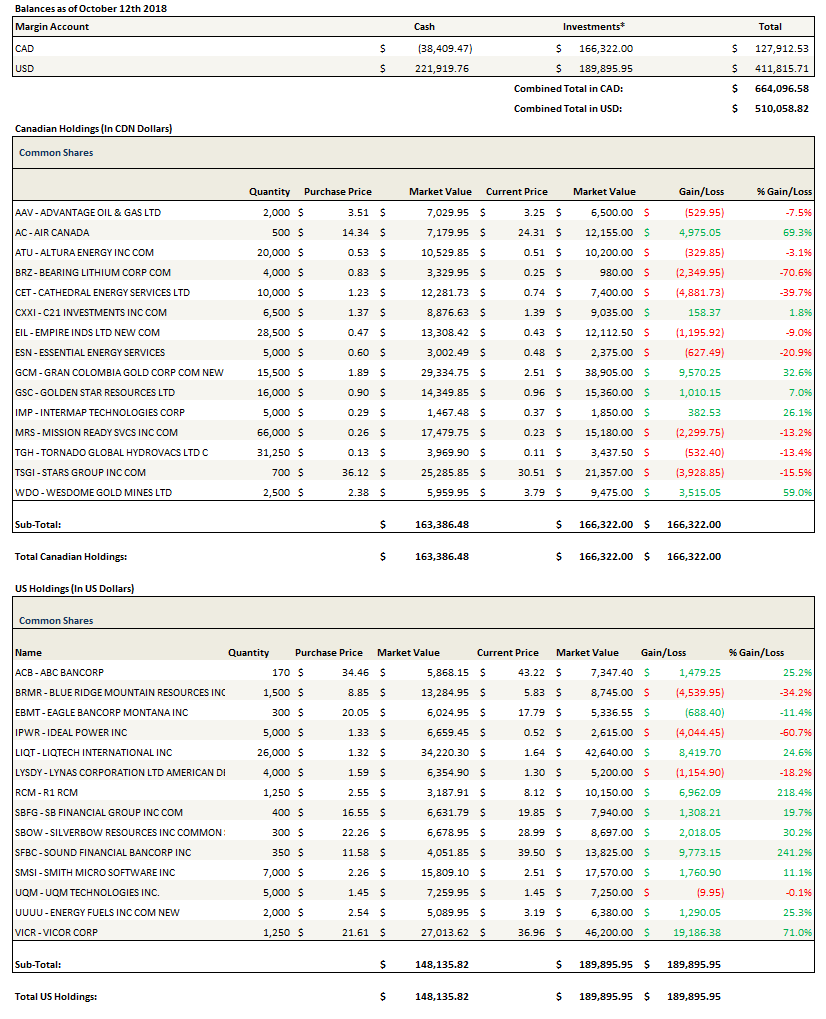
Here’s what I sold, a few comments on what I’ve held, and a mention of the two stocks I bought.

What I sold

I don’t know if I would have sold RumbleOn if I hadn’t been so concerned about the market.  I still think that in the medium term the stock does well.  But it was $10+, having already shown the propensity to dip dramatically and suddenly (it had fallen from $10 to $8 in September once already), and having noted that Carvana had already rolled over in early September, I decided to bail at least for the time being.  Finally there was site inventory turnover, which if you watch daily appeared to have slowed since mid-September.  Add all those things up and it just didn’t feel like something I wanted to hold through earnings.

I was late selling Precision Therapeutics because I was on vacation and didn’t actually read the 10-Q until mid-September.  That cost me about 20% on the stock.  I wrote a little about this in the comment section but here is what has happened in my opinion.  On August 14th the company filed its 10-Q.  In the 10-Q on page 14 it appears to me to say that note conversion of the Helomics debt will result in 23.7 million shares of Precision stock being issued.  This is pretty different than the June 28th press release, where it said that the $7.6 million in Helomics promissory notes would be exchanged with $1 shares.  Coincidentally (or not) the stock began to sell off since pretty much that day.

Now I don’t know if I’m just not reading the 10-Q right.  Maybe I don’t understand the language.  But this spooked me.  It didn’t help that I emailed both IR and Carl Schwartz directly and never heard back.  So I decided that A. I don’t know what is going here, B. the terms seemed to have changed and C. it’s not for the better. So I’m out.

I decided to sell R1 RCM after digging back into the financial model.  I came to the conclusion that this is just not a stock I want to hold through a market downturn.   You have to remember there is a lot of convertible stock because of the deal they made with Ascension.  After you account for the conversion of the convertible debt and all the warrants outstanding there are about 250 million shares outstanding.   At $9.30, where I sold it, that means the EV is about $2.33 billion.  When I ran the numbers on their 2020 forecast, assuming $1.25 billion of revenue, 25% gross margins, $100 million SG&A, which is all pretty optimistic, I see EBITDA of $270 million.  Their own forecast was $225 – $250 million of EBITDA.  That means the stock trades at about 9x EV/EBITDA.  That’s not super expensive, but its also not the cheapie it was when I liked the stock at $3 or $4.  I have always had some reservations about whether they can actually realize the numbers they are projecting – after all this is a business where they first have to win the business from the hospitals (which they have been very successful at over the last year or so) but then they have to actually turn around the expenses and revenue management at the hospital well enough to be able to make money on it.  They weren’t completely-successful at doing that in their prior incarnation.  Anyways, I didn’t like the risk, especially in this market so I sold.  Note that this is an example of me forgetting to sell a stock in my online tracking portfolio so it still shows that I am holding it in the position list below. I dumped it this week (unfortunately at a lower price!).

I already talked a bit about my struggle and then sale of Aehr Test Systems in the comment section.   I didn’t want to be long the stock going into the fourth quarter report.  Aehr is pretty transparent.  They press release all their big deals.  That they hadn’t announced much from July to September and that made it reasonably likely that the quarter would be bad.  It was and the stock felll.  Now it’s come back.  It was actually kind of tempting under $2 but buying semi-equipment in this market makes me a bit nervous so I didn’t bite.  Take a look at Ichor and how awful this stock has been.  Aehr is a bit different because they are new technology that really isn’t entrenched enough to be in the cycle yet.  Nevertheless if they don’t see some orders its not the kind of market that will give them the benefit of the doubt.

BlueLinx. I don’t have a lot to say here. I’m not really sure what I was thinking when I bought this stock in the first place.  Owning a building product distributor when it looks like the housing market is rolling over was not one of my finer moments.  I sold in late August, then decided to buy it in late September for “an oversold bounce”.  Famous last words and I lost a few dollars more.  I’m out again, this time for good.

When I bought Overstock back in July I knew I was going to A. keep the position very small and B. have it on a very short leash.  I stuck with it when it broke $30 but when it got down to $28 I wasn’t going to hang around.  Look, the thing here is that who really knows?  Maybe its on the verge of something great? Maybe its a big hoax?  Who knows?  More than anything else what I liked when I bought it was that it was on the lower end of what was being priced in and the investment from GSR showed some confidence. But with nothing really tangible since then it’s hard to argue with crappy price action in a market that I thought was going to get crappier.  So I took my loss and sold.

Thus ends my long and tumultuous relationship with Radcom.  I had sold some Radcom in mid-August before my last update primarily because I didn’t like that the stock could never seem to move up and also because I was worried about the second quarter comments and what would happen to the AT&T contract in 2019.  I kept the rest but I wish I would have sold it all.  In retrospect the stocks behavior was the biggest warning sign.  The fact that it couldn’t rise while all cloud/SAAS/networking stocks were having a great time of it was the canary in the coal mine.  As soon as the company announced that they were seeing order deferral I sold the rest.  I was really quite lucky that for some reason the stock actually went back up above $13 after the news (having fallen some $4-$5 the day before mind you), which let me get out with a somewhat smaller loss.  The lesson here is that network equipment providers to telcos are crummy stocks to own.

Finally, I sold Smith Micro.  This is a second example where I actually didn’t sell this in the online portfolio until Monday because I didn’t realize I had forgotten to sell it until I put together the portfolio update.  But it’s gone now.  I wrote a little about this one in the comment section as well.  The thing that has nagged me is that the second quarter results weren’t really driven by the Safe & Found app.  It was the other products that drove things.  That worries me.  Again if it wasn’t such a crappy market I’d be more inclined to hold this into earnings and see what they have to say.  They could blow everyone away.  The stock has actually held up pretty well, which might be saying that.  Anyways I’ll wait till the quarter and if it looks super rosy I’ll consider getting back in even if it is at a higher price.

What I held

So I wrote this update Monday and Vicor was supposed to report Thursday.  Vicor surprised me (and the market I think) by reporting last night.  I’m not going to re-write this, so consider these comments in light of the earnings release.

One stock I want to talk about here is Vicor, which I actually added to in the last few weeks.  Vicor has just been terrible since late August.  The stock is down 40%.  I had a lot of gains wiped out.  Nevertheless this is one I’m holding onto.

I listened to the second quarter conference call a couple of more times.  It was really quite bullish.  In this note from Stifel they mention that Intel Xeon processor shipments were up significantly in the first 4 weeks of the third quarter compared to the second quarter.  They also mention automotive, AI, cloud data centers and edge computing as secular trends that are babies being thrown out with the bath.  These are the areas where Vicor is growing right now (Vicor described their core areas on the last call as being: “AI applications including cloud computing, autonomous driving, 5G mobility, and robots”).

Vicor just started shipping their MCM solutions for power on package applications with high ampere GPUs in the second quarter.  They had record volume for some of their 48V to point of load products that go to 48V data center build outs and a broader acceptance by data center players to embrace a 48V data center.  There’s an emerging area of AC-DC conversion from an AC source to a 48V bus.  John Dillon, who is a bit of a guru on Vicor, wrote a SeekingAlpha piece on them today.

I know the stock isn’t particularly cheap on backward looking measures.  But its not that expensive if the recent growth can be extrapolated.  I’m on the mind it can.   Vicor reports on Thursday.  So I’ll know soon enough.

The second stock I added to was Liqtech.  I’ve done a lot of work on the IMO 2020 regulation change and I think Liqtech is extremely well positioned for it.  When the company announced that they had secured a framework agreement with another large scrubber manufacturers and the stock subsequently sold off to the $1.50s, I added to my position.

I’m confident that the new agreement they signed was with Wartsila.  Apart from Wartsila being the largest scrubber manufacturer, what makes this agreement particularly bullish is that Wartsila makes its own centrifuges.  Centrifuges are the competition to Liqtech’s silicon carbide filter.  If Wartsila is willing to hitch their wagon to Liqtech, it tells me that CEO Sune Matheson is not just tooting his horn when he says that Liqtech has the superior product.  I’ve already gone through the numbers of what the potential is for Liqtech in this post.  The deal with Wartsila only makes it more likely that they hit or even exceed these expectations.

Last Thought

I took tiny positions in three stocks.  One is a small electric motor and compressor manufacturer called UQM Technologies.  The second is a shipping company called Grindrod (there is a SeekingAlpha article on them here).  The third is Advantage Oil and Gas.  All of these positions are extremely small (<1%). If I decide to stick with any of them I will write more details later.

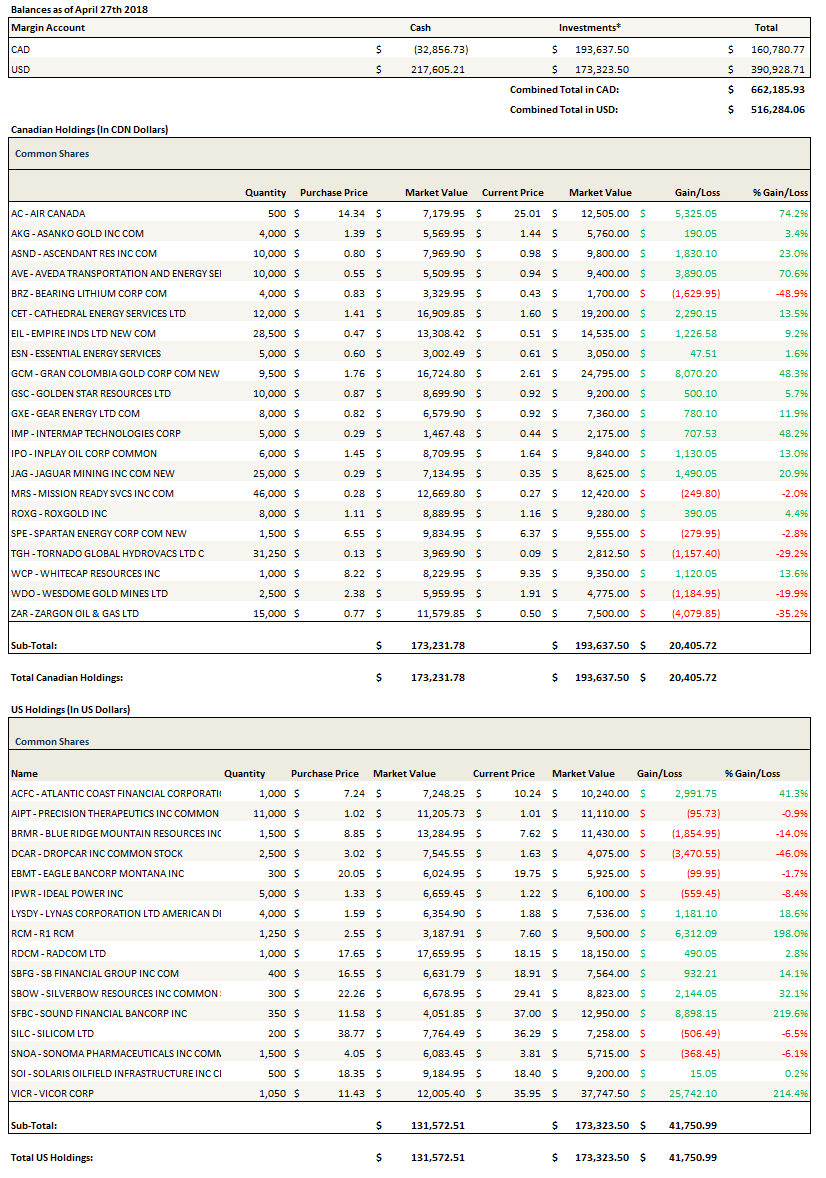
Portfolio Composition

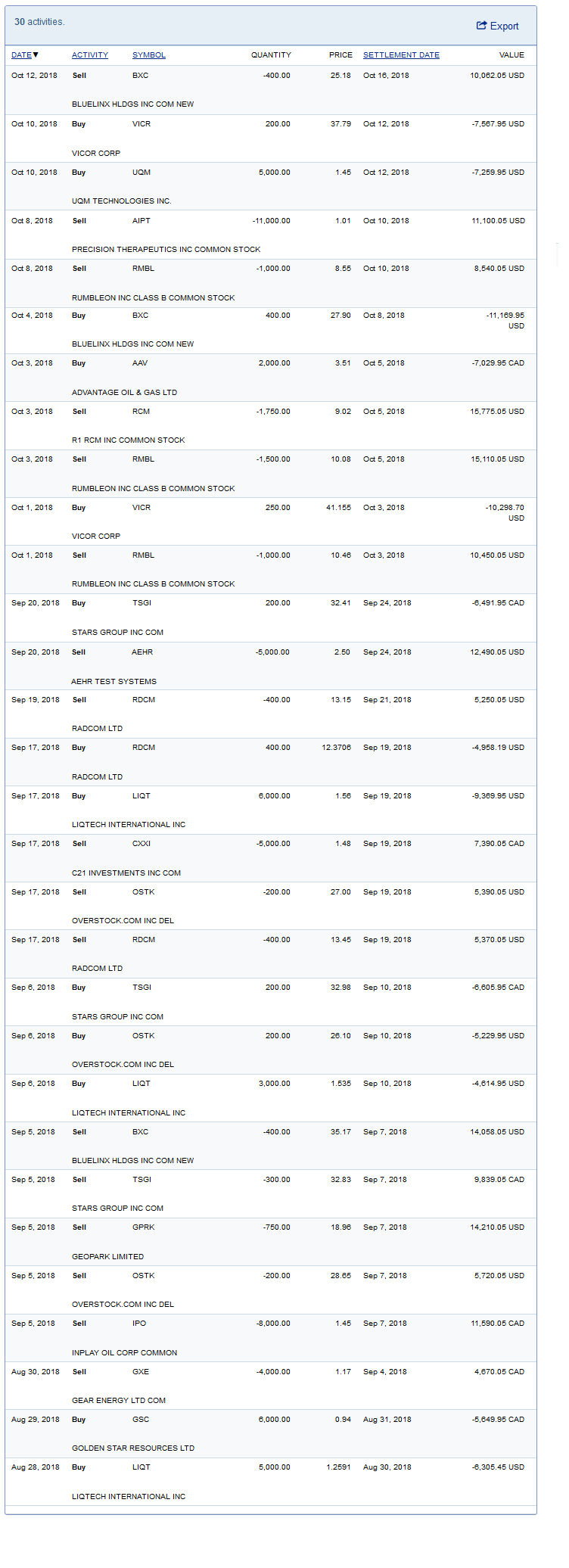
Click here for the last seven weeks of trades.

Week 354: Winners and Losers

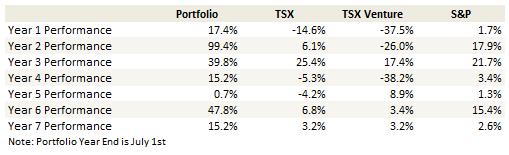
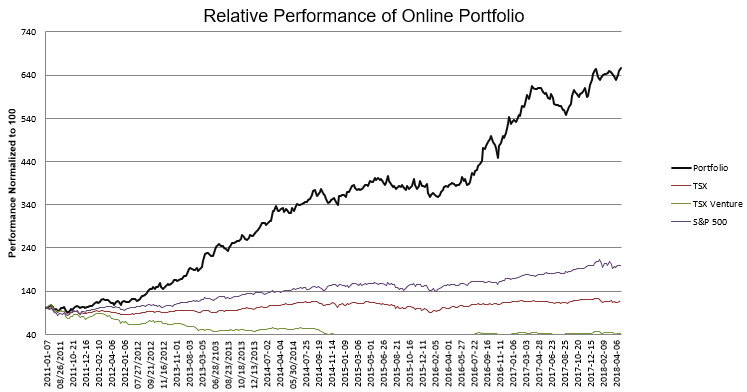
Portfolio Performance

Thoughts and Review

My method of investing generates a lot of losers.  I think it’s a pretty good bet that over 50% of the stocks I pick for my portfolio lose money.

My performance is generated primarily by a few winners that end up being big winners.  When I went through a slump in late 2015 – early 2016 I pointed out how few multi-baggers I had.  I was generating lots of losers of course, but I didn’t see that as a problem.  The problem was that the winners weren’t winning enough.  For my method to work, I need at least 2-3 stocks a year that go up 2-5 times.

The math on that works in my favor.  If I have 2 stocks a year that make up 4% of my portfolio each (I usually start out at 2-3% positions but add as they go up) and they go up 3x then my portfolio gains 24% from those positions.  If they double then I gain 16%.  If I can manage the rest of the portfolio to limit the damage; sell the losers before they get too destructive and have a few other smaller wins to help offset the losses, then overall I’ll do okay.

Anyways, that’s my plan.  Its why I invest in a lot of businesses with high upside but questionable paths to achieve that upside.  I’m fine with those that don’t pan out, as long as a few of them do.

Since last summer my big(gish) winners (this is off the top of my head) were: Combimatrix, R1 RCM, Gran Colombia,  Aveda Transportation, Vicor, Helios and Matheson and Overstock.

Combimatrix was taken over and ended up being between a 2-3 bagger.  R1 RCM was a triple.  Gran Colombia is almost a double so far from my original purchase at $1.40.  Aveda Transportation got taken over a couple weeks ago and was nearly a double.  Helios and Matheson was a little less than a triple (I sold out well before the top, in the $9-$10 range) and Overstock was about a 70% gain.

Both Helios and Matheson and Overstock turned out to be flops in the end, but that’s okay too.  A big part of my strategy is to know what I’m getting into, and not fall in love with it because there is a good chance it ends up going south.  In both those cases I was pretty cognizant of the company’s faults, and I freely admitted there was a lot of uncertainty with both.  As the faults materialized, or as too much optimism was priced in, I reduced my position in each and eventually sold out.

Vicor Results

I had been going through a drought in the new year before I finally got the move I had been waiting years (literally years!) for with Vicor.  Finally the rest of the tech-world is catching up with Vicor’s 48V converter technology.  Applications are popping up all over.  There are the 48V servers, which were the original reason I got into the stock, but also low voltage GPUs (from Nvidia and AMD) requiring power on package, new areas like electric vehicles and AI, and most recently the evolution of a reverse 12V to 48V datacenter application.  All these customers seem willing to pay for Vicor’s superior and patented technology.

I looked at Vicor way back in March of last year and worked out the numbers on an optimistic trajectory for the company.  At the time I pointed out that while the stock didn’t appear cheap on most metrics (it had no earnings and was at a fairly high P/S ratio given the lack of growth), if they could follow through on their growth plan, the earnings they could generate were pretty impressive.

I updated that model recently based on new projections and the fact that after the first $100 million of earnings Vicor is going to have to start paying taxes (they have about $34 million of valuation allowances right now).

It looks to me like a $450 million of revenue run rate gives Vicor about $2.10 EPS when fully taxed.

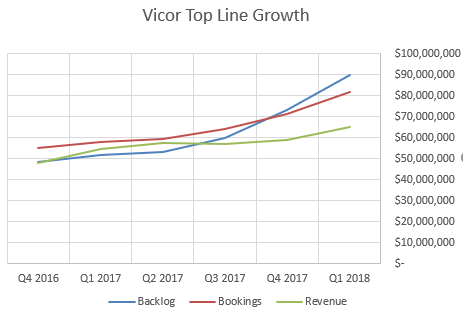
The first quarter numbers were strong.  Bookings and backlog have been outgrowing revenue.  Backlog grew 23% sequentially.  Bookings grew 15% sequentially.  Revenue grew 11% sequentially.

After the first quarter numbers its looking more like that first $450 million of revenue could happen sooner than you think.  $450 million is roughly what Vicor can do in their current facility.

Vicor is expecting to double capacity with a second facility later this year.    If you assume that Patrizio (Vicor’s CEO) hasn’t gone off the deep end and that they can fill that second facility, the earnings numbers get much higher.  Given that right now they are growing at 10% sequentially and that is before the larger orders that are expected in the third quarter start hitting.

I am inclined to hold the stock with the view that we are just getting started.

What I did in the Last 5 weeks

As I said I will always have a lot of losers.  An important part of the strategy is to sell that which I perceive as not working out.

In the last month I did more selling than buying.  This is partly due to broken theses but also because I remain cautious about the market.  But to be honest, this caution has hurt me more than it’s helped.

Much of my selling has been poorly timed.  For example, I sold Largo Resources at 1.30, only a couple of days before the stock made a run up to $1.90.  I’ve written about the Largo story before: Largo is a great theme play on vanadium but it has always been hard to make the stock look cheap by the numbers.  That has nagged at me and it finally won out.  I took a nice gain on Largo, having bought it at 80-90c, but it still hurt to watch the stock subsequently take off.

I also sold Aehr Test Systems shortly before it ran from $2.20 to $2.60.  With Aehr I took a loss.  I’m still not sure whether I did the right thing selling it.  On the one hand it feels late in a semi-equipment cycle, and the company has had very few announcements of new contracts lately.  On the other hand it appears their relationships with Intel and Apple are intact and so the next big deal could happen at any time.  It’s a tough stock to judge.

I also had poor timing with Essential Energy, which I sold at 55c range after listening to their fourth quarter conference call.  The call painted a depressing picture of drilling in Western Canada.  I didn’t get the sense they had any pricing power and the year over year utilization rate appeared to be flat.  Now maybe that has changed as oil has risen another $10 since I sold.  As well, the lawsuit with Packers Plus is in appeal (so its still not settled), which means a takeover is unlikely.   I decided to focus instead on US leaning servicing companies like Aveda Transportation (which subsequently got taken over for a double, though it was a modest position for me) and Cathedral Energy Services, which I continue to hold.

I had somewhat better timing with my exit of Sherritt International, as the stock sank after I sold.  But even the jury is still out as the share price has come back with nickel skyrocketing.

I likewise sold my position in both Orocobre and Albemarle.  This fits into the “loser thesis” even though I made small profit on Orocobre.  My thesis was that the consensus for lithium had under-estimated demand and over-estimated supply.   However, the more I’ve learned about the supply/demand dynamic the less sure I am.  It’s not so much that I’m a believer in the coming lithium supply tsunami.  It’s just that I’m unsure enough to not want to make the bet either way.   I’ll revisit these names again, especially Orocobre, but I need to study lithium some more and make sure I’m not wrong about it.

I also exited my position in Foresight Autonomous.  I mentioned the stock last month and its just not working.  They are going to need capital at some point and the recent death that was at the hands of an autonomous car isn’t helping.  But probably my biggest reason for the turnaround is that this just doesn’t seem like a good market to be holding many nano-caps in.

Finally I reduced my DropCar position (which is heavily in the red) by about 20%.  I probably should have reduced this stock earlier, but it was a tiny position to begin with (~1%) and so I’ve been more willing than maybe I should have been to give it some leeway.  I still think they could pull off some big growth but the revisions of their option strikes, the share offerings and the lack of news has worn me down.  Being down 40% on the position means at this point it so small that its a bit of a lottery ticket.  Which is really what it always was.

Gold and Oil

What’s been working for me are my gold and energy stocks.  Those that follow the blog know that I’ve been holding a number of gold and energy stocks for months now and that number has been increasing.  Up until recently they have done nothing.

I wrote up my reasons for owning Golden Star Resources a few weeks ago.

I also continue to hold Gran Colombia Gold.  I admit that I am a little nervous about selling pressure in the near term.  I don’t totally understand what the short term outcome of the 2018 debenture conversions will be and whether sellers of those debentures will pressure the stock over the next while.  Nevertheless, I think the company is on track for a re-rating at some point and I’m happy to wait out the weakness.

I also have positions in Jaguar Mining, RoxGold and Wesdome.

The idea with these stocks isn’t really about gold prices.  I don’t feel like I am making a bet on whether gold will imminently go through the roof.  I feel like I’m just buying stocks that are really cheap.

All the miners I mentioned above have EV/EBITDA ratio of between 2x and 5x.  Those multiples are trailing ratios that are based on lower gold prices then what we have now.  Each of the miners  has good growth prospects and an exploration upside if drilling comes up positive.  Apart from Gran Colombia, they are all well off their 52 weeks highs.

I also recently took a small position in Asanko Gold.  The stock has been written up a number of times on the IKN blog.  Gold Fields recently did a deal with Asanko, taking 50% of their property in return for enough cash to pay out their debt.  Otto Rock, who writes on IKN, thinks Asanko should trade back to at least 1x book value now that Gold Fields is available to provide their expertise and hopefully right the ship at the Asanko Gold mine.

So if the gold price breaks out, that’s an added bonus.  But these stocks are more of a play on sentiment.  I think all I really need on the commodity side is for gold not to crash.

I don’t really have a crystal ball with what gold will do.  I will note that the chorus of the gold bears on twitter seems very loud right now.  “It didn’t go up with North Korea”, “It can’t break $1,360”, “It’s setting up a technically bearish formation (a compound fulcrum top?)”, “The Australian dollar, the Canadian dollar are canaries in the coal mine that the rally isn’t real”, and so on.

Who knows?  Maybe they will be right this time.

I have been reading about the 70s, and in particular what Nixon did that led up to the Smithsonian agreement.  The circumstances today are different of course, but not so different, and I was surprised how much of what Nixon did rang true to what Trump is doing now.

Nevertheless,  I own tiny companies that are not in the GDX or GDXJ, typically don’t follow gold prices all that closely (Golden Star went down nearly 40% during the last gold rally!), and have unique attributes that I believe will lead to price appreciation. Gran Colombia, which is up 90% since I bought it last summer, is the poster child for this.

On the oil side I have all my old names: Gear Energy, Spartan Oil and Gas (which got taken over so now I effectively hold Vermillion shares), Zargon Oil and Gas, and InPlay Oil and Gas.  I also bought WhiteCap as another way to play the run.

On the US side I continue to hold SilverBow and Blue Ridge Mountain.  I also added Extraction Oil and Gas, which looks to be generating a lot of free cash in the coming years at these prices.  I’ll write something up on them shortly.

The summary of what I have read on oil is that things are potentially tighter than we realize, that they are getting tighter, and that relying on a small patch of west Texas to supply the world’s growth is likely not the best strategy.

I’ve been surprised by the strength in the oil stocks.  They seem to go up every day, and a lot of days they start down big and recover throughout the day.  It’s hard to see that as bearish.  I’ve read about the big net long positions, and I suppose that means we get a correction here at some point soon.  But I’ve held these stocks for this long, I might as well see it through.

New Purchase: Ideal Power

The one stock I bought that I will mention in some detail is Ideal Power.   This is the perfect example of a high risk, tiny little micro-cap that has a chance (maybe not a big chance but a chance) of being a 5-10 bagger.

Ideal Power sells inverters into the solar industry.  One of their inverter products, called the Sundial, has been built into a Flex solar plus storage offering called NX Flow.  NX Flow, interestingly enough, uses a vanadium battery.

Flex initially had huge expectations for NX Flow.  Leading up to the product launch in December, Flex was saying they could sell 15MW per week of their product.

Now if you do the math on 15 MW per week, considering that Ideal Power sells their Sundial for about $10,000 per unit, that there is one Sundial per  30 KW capacity, you get a very, very big revenue number.

The reason the stock is at a buck and change is that those sales forecasts haven’t materialized.  Maybe they never will. Flex is trying to “educate” their customers on the vanadium battery.   The real benefit of a vanadium battery compared to its lithium-ion competitor is that the vanadium battery doesn’t degrade over time.   The life span can be significantly longer and performance doesn’t suffer.  The problem is that customers are used to buying a battery strictly on a per MW basis.   On that metric alone the vanadium alternative appears more expensive.

Nevertheless Flex is a big company and I don’t believe they just pulled these numbers out of their ass.  I feel like it’s worth a bet that the NX Flow begins to get some traction.

The stock has one other lottery ticket in its back pocket.  Ideal Power has developed an alternative switch for converting between DC and AC power called a B-Tran device.  Pretty much every inverter out there has some combination of IGBTs, MOSFETs and diodes that let you switch power back and forth from AC to DC and vice versa.   The B-Tran can do this too, and it can do it while reducing losses to 1/10th of what an existing IGBT solution will have.  The double-sided nature of the device means that you can replace two IGBT’s or MOSFETs, and two diodes with a single B-Tran.  So there is a cost savings.

The company just finished prototyping the device using their anticipated manufacturing process and it appears to work as advertised.  The power semi-conductor market is $10 billion and the company has said that if all goes well B-Tran could address 50% of that.

Look I have no idea if this concept flies.  It seems to have some merit based on what I’ve read from various electrical sites and papers but its very technical, there is incumbency at play, lots of factors will determine the success.  My main point is if you are going to throw a hail Mary you might as well go for the end zone and that is exactly what this is.

The stock has a $20 million market cap and $12 million of cash, which they are burning as we speak.  I could easily see myself selling this stock at 80c in 6 months time.  In fact, that’s probably the base case.  But the bull case is so big that I believe its worth the risk.

Portfolio Composition

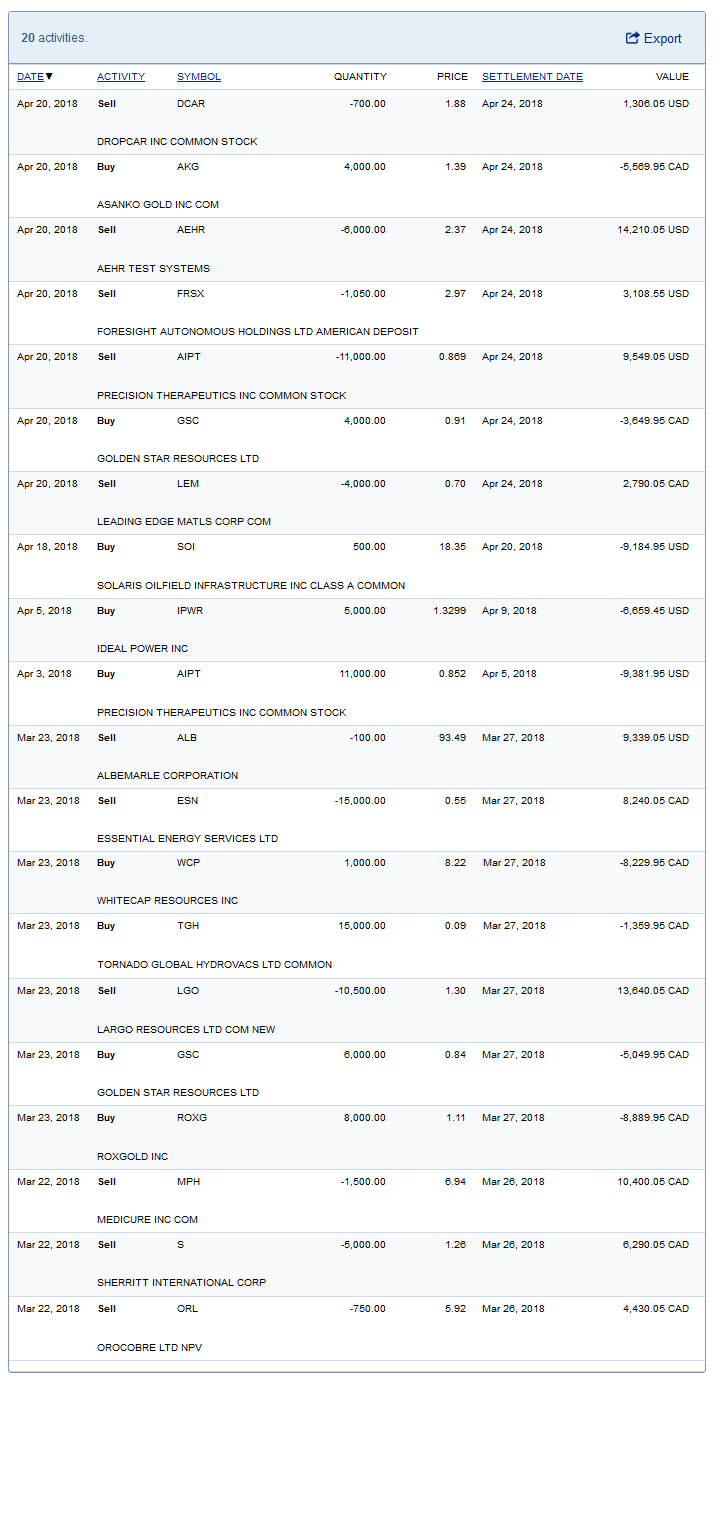
Click here for the last five weeks of trades.

Vicor: finally the results we’ve been waiting for

The long wait for Vicor to post a step change in results is over.  With the release of the fourth quarter there was an end to the delays and they put out some solid concrete numbers.   To be sure, the fourth quarter itself was not very good (this was expected), but guidance and color around what to expect next quarter and beyond was very positive.

Here’s a summary

  • Backlog at the end of the fourth quarter sat at $73 million compared to $60 million at the end of the third quarter
  • Bookings grew 11% sequentially to $71 million
  • Bookings thus far in the first quarter were $55 million (through 8 weeks of a 13 week quarter)
  • They expect sequential bookings improvement throughout the year

As is typically the case, Vicor gave hard data on the next quarter but you had to piece together the long-term picture from circumstantial evidence and color.   This quarter we got to extrapolate from their comments on facility expansion.

Vicor  has a 240,000 sq. ft. facility in Andover, MA.  They said on past calls that they can produce $400-$600 million of revenue from Andover.  In the fourth quarter updated/reiterated that this number at $500 million.

In the past Vicor has talked about adding capacity by purchasing or leasing additional space nearby.  From the second quarter call:

…we’re also actively looking for incremental space nearby, not far away from the Andover facility, to further expand capacity in about 1-year time frame

On the third quarter call they hinted that this plan might be evolving as they were leaning towards building their own facility.  Last week  they confirmed this was the case, and in the process gave us a hint about where revenue might eventually go:

…we’ve had a change of plans regarding that. What we concluded after investigating certain options in the neighborhood of our existing Federal Street facility is that a building of the order of 80,000 to 100,000 square feet would not serve our long-term needs. So we were able to secure a deal with a partner to help our short-term capacity requirements to give us some breathing room for breaking ground on larger lot with considerably more room for expansion. So we’re looking at options for as much as 250,000 square feet, which would be equivalent in terms of capacity to our Federal Street building.

So the circumstantial evidence that we got is that while they have a $500-$600 million revenue facility, they have decided to forego a 100,000 square foot addition via an existing nearby building in favor of building another $500-$600 million facility.  They are taking this course of action because they think they would outgrow the smaller facility.

Conclusion

The reason I have been in Vicor is because of the potential for big revenues as they ramp product for 48V servers, for automotive, and for high-end FPGA’s that utilize power on package technology.  They have always been vague about how big these opportunities might be.  With the fourth quarter results we started to get some sense of that size.

To be honest, the opportunity needs to be big, because the stock isn’t particularly cheap.   At a $27 share price the enterprise value is about $1 billion.  Trailing twelve month revenue is $227 million and EBITDA is non-existent.

Looking forward, if we get 50% growth in 2018 and if gross margins improve to 50%, I estimate that EBITDA should be around $70 million if most of the gross margin falls to the bottom line.  That gives Vicor a 13.5x EBITDA multiple.

Vicor starts to look cheap if you think they can get to $500 million plus of revenue.  Again, assuming a modest increase to operating expenses (I’m guessing $140 million annualized), and an uptick in gross margins to 52%, I come up with $135 million of EBITDA, which would give Vicor a forward multiple of 7.5x.

Of course if you start factoring in the second facility, you are looking at $1 billion plus revenue and then the stock clearly has further to run.

So that’s the potential trajectory.  It’s actually always been the big picture that I have hoped would play out.  With the fourth quarter numbers and first quarter guidance, that picture is a little less presumed and a little more expected.   Its still a long way from being a sure thing, but its moving in the right direction.  And that’s why you have gotten the move in the stock that you have.